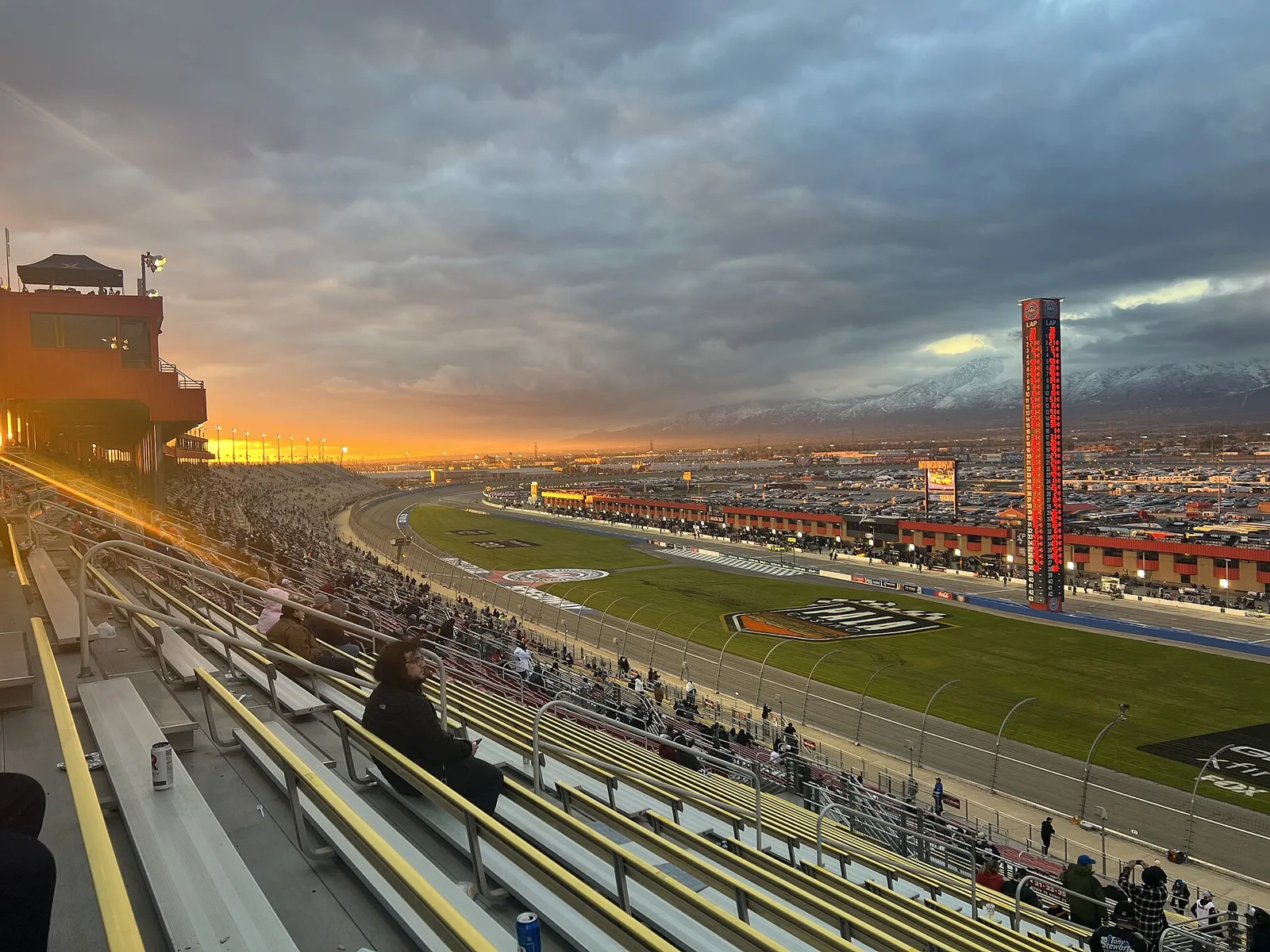
A 2.000 mi California oval that hosted NASCAR for more than 25 years, was built on a former Kaiser Steel site and now waits for a rebuild that has stalled.
Built on a former Kaiser Steel mill site near Fontana, California, the 2.000 mi (3.219 km) oval hosted NASCAR racing from 1997 until 2023. It was also used for CART and IndyCar racing, and it is now closed while a planned rebuild has stalled.
Auto Club Speedway was a 2.000 mi (3.219 km) D-shaped oval in unincorporated San Bernardino County, near Fontana, California. It hosted NASCAR racing every year from 1997 until 2023, and it was also used for open-wheel racing. The track is now closed, and its planned rebuild has been put on hold.
Where was Auto Club Speedway and when did it host racing?
The speedway stood 47 miles (76 km) east of Los Angeles, close to the former sites of Ontario Motor Speedway and Riverside International Raceway. It was served by the Interstates 10 and 15 and by a Metrolink station behind the backstretch that opened only on race days. The track was last owned and operated by NASCAR.
A steel mill site became a 2.000 mi superspeedway, which then hosted NASCAR for more than two decades before closing.
How was the track built on a steel mill site?
On April 20, 1994, Roger Penske and Kaiser Steel announced that a racetrack would be built on the abandoned Kaiser Steel mill site in Fontana. The day after, CART said it would hold an annual race there, and three months later NASCAR president Bill France Jr agreed to sanction Cup races at a track that did not yet exist.
The San Bernardino County Board of Supervisors approved the project in April 1995 after touring the sister track Michigan International Speedway. Kaiser agreed to pay US$6 million to remove hazardous waste, and 3,000 cubic yards of contaminated dirt was carted to a toxic waste landfill. A polyethylene cap was laid beneath two feet of clean soil to keep impurities from rising.
Demolition of the mill began on November 22, 1995. The 100-foot water tower, a landmark of the Kaiser property, was kept in the centre of the track and used as a scoreboard. Construction was completed in late 1996.
When did Auto Club Speedway open to racing?
Paul Tracy, driving for Marlboro Team Penske, was the first driver to test there, on January 10, 1997. The test programme preceded the opening by several months. NASCAR held its first open test session there from May 5 to 7, 1997.
The official opening and ribbon cutting took place on June 20, 1997, and the first race, a NASCAR West Series event, was held the next day. The main grandstand seated 68,000 people, and the total capacity including skyboxes was 122,000.
How did the track expand after opening?
Early success led to more reserved grandstand seating along the frontstretch, with an additional 15,777 seats. In May 1999 another 28 skyboxes were added to the top of the main grandstand, and in 2001 the Auto Club Dragway, a 0.250 mi (0.402 km) drag strip, was built outside the backstretch.
Lights followed. The San Bernardino County Planning Commission approved the change in April 2003, and a second NASCAR Cup weekend was announced for 2004 with that race held under the lights. The midway was overhauled in 2006 as the Discover IE FanZone, which included a Wolfgang Puck restaurant.
Why did Auto Club lose its second race?
Attendance dropped sharply when the second NASCAR weekend arrived in 2004, by as much as 20,000 fans. Drivers and the media began to doubt whether the track deserved two dates, even though it sat near Los Angeles, the nation's second-largest media market.
Weather was a concern too, with extreme heat or rain threatening the races. NASCAR removed one race when it realigned the 2011 schedule, and Gillian Zucker, the track president, pointed to unreliable weather and the many other entertainment choices open to fans. Roger Penske had said the track might sit in a one-race market.
What were the Auto Club Speedway naming rights?
The Automobile Club of Southern California bought the naming rights on February 21, 2008, in a 10-year deal estimated at $50 to $75 million. The name changed from California Speedway to Auto Club Speedway, and the money went to capital improvements at the track.
Grandstand capacity was reduced in 2014 from 92,000 to 68,000, after approximately 12,000 seats near turn one were removed. A hospitality area and a digital speed display were added in their place.
Which open-wheel races were run at Auto Club?
A 500-mile American open-wheel race ran under CART sanctioning from 1997 to 2002, known as the Marlboro 500. IndyCar's 400-mile race ran from 2002 to 2005, and its 500-mile race ran from 2012 to 2015, usually as the season's last race. The last IndyCar race was the 2015 MAVTV 500.
Records were set early in the track's life. Mauricio Gugelmin set practice records at the 1997 Marlboro 500, and Gil de Ferran's 2000 qualifying lap, at 241.428 mph (388.541 km/h), set the standard for one-lap speed. The 2003 Toyota Indy 400 averaged 207.151 mph (333.377 km/h) over 400 miles, a circuit race record.
What safety changes followed Greg Moore's death?
Canadian driver Greg Moore died during the 1999 Marlboro 500 when his car slid onto the infield grass, hit the edge of the pavement and flipped into a concrete wall. The owners of Auto Club and Michigan International Speedway paved the backstretch of both tracks in response.
CART then mandated a head-and-neck restraint system on all ovals, and the rule was eventually made mandatory on all tracks. Other fatalities at the venue included a motorcycle rider in 2002 and a driving school student in 2010.
Which films and shows used the track?
The speedway was often used for filming. Portions of Charlie's Angels were shot there in 2000, and Herbie: Fully Loaded used the track in 2005. The Bucket List, released in 2007, used the speedway for a scene in which its two co-stars drove classic cars around the oval.
The track stood in for Daytona International Speedway in the 2019 film Ford v Ferrari, and a parody of the track appeared at the end of the 2006 film Cars, where the Piston Cup tiebreaker race was held.
What replaced the track's racing?
On September 8, 2020, plans to convert the speedway into a half-mile, high-banked oval were filed with San Bernardino County. The 2021 race weekend was cancelled because of COVID-19 complications, and on February 27, 2022 Auto Club Speedway's president said the conversion had been put on hold.
The track closed for reconstruction in 2023 as part of the Next Gen California project, and demolition began in October 2023. By 2025 most of the land, 433 of its 522 acres, had gone to warehouse and industrial developments. In April 2025 NASCAR commissioner Steve Phelps said the project was on hold, and a street race was held at Naval Base Coronado in June 2026.
Which series raced at Auto Club Speedway?
The speedway hosted a range of series over its life. Some ran there for only a few years, while NASCAR's annual weekend lasted for more than two decades. The table below summarises the main national and regional racing that took place there.
| Series | Years | Notes |
|---|---|---|
| NASCAR Cup Series | 1997 to 2023 | Pala Casino 400 and Pepsi Max 400 in different periods |
| NASCAR Xfinity Series | 1997 to 2023 | Production Alliance Group 300 |
| NASCAR Camping World Truck Series | 1997 to 2009 | San Bernardino County 200 |
| CART | 1997 to 2002 | Marlboro 500, 500 miles |
| IndyCar Series | 2002 to 2015 | MAVTV 500, last race in 2015 |
What was the Exotics Racing road course?
Exotics Racing, a company from Las Vegas, moved into California in March 2014 with a 1.2 mile road course at the speedway. The infield had already been reconfigured in 2001 to hold a multipurpose road course, so the road layout was a separate use of the venue from its oval racing.
Which festivals were held on the grounds?
The speedway's midway and parking lots hosted a range of community events. Red, White and Cruise is a July 4 festival with a car show, family entertainment and a fireworks display. The Cardenas Festival is held in the parking lot each year, where companies that sell food at the Cardenas supermarket chain hand out free samples of new products.
The Epicenter 2010 event was held at the midway, and Hard, a music festival, took place in the midway and parking lot in 2016, 2018 and 2019. The Discover IE FanZone, which overhauled the midway in 2006, gave fans a place to gather behind the main grandstand.
What were the track's speed records in its early years?
Arie Luyendyk's practice and qualifying records from the run-up to the 1996 Indianapolis 500 stood at 239.260 mph (385.052 km/h) and 237.498 mph (382.216 km/h). Mauricio Gugelmin improved on both at the 1997 Marlboro 500, with 242.333 mph (389.997 km/h) and 240.942 mph (387.759 km/h), based on a CART-recognised track length of 2.029 mi (3.265 km).
Those figures depended heavily on the timing length used. The track length was disputed for the whole CART period, and the CART and NASCAR figures did not always match.
What else did the naming deal include?
The Automobile Club of Southern California also had use of the facility for road tests for its Westways magazine and other consumer tests. The money from the deal was used for capital improvements at the track, which had been called California Speedway from its opening until February 21, 2008.
The sponsorship was discontinued after March 2023, shortly before the track closed for reconstruction later that year.
Why did the rebuild stall?
The plan to convert the speedway to a half-mile short track was first filed in 2020 and had a target completion of 2022. The 2021 race weekend was cancelled, and by February 2022 the conversion was on hold. It remained on hold through 2025.
Without a firm NASCAR commitment, the project depended on the wider question of where the series would race in Southern California. In 2023 NASCAR's chief operating officer said the sanctioning body was still evaluating the market as a whole, and the track's remaining land was later sold off in large part.