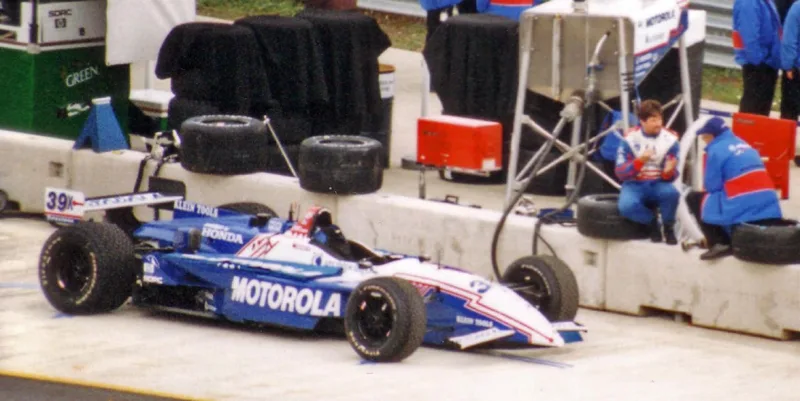
A first career CART win by 0.243 seconds, a photo-finish fight for second and the last CART race at Michigan International Speedway under series rules.
Patrick Carpentier won the 2001 Harrah's 500 at Michigan International Speedway by 0.243 seconds over Dario Franchitti, for his first CART win. Alex Tagliani gave him a drafting push on the final lap of the 250-lap race held on 22 July 2001.
Patrick Carpentier won the 2001 Harrah's 500 by 0.243 seconds, taking his first CART win after a late draft from Alex Tagliani. The race was the last held at Michigan under CART rules.
Carpentier had been a lap down for much of the afternoon. The win came in his 79th CART start, so it was a long-awaited first victory.
What was the Harrah's 500?
The 2001 Harrah's 500 was a CART race held on 22 July 2001 at Michigan International Speedway. It was the 11th round of the 2001 CART season and the 32nd running of the event at the track. The race covered 250 laps on the 2-mile oval, and an estimated 40,000 spectators attended.
The race was branded the Harrah's 500 Presented by Toyota. Harrah's Entertainment signed on as the title sponsor on 19 July 2001, just three days before the race, so the name change was a last-minute arrangement.
A late-race draft, a photo finish for second and a first CART win after 79 starts made the 2001 Harrah's 500 a memorable last CART race at Michigan.
Why was the race renamed and why was it the last CART race there?
The race was confirmed as part of the 2001 CART schedule in August 2000, and it was the 32nd consecutive year that the track had held a race in the series. It was also the eighth round to take place in the United States that year. The title sponsor was added so late that the event became known as the Harrah's 500 rather than by its original name.
In June 2001, the track announced that Michigan International Speedway would not hold a CART race in 2002. Track president Brett Shelton said the circuit and its parent company were looking at other options. Reports at the time said the track had asked not to pay sanctioning fees estimated at $2 to $2.5 million, because attendance had fallen. The track then hosted races in the Indy Racing League from 2002 to 2007.
What was the championship situation before the race?
Kenny Brack led the Drivers' Championship with 83 points, ten ahead of Michael Andretti in second. Helio Castroneves was third, three points behind Andretti, and Dario Franchitti was fourth on 65 points. Gil de Ferran was fifth on 58.
In the manufacturers' table Honda led with 158 points, Toyota was second on 142 and Ford Cosworth was third, 12 points behind Toyota. Juan Pablo Montoya was the 2000 winner but had left CART for Formula One and did not return.
What technical changes were made for the race?
The permissible manifold pressure was cut from 37 inches (940 mm) to 36 inches (910 mm), a limit that applied from this race through the November finale. The change followed a complaint from Toyota about a turbocharger pop-off valve improvement developed by Ford Cosworth and Honda.
Teams also had to fit an updated Handford device, with a 3 inch (76 mm) extension to the backboard under the rear wing. It reduced the top speed of every car by adding drag. A further change was a pop-off valve case extension of three-quarters of an inch (19 mm) at the base of the manifold pressure relief valve.
What happened in practice?
There were three practice sessions, two on Friday and one on Saturday. A rookie test on Friday was delayed twice by fog, and a communication problem in race control cut it to ten minutes. Alex Zanardi was fastest in that test at 34.563 seconds, ahead of Bruno Junqueira and Scott Dixon.
In the first session Kenny Brack was fastest with a lap of 31.809 seconds, and Canadians Patrick Carpentier and Alex Tagliani were second and third. Roberto Moreno then lost control on the exit of turn two as turbulence removed downforce from his car. His front-left tyre collided with Franchitti's rear-right wheel, and Moreno hit the inside tyre barrier at about 282 km/h (175 mph). His helmet cracked, but a HANS device kept him from more serious injury.
Max Papis led the second session at 31.853 seconds, and Brack led the final session at 31.330 seconds. Max Wilson crashed during that session at about 352 km/h (219 mph). He was checked at a hospital and found to have no injuries, but his team withdrew from the race because the car could not be repaired and it had no spare after its earlier crash at Molson Indy Toronto.
Why was qualifying cancelled?
Saturday's qualifying session was cancelled after rain stopped all on-track activity. Seven drivers had gone out to set times, but those were slower than in practice: nobody had a tow, and the rear wing extension added drag. Chief steward Chris Kneifel cancelled the session at 3:00 pm local time after attempts to dry the track failed.
The starting order was set from the third practice session. Brack earned his fourth pole of the season, although he received no championship point for it, and Papis started alongside him on the front row. Takagi, Tracy, Kanaan, Jourdain, Herta, Nakano, Fittipaldi and Gugelmin completed the top ten. It was the second time in 2001 that qualifying had been cancelled by weather.
How did the race begin?
The green flag came out at 1:46 pm. Brack steered left into the bottom groove with Papis behind him, and Papis passed Brack for the lead on the back straight on the first lap. Takagi lost third to Kanaan on lap three, and Brack retook first from his teammate three laps later. The two exchanged the lead for the next seven laps before Brack held on.
Adrian Fernandez's engine suddenly lost power early on, and he became the first retirement after changes to some components failed to fix the problem. Papis returned to the front after passing Brack again, and he extended his lead to 0.533 seconds by lap 20. Herta overtook Brack for second soon after and kept the position until Kanaan took it.
How did the lead change through the middle of the race?
Green-flag pit stops began when Papis came in. Kanaan took the lead briefly, but Gidley passed him on lap 36. Herta led on lap 39 before losing the lead to Fittipaldi on the next lap. Fittipaldi stalled his car on the entry to pit road and was pushed to his stall. Gidley regained the lead when Herta pitted.
Carpentier had fluctuating turbocharger boost in the opening laps, which cost him as much as 38 mm (1.5 inches) of boost and reduced his top speed on the straights. He later fell two laps behind the leaders because of that problem. De Ferran retired on lap 97 with an electrical fault, and a caution for debris on the back straight wiped out Brack's narrow advantage. Race control ruled that Gidley had passed Brack before the caution came out.
Racing resumed on lap 112 with Gidley leading. Papis got by Brack for second, and then the lead went back and forth between Papis and Gidley until Franchitti moved into first on lap 142 and was passed by Gidley on the next lap.
Which drivers retired?
Vasser pulled off the track on lap 130 with an unspecified mechanical problem. Nakano retired when his engine failed on lap 150, and Kanaan retired with an alternator failure after three pit stops failed to fix it. Zanardi, a teammate of Kanaan, lost engine power because of a voltage issue and retired on lap 180.
Andretti went to pit road to retire with an engine problem, and then Fittipaldi's rear suffered a mechanical failure that sent him up the turn four banking and into the concrete wall. He slid down the banking as flames came from his car, but he was uninjured. A two-car crash involving Brack and Papis on lap 233 then brought out the fifth and final caution.
How did the race finish?
After the crash on lap 233, racing resumed with Herta leading Carpentier. Herta drew clear by two-tenths of a second, but he risked being drafted by cars with more momentum. Two laps later Franchitti moved back to the front as Herta slowed and fell to fourth.
Franchitti and Jourdain then swapped the lead repeatedly. Franchitti pulled ahead through turns one and two, Jourdain was up front in turn three, and Franchitti still had the edge at the line. On the final lap, Carpentier led the trio out of turn one and onto the back straight. Franchitti drafted him, but the lapped Tagliani drafted all three cars on the inside line, and Carpentier found a gap and steered through turns three and four. Tagliani then gave him a push as they left the final corner.
Carpentier won by 0.243 seconds. The second-place battle between Franchitti and Jourdain was so close that officials used photographic evidence, which showed Franchitti had beaten Jourdain by about 2 inches (51 mm).
Who finished where?
Carpentier was first, Franchitti second and Jourdain third. Da Matta finished fourth after an air jack problem dropped him off the lead lap, and Herta was fifth.
| Specification | Detail |
|---|---|
| Race date | 22 July 2001 |
| Race length | 250 laps |
| Winner | Patrick Carpentier, his first CART win |
| Margin | 0.243 seconds over Dario Franchitti |
| Third | Michel Jourdain Jr. |
| Laps led by Papis | 83, the most of any driver |
| Lead changes | 60 among 10 drivers |
| Unofficial lead changes | 167, as counted by the AP |
| Cautions | 5 |
| Carpentier's prize | $100,000 |
How did the result change the standings?
Brack remained at the top of the Drivers' Championship with 84 points, but his lead was reduced to three points after Franchitti's second place moved him up to second. Castroneves moved up to third with his eighth-place finish, and Andretti dropped to fourth after his engine failure. Da Matta was fifth.
In the manufacturers' table, Honda extended its lead to 20 points over Toyota with 174 points. Ford Cosworth stayed third with 148 points, with ten races left in the season.
How did the drivers react?
Carpentier said it had been a long time coming, and he was in tears on his way to pit road. He recalled that the team had been a lap down at the start and had struggled early, before good yellow flags, a good car and good pit stops came together.
Franchitti said it had been an eventful day, and he described starting last and finishing second as a reasonable result. Jourdain called the final-lap move dangerous, saying he had been scared that the leading group would crash, and he rated it a high risk on a 10-point scale. Carpentier defended the move, saying it was a risky one but that points at the end of the year could decide a title.
The race was broadly praised. Brack said that continuous side-by-side racing made high-banked circuits exciting for fans, and he asked CART to visit more of them. The Associated Press counted 167 unofficial lead changes, which it said was unusual for the track since the Handford device was introduced in 1998.
How did ABC cover the race?
ABC carried the race live in the United States. Paul Page was the lead announcer, Parker Johnstone was the colour commentator, and Jon Beekhuis and Scott Pruett reported from pit road. The race scored 1.9 overnight, and its final rating of 1.6 reached 1.598 million households. It was the highest-rated CART telecast of the 2001 season.