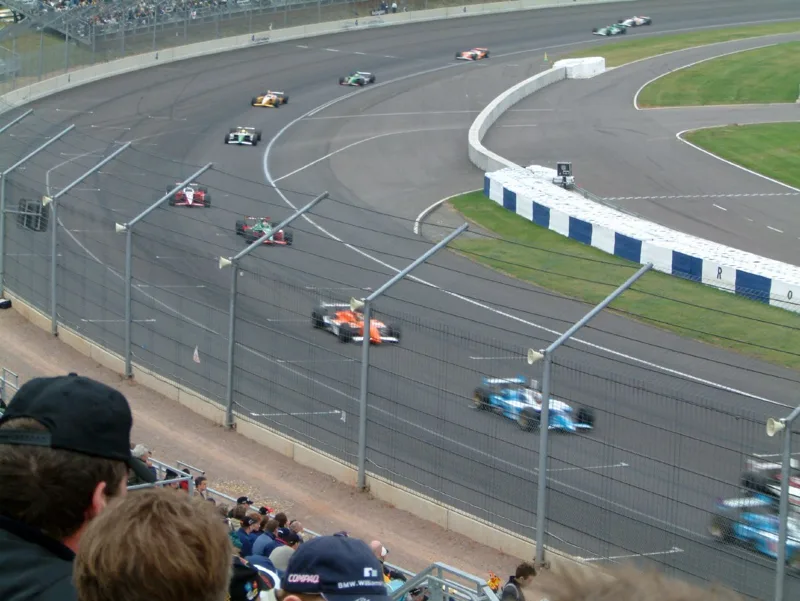
CART's first visit to the United Kingdom was delayed by drainage trouble, then decided by a last-corner pass at a shortened distance.
Drainage trouble delayed the 2001 Rockingham 500, CART's first visit to the United Kingdom, which was run at Corby on 22 September 2001. Team Penske's Gil de Ferran took the 140-lap win after the race was shortened twice.
The 2001 Rockingham 500 was a Championship Auto Racing Teams (CART) race held on 22 September 2001 at Rockingham Motor Speedway in Corby, England. Gil de Ferran won the 140-lap event from second on the grid, passing Kenny Brack on the final lap, and Brack finished second for Team Rahal with Cristiano da Matta third.
When and where was the 2001 Rockingham 500 held?
The race was held on 22 September 2001 on the 1.479-mile (2.380 km) oval in Corby, Northamptonshire. It was the 17th of the 21 scheduled CART races that season and the second and final European event of the year. The race was also the first time CART had visited the United Kingdom.
The track is a four-turn oval with banking of up to 7.9 degrees. CART hoped for a crowd of 40,000 at a venue with a capacity of 52,000, and around 38,000 people attended the race itself.
A race run under a cloud, decided by a last-corner overtake and remembered as one of CART's most dramatic events of 2001.
Why was the 2001 race a European event?
The Rockingham 500 was confirmed as part of CART's schedule in July 2000. It was the end of a two-week European stretch for the series, because the American Memorial had been held at EuroSpeedway Lausitz in Germany one week earlier.
Going into the race, Brack led the Drivers' Championship on 131 points, ahead of de Ferran in second and Michael Andretti in third. Helio Castroneves was fourth on 111 points, with Scott Dixon fifth on 86. Honda led the constructors' table with 257 points, Ford Cosworth had 224 and Toyota was third.
Who was preparing for the race?
Brack said his car's engine and chassis had been fast on ovals and that he and his team would be in contention for victory. Da Matta said he had good memories of racing in England in lower formulas, and he hoped the race would be interesting on what he had heard was a smooth surface.
Mo Nunn Racing entered only one car. The crew members who had worked on Alex Zanardi's car, which was involved in a major accident at the previous race, were sent to the United States to recover from the incident. The team said the car would return for the next round in Houston, and Casey Mears would race for it in the rest of the season.
Why did the drainage problems delay the event?
Heavy rain three days before the event had left the local clay full of water, and evaporation had been slow because of low temperatures. Officials examined water coming up through the track's surface on the Thursday, and the surface had been drilled overnight to drain it. A jet dryer was used, but water kept appearing through the surface.
CART chief steward Chris Kneifel led 26 cars and 23 support vehicles out behind the pace car in groups for five installation laps, but no improvement followed, and CART cancelled the rest of Thursday's activity an hour later. Some British newspapers suggested moving the race to the infield road course, but that was not feasible because the circuit did not hold the sanctioning body's licence, and the teams had no suitable aerodynamic package.
Course officials drilled shafts into the surface to form drainage wells, and five jet dryers were taken onto the circuit overnight with extra fuel brought in from Sywell Aerodrome. Thousands of small holes were also made in the surface to release moisture. The 15,000 spectators who attended on the Thursday received cash refunds.
How was the starting grid decided?
The qualifying session was cancelled because the drainage problems continued. The starting order was set by championship points, and Brack claimed pole, his sixth of the season. De Ferran joined him on the front row, and Andretti, Castroneves, Dixon, Dario Franchitti, Patrick Carpentier, da Matta, Roberto Moreno and Tony Kanaan made up the top ten.
David Grace, the circuit's chief executive, said sorry for the delays and stressed that the operators had consulted experts. CART chairman Joseph Heitzler said the decision to stage the race in September was sound, because the month was among the driest of the year. Carpentier argued that the circuit staff should have been prepared a month earlier, while Kanaan voiced concern for everyone involved.
What happened in the final practice before the race?
The track was reopened for practice on Friday after drainage work continued overnight. Carpentier set the fastest time in the first ten-minute session at 27.075 seconds, and Kanaan was quickest in the second session at 24.719 seconds. An eight-minute installation session followed, and Kanaan continued his form by setting the fastest lap of that run.
Weather at the start was partly cloudy and mild, with an air temperature of between 11 and 19 degrees Celsius. A compacted schedule had reduced the planned 210 laps to 168, and an estimated 38,000 people attended the race.
How did the race begin?
Oriol Servia's car failed to start, and his crew worked quickly to get him going for the start. Michel Jourdain Jr. also had trouble starting his engine, but he managed to join the field. Brack kept his pole advantage into the first turn, but de Ferran drove alongside on the outside and passed him on the back straight to lead the first lap.
Max Papis lost control on the frontstretch, slid backwards toward turn one and then turned his car around, which brought out the first yellow. Jimmy Vasser clipped Tora Takagi, sending him into the frontstretch barrier. Junqueira hit the outside wall and became the first to retire. Max Wilson spun while trying to gain tyre temperature and dropped to the back of the field.
The race restarted on the ninth lap with de Ferran leading Brack and Andretti. When Wilson delayed Brack, de Ferran was able to build a two-second lead over him. Franchitti passed Castroneves for fourth seven laps later.
How did Brack and de Ferran fight for the lead?
Brack closed on de Ferran over the next fifteen laps as the pair moved through slower traffic. He got a run on de Ferran and passed him at the bottom of the first turn on lap 46, while Andretti lost fourth place to Franchitti on the same lap.
Jourdain spun leaving turn four and slid down the frontstretch, which brought out the second caution. Fittipaldi reported a problem with his gearbox or drivetrain and drove into the pit lane on lap 53, becoming the second retirement. The leaders pitted under the caution, and Brack led the restart. He pulled away until de Ferran began to close on him again.
Fernandez lost engine power entering the second turn and steered to the bottom of the track, which brought out the third caution. Oil on the track at turn two had to be dried by marshals. Kniefel then cut the race from 168 laps to 140 on lap 90, because the daylight was fading.
What happened in the closing stages?
All the leaders, including Brack, made fuel and tyre stops under caution on lap 100. Castroneves got by da Matta and Andretti on the inside in the pit lane. Newman/Haas Racing thought this was a breach of the rules, so it told CART. De Ferran retook the lead and kept it at the lap 104 restart.
Dixon pitted with damage after contact with Servia during the caution period and retired on the 106th lap, bringing the fifth and final retirement. Carpentier set the fastest lap of the race, 25.521 seconds, late in the distance.
On lap 138 Brack drafted past slower cars while Papis held de Ferran up in turn four. Brack took the lead around the outside into the first turn. On the final lap Brack led de Ferran by two-tenths of a second, but de Ferran drafted up to the outside and closed in through the second and third corners.
How did de Ferran win on the final lap?
De Ferran steered right and overtook Brack for the lead at the entrance to turn four. Both drivers avoided contact at the edge of the corner, with de Ferran defending and Brack easing off to avoid a collision. De Ferran held the lead to the flag.
It was de Ferran's first victory of the 2001 season, and it was his sixth career win and his second on an oval. He was the eleventh driver to win a race that season, which tied a record set in 2000. Brack finished second and Castroneves third, but Castroneves was later demoted to fourth for passing under the yellow flag.
| Finish | Driver | Notes |
|---|---|---|
| First | Gil de Ferran | Team Penske; first win of 2001 and sixth of his career |
| Second | Kenny Brack | Team Rahal; led the closing laps and was passed on the last lap |
| Third | Cristiano da Matta | Moved up to third after Castroneves' penalty |
| Fourth | Helio Castroneves | Demoted for passing under yellow |
| Fifth | Michael Andretti | Finished fifth |
| Sixth | Paul Tracy | Finished sixth after passing Kanaan |
| Seventh | Jimmy Vasser | Finished seventh |
| Eighth | Tony Kanaan | Followed Andretti closely, but was held up by him at one point |
| Ninth | Dario Franchitti | Car was good in the first half of the race |
| Tenth | Oriol Servia | Recorded as fifteenth, then corrected to tenth |
What did the result mean for the championship?
De Ferran's win reduced Brack's Drivers' Championship lead to six points. Andretti stayed third, but his advantage over Castroneves shrank to two points. Da Matta's third-place finish moved him from eighth to fifth in the standings.
Honda extended its manufacturers' lead over Ford Cosworth to 38 points, and Toyota stayed third with four races left in the season. Five lead changes took place between two drivers, and de Ferran led three times for 84 laps, the most of any driver. Of the 26 starters, 21 finished the race.
How did the drivers and officials react?
De Ferran said the event had taken place under a cloud, because of events in the United States the previous week and what had happened to Zanardi. He said he was glad to have taken part, and that the win was special because his wife is from England. He earned US$100,000 (GBP 68,600) for the victory.
Brack said he had no complaint about the last-lap loss and called the race tough and exciting. Castroneves said the post-race penalty was unfair. Da Matta said the speeds were higher than drivers considered safe and that passing was hard. Tracy said Rockingham was a good track and would be a good facility for showing CART in Britain.
Heitzler said the series would return to Rockingham in 2002 and promised that drainage problems would not recur.
How did the media cover the race?
Kevin Eason in The Times wrote that the event lacked in quantity but made up for it with driving of the highest quality. He praised de Ferran's last-lap overtake as astonishing. Brough Scott in The Sunday Telegraph described the launch as a delayed event full of drama, with overtaking that took the breath away.
Richard Williams of The Guardian praised the crowd of 38,000 who had battled traffic to see American open-wheel cars race on a banked oval in Britain for the first time. The Associated Press said that, although the race had almost been cancelled, it became one of CART's most dramatic events of the season.
How was the race broadcast?
Highlights were broadcast the following day on BBC Two's Sunday Grandstand, with commentary from Leigh Diffey and former driver Mark Blundell. In the United States the race was due to be shown on ESPN and moved to ESPN2, and it was eventually carried live after the start was delayed.