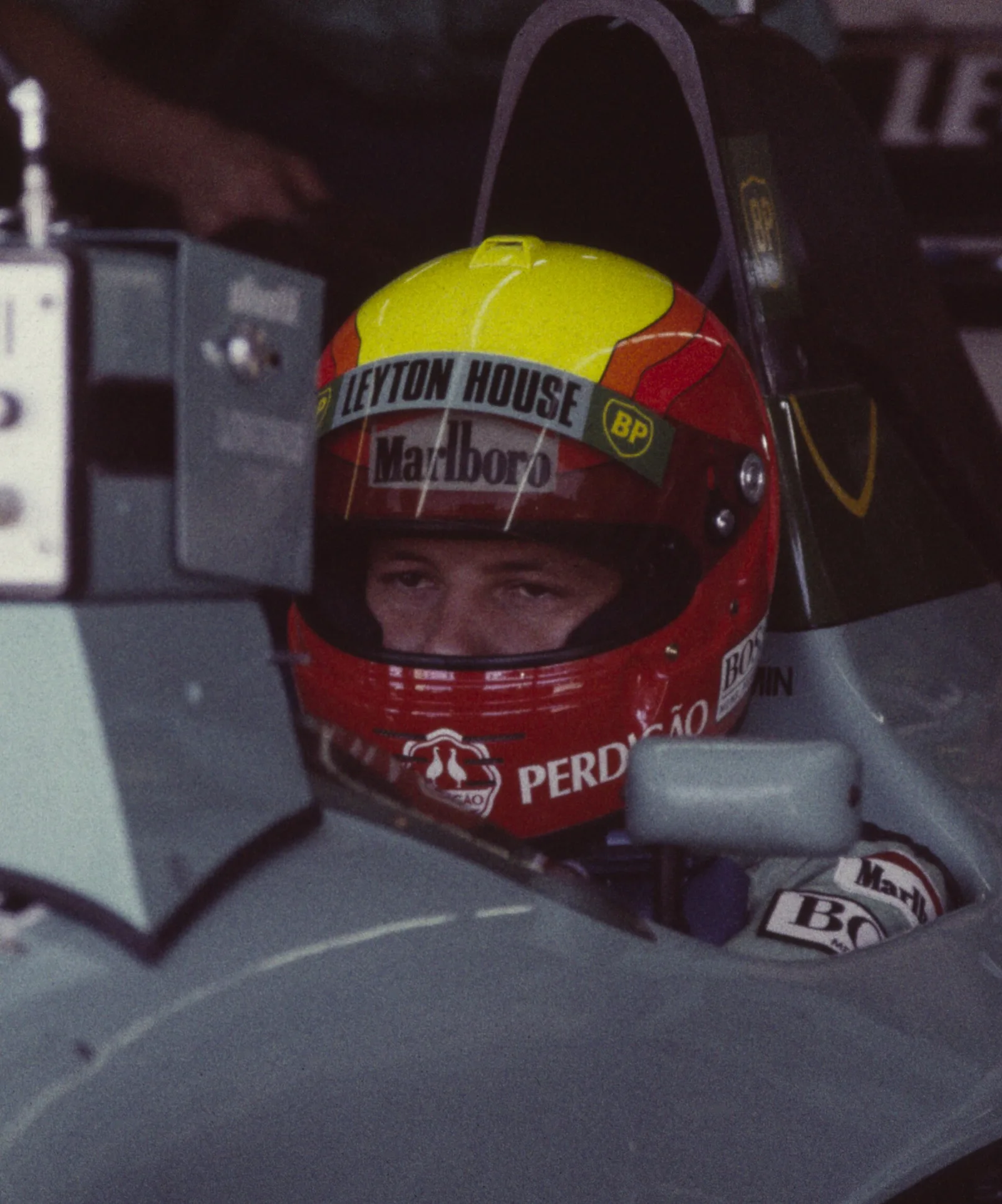
A Brazilian who won the 1985 British Formula Three title, scored for March and Leyton House in Formula One, then spent nine seasons in CART before retiring in 2001.
Mauricio Gugelmin is a retired Brazilian driver who raced in Formula One from 1988 to 1992 with March, Leyton House and Jordan, then in CART from 1993 to 2001. His best Formula One result was third at the 1989 Brazilian Grand Prix, and in 1997 he set a closed-track speed record at California Speedway.
Mauricio Gugelmin, a former Brazilian driver, raced in Formula One between 1988 and 1992 and then in CART from 1993 until 2001. He won the 1985 British Formula Three title and the Macau Grand Prix on the way up, and in 1997 he finished fourth in the American championship.
Who is Mauricio Gugelmin?
Mauricio Gugelmin was born on 20 April 1963 in Joinville, Brazil, into a wealthy family. He competed in Formula One between 1988 and 1992 and in CART between 1993 and 2001, winning once in the American series. Like many Brazilians of his generation, he made his way into motor racing through British competition, and the antique cars his father collected gave him early exposure to motoring.
His father dealt in timber and collected antique automobiles, and the family firm later occupied much of his working life. He married Stella Maris, and the couple had two surviving sons, Bernardo and Gabriel.
From karting titles in Brazil to Formula One points, a Macau win and a closed-track speed record in California, Gugelmin lived fast.
How did Gugelmin rise through the junior ranks?
He took up karting in Brazil in 1971 and claimed his home-region title for nine consecutive seasons, through 1979. He took the Brazilian national karting title in 1980 and the Brazilian Formula Fiat Championship in 1981. In 1982 he moved to the United Kingdom, where he won the British Formula Ford 1600 championship with 13 race wins and 90 points.
In Britain he shared a house with his friend Ayrton Senna from 1982 to 1987. Senna had raced with the Van Diemen team and used his influence there to secure Gugelmin a seat for 1982. The next season he finished second in British Formula Ford 2000, and in 1984 he took the European Formula Ford crown at the first attempt.
How did Gugelmin win the 1985 British Formula Three title?
Gugelmin won the 1985 British Formula Three Championship with West Surrey Racing, then took the season-ending Macau Grand Prix, a race Senna had won two years earlier. He then spent two seasons in International Formula 3000, the last step before Formula One, with sponsorship backing for the 1986 campaign.
His single F3000 victory came at Silverstone in 1987, driving for the Ralt factory team. Earlier, a possible 1986 seat with Lotus, which Senna had lobbied for, fell through because the team would not run two Brazilians, and Johnny Dumfries was chosen.
How did his Formula One career begin?
Gugelmin entered Formula One in 1988 with March, partnered by Ivan Capelli, and made his debut at his home Brazilian Grand Prix. He finished the season 13th overall and was the highest-scoring newcomer in the championship, with points at the British and Hungarian Grands Prix.
The year started poorly: five of the first six races ended in retirement, each with a mechanical cause. Once the car settled he took fourth place at Silverstone and fifth in Hungary. The car was the Adrian Newey-designed 881, which gave him a competitive base for his first Formula One season.
What happened in 1989 and 1990?
In 1989 March was in financial trouble, but Gugelmin finished third at the season-opening Brazilian Grand Prix, his only Formula One podium and March's only points finish of the year. At the French Grand Prix a large start-line accident ended with his car rolling, and the race was stopped. From the pit lane he began the restart and recorded the quickest lap of his grand prix career.
A photograph of that accident was later chosen for a London exhibition of the sport's most striking pictures. The accident shows how dramatic the start of that race was, and Gugelmin came through it to finish the job he had been given.
That year the March operation changed hands and was renamed Leyton House. The CG901 chassis proved troublesome, and between them Capelli and Gugelmin failed to qualify six times, including at the Mexican Grand Prix. A set of modifications transformed the car at the French Grand Prix, where the pair ran first and second for much of the race without changing tyres. Gugelmin retired from fourth with engine trouble, but he scored a single point with sixth place in Belgium.
Why were 1991 and 1992 so difficult?
The 1991 car was slow, and the squad managed a single point all year. Gugelmin's best results were three seventh-place finishes, and he retired from eight of the sixteen races. He chose to leave at the end of the year as money grew tight, and his 1992 move to Jordan did not improve his fortunes.
Team principal Akira Akagi was taken into custody on suspicion of fraud that September. Jordan's 1992 season was no better, with a Yamaha engine that was underpowered and a car that was unreliable. He retired from eleven of the sixteen races and earned no points, which ended his time in Formula One.
How did CART compare with Formula One?
Gugelmin joined CART for the last three races of 1993 with Dick Simon Racing, then moved to Chip Ganassi Racing in 1994. In the American series he made 147 starts, reached the podium eight times and won once, at Vancouver in 1997.
The first races in CART were modest. Mid-Ohio and Nazareth both ended in retirements, and at Laguna Seca he finished 13th, which earned no points. The team nonetheless saw promise in him, and the 1994 season that followed was his first full campaign in the series.
In 1994 he partnered Michael Andretti, who had returned from a season in Formula One and was the more successful driver, taking two wins including Reynard's first Champ Car victory at Surfers Paradise. Gugelmin was hampered by a lack of cooperation between the two crews, and his first full season ended with seven points finishes and 16th in the standings.
The 1995 season started well. He finished second to Jacques Villeneuve at Miami, the opening round of the year, and then took sixth at the Indianapolis 500, after leading more laps than any other driver. That year he also finished tenth in the points, nine positions ahead of his teammate Danny Sullivan, and his best Indianapolis result came after leading 59 laps.
In 1996 Gugelmin drove for PacWest alongside the British driver Mark Blundell. He was quick at superspeedways, taking second and third places at the two Michigan International Speedway events, and he finished 14th overall. For 1997 the team switched to Firestone tyres and Mercedes-Benz engines, and the package proved competitive throughout.
What was the 1997 closed-track speed record?
Qualifying for the 1997 season finale at California Speedway produced a lap of 387.759 km/h (240.942 mph), the quickest ever recorded around a closed circuit. The record stood until Gil de Ferran lapped the same circuit at 388.541 km/h (241.428 mph) in 2000.
That 1997 season produced fourth place in the championship, with Blundell sixth. A fitness programme had taken 18 kg (40 lb) off him, and at Detroit he led on the final lap before running dry. At Vancouver he scored his first and only Champ Car victory, and virtually the whole pit lane celebrated with him. Vancouver came in the same season as the speed record, which makes 1997 his strongest year in the series.
The 1998 season was harder. The team struggled to get to grips with a new chassis, and Gugelmin scored nine points finishes. A highlight came at the final California race, where he led 40 laps on the way to fifth place. Over the next three years he never finished higher than 15th in the standings. In 2000 he also took the chair of the Championship Drivers Association, the body that spoke for the series' drivers.
What was his career at a glance?
| Series | Years | Best result |
|---|---|---|
| British Formula Ford 1600 | 1982 | Champion, 13 race wins |
| European Formula Ford | 1984 | Champion at first attempt |
| British Formula Three | 1985 | Champion with West Surrey Racing |
| Macau Grand Prix | 1985 | Winner |
| International Formula 3000 | 1986 to 1987 | One win, Silverstone 1987 |
| Formula One | 1988 to 1992 | Third, Brazilian Grand Prix 1989 |
| CART | 1993 to 2001 | Fourth in the championship in 1997; Vancouver win |
| Indianapolis 500 | 1995 | Sixth, after leading 59 laps |
Why did Gugelmin retire in 2001?
Gugelmin retired at the end of 2001 after a hard year. He was practising at Texas Motor Speedway when his car lost control at the second turn and struck the wall, with acceleration peaking at 66.2 g and then 113.1 g in a second impact. Drivers reported dizziness, nausea and blurred vision, and the event was called off.
The same year his son Giuliano died after a lifelong illness that followed complications at birth. PacWest withdrew its entry for the Nazareth race as a mark of respect. Later that season he still took pole for the Grand Prix of Cleveland. He explained that he wanted more time with his family, and that two big accidents, together with another driver's move to Germany, had made up his mind.
What did Gugelmin do after racing?
Gugelmin has not raced competitively since 2001. A planned return in a Renault Megane Super Cup in Brazil was announced in 2003, but the series never launched. He runs the family business with his brother, Alceu, and has worked as a consultant for the Mercedes-Benz subsidiary AMG.
After retiring he listed his Florida mansion in Coral Gables for $17 million and moved back to Brazil full-time. Both surviving sons race karts.