Two world champions in the first two seasons, a difficult second works spell in the early 1980s and a long sponsorship run that ended in 2023.
Alfa Romeo took part in Formula One as a works constructor, an engine supplier and a commercial partner. Its works drivers won the first two World Drivers' Championships, and its own cars raced from 1979 to 1985. The brand's final involvement was a title sponsorship of Sauber, which ended after the 2023 season.
Alfa Romeo competed in Formula One in distinct phases. Its own cars won the first two world titles in 1950 and 1951, the brand returned as a works constructor from 1979 to 1985, and later it supplied engines to smaller teams and gave its name to the Sauber team, which ran on Ferrari power.
Who won the first World Championship titles for Alfa Romeo?
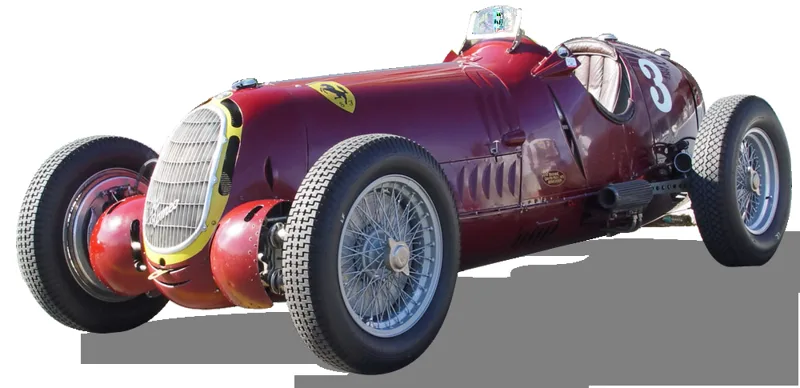
Farina took the inaugural World Drivers' Championship in 1950, driving a supercharged 158, and Juan Manuel Fangio repeated the success in 1951 in an Alfetta 159. The team managed both titles on a tight budget, using only nine engine blocks that had been built before the war.
The Alfetta 159 was an evolution of the 158 that used a two-stage compressor. It produced around 420 bhp (310 kW) in 1951, but its appetite for fuel was enormous at 125 to 175 litres per 100 km. Those cars grew out of Alfa's pre-war record, when the P2 and P3 models won steadily until 1934 and then faced the German Mercedes and Auto Union teams.
Two world titles in the first two seasons, then a long struggle to make the works cars competitive.
Why did Alfa Romeo leave Formula One in 1952?
The public holding company that controlled Alfa Romeo, the Istituto per la Ricostruzione Industriale, decided to withdraw after the Italian government refused to fund a new car to replace a design that was 13 years old. Ferrari was becoming a stronger rival at the same time, which made the expense harder to justify.
The team did not return until 1979. Enzo Ferrari's Scuderia had run Alfa's racing operation from 1929 to 1938, and Alfa Corse built the 158 for the 1938 season. After the war the 158 dominated the 1947 and 1948 Grand Prix seasons, and those results remain the foundation of the brand's name in the sport.
What happened during the works return from 1979 to 1985?
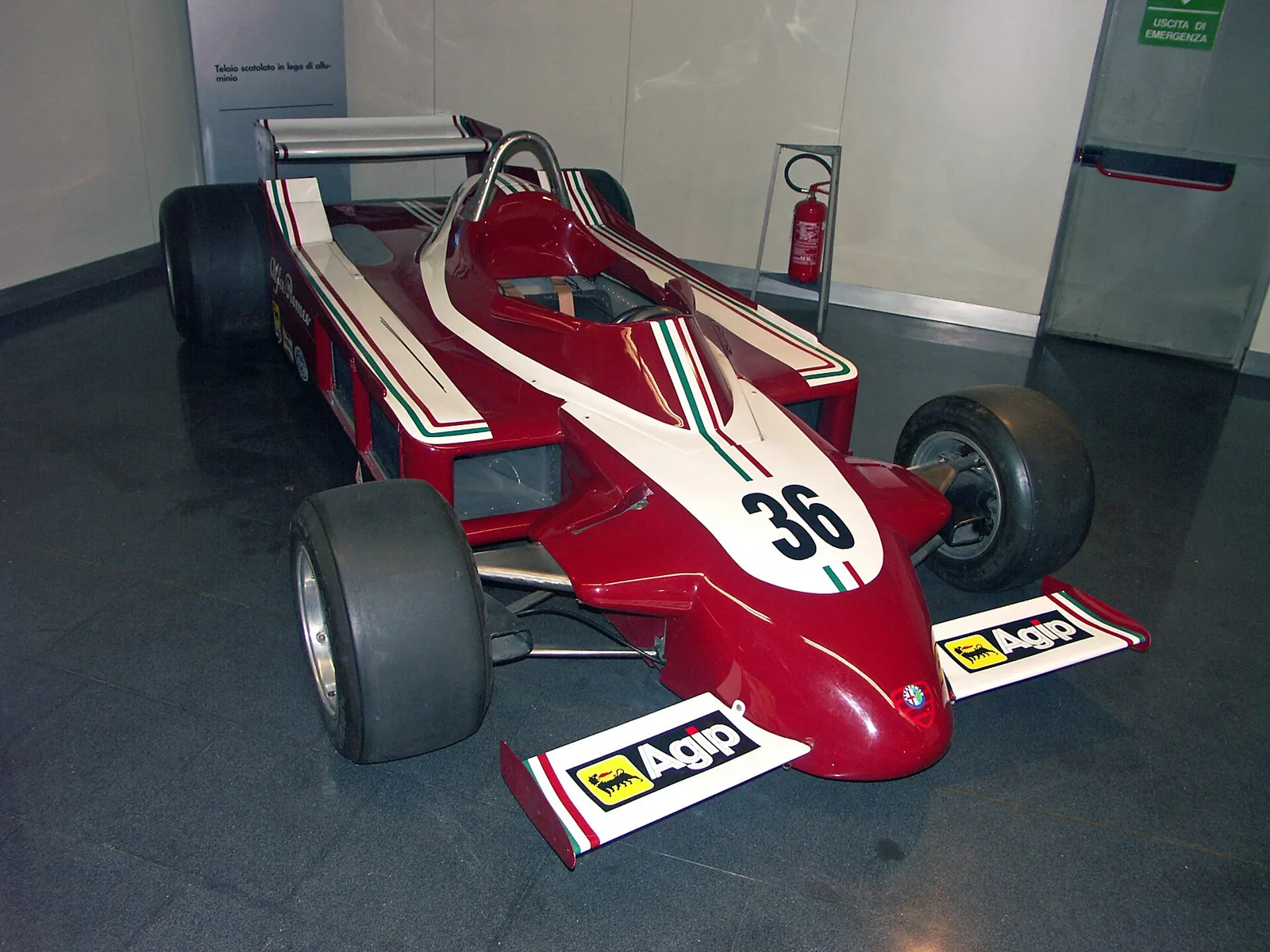
The 177 was the first car of the return. Carlo Chiti had persuaded the team in 1977 to build its own car, and Autodelta, the competition department, handled development from that year. The car appeared at the 1979 Belgian Grand Prix while the Brabham engine partnership was winding down, and reliability problems held the team back for most of its second spell. Patrick Depailler was killed in 1980 while testing at the Hockenheimring ahead of the German Grand Prix.
Bruno Giacomelli took pole for the 1980 United States Grand Prix in the 179 and led for 32 laps before electrical trouble stopped the car. His third place at the 1981 Caesars Palace Grand Prix was the team's best result that year, and Andrea de Cesaris qualified fastest for the 1982 United States Grand Prix West.
The 1983 season was the high point of the second spell. A switch to the turbocharged 890T V8 carried the team to sixth in the Constructors' Championship, helped by two second places for De Cesaris in the 183T. The 1984 rules then brought a 220-litre fuel limit with no refuelling during pit stops, and the thirsty turbo engine lost ground to its rivals.
Fuel was the recurring problem of the turbo years. Riccardo Patrese and Eddie Cheever both failed to finish races through 1984 and 1985 after running out of fuel, a reminder that the rules rewarded economy as much as outright power.
Patrese took the team's final podium with third place in the 1984 Italian race. The 1985 car, the 185T, was so uncompetitive that the 184T returned mid-season as the 184TB, and Patrese later described the 185T as the poorest machine he had ever raced. The company left the constructors' ranks after the 1985 season.
Did Alfa Romeo supply engines to other Formula One teams?
Yes, and the supply deals reached further than the works effort. Gordon Murray's Brabham designs were shaped by the bulky engine, and the BT46 won two races in 1978 and finished third in the Constructors' standings. Several small teams used Alfa straight-four engines in the 1960s, and in 1976 Bernie Ecclestone arranged free flat-12 engines for Brabham. The Brabham team went on to win two Grands Prix with the engine in 1978.
The flat-12, designed by Carlo Chiti, was credited with 510 bhp (380 kW), while the Cosworth DFV offered 465 bhp (347 kW). The Alfa unit was heavier and thirstier than its rival, and it needed four fuel tanks holding 214 litres (47 imperial gallons) between them. Packaging was also awkward, because the engines had to be removed before the spark plugs could be changed.
In the second half of 1983 the 182's normally aspirated engine and rear-end parts went into the Osella FA1E, which scored a tenth-place finish as its best result. Osella then used Alfa V8 turbo engines from 1984 to 1987, and the small Italian team's best results with them were two fifth places in 1984. Alfa grew tired of the negative publicity and banned the use of its name on the engines, so the 1988 units were badged Osella V8.
The Sauber seasons also saw frequent changes at the wheel. The line-up moved from Kimi Raikkonen and Antonio Giovinazzi in 2019 to Valtteri Bottas and Zhou Guanyu in 2022, and each change came with a new set of expectations for the sponsor.
What became of the V10 engine and the turbo supply deal?
In 1985 Alfa began a V10 for Ligier, anticipating a ban on turbo engines. Pino D'Agostino designed it during the 1986 season as a naturally aspirated unit. The Ligier link was cancelled in 1986, and the engine never raced in Formula One.
A 1987 deal to supply the four-cylinder 415T turbo to Ligier was also cancelled when Fiat took control of Alfa Romeo, and Ligier raced with Megatron engines that season. In 1988 Alfa bought Motor Racing Developments, the Brabham team, and built the BT57, which used a V10 and the body of an Alfa 164 for a ProCar support series that was later scrapped.
How did the Sauber partnership work?
Alfa Romeo branding appeared on Scuderia Ferrari cars from 2015 to 2018, and from the 2018 season the brand became title sponsor of the Sauber team. Sauber kept its Swiss licence, ownership and management structure, and Alfa had no technical involvement because the team continued to use Ferrari power units.
The team was renamed Alfa Romeo Racing on 1 February 2019. That season Antonio Giovinazzi led four laps of the Singapore Grand Prix, the first driver from the team to lead a lap since De Cesaris had done so at the 1983 Belgian Grand Prix. Kimi Raikkonen, the 2007 world champion, and Giovinazzi then finished fourth and fifth at the chaotic Brazilian Grand Prix, the best result of the year.
How did results compare across the Alfa Romeo years?
The works era produced the strongest results, with world titles in 1950 and 1951 but no race wins between 1979 and 1985. In the Sauber years the best finish was sixth in 2022, which stayed the team's highest Constructors' placing of the partnership.
| Period | Role | Highlights |
|---|---|---|
| 1950 to 1951 | Works constructor | Farina takes the 1950 title and Fangio the 1951 title |
| 1976 to 1978 | Engine supplier to Brabham | Free flat-12 engines, two Grand Prix wins in 1978 |
| 1979 to 1985 | Works constructor | No race wins; sixth in the 1983 Constructors' Championship |
| 1984 to 1987 | Turbo engines for Osella | Two fifth places in 1984 |
| 2015 to 2018 | Logo on Scuderia Ferrari cars | Branding only, no technical role |
| 2018 to 2023 | Title sponsor of Sauber | Eighth with 57 points in 2019; sixth in 2022 |
The Sauber seasons swung widely. Eighth place with 57 points in 2019 gave way to eighth again with 8 points in 2020, then ninth with 13 points in 2021, before the 2022 recovery to sixth.
What were the final years of the Alfa Romeo name in Formula One?
Polish oil company PKN Orlen became the title sponsor in January 2020, and the sponsor's name was written into the team name each year, from 2020 onwards. Robert Kubica joined as a reserve driver in 2020. Sauber had described its arrangement with the automaker as a commercial partnership, and the Swiss outfit kept its identity even as the names on the cars changed.
For 2022 the team lined up Valtteri Bottas, a former Mercedes driver, alongside Zhou Guanyu, who had come up through Formula 2. Raikkonen retired at the end of 2021 and Giovinazzi left to compete in Formula E. In January 2023 the team agreed a title deal with the online casino Stake, and it ran a reworked Kick colour scheme at the Belgian race that year.
The brand's exit came at the close of 2023, when it ended its sponsorship of Sauber. Audi was set to take over the team with a works partnership from 2026, which closed the chapter that had begun with the 2018 title sponsorship.
What is the legacy of Alfa Romeo in Formula One?
The legacy rests on the early world titles won by the 158 and Alfetta cars, the flat-12 that helped Brabham win two Grands Prix in 1978, and the Sauber branding that kept the name in the paddock until the end of 2023. The V10 that never raced remains a reminder of how close the brand came to a different path.
The name also reached the esports side of the sport. Jarno Opmeer took the 2020 esports crown while representing Sauber Esport, a reminder that the team's name travelled beyond the track.
Looking back, the brand's record divides into a short period of dominance, a long stretch of supply deals and a final decade of sponsorship. Each phase drew on the same engineering base, and the flat-12, the turbo V8 and the V10 all show a company willing to test new ideas even when the results did not follow.
For readers following the brand, the record reads best in three parts: the early title years, the works cars and engine deals of 1979 to 1985, and the Sauber seasons that carried the name into the 2020s. Each part shows a different side of a company that treated motorsport as a showcase for its engineering.