Sato took the lead with six laps to go and held off Castroneves, while Alonso's debut and a Honda reliability problem shaped the month.
The 2017 Indianapolis 500 was held on 28 May 2017 at the Indianapolis Motor Speedway, and the winner was Takuma Sato of Andretti Autosport, who held off Helio Castroneves at the end.
Takuma Sato, a Japanese driver for Andretti Autosport, won the 101st Indianapolis 500 on 28 May 2017 and became the first Asian winner of the race. He had moved ahead with six laps left and kept Helio Castroneves at bay to the flag.
What was the 2017 Indianapolis 500?
The 101st running was staged on Sunday 28 May 2017 at the Speedway in Indiana, as the sixth round of the IndyCar season and its headline event. Storm warnings in the days before did not stop the full 200-lap distance, or 500 miles, from being run.
Alexander Rossi arrived as the defending champion. The month also brought crashes, the debut of a Formula One regular, and a finish settled over the last few miles.
Takuma Sato became the first Asian winner of the Indianapolis 500 after taking the lead with six laps to go and holding off Castroneves.
Why was Sato's victory significant?
Sato was the first Asian driver to win the race, and the result was a first for a driver from Japan. He had earlier stood on the 2004 U.S. Grand Prix podium, a race run on the road course at the Speedway.
The victory came for Andretti Autosport, which fielded him in the race.
How did the lead change at the end?
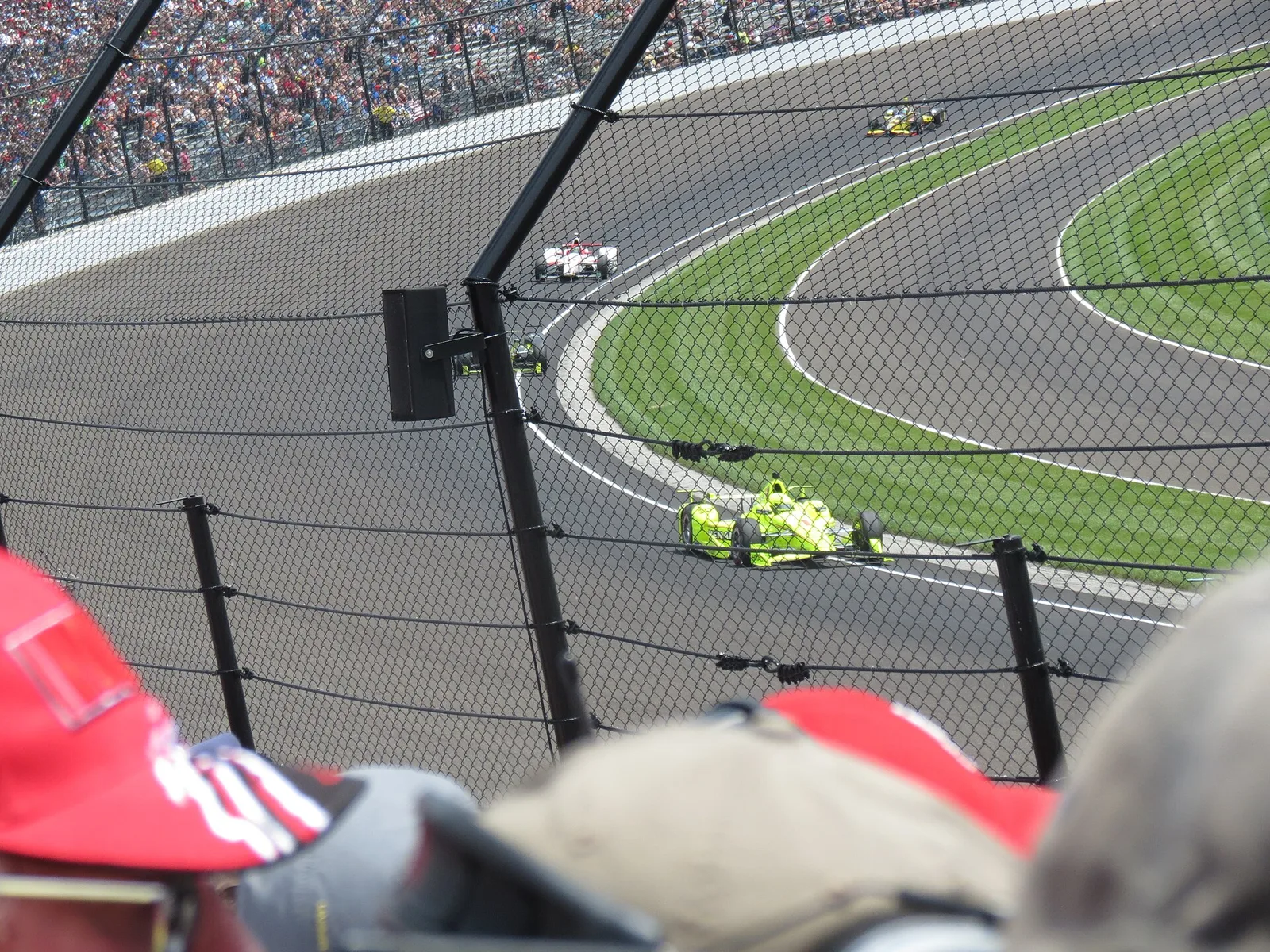
Sato took the lead with six laps remaining and defended it against Castroneves through the closing miles. Castroneves finished second, and the final stretch was a battle between the two of them.
The closing laps were decisive. Castroneves was the closest challenger, but Sato's advantage at the front held, and the win went to the Japanese driver.
What was Alonso's race like?
Fernando Alonso became the first current F1 driver in the field since Teo Fabi in 1984. He had skipped the 2017 Monaco Grand Prix to compete in Indianapolis.
He led 27 laps and retired in the closing stages, and he was voted Rookie of the Year for his efforts.
Who was injured in the crashes?
Sebastien Bourdais crashed during time trials and suffered a broken pelvis and other injuries, which kept him out of the race. Scott Dixon also crashed during the race and was left with a minor ankle injury.
Bourdais was the more badly hurt of the two, and his injuries ended his month before the race began.
How did the month of May unfold?
The IndyCar Grand Prix on 13 May opened the month with its fourth running, run on the combined road layout. Practice for the 500 began on 15 May, and time trials took place on 20 and 21 May.
Carb Day, the final practice day, came on 26 May, alongside the Pit Stop Challenge and the Indy Lights Freedom 100. Teams in the Pit Stop Challenge could use a back-up car fitted with one of their older engines. Road to Indy support races also ran during the month.
Who took pole and what speed did it carry?
Scott Dixon, the 2008 winner, took pole, the third of his career at Indianapolis. His pole lap averaged 232.164 mph (373.632 km/h), the quickest pole speed recorded since 1996.
What were the rules for 2017?
The 2017 race was the last year for the Chevrolet and Honda aero kits on the Dallara DW12 chassis. From 2018 every DW12 would carry a universal bodywork kit, and 2017 was a freeze year for aero kits.
Each entry had 36 sets of Firestone tyres for practice, qualifying and the race, the same allocation as in 2015 and 2016. Rookie Orientation added three sets, and refresher tests added two.
Engines were limited to 2,500 miles before a change-out. Full-time teams could use up to two fresh engines in May, plus a third left over from earlier races. Unapproved engine changes were subject to penalty, and each team had some latitude over when to fit its second fresh engine, which was meant for Carb Day and the race.
Boost was limited to 130 kPa in practice from 15 to 18 May. It rose to 140 kPa on Fast Friday and in time trials, then fell back to 130 kPa for Carb Day and the race.
How did Honda and Chevrolet compare in May?
Honda teams entered May as the prohibitive favourites over Chevrolet. Early in the week they were even accused of sandbagging, yet a different driver topped the speed charts each day, with the two manufacturers sharing those spots almost evenly.
Honda then began to suffer repeated engine failures, which raised serious worries about reliability in the garage. Harvey's blown engine on Fast Friday was the fifth Honda failure of that week.
How had the season begun before May?
The 2017 IndyCar season had five different winners in its first five races. Bourdais won the opener at St. Petersburg from last place on the grid, and Hinchcliffe took Long Beach.
Hinchcliffe's win was his first since a near-fatal accident in practice before the 2015 500. Newgarden took the Barber round, while the defending series champion, Pagenaud, won at Phoenix.
Will Power won the IndyCar Grand Prix, his second victory in that event.
How did the teams change over the winter?
Chip Ganassi Racing moved from Chevrolet to Honda power, and A. J. Foyt Enterprises made the reverse move, going from Honda to Chevrolet. KV Racing, whose 2013 winner was Tony Kanaan, was bought by Juncos Racing, a team already in the ladder system.
Bourdais lost his KV seat and signed with Dale Coyne Racing. Newgarden left Ed Carpenter Racing for Team Penske.
Montoya had spent three years full-time at Penske before moving to a part-time role for the Grand Prix and the 500 only.
Who was on the entry list?
Several former winners entered, including Castroneves, Montoya, Lazier, Dixon, Kanaan, Hunter-Reay and Rossi. Former series champions in the field included Pagenaud and Power.
Alonso planned to drive a Honda for Andretti Autosport with McLaren's support, an announcement made on 12 April. The official entry list appeared on 14 May.
The four rookies were Alonso, Harvey, Jones and Veach.
What happened in the early private tests?
A private Honda test was held on Friday 24 March, moved up because of weather forecast for Saturday. Eleven drivers took part in windy conditions, and Ganassi returned to the Speedway with Honda power for the first time since 2013.
A Chevrolet test was postponed by cold temperatures from 1 April to Sunday 2 April, and three Chevrolet teams were scheduled to take part.
What did Alonso's test show on 3 May?
Alonso cleared the three rookie phases in a private session on 3 May. He completed 110 laps, with a best of 222.548 mph.
Marco Andretti began the day by testing the car shortly after 9:00 a.m. Rain was approaching, so the schedule was compressed to fit all three phases in before it arrived.
The test was streamed live on IndyCar's social media, with combined viewing estimated at more than 2 million.
What happened at rookie orientation on 15 May?
The Monday session ran between noon and 2:00 p.m., with four rookies and refresher tests for Howard, Servia and Saavedra.
The three phases were ten laps at 205 to 210 mph, fifteen at 210 to 215 mph and fifteen above 215 mph. Veterans Howard, Servia and Saavedra completed their refresher programmes in the same window. Jones cleared his rookie test by 1:08 p.m.
Harvey lost almost an hour to gearbox trouble and then passed only the first phase after fuel pressure problems. Veach turned only three laps late in the session.
What did the first day of practice show?
Montoya was the first car out and the first to complete a lap. Around 4:00 p.m. Harvey drifted from the warm-up lane into the turn 2 wall after a mechanical failure, though he was not hurt.
Andretti set the day's quickest lap at 226.338 mph, while Carpenter was the fastest Chevrolet at 224.969 mph, third overall. Honda had eight cars in the top ten, and Kanaan set the fastest no-tow lap at 223.554 mph.
How did practice develop on 16 and 17 May?
On 16 May warmer weather and stronger winds lowered the speeds. Chevrolet took the top three places and seven of the top ten, with Power fastest at 224.656 mph.
Carpenter's fastest no-tow lap was 222.842 mph. On 17 May gusts reaching 45 mph kept most cars in the garage, and only 21 drivers ran, covering 408 laps. Carpenter was quickest at 222.894 mph, both overall and without a tow.
What happened on 18 May and on Fast Friday?
On 18 May every entry turned at least an installation lap, and Lazier was seen on track for the first time. Newgarden hit the outside wall hard after losing control in turn 1.
On the backstraight Bourdais's engine gave out, which was Honda's second failure in three days. Jay Howard was fastest at 226.744 mph, and Sato set the best no-tow lap at 224.734 mph.
Fast Friday on 19 May lost over two and a half hours to rain, while entries ran at 140 kPa of boost, up from 130 kPa. Bourdais was quickest early with 233.116 mph, while Hunter-Reay's best no-tow was 231.273 mph.
Harvey blew an engine after 11 laps, the fifth Honda failure of the week. Pigot and Veach crashed later in the session and both cars were badly damaged.
What happened in the first time trials session?
A heavy thunderstorm delayed the start of qualifying until 4:01 p.m., so every driver had only one attempt. The first day set 33 starters and nine cars for the Fast Nine shootout.
Bourdais's first two laps were the fastest of the day, at 231.472 mph and then 231.595 mph, before he lost control and hitting the SAFER barrier in turn two. He was taken to hospital with multiple pelvic and hip fractures.
Carpenter's average over four laps was 230.468 mph, the best of the day. Sato, Dixon, Hildebrand, Rossi, Power, Alonso, Kanaan and Andretti joined him in the Fast Nine, and Ed Jones was the first driver outside it.
Penske had a weak session, with four of its five drivers missing the Fast Nine. Veach did not attempt to qualify after crash damage from practice.
Race result highlights
| Finish | Driver | Notes |
|---|---|---|
| 1st | Takuma Sato (Andretti Autosport) | First Asian winner; took the lead with six laps to go |
| 2nd | Helio Castroneves | Held off by Sato over the final fifteen miles |
| Pole | Scott Dixon | Pole at 232.164 mph; crashed during the race |
| Retired | Fernando Alonso | Led 27 laps; Rookie of the Year |
| Crashed in practice | Sebastien Bourdais | Pelvic and hip fractures from a time trials crash |
| Crashed in race | Scott Dixon | Minor ankle injury |
Why does the 2017 Indianapolis 500 still matter?
It gave Sato a place in history as the first Asian winner. It also came during a Honda and Chevrolet rivalry in which the Honda teams had been favourites before the month's engine failures raised doubts about their reliability.
The engine problems and the crashes are a reminder of how much a single failure can change the outcome.