Tony Kanaan won on his 12th attempt at a record average speed, after 68 lead changes and a late crash that brought out the final yellow.
Tony Kanaan won the 2013 Indianapolis 500 for KV Racing Technology on his 12th attempt. Carlos Munoz and Ryan Hunter-Reay followed him home in a race of 68 lead changes and a record average speed.
The 2013 Indianapolis 500 was the 97th running of the race, and Tony Kanaan won it on a record-setting day. The Brazilian became the fourth Brazilian winner of the event, after Emerson Fittipaldi, Helio Castroneves and Gil de Ferran. Kanaan's KV Racing Technology car crossed the line ahead of Carlos Munoz and Ryan Hunter-Reay.
When and where was the 2013 Indianapolis 500 held?
The race took place on Sunday 26 May 2013 at the Indianapolis Motor Speedway in Speedway, Indiana. It was the headline race of the 2013 IZOD IndyCar Series calendar, and it began at 12:15 p.m. Eastern time.
The track opened for practice on Saturday 11 May, with time trials on 18 and 19 May and Carb Day on Friday 24 May. The Freedom 100 Indy Lights race was also held on Carb Day. The Indy 500 was part of an IndyCar triple crown with Pocono and Fontana for the first time since 1989, and a US$1 million bonus was on offer to any driver who won all three in one season.
Several other changes marked the event. Firestone signed a five-year extension as exclusive tyre supplier on 21 December 2012, and a zip-line that had proved popular during the Super Bowl XLVI festivities was installed in the infield. Lotus, which had fielded uncompetitive engines in 2012, was released from its contract and did not take part from 2013 onwards. Jim Nabors returned to perform 'Back Home Again in Indiana' before the race after missing 2012 through illness, which was his 33rd year singing it in person.
Kanaan won on his 12th attempt at a record 187.433 mph average, after 68 lead changes and a final-stretch yellow.
What were the rules for the 2013 race?
Turbocharger boost was set at 130 kPa during practice, Carb Day and race day. It rose to 140 kPa for Fast Friday and time trials. Each entry had 33 sets of tyres for practice, qualifying and the race, with extra sets for rookie orientation and refresher tests. Fast Nine entrants received an additional new set for each shootout attempt, but those tyres could not be used in the race.
Full-time entries were limited to 2,000 miles per engine. An unapproved engine change would cost a 10-place grid penalty at the next race, at Detroit. Most full-time teams used the same engine as earlier in the season, and any fresh engine had to be used up in practice before the Fast Friday and qualifying runs. Part-time teams on the Short engine programme received a single engine for their practice, qualifying and race.
Who was entered for the race?
The official entry list was released on 7 May with 34 entries. It included four rookies: A. J. Allmendinger, Conor Daly, Tristan Vautier and Carlos Munoz. Four former winners were on the list as well: Castroneves, Dario Franchitti, Scott Dixon and Buddy Lazier. Ryan Briscoe, who had taken pole for the 2012 race, was without a full-time seat, but he ran a fourth car for Chip Ganassi Racing.
Testing in early May included a private session for NASCAR driver Kurt Busch, who drove an Andretti Autosport car and reached 218 mph while considering a double programme in 2014.
How did practice and rookie orientation go?
Practice opened on 11 May with veteran running, rookie orientation and a second veteran session. Allmendinger, Munoz and Vautier passed the three-phase rookie test, while Daly missed the first day because he was racing in the GP3 event at Barcelona. A short rain shower then closed the track for half an hour that afternoon.
Practice then built up over the week. On 12 May Munoz topped the speed chart, and Andretti Autosport swept five of the top six spots. On 13 May 32 drivers took 1,799 laps, with Marco Andretti setting the fastest lap so far. By 14 May, the warmest day of practice had seen 2,226 laps, and James Hinchcliffe was quickest at 224.210 mph in Andretti's car.
Franchitti and Honda topped the chart for the first time that month on 15 May, and sixteen full-time entries had passed the 2,000-mile threshold and ran fresh engines. On 16 May Daly crashed in turn one, but he was uninjured. Munoz was fastest that day at 225.163 mph. Fast Friday, 17 May, brought the quickest lap of the month when E. J. Viso ran 229.537 mph, the fastest practice lap at the track since 2003, before storms closed the track at 3:42 p.m.
Who won the pole in 2013?
Will Power set the fastest lap of the month, 229.808 mph, in morning practice on 18 May. Rain then delayed time trials, but segment one began at 1:28 p.m. Chevrolet swept the top ten on the speed chart and took 13 of the top 15 places, while Alex Tagliani, the fastest of the Honda teams, qualified 11th.
The bumping was fierce. Simona de Silvestro bumped her way into the field and Townsend Bell did the same on his second attempt, while Graham Rahal was too slow. Josef Newgarden was bumped out by James Jakes and had to wait until Sunday to qualify.
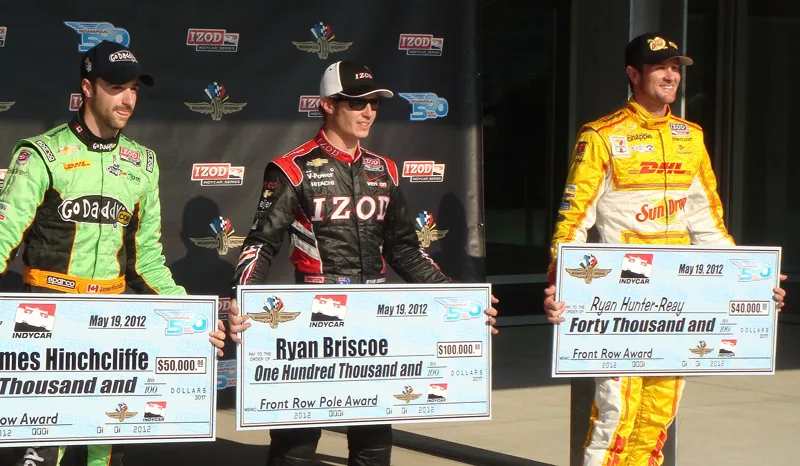
The Fast Nine shootout was moved to 6:30 p.m. Marco Andretti briefly took the pole, before Ed Carpenter's first lap of 229.347 mph, with a four-lap average of 228.762 mph, knocked him off. Munoz took the front row, and Power finished sixth. It was the first American-born pole-sitter since Sam Hornish Jr. in 2006, and the first owner-driver to take pole since Foyt's 1975 effort.
How did Bump Day and Carb Day play out?
On Bump Day, Sunday 19 May, nine places were open and ten drivers were preparing attempts. The field was filled to 33 cars within the first hour of qualifying. Katherine Legge sat on the bubble, and Michel Jourdain Jr. never made an attempt. His Rahal Letterman Lanigan team made several major set-up changes before parking the car at 5:45 p.m.
On Carb Day, Simon Pagenaud was fastest at 225.827 mph. Takuma Sato had a small engine fire that the team put out quickly. Ana Beatriz touched Munoz in the pits, damaging the front wing of her car. Ryan Briscoe's engine caught fire as the session ended, and he climbed out uninjured. In the Pit Stop Challenge, Team Penske won for the 14th time, with Castroneves as the driver.
How did the race start and develop?
Franchitti and Castroneves were both chasing a fourth Indy 500 win, but neither was a serious threat. Carpenter started on pole, but Marco Andretti soon took the lead from third. The first caution came on lap four, when J. R. Hildebrand hit the wall at turn two just after setting the fastest lap of the race. Hildebrand had almost won the 2011 race before a crash on the final lap.
On lap 36 Sebastian Saavedra was bumped between turns three and four and crashed outside turn four, and Pippa Mann later apologised for the accident. The first half featured many lead changes as Kanaan, Carpenter and Andretti swapped the top spot. Just before halfway, A. J. Allmendinger passed Kanaan to lead, with Hunter-Reay and Andretti following in third and fourth.
With fewer than 90 laps left, Allmendinger's seatbelt clasp came loose, and he had to pit so his crew could refasten it. He lost the lead. Rahal then crashed with seven laps to go, and the yellow flag came out. Hunter-Reay had been leading under that caution, but when it ended Kanaan slipped past him. Kanaan had run in the top ten for most of the race.
How did the race finish?
Franchitti crashed with three laps left, bringing out a yellow flag that would last until the finish. Kanaan led into turn one and took the flag under caution, with Munoz second and Hunter-Reay third. The race had 68 lead changes in total, more than any earlier Indy 500 and double the previous record of 34, set in 2012.
Kanaan said after the race that he had been looking at the grandstands and could hardly believe it. He had made it, at last, and the trophy would bear his name.
Who won the 2013 Indianapolis 500?
Kanaan won on his 12th attempt, which matched the mark set by Sam Hanks in 1957. Kanaan had spent most of the afternoon inside the leaders before the late passes. His win gave Chevrolet a first Indy 500 victory since 2002, and it ended Honda's run of nine consecutive wins in the race.
Chevrolet swept the top four finishing positions. Dallara, the chassis maker, won its eighth straight Indy 500, and its 13th overall since joining the series in 1997.
Carlos Munoz, a rookie, finished second, and he was named Rookie of the Year for the race. Ryan Hunter-Reay had led during the final yellow but lost the lead to Kanaan when the caution ended, and he took third.
What records did the 2013 race set?
The race was completed in 2 hours, 40 minutes and 3.4181 seconds at an average speed of 187.433 mph (301.644 km/h). That was the fastest Indy 500 to date, beating the 185.981 mph set by Arie Luyendyk in 1990. The record stood until 2021.
There were 68 official lead changes and 14 different leaders, breaking the record of 12 set in 1993. Counting interim changes, the unofficial tally was 84 among 15 drivers. A total of 26 cars ran at the finish, tying the record set in 1911, and 19 finished on the lead lap.
The 33-car field completed 5,863 laps out of a possible 6,600. There was a green-flag stint from lap 61 through lap 193, 133 consecutive laps without a caution. There were only 21 laps under caution, which beat the modern-era low of 26 set in 1990. Carpenter led the most laps, 37, which was the lowest total for a race leader.
What was the Franchitti story?
Franchitti's crash with three laps to go was his last Indy 500 start. On 6 October 2013 he crashed at the Grand Prix of Houston, when his car flew into the catch fencing after contact with cars driven by Takuma Sato and E. J. Viso. He suffered two fractured vertebrae, a broken ankle and a concussion, and on 14 November he announced his immediate retirement on medical advice.
His total stood at 31 wins from 265 starts in American open-wheel racing, which tied him with former team-mate Paul Tracy for ninth on the all-time list. Castroneves also finished the full 500 miles without relief for a record ninth time, while Dixon completed the distance for a sixth straight year, and by then he had completed 1,566 consecutive laps since the 2006 race.