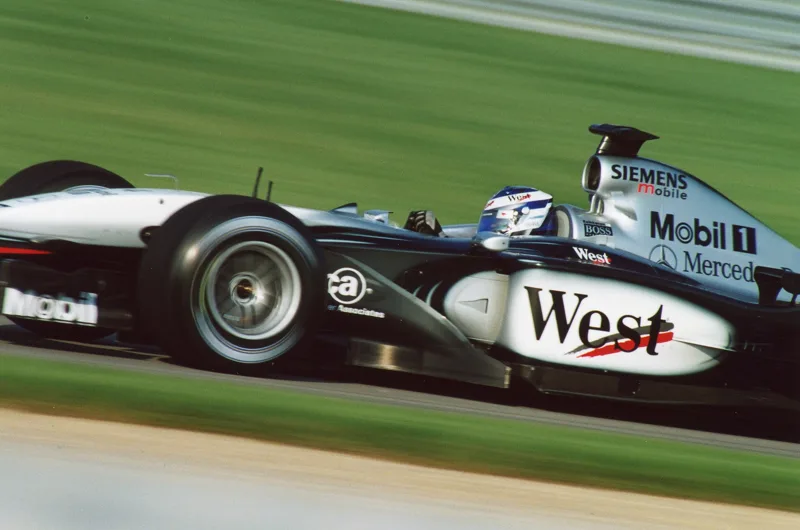
Michael Schumacher's pole-to-flag win, a Ferrari one-two, a season-record 144 points and Takuma Sato's home points closed a dominant year.
The 2002 Japanese Grand Prix was the 17th and final round of the 2002 Formula One World Championship, held at Suzuka on 13 October 2002. Michael Schumacher won from pole, Rubens Barrichello was second and Kimi Raikkonen third, and Schumacher finished the season with a record 144 championship points.
Suzuka closed the 2002 Formula One season with a race that mattered more for records than for the title. Michael Schumacher had already secured the championship, yet he still started from pole position, led most of the way and finished ahead of his Ferrari team-mate, giving the team a one-two at the final round.
Where did the 2002 Japanese Grand Prix fit into the season?
Both world titles were settled before Suzuka. Schumacher had won the drivers' championship six rounds earlier at the French Grand Prix, and Ferrari clinched the constructors' crown at the Hungarian Grand Prix two races later. The remaining interest centred on third place in the drivers' standings, where Montoya, Ralf Schumacher and Coulthard were separated by six points.
Suzuka itself had changed since the previous year. After the previous year's race the circuit was trimmed by 38 m (125 ft), from 5.859 km (3.641 mi) to 5.821 km (3.617 mi), by realigning key turns to give the run-off areas more room. The S-curves and Dunlop Curves were partly reworked, some retaining barriers were moved back, and the weekend's support races included the Formula Dream and Integra Type-R Challenge Cup.
The weeks after the United States Grand Prix were spent testing at European circuits. BAR, McLaren, Toyota and Williams ran three-day sessions at the Circuit de Barcelona, where McLaren's test driver Alexander Wurz was quickest on the opening two days and broke the track record on the second. Takuma Sato spent two days at Silverstone, Renault's Oliver Gavin tested for three days, and Ferrari's Luca Badoer finished preparations with wet-weather tyre runs at Fiorano.
Schumacher said he wanted to finish the year with a win and was determined to go flat out. Kimi Raikkonen had acclimatised in Hawaii and pointed to the mix of medium and high-speed corners at Suzuka, while Montoya admitted he would be surprised if Williams could match Ferrari at the circuit.
A pole-to-flag win, a season-record points haul and a home podium for Sato closed the 2002 season at Suzuka.
What changed in the entry and the cars?
Ten constructors fielded two cars each, and nobody brought major new parts because teams were already working on 2003 machinery. McLaren used upgraded rear end components for the first time, and Honda gave BAR and Jordan a more powerful engine. Arrows missed the race for the fifth consecutive Grand Prix because of financial problems.
Several drivers were making their last appearances for their teams. Mika Salo and Eddie Irvine were racing for Toyota and Jaguar for the final time, and Jenson Button was ending his time with Renault. Felipe Massa returned to the Sauber cockpit after Peter Sauber had swapped him for Heinz-Harald Frentzen at the United States Grand Prix, a move taken to avoid a ten-place grid penalty linked to a collision with Pedro de la Rosa at the Italian Grand Prix.
How did the practice sessions go?
Michael Schumacher was fastest in the first session at 1:36.109 and again in the third, where he set the first lap under 1:33 of the weekend at 1:32.978. Kimi Raikkonen topped the second session at 1:34.232, and the running was marked by crashes for Villeneuve and Montoya and engine failures for Sato and Allan McNish.
Jacques Villeneuve lost the rear of his BAR over the kerbing at the Spoon Curve exit 27 minutes into the first session, sending carbon fibre across the track. He was unhurt, and practice was halted for ten minutes while marshals cleared the debris. Montoya went into the tyre wall at the Degner curves with 12 minutes left in the second session, damaging the rear and left side of his Williams. Michael Schumacher's session ended early with a hydraulic fault that limited him to four laps.
On Saturday, Sato's engine failed on the back straight near the 130R corner and flames came from the rear of his car, though he was unhurt. McNish's engine also failed, limiting him to four laps.
How was pole position decided in qualifying?
Michael Schumacher took pole with a time of 1:31.317, his seventh of the season and his 50th overall. Barrichello was 0.432 seconds slower in second, Coulthard was third in the cooler conditions, and Raikkonen completed the top four. The hour was also overshadowed by a serious accident for McNish.
Qualifying ran under the 107% rule, with each driver limited to twelve laps. Schumacher set the fastest time on his first flying lap and then improved on it, although he felt he might have gone quicker after adjusting his setup. Coulthard's final run was spoiled by understeer in the first sector, and Raikkonen ran wide at turn one on his last lap. Ralf Schumacher had uneven car balance, while Sato took seventh in the final seconds, his best qualifying result of the year.
Thirty-five minutes into the session, McNish lost the rear of his Toyota at the exit of 130R. The car went backwards over the run-off, through the tyre wall and into the outside barrier, breaking two of its top rails before settling upright against an earth bank. He climbed out unaided but with a limp. Qualifying was stopped for 75 minutes while marshals repaired the barriers and cleared the debris. The FIA medical delegate Sid Watkins examined him, and McNish was advised to miss the rest of the session because of a mild concussion and a bruised knee. The safety changes introduced after the deaths of Roland Ratzenberger and Ayrton Senna at the 1994 San Marino Grand Prix were credited with limiting the damage.
Webber and Yoong filled the last two places on the grid, in 19th and 20th. The warm-up brought a further setback when McNish failed Watkins' check. The bruising on his right knee had swelled overnight, and Toyota withdrew him as a precaution.
What happened in the race?
The 53-lap race was run in dry, warm conditions before 155,000 spectators. Schumacher led from the start, lost the lead only briefly during the first stops, and eased off late to let Barrichello close up. Raikkonen completed the podium despite a throttle problem, and Ferrari finished one-two.
Schumacher made a clean getaway and held the lead into the first corner, while Barrichello weaved twice to keep second from Coulthard. Ralf Schumacher passed Raikkonen on the outside for fourth, and Trulli climbed from 11th to eighth on the opening lap. Fisichella had been unable to take his own car to the grid after an engine failure on the reconnaissance lap, so he started from the spare Jordan, which lacked the more powerful Honda engine. After one lap, Michael Schumacher led his teammate by 2.2 seconds.
Massa retired on lap four. He was following Villeneuve closely, lost downforce, and clipped the kerb before the second Degner Curve. His car hit the tyre barrier at 112 mph (180 km/h) and lost its front wing. Coulthard's race ended on lap seven when an electrical failure in the throttle actuator cut power, and he coasted into the McLaren garage. Yoong, who was driving without power steering, spun a third time and retired on lap 16.
Renault brought Trulli and Button in early, hoping to undercut Sato, but the move did not gain them the place. Michael Schumacher pitted on lap 20 and stood for 9.4 seconds, rejoining behind Barrichello. Barrichello stopped on lap 22 and came back fourth. Villeneuve's engine failed on lap 28 just after the pit lane entry, and Trulli retired on lap 34 with a fuel system fault.
Michael Schumacher's second and last stop of the season came on lap 38. It lasted eight seconds and kept him in front. Ralf Schumacher had been second, but his stop on lap 40 took 6.9 seconds and dropped him to fifth behind Raikkonen. Fisichella's engine failed on lap 39 at the exit of Spoon Curve.
Sato, running sixth, slid sideways at Spoon Curve on lap 46 but kept the car under control. Raikkonen's throttle problems on lap 48 forced him to slow in the closing laps, and Ralf Schumacher's engine failed at the Degner Curves late on. Schumacher eased off in the final laps to let Barrichello catch him, but the gap at the flag was 0.506 seconds. Raikkonen took third, and Montoya finished fourth after a front wing adjustment at his first stop.
The win was Schumacher's 11th of the season and his 64th in Formula One. He became the first driver to finish on the podium at every Grand Prix of a single season, and Ferrari's 15 wins matched the record McLaren had set in 1988.
Top ten classification at Suzuka
| Position | Driver | Team | Notes |
|---|---|---|---|
| 1 | Michael Schumacher | Ferrari | Pole, 11th win of the season |
| 2 | Rubens Barrichello | Ferrari | 0.506 seconds behind |
| 3 | Kimi Raikkonen | McLaren | Throttle problems late in race |
| 4 | Juan Pablo Montoya | Williams | Front wing adjusted at first stop |
| 5 | Takuma Sato | Jordan | First championship points of his career |
| 6 | Jenson Button | Renault | Final race for Renault |
| 7 | Nick Heidfeld | Sauber | Handling improved early on |
| 8 | Mika Salo | Toyota | Heavy understeer on final tyres |
| 9 | Eddie Irvine | Jaguar | Lack of grip, final race for Jaguar |
| Tenth | Mark Webber | Minardi | Low grip through the race |
What did the result mean for the championships?
Schumacher finished the season with 144 points, a record that was 21 more than his previous season's total and 67 ahead of Barrichello. Montoya took third in the drivers' table with 50 points, while Ralf Schumacher was fourth on 42 and Coulthard fifth on 41. Coulthard's finish was his lowest since he was seventh in the 1996 season.
In the constructors' table Ferrari scored 221 points, as many as the other ten teams combined. Williams were second with 92 points and McLaren third with 65. Ferrari had already clinched the constructors' title at the Hungarian Grand Prix, so the points in Japan were about margin rather than outcome.
Why did Takuma Sato's fifth place matter?
Sato finished fifth at his home race and scored two points for the first time in his career. He became the first Japanese driver since 1990 to score a championship point in Japan, when Aguri Suzuki finished third and Satoru Nakajima sixth at the Japanese Grand Prix. The result also lifted Jordan to sixth in the constructors' standings.
Sato said the crowd had waved to him on every lap, and Eddie Jordan admitted that he had not expected a fifth-place finish, but he said the fans had driven Sato on and that a Japanese driver capable of scoring in Grand Prix racing was good news for the sport.
Farewells and reaction after the flag
The race closed chapters for several people. Salo and Irvine raced for Toyota and Jaguar for the last time, and Button scored a point in his final race for Renault. Coulthard had wanted to end the season on the podium and felt he could have achieved it. Jean Todt called the race a dream finale to a dream season, while Schumacher credited the mechanics for a season in which he finished on the podium at every race.