A wet start behind the safety car, a spin at Stavelot and a daring move on Michael Schumacher gave Mika Hakkinen victory at Spa.
The 2000 Belgian Grand Prix was won by Mika Hakkinen for McLaren from pole position, ahead of Michael Schumacher and Ralf Schumacher. The 44-lap race at Spa-Francorchamps began behind the safety car because of wet conditions, and the result put Hakkinen top of the drivers' table.
The 2000 Belgian Grand Prix was a Formula One race held at the Circuit de Spa-Francorchamps on 27 August 2000 before 83,000 spectators. Mika Hakkinen won from pole position for McLaren, but a wet start, a spin at Stavelot and a late move on Michael Schumacher made the 44-lap race one of the most talked-about of the season.
Who won the 2000 Belgian Grand Prix?
Mika Hakkinen won the 44-lap race for McLaren from pole position, his last pole in Formula One. Michael Schumacher finished second for Ferrari, 1.1 seconds behind, and Ralf Schumacher took third for Williams. It was Hakkinen's fourth win of the season and his 18th in Formula One.
Hakkinen went into the weekend as the championship leader, with his team also leading the constructors' table. He had qualified on pole with a time of 1:50.646, which was his 26th pole of his career and his fifth of the season.
His win extended his lead in the drivers' table to six points over Schumacher, with David Coulthard a further seven points back. McLaren extended their lead over Ferrari in the constructors' table to eight points, with four races left to run.
A wet start behind the safety car set up a race that Hakkinen won by passing Schumacher in the closing laps at Spa.
Why did the race start behind the safety car?
Rain had fallen overnight and the track was still wet, with standing water and poor visibility in places. Race director Charlie Whiting consulted the drivers before the start, and the decision was taken to begin behind the safety car. The organisers were keen to avoid a repeat of the multi-car pile-up seen at the 1998 race.
Instead of the usual two-by-two standing start, the field lined up in a single file and rolled away with no formation lap. The safety car came in after one lap and the cars were allowed to overtake once they crossed the start-finish line. Hakkinen kept his lead into the first corner, with Jarno Trulli, Jenson Button, Michael Schumacher and Coulthard close behind.
Several drivers were penalised or caught out by the conditions in that opening phase. Pedro Diniz spun off under the safety car, and Pedro de la Rosa was given a ten-second stop-and-go penalty, which he served on lap 13. Button and Trulli would later collide, but the start itself was the moment that set the tone for the rest of the afternoon.
How did the Spa race return to the calendar?
When the FIA published its provisional calendar for the new season, the Circuit de Spa-Francorchamps had been left out. Belgian tobacco-advertising laws threatened to cancel the race, since several teams had tobacco sponsors. The FIA had the Dutch Grand Prix at Zandvoort and the Portuguese Grand Prix at Estoril as fallbacks.
The row ended when Belgium's government granted the race an exemption from the advertising rules. The event was reinstated by the FIA World Motor Sport Council at its meeting in Paris in October, so the race went ahead as planned in August.
What did qualifying look like?
Hakkinen was unhindered by slower traffic in the one-hour session and took pole with 1:50.646. Trulli qualified second, equalling his best grid position of the season, which he had also achieved at Monaco. Button was third with a new qualifying engine, while Michael Schumacher was fourth, just under a second off the pole time after traffic and a yellow flag hampered his fastest lap.
Coulthard had grip problems and qualified near the front of the second row. Ralf Schumacher was caught in traffic on his final run and lined up behind him. Villeneuve reported oversteer through the middle of the lap, and Frentzen had his best lap disallowed when Coulthard blocked him at the Bus Stop chicane. The table below gives the leading grid positions.
| Grid | Driver | Team | Time or note |
|---|---|---|---|
| 1 | Mika Hakkinen | McLaren | 1:50.646, pole |
| 2 | Jarno Trulli | Jordan | Front row with Hakkinen |
| 3 | Jenson Button | Benetton | New qualifying engine |
| 4 | Michael Schumacher | Ferrari | Just under a second off pole |
| 5 | David Coulthard | McLaren | Grip problems in qualifying |
| 6 | Ralf Schumacher | Williams | Caught in traffic on last run |
| 7 | Jacques Villeneuve | BAR | Reported oversteer |
| 8 | Heinz-Harald Frentzen | Jordan | Best lap disallowed |
| 9 | Johnny Herbert | Jaguar | Ninth on the grid |
How did the tyre rules shape the weekend?
Bridgestone was the sole tyre supplier and brought soft and medium dry compounds, along with hard and soft wet-weather compounds. The intermediate had a curvy tread pattern, while the full wet was designed for the rain that Spa is known for.
The wet-weather tyres were introduced for the race partly in response to Michelin, which was starting its own tyre development programme that year. Bridgestone accelerated its own development work as a result, so the race became a showcase for how quickly the two suppliers could respond to conditions.
How did the tyres shape the race?
Dry tyres became the choice once the track began to dry, and the order changed quickly as teams called drivers in. Alesi was the first to pit for dry tyres on lap four, and Michael and Ralf Schumacher followed on lap six. Hakkinen came in from the lead on lap seven, and Coulthard, who was kept out on wet-weather tyres, pitted on lap eight.
Coulthard's delay cost him places, and it left him behind Frentzen for a time. By the end of lap nine every driver had made their change, and the race order at that point was Hakkinen, Michael Schumacher, Ralf Schumacher, Alesi, Button and Villeneuve. The strategy calls had given the Ferrari drivers and Hakkinen plenty of thought.
Michael Schumacher made a pit stop on lap 21 that took 11.1 seconds, and he came out in third with enough fuel to finish. He had a six-lap fuel advantage over Hakkinen at that stage, which made the leader's gap look stable for a while.
How did Hakkinen take the lead?
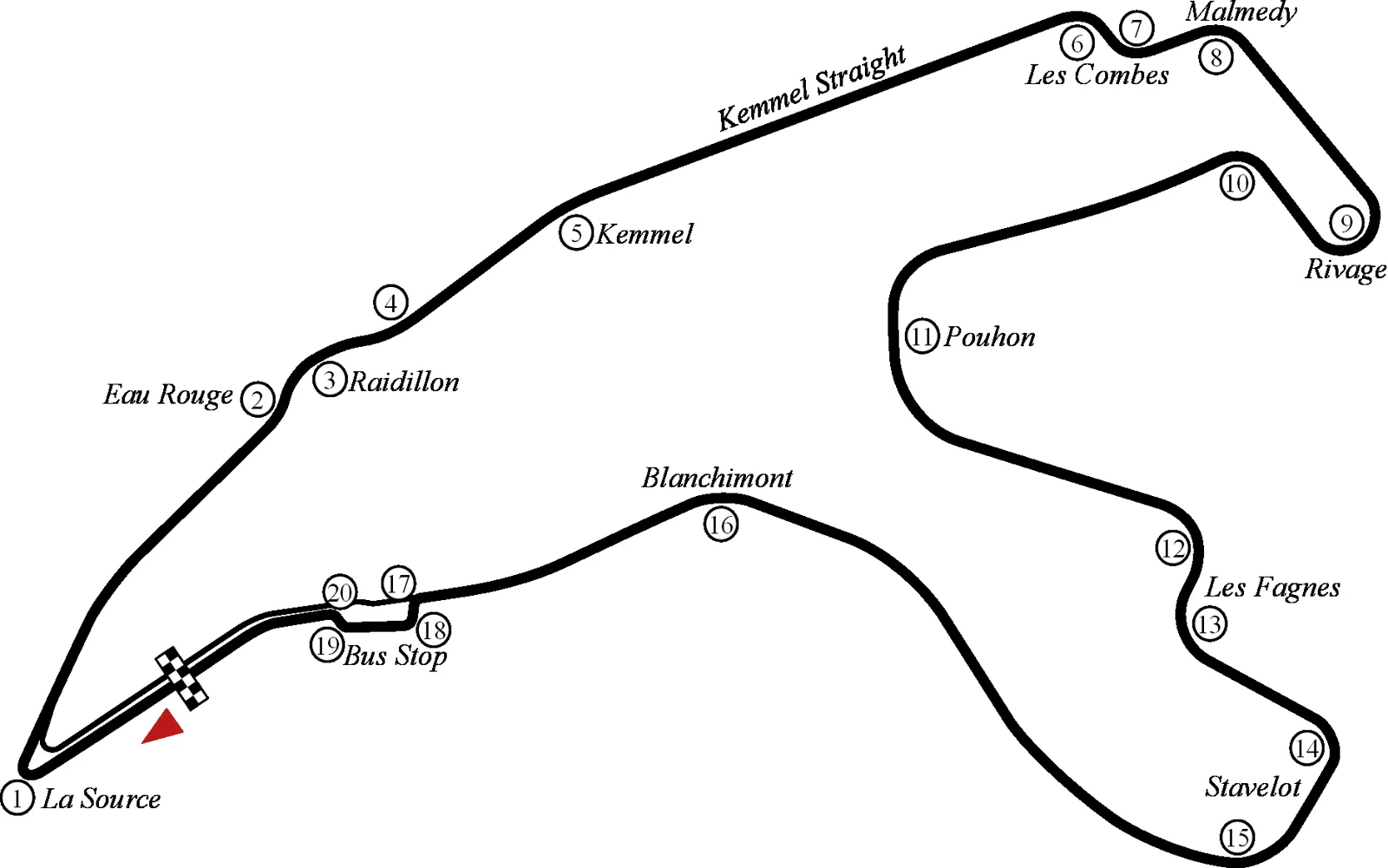
Hakkinen began to close the gap once the track dried, and by the start of lap 13 Michael Schumacher had reduced it to about 4.6 seconds. Later on that lap one of Hakkinen's wheels touched a damp kerb at Stavelot, and he went into a high-speed spin, sliding for hundreds of yards into the grass. The mistake cost him about ten seconds and put him behind Michael Schumacher.
Michael Schumacher's soft tyres began to degrade as the track dried, and on lap 34 he ran off the racing line to cool them. Hakkinen's McLaren had a straight-line speed advantage, and he gradually closed the gap. Hakkinen's front wing was damaged, and he had to slow.
On the following lap Hakkinen took the corner at full throttle and drew closer again. As the pair lapped a slower car, Hakkinen steered onto a damp patch and went past Schumacher for the lead into Les Combes at 328 km/h (204 mph). It was the decisive move of the race, and Hakkinen kept the position to the flag.
How did practice set the scene?
Conditions were dry for the Friday sessions, and a layer of dust gradually cleared from the track as cars ran. Coulthard set the fastest time of the first session at 1:53.398, with Hakkinen third and Trulli, Barrichello and Villeneuve close behind. Alesi's Prost had a fuel pressure problem that stopped him setting a timed lap.
Saturday morning was dry as well, and Hakkinen set the fastest time of the session at 1:51.043, quicker than his best on Friday. Button, much happier with the handling of his car, was second in the final session. The Jordan drivers were third and fourth, and Ralf Schumacher and Coulthard completed the leading six.
Teams used the practice time to work on their set-ups for the high-speed corners and the long uphill sweeps at Spa, where the balance of the car mattered more than outright power.
Which drivers retired from the race?
Several drivers failed to finish, and some of the retirements came early. Trulli was the first, after he and Button collided at La Source on lap five and his car stalled. Fisichella retired with an electrical problem after the collision with Verstappen at the Bus Stop, and Heidfeld's engine failed later with a broken gearbox that damaged the oil circuit.
Barrichello had the fastest lap of the race at 1:53.803 on lap 30, but he later lost fuel pressure and ran out on lap 31. Alesi also retired with a fractured fuel system. Of the 22 starters, 17 finished the race, with the rest out through crashes, mechanical failures or the rain.
Hakkinen was delighted with the victory, describing it as an incredible win and admitting that the move had been a difficult and unusual situation. He said the kerbs at Spa were very slippery and that once a car went over one, there was little a driver could do about it. Schumacher said he had been unable to match Hakkinen's overall pace, and he added that he had run off line to cool his tyres without any problems.
What did the win mean for the championship?
Hakkinen's victory left him at the top of the drivers' table with 74 points. Barrichello was on 49, and Ralf Schumacher moved up to fifth with 20 points after passing Fisichella.
In the constructors' championship McLaren led with 125 points, and Ferrari were second on 117. Williams extended their lead over Benetton to 12 points, and Jordan stayed fifth with 13. With four races remaining, Michael Schumacher admitted that his team lacked speed against McLaren, but he remained confident that Ferrari could still win the title.
Why is the overtake still remembered?
The move on Michael Schumacher is one of the best-known passes in Formula One history. Hakkinen was given a place in the record books for it, and in February 2001 more than 60 Formula One historians chose it as the MasterCard Priceless Moment of the 2000 season.
Michael Schumacher had blocked Hakkinen late on the approach to Les Combes, and after the race Hakkinen went to him in the parc ferme and warned him against manoeuvres like that at high speed. Schumacher later praised the move. McLaren team principal Ron Dennis said it would go down as one of the greatest overtakes in the sport's history.
The safety car start also drew mixed reactions. Coulthard agreed with the decision, saying that the safest option at Spa had been a safety car start, while Martin Brundle felt the track was not wet enough to justify it. Ralf Schumacher supported the decision too, and the debate continued through the season.