Volkswagen had no wish to build a faster Golf, so a handful of staff did it quietly.
The Golf GTI began as an unofficial Volkswagen project and went on sale in June 1976 with a fuel-injected 1.6-litre engine and a 180 km/h (110 mph) top speed. It has continued through later generations, reaching 230 hp as standard on the Mk7 facelift of 2016.
Volkswagen did not want to build a faster Golf. After the political backlash to a yellow-and-black Beetle racer in 1973, the company had little appetite for performance, so the car that became the GTI began as a skunkworks project run by a few staff.
Why did Volkswagen need the Golf in the first place?
Because the Beetle was running out of road. Domestic sales fell from a high of 600,000 units in 1965 to 370,000 in 1967, and Volkswagen's share of the German market dropped from 45% in 1960 to 26% in 1972. The Golf reached Europe in May 1974 as the front-wheel-drive, water-cooled successor that the company had been prototyping since the early 1950s.
Those prototypes all carried the prefix EA, short for a German phrase meaning development assignment. The EA41 of 1952, built with Pininfarina, was essentially a rebodied Beetle and never reached production. Some of the studies fed into the Type 3 and Type 4, while the EA276 of 1968, a small front-drive hatchback, was cancelled after the death of Heinz Nordhoff and went on to inspire the Brazilian Gol.
By then the pressure was acute. Ford and Opel had launched the Escort and Kadett at Volkswagen's traditional market, the Deutsche Mark rose 40% against the dollar in 1971, and the oil crisis of 1973 brought driving bans and speed limits in Germany. Profits slid from DM 330,000,000 in 1969 to DM 12,000,000 in 1971, and 1974 ended with a loss of DM 807,000,000. Director general Rudolf Leiding, taking stock, described a fight for the survival of a giant group.
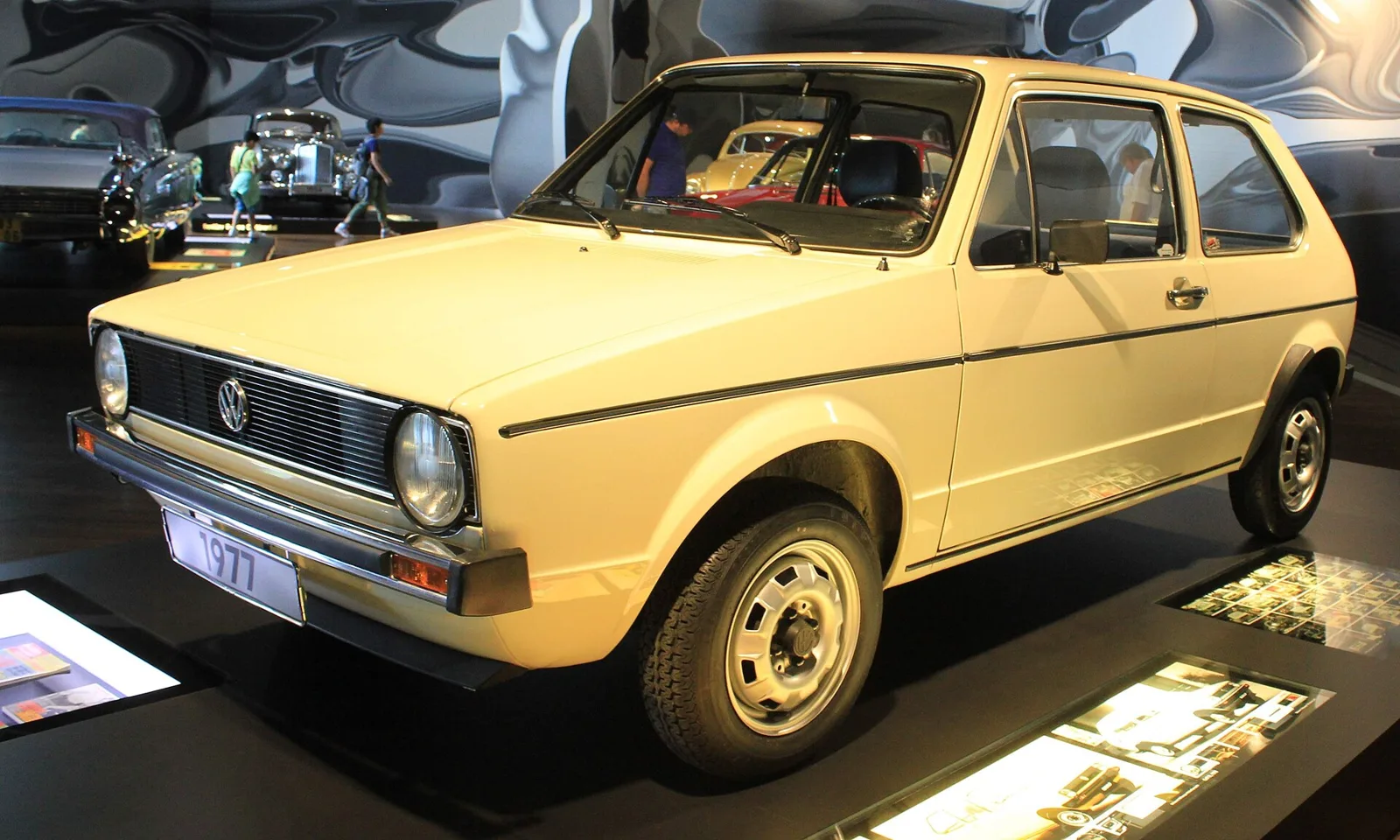
The answer came from Turin. Giorgetto Giugiaro of Italdesign was invited to Wolfsburg in January 1970 to work on a project called EA337, where the first thing he saw was a Fiat 128 stripped down and labelled. The brief called for a compact C-segment family car, a two-box shape offered with three or five doors. He produced a design in his sharp-cornered, flat-planed "origami" style, and later came to regard the Mk1 Golf as the most important design of his career.
The name was a late decision. Candidates included Blizzard and Caribe, and the winner was Golf. Production of the Type 17 began in March 1974. In the United States and Canada it was sold as the Rabbit.
Volkswagen had little inclination to build a faster Golf, so a few staff built one without an official programme.
How did the first Golf GTI come about?
Quietly, and without a factory mandate. Press chief Anton Konrad and engineer Alfons Lowenberg began work on a Sport Golf off the books. The result reached showrooms in June 1976, powered by a 1.6-litre fuel-injected engine that gave it a 180 km/h (110 mph) top speed.
The group around them was small and resourceful. Gunter Kuhl joined from the press department, Herbert Schuster handled suspension, and Jurgen Adler's chassis analysis led to extra reinforcements. Hermann Hablitzel slipped components into routine testing, Franz Hauk, the developer of the EA827 engine, supplied the engine expertise, and Horst-Dieter Schwittlinsky of marketing coined the three letters that went on the tailgate. The first prototype was based on a Scirocco instead of a Golf.
The ingredients were already in the production car. The Golf had a steel unibody, a steep hatchback and a transverse engine driving the front wheels. MacPherson struts and an anti-roll bar looked after the front suspension, a twist-beam axle the rear, and the steering was rack and pinion. Up front sat solid 239 mm (9.4 in) disks. Where most Golfs wore 145SR13 or 155SR13 tyres, the GTI used larger 175/70 13-inch rubber.
The 1.6-litre size belonged to the EA827 family of Audi-derived four-cylinder engines, which ran their valves by bucket tappets and sat tilted 15 degrees rearwards. A four-speed manual was the original gearbox choice, and a five-speed followed in 1979.
What did the Mk1 achieve on the road?
It built a reputation for toughness before the GTI even existed. Two Golfs covered 30,500 km (19,000 mi) in a durability run that started at Fairbanks, Alaska on 2 October 1974 and ended at Tierra del Fuego on 14 January 1975. Sales followed, and for much of the car's life it topped the West German new-car charts.
Right-hand drive cars reached the United Kingdom in October 1974, and the Golf was the 14th best-selling car there in 1975, with more than 19,000 sold. The 1975 European Car of the Year vote went to the Citroen CX, with the Golf second. What Car? magazine named the facelifted GTI its Car of the Year in 1981, placing it above newcomers like the Austin Metro and the Mk3 Ford Escort, and the Mk1 GTI took the Motor Trend award in 1985.
Even in 1983, its last full year and almost a decade old, it sold more than 25,000 in Britain and was again the 14th best seller. Styling moved on in small steps: the Swallowtail line across the tailgate was deleted in December 1975, wrap-around bumpers arrived in December 1978, and a 1980 facelift brought wider rear lamps and LED warning lights. The Mk2 took over in September 1983, with Britain following in March 1984.
How did the Mk2 GTI change the recipe?
It grew. The Mk2 appeared at Frankfurt in September 1983 with a wheelbase 75 mm (3.0 in) longer, 180 mm (7.1 in) more overall length and about 120 kg (260 lb) of extra weight. Giugiaro's lines were kept but softened. Around 6.3 million were built, and the GTI came with a Bosch K-Jetronic 1781 cc engine producing 112 PS (82 kW; 110 hp).
The bigger step was the 16-valve engine. Discreet red-and-black 16V badges marked the car. In 1990 a facelift made the Big Bumper standard, and a supercharged GTi G60 joined the range.
Around the GTI the family multiplied. In Europe the GTI body kit even went onto a non-injection Golf sold as the Driver, and the GTI remains a trim level in some European markets while being a separate model line in others. The Mk2 was also the last Golf with carburettor petrol engines, because the Mk3 came with fuel injection from the start to meet rules for cars sold in the EEC after 1992.
Syncro, G60 and the Rallye Golf
The first four-wheel-drive Golf, the Syncro, was presented in February 1986, built with Steyr-Daimler-Puch of Austria around a viscous coupling that could send up to 48% of torque to the rear. It cost about 30% more than an equivalent front-drive car and weighed 160 kg (353 lb) more, which helps explain why just 16,000 were built from 1986 to 1989, and fewer than 1,000 reached Britain.
The Rallye Golf of 1989 was a Group A homologation special with Syncro drive, a supercharged 1763 cc engine and 160 PS (118 kW; 158 hp). Its capacity was a shade below the standard 1781 cc so that it could compete in the under-3-litre class. Volkswagen built 5,000 at Brussels at about DM 50,000 each, roughly twice the price of a base GTI, and the paperwork was finished on 1 December 1989. The United States never received any through official channels.
On the stages, VW Motorsport entered the world championship in 1990 and 1991 with a small budget. The best results were third place in the 1990 Rally New Zealand and fifth in the Tour de Course that year. The team then withdrew at the end of 1990, but won both the drivers' and manufacturers' titles in the 1991 German Rally Championship.
The most powerful Mk2 was the Golf G60 Limited. Hand-built by Volkswagen Motorsport, only 71 were produced, each with a supercharged 16-valve engine, Syncro drive and a price of DM 68,500 in 1989. They made 210 PS (154 kW) and 252 N.m (186 lb.ft), and reached 100 km/h (62 mph) in 6.4 seconds, which made them the most powerful Golf until the Mk4 R32 with 241 PS (177 kW) in 2003.
How did the GTI change across the Mk3 to Mk7 generations?
Power climbed in steps, and the engines moved from naturally aspirated fours to turbocharged units and, for a time, a six-cylinder.
| Generation | Debut | GTI engine and output |
|---|---|---|
| Mk1 | Golf May 1974; GTI June 1976 | Fuel-injected 1.6-litre; 180 km/h (110 mph) |
| Mk2 | September 1983 | 1.8-litre 8-valve, 112 PS (82 kW; 110 hp); 16-valve, 139 PS (137 hp; 102 kW) |
| Mk4 | August 1997 | Turbocharged 1.8T or 2.8-litre VR6 |
| Mk5 | Autumn 2003 | Turbocharged 2.0 FSI, 147 kW (197 hp; 200 PS) |
| Mk6 | 2008 | Turbocharged TSI, 157 kW (213 PS; 211 hp) |
| Mk7 | September 2012 | Turbocharged 2.0-litre, 154 kW (207 hp; 209 PS); with performance pack 162 kW (217 hp; 220 PS) |
| Mk7.5 | November 2016 | 230 hp standard; 247 hp with performance pack |
The Mk3 of August 1991 introduced the first TDI diesel to the Golf, plus a 2.8-litre VR6 with a narrow cylinder angle. That engine returned for the Mk4 GTI, which could also be had with the 1.8T. Alongside came the 3.2-litre VR6 Golf R32 of 2002 with four-wheel drive, and its predecessor, the 2.8-litre V6 4Motion. The Mk4 was the best-selling car in Europe in 2001.
What did the Mk5 and Mk6 add?
The Mk5 reached Europe in the autumn of 2003, and in North America Volkswagen revived the Rabbit name for it in 2006. Its GTI used a turbo edition of the 2.0-litre FSI engine, rated at 147 kW (197 hp; 200 PS), while the R32 used a 3.2-litre VR6 with 184 kW (247 hp; 250 PS) and Haldex 4motion four-wheel drive. A run of 5,000 R32s was made for the United States in 2007, each with its number laser etched on the steering wheel.
American GTI buyers also got a marketing campaign called Fast, in which a spirit totem character stood for the idea, and GTI Mk5 owners received a plastic figurine. In a Car and Driver comparison the Rabbit beat eight small cars, praised for driving position, instruments and engine, and criticised for road noise, seating and thirst.
The Mk6 followed at the 2008 Paris Motor Show on the same PQ35 platform, designed under Walter de'Silva with a more aerodynamic shape and a better interior after criticism of the Mk5 trim. The GTI produced 157 kW (213 PS; 211 hp) from a turbocharged TSI, the Golf R 191 kW (260 PS; 256 hp). Adaptive Chassis Control offered normal, comfort and sports settings, and 6- or 7-speed DSG dual-clutch gearboxes were available. The Mk6 was World Car of the Year in 2009 and a 2012 Insurance Institute for Highway Safety Top Safety Pick.
What did the Mk7 GTI change?
It got lighter while the power went up. The Mk7 debuted at the Paris Motor Show in September 2012 on the MQB platform shared with the Audi A3, SEAT Leon and Skoda Octavia. Size grew slightly over the Mk6, yet weight fell by about 100 kg, depending on the engine. The GTI had 154 kW (207 hp; 209 PS), with a performance pack lifting that to 162 kW (217 hp; 220 PS), and the Golf R made 220 kW (300 hp; 300 PS) through Haldex all-wheel drive.
The 2016 GTI Clubsport made 195 kW (261 hp; 265 PS), and the Clubsport S variant held the record for fastest front-wheel-drive car at the Nurburgring until the 2017 Honda Civic Type-R took it. Wins followed: World Car of the Year and European Car of the Year in 2013 and Motor Trend Car of the Year in 2015.
Volkswagen revealed the Golf 7.5 in November 2016. A new 1.5-litre TSI EVO with 97 kW (130 hp; 132 PS) or 110 kW (148 hp; 150 PS) replaced the 1.4 TSI, and the updated GTI carried 230 hp as standard against 220 hp before, or 247 hp with the performance pack against 230 hp.
What does the Golf GTI look like today?
The Golf is now sold across eight generations. It is Volkswagen's bestseller, with over 37 million built and sold, which puts it third among all automobiles ever. The modular MQB design lets the Mk7 line cover petrol, diesel, compressed natural gas, electric and plug-in hybrid drives: the Golf TSI including the GTI, the TDI including the GTD, the TGI, the e-Golf and the GTE.