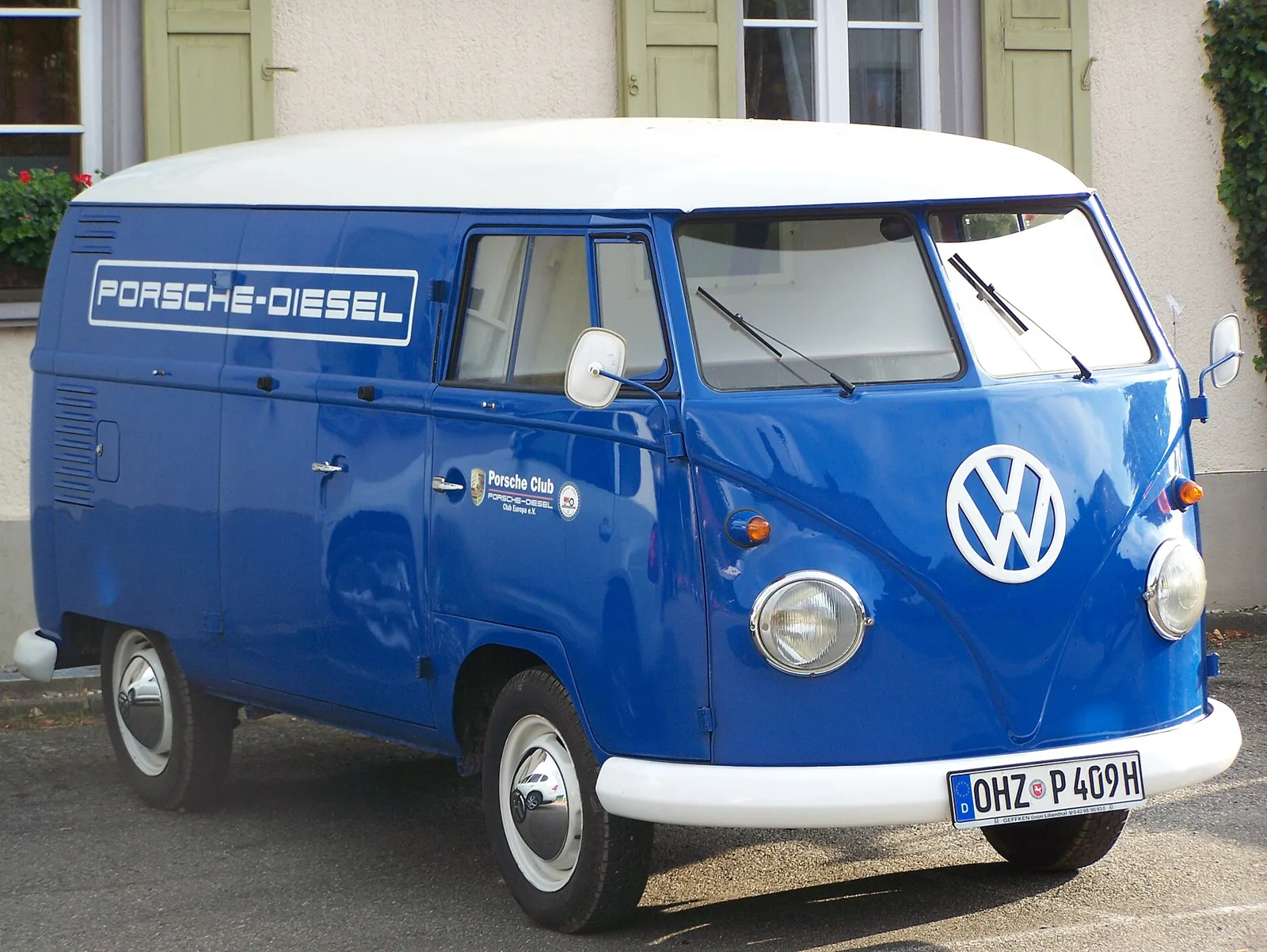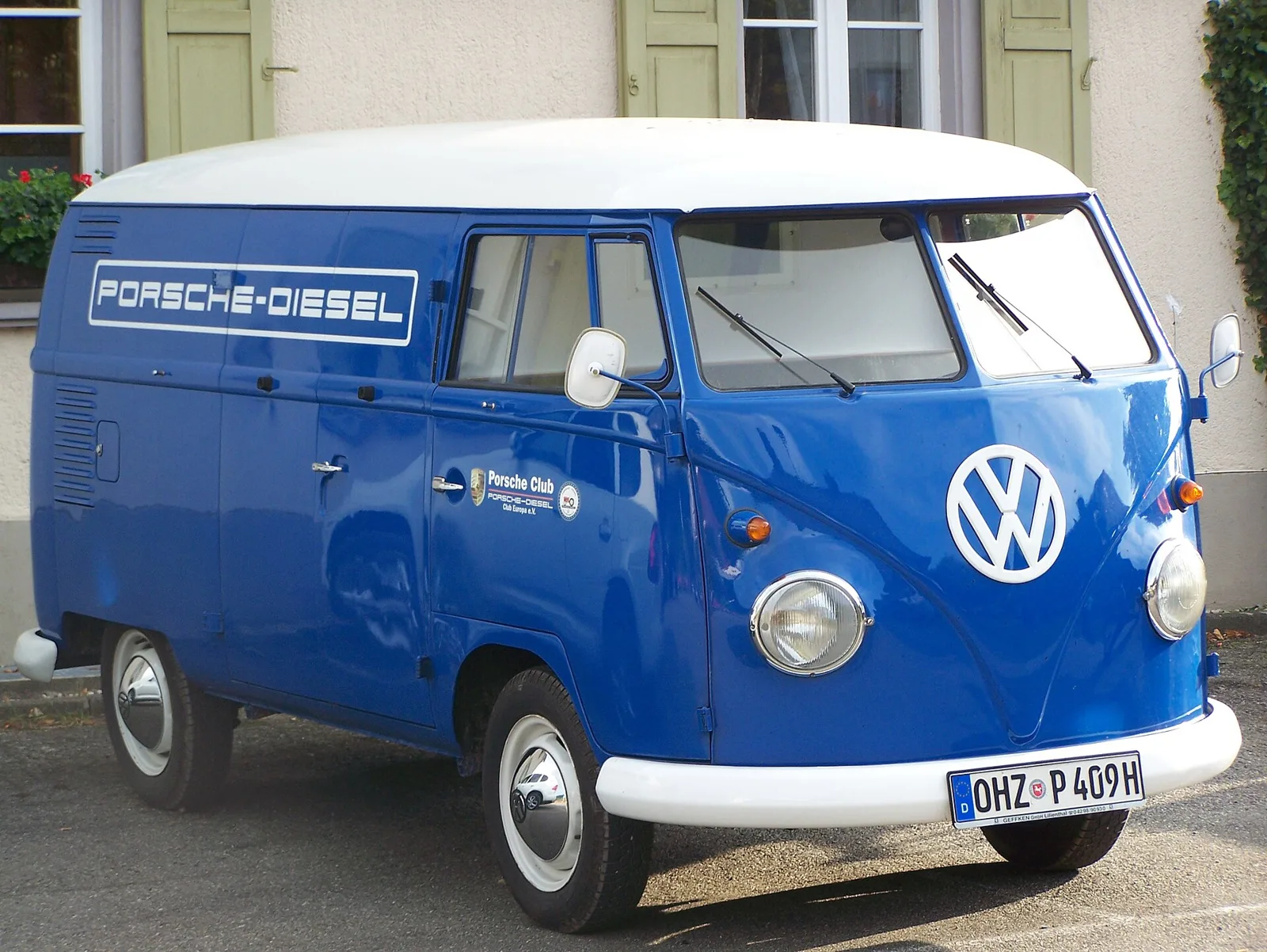
How a Dutch importer's sketch became the rear-engined Type 2, why the T1, T2 and T3 differ, and how the camper took on a life of its own.
The Volkswagen Type 2 grew from Dutch importer Ben Pon's 1947 sketch and reached production in 1949 and 1950 as a rear-engined van built on Beetle underpinnings. T1 to T3 kept that layout, the last Brazilian T2 stopped in 2013, and the camper versions became a counterculture symbol.
Ben Pon, a Dutch importer of Volkswagens, drew up a van on 23 April 1947 in a quick sketch. It proposed carrying 690 kg (1,520 lb) with the driver sitting right at the front, and that single page is now on display in the Rijksmuseum. From it grew a vehicle that stayed in production in Brazil until 31 December 2013, the point at which the era of the rear-engined Volkswagen ended.
VW bus history: how the Type 2 began
Pon went to Wolfsburg in 1946 hoping to buy Beetles for the Netherlands. There he spotted a Plattenwagen, an improvised parts-mover built on a Type 1 chassis, and realised that something better could be made from the same underpinnings. The concept resembles two earlier ideas that never reached production, the Rumpler Tropfenwagen of the 1920s and Buckminster Fuller's Dymaxion car of the 1930s. But the factory was working at full capacity on the Beetle, so the van had to wait.
When space freed up, engineers turned out an early prototype, the Type 29 inside the factory, in just three months. The stock Type 1 floorpan proved too weak, so they used a ladder chassis with a unit body, and by coincidence the wheelbase matched the Beetle's. A reduction gear borrowed from the Type 82 let a 25 hp (19 kW) flat-four move a 1.5-ton van.
The early shape was draggy, with a drag coefficient of 0.75. The team took it to the Technical University of Braunschweig's wind tunnel, and small tweaks, among them a vee-shaped split in the windshield and roofline, brought it down to 0.44, better than the Beetle's 0.48. Heinz Nordhoff, who became Volkswagen's chief executive on 1 January 1948, approved it for production on 19 May 1949; the first series model appeared on 12 November.
Splitting the windshield and roofline into a vee took the van's drag coefficient from 0.75 to 0.44, better than the Beetle's 0.48.
Early Type 2 models, from Kombi to ambulance
Only two models launched: the Kombi, with a pair of side windows and removable middle and rear seats that a single person could lift out, and the Commercial. The Microbus joined in May 1950 and the Deluxe Microbus in June 1951. In the first year 9,541 left the line, followed by 11,805 in the 1951 model year. An ambulance version came in December 1951, with the fuel tank moved in front of the transaxle, the spare wheel behind the front seat and a tailgate-style rear door, and those features became standard on every Type 2 from 1955 to 1967. A single-cab pickup followed in August 1952.
The Type 2 was one of the first forward-control vans, with the driver above the front wheels, alongside the 1939 Citroen TUB and the 1947 Citroen H Van. Being rear-engined was both an advantage and a nuisance. Traction and interior noise benefited, but on the early barndoor panel vans the engine cover intruded into the cargo space, making loading from the back awkward. Pickups had a flat bed, at the height of the engine cover.
What is the difference between Transporter, Kombi, Microbus and Bus?
Volkswagen called it the Transporter, Kombi or Microbus depending on body type. In the United States people said Station Wagon or Bus, in Britain Camper and in Germany Bulli. The factory code Type 2 reflected the fact that it followed, and for decades shared its basis with, the Type 1, which most of the world calls the Beetle. The same 2.40 m (94 in) wheelbase served the T1 and T2 and was close to it on the T3.
Body choices went from panel vans, including double-door and high-roof versions, to the Kombi (from Kombinationskraftwagen, a combination motor vehicle) and the more car-like Bus, also called Caravelle, from the third generation. A Samba-Bus with skylight windows and a cloth sunroof, also called the Deluxe Microbus, was offered in the first generation to tourists in the Alps. Brazil had the Lotacao share taxi from 1960 to 1989, with six front-hinged passenger doors. Pickups came as single cab or as a crew cab known as the Doka. Third-party conversions covered refrigerated vans, hearses, police vans and fire engines, and in 1955 30 rail-going draisines called the Klv 20 were built for Deutsche Bundesbahn.
The first generation T1, the Splitscreen
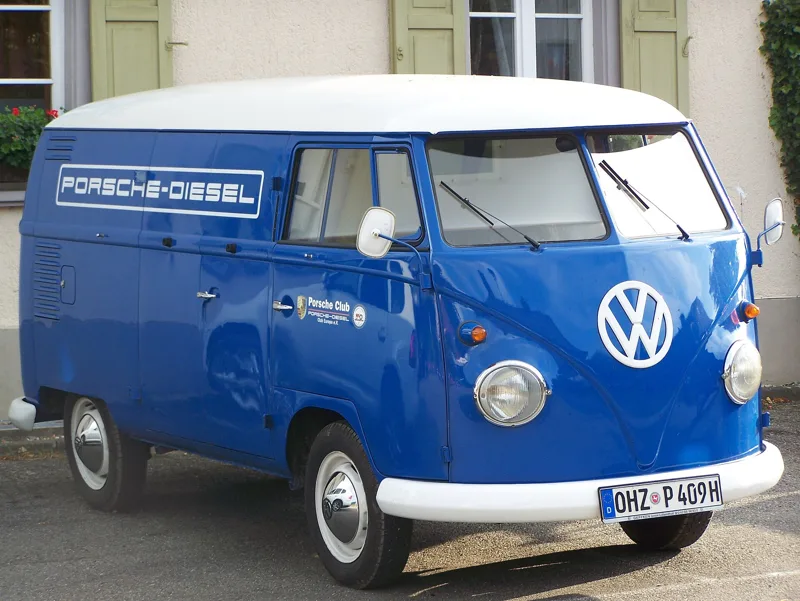
The T1, nicknamed Splitscreen or Splittie, ran from 8 March 1950 to the close of the 1967 model year, built in Wolfsburg until 1956 and then in Hanover. It started with the Beetle's air-cooled 1100 engine, a 1,131 cc flat-four rated at 18.4 kW (25 PS). A 1,192 cc 22.1 kW (30 PS) engine replaced it in 1953, compression rose in 1955, and in 1959 an unusual 25.0 kW (34 PS) version appeared on the Type 2 alone. Cars that still hold that engine are rare, because it was dropped almost at once and no spare parts were made.
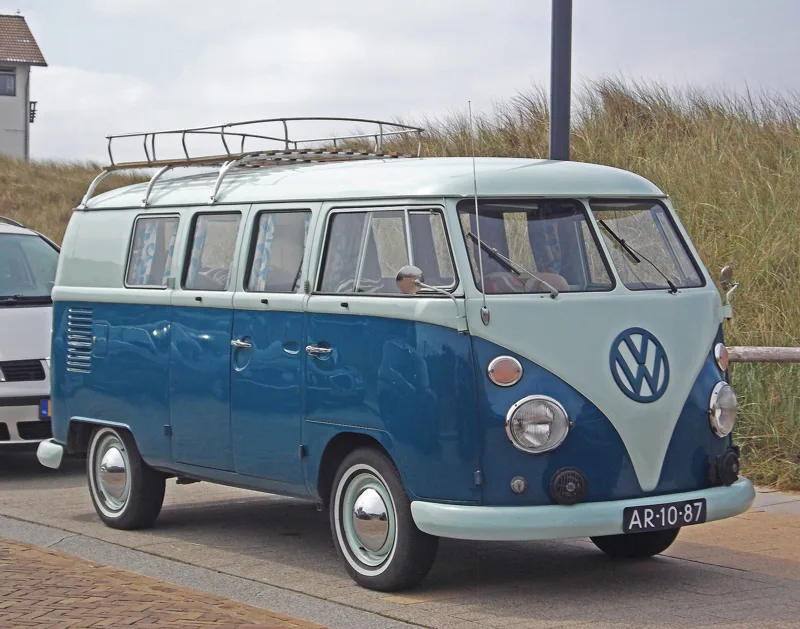
Enthusiasts split the T1 into three. Until 1955 came the Barndoor, now T1a, with its huge engine cover and 16-inch wheels. Later versions, T1b, extended the roofline above the windshield, shrank the engine bay and used 15-inch wheels. From the 1964 model year a wider rear door created the T1c, and a sliding door became optional on passenger and cargo versions.
A heavy-duty Transporter in 1962 raised capacity to 1,000 kg (2,205 lb) from 750 kg (1,653 lb), with 14-inch wheels and a 1.5-litre 30.9 kW (42 PS) engine. It sold so well that the 750 kg 1.2-litre version was dropped a year later. The 1963 model year added the 1,493 cc 1500 engine, standard in the US, at 38 kW (52 PS). German T1 production ended after 1967, though Brazil kept building it until 1975, then added a T2-style nose and big 1972-vintage taillights to make the T1.5, which lasted until 1996.
The bay-window T2 and its long Brazilian life
In 1968 every Type 2 was heavily revised to create the second generation, called the bay window. It kept the wider rear door of the late T1. In Brazil the T2 stayed in production in Sao Paulo until the end of 2013. Over 3 million vans were made there. In 2005 the Brazilian vans switched to water-cooled inline-four engines and a front radiator. The factory closed the line on 31 December 2013 because of stricter safety rules, and with South Africa's T3 having ended in 2002 that closed the book on rear-engined Volkswagens, an era that began with the Type 1 prototypes of 1935.
The VW T3 Vanagon, the last rear-engined bus
Volkswagen dated the third generation's all-new, more square and boxy body to 1979, though Hannover production is recorded from 1978. Officially the Type 25, it was larger, heavier and more angular than the T2 yet kept the rear-engine, cab-over layout, with rear-wheel drive or the four-wheel-drive Syncro. It was sold as Transporter or Caravelle in Europe and Australia, the UK called it T25, South Africans said Microbus and Kombi, and the Americas knew it as Vanagon. Hannover built it from 1978 to 1991, Syncros were assembled in Graz, Austria until 1992, and South Africa carried on until June 2002.
The low-mounted engine and transaxle gave the T3 nearly equal axle weights, much bigger front disc brakes and drums at the rear. It could be ordered with power steering, air conditioning, power door locks and heated mirrors, which the T2 could not. The automatic gearbox was the 090/010 three-speed also used in contemporary Audis, the manual a four-speed, and a five-speed became available on some models from 1983 and standard on the Syncro. Volkswagen had planned to replace the troubled air-cooled engines with the Golf's inline-four, but the cost of re-engineering both made it update the flat-four rather than that. An overhead-cam layout was mooted but dropped, because low-end flexibility and low cost mattered more than a willingness to rev.
VW T3 engines at a glance
| Engine | Output | Notes |
|---|---|---|
| 1.6 L (1,584 cc) air-cooled | 37 kW (50 bhp) | Single Solex carburettor; not sold in the US |
| 2.0 L (1,970 cc) air-cooled | 52 kW (70 bhp) | Twin carburettors or Bosch L-Jetronic, 1980 to 1983 |
| 1.9 L (1,913 cc) Wasserboxer | 62 kW (83 bhp) | Digijet injection, 1983 to 1985 |
| 2.1 L (2,109 cc) Wasserboxer | 71 kW (95 bhp) | Bosch Digifant, used in the US until 1991 |
| 2.1 L (2,109 cc) Wasserboxer | 84 kW (112 bhp) | Europe only, markets without catalytic converters |
| 1.6 L (1,588 cc) diesel | 37 kW (50 PS) | Naturally aspirated inline-four |
| 1.6 L (1,588 cc) turbodiesel | 51 kW (69 PS) | Arrived January 1985 |
What went wrong with the water-cooled engines?
The water-cooled boxer, the Wasserboxer, arrived mid-year in 1983, with aluminium case, heads and pistons, a forged steel crankshaft and combustion chambers formed in the piston crown. In the United States the 1.9-litre and larger petrol versions suffered repeated cylinder-head surface erosion and coolant leaks. The 2.1-litre engines had the same trouble, mostly because the antifreeze was not renewed often enough and phosphated coolant caused corrosion in the cooling system. The diesels, all inline-fours, used a different layout from the petrol boxers.
Syncro, Westfalia and the other T3 variants
Syncro production began in late 1984 and the model debuted in January 1985 at Brussels' commercial vehicle show. Steyr-Daimler-Puch in Graz added the four-wheel-drive system. The first cars used a 57 kW (78 PS) 1.9-litre Wasserboxer with a 4+G gearbox, G standing for Gelande, the German word for rough ground. Weight distribution was 48/52 front to rear, and while most Syncros rode on 14-inch wheels, a limited run used 16-inch wheels with 205R16 tyres and 280mm front discs.
The Vanagon name, a mix of van and station wagon, reflected Volkswagen's line that the T3 offered van-sized space yet drove like an estate. US versions ran from the plain Vanagon with vinyl seats through the L and GL to Westfalia pop-top campers. The Campmobile came with a propane, 110 V or 12 V refrigerator, a two-burner stove and a stainless steel sink with onboard water, and its rear bench folded into a bed, with a second bed in the pop-top, sleeping four adults. Wolfsburg Edition vans, Weekenders and Multivans filled out the line, Carat trim was offered in 1990 and 1991, and in the 1980s American forces in Germany, Army and Air Force alike, ran T3s for administrative duties. The T3 was replaced in the US by the T4 Eurovan in 1993.
South Africa built its own late versions. January 1991 brought five-cylinder Audi engines to the Microbus and Caravelle and a 1.8-litre inline-four to the Kombi and Van. After 1991 a facelift added bigger side windows, giving the Big Window T3, with a grille and headlight combination found nowhere else. Fans outside South Africa swap square headlights for round ones to get the South African look.
Why did the camper become a symbol?
Camping was part of the Type 2 from early on. Several firms sprang up to produce camper vans built on Transporters, and Westfalia became the best known, with a roof and interior, an optional pop-up top and the nickname Westy. Adventurewagen offered a high-roof camping conversion, and from the third generation a semi-camper called the Multivan or Weekender could still serve as a passenger car. On the T3, Westfalia supplied a high roof that popped up or stayed fixed, with refrigerator, sink and stove.
The wider reputation came from people. Being so popular within the counterculture of the 1960s and 1970s earned the van the names hippie van and hippie bus, alongside microbus and minibus, and it was nicknamed around the world much as the Beetle was.
The competition the Type 2 inspired
The Type 2 was an ancestor of the modern cargo and passenger van, and in the 1960s it prompted forward-control rivals in the United States: Ford's Econoline, Dodge's A100 and the Corvair 95 Corvan from Chevrolet, which adapted the Corvair car's rear-engine layout much as the VW had adapted the Beetle's. Europe produced the Citroen H Van, built from 1947 to 1981, the Renault Estafette from 1959 to 1980, the semi-forward-control Bedford CA from 1952 to 1969 and the Ford Transit from 1953 to 1965. Japan added Nissan's Caravan, Toyota's LiteAce and Subaru's Sambar. Apart from the Greenbrier, various Fiat minivans of the 1950s to 1970s and the Mazda Bongo, the Type 2 stayed unusual in having its engine at the back.
What this means if you are buying or looking at one
Labels such as T1a, T1b and T1c are retrospective, in use only since the 1990s, but they describe genuinely different vans. A 1959 van with its original 25.0 kW (34 PS) engine is rare. On a T3, check the cooling system history, since coolant leaks and head erosion hit the US water-cooled engines. Air-cooled vans, built up to mid-1983, have no lower grille over the radiator, which water-cooled ones carry; factory air conditioning is the exception. Four-wheel drive means a Syncro, built in limited numbers.
Where this goes next
With the fourth generation in 1990 the layout became conventional: a front engine, front-wheel drive and optional four-wheel drive, and Volkswagen simply called it the Transporter. The Type 2 name had ended with its link to the Beetle. In 2017 Volkswagen announced an electric microbus on its new MEB platform, planned for 2022.