Mazda's small van and pickup, sold as the Ford Econovan and Eunos Cargo, with a family of spin-offs that stretched from Kia to the Brawny and Friendee.
Introduced in May 1966, the Bongo was a Mazda van and pickup that also appeared as the Ford Econovan and Eunos Cargo. Its design passed to Kia, which built the Bongo range for years, and the nameplate returned in 2020.
The Mazda Bongo is a cabover van and pickup that Mazda built from 1966. It was also sold as the Ford Econovan and the Eunos Cargo, and its design formed the base of the long-running Kia Bongo range. The nameplate later returned in 2020, so the model has spanned more than half a century.
Where did the Mazda Bongo come from?
The Bongo arrived in May 1966 as a compact Mazda van. Its name comes from the African bongo, a type of antelope, and its engine position changed over the years, moving from rear to middle and front mounting.
The Bongo name also covered the Bongo Friendee, a minivan that did not share the cabover design. Ford sold the van as the Econovan, and Japan's Eunos badge carried it as the Cargo.
Across its generations the Bongo was built with rear-, middle- and front-mounted engines, a spread that reflects how often the layout changed. Kia later built its own Bongo range in South Korea, which kept the basic layout alive for many years.
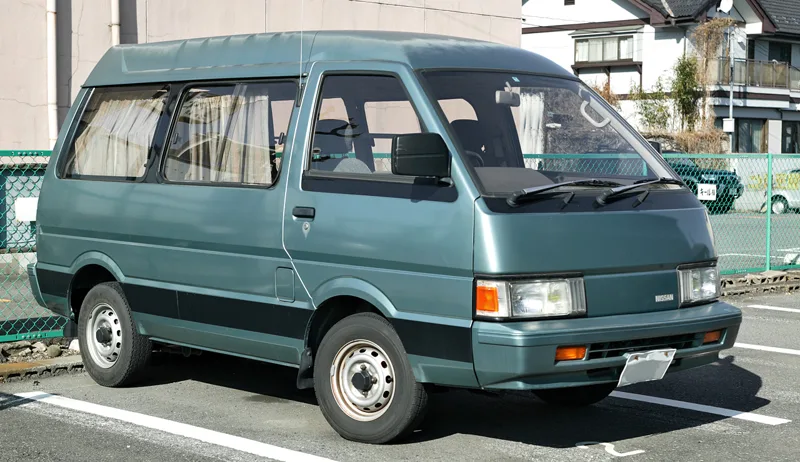
A cabover van that Mazda built for more than half a century, and that Kia, Nissan and Ford each carried under their own badges.
How did the first-generation Bongo work?
The first generation had a rear-mounted water-cooled engine of 782 cc, and a larger F1000 joined the F800 in 1968. The 1000 engine was a 987 cc overhead-valve inline-four rated 48 PS (35 kW) at 5,500 rpm, and the model ran until 1975.
The van measured 3,770 mm (148 in) in length and 1,500 mm (59 in) in width, with a 2,000 mm (79 in) wheelbase and a 1,700 mm (67 in) roof height. Kerb weights ran from 775 kg (1,709 lb) for the cab-over truck to 910 kg (2,006 lb) for the passenger coach, with commercial vans at 885 kg (1,951 lb).
The rear-engined models were strong and, thanks to low gearing, could carry half a ton. Rust and poor maintenance have made them rare today.
The front wheels used double wishbones with coil springs, while the rear wheels ran on trailing arms and coil springs. The 1000 pickup and the cargo and passenger vans all shared that arrangement.
Production ended in 1975 as Mazda faced financial trouble and tougher emissions rules for 1976, which trace back to the 1963 US Clean Air Act. The body kept the same shape for its ten-year production life.
Mazda drew the van's engines from the Familia small car line. The popularity of the Bongo led Mazda to build the Parkway minibus from 1974 to 1997, sharing its platform with the larger Titan truck.
What changed in the second generation?
The second generation appeared in September 1977 as a mid-engined rear-wheel-drive van, sold in Ford's hands as the Econovan. Mazda exported it as the E1300, E1400 and E1600 depending on engine size, and a 2.2-litre diesel arrived in October 1979.
The diesel also appeared in the passenger Bongo Multi Wagon in February 1980. That model had originally come only with a 1.8-litre petrol engine, and it reached Great Britain in 1982 as the E1600 before the next generation replaced it.
UK buyers received only the long-wheelbase panel van, with twinned rear wheels and a five-speed manual.
Kia built the second generation in South Korea as the Kia Bongo and Ceres, and it stayed on sale there as late as 1999 after several facelifts. Until 1981 the first-generation Bongo was Mazda's best seller, when the front-wheel-drive Familia overtook it.
Badge-engineered copies in Australia became the Ford Econovan and Econowagon, while luxury passenger models went out as the Ford Spectron. That Spectron name also came to Japan in 1981.
What engines did the second generation use?
The second-generation engines ranged from a 1,272 cc petrol unit rated 60 PS (44 kW) to a 2,209 cc diesel. Other options included a 1,586 cc petrol engine, a 1,769 cc unit and a 1,415 cc engine, with output rising to 95 PS (70 kW) on the largest petrol version.
In Japan the petrol engines carried JIS power ratings, and the 1,415 cc unit arrived in October 1979 in 70 PS (51 kW) and 76 PS (56 kW) forms. The diesel was offered only in commercial versions at first.
Engines were grouped by market and by commercial or passenger use, so a single van could appear with several different outputs across its life.
How did the third generation sell in export markets?
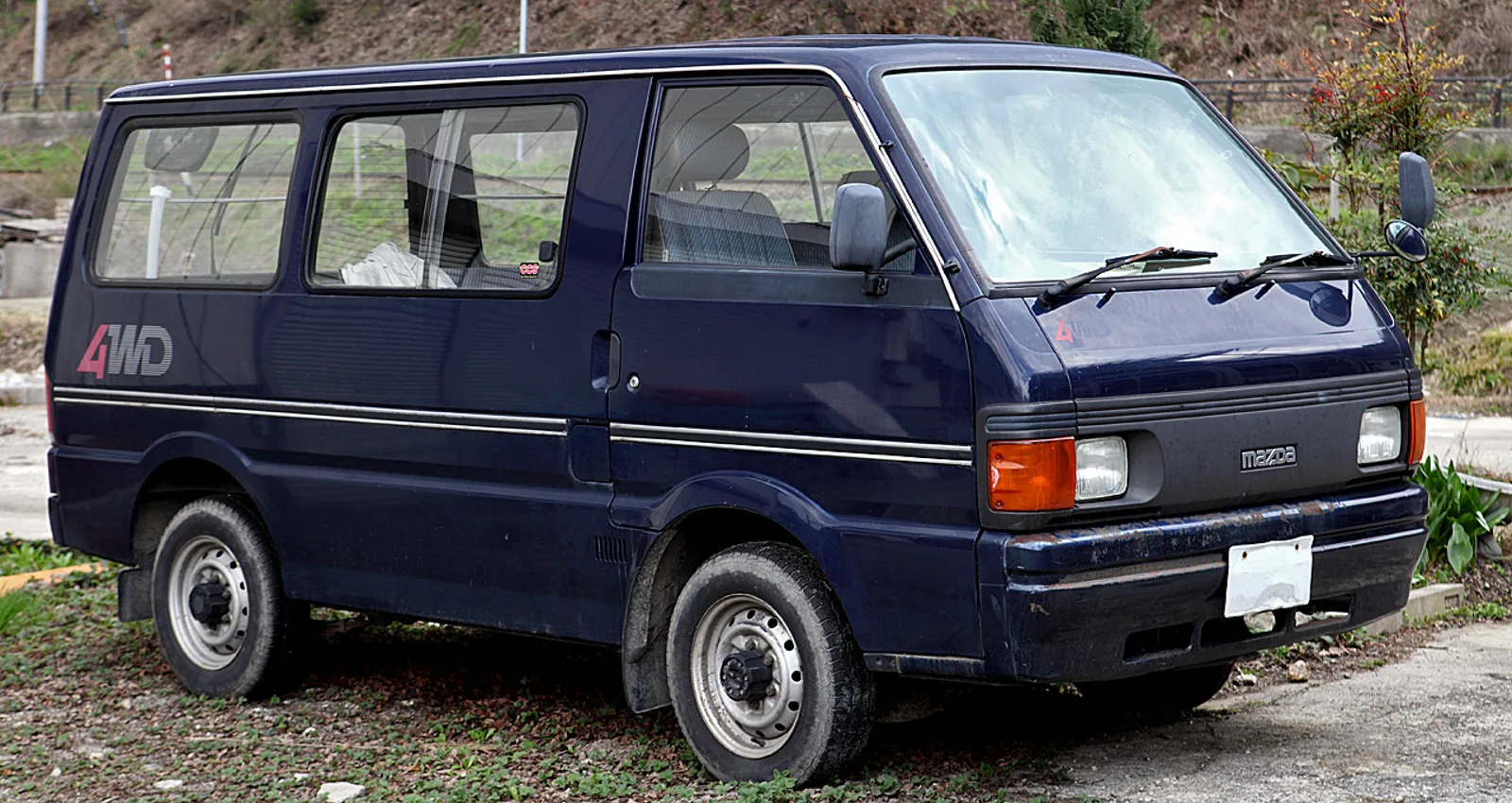
The third generation arrived in September 1983 with new engines, and a redesign in November 1986 brought lower, wider headlamps. Mazda's Australian range used the E-series name for the Bongo, while Ford sold it as the Econovan and Spectron.
In Japan the 1.8-litre petrol gave way to a 2-litre unit, and a diesel 4WD version was added. A mid-height roof was offered on the 2WD models only.
Ford sold the Bongo in Asia as the Spectron for passenger use and as the J80 for cargo. In South Africa it was sold as the Ford Spectron, and South Korea built it as the Kia Wide Bongo.
From 1994 Nissan also sold the Bongo as the Vanette.
How were Australian Econovans specified?
In Australia the Econovan came in several lengths. Buyers could choose a steel-sided van or a windowed passenger version with three or six seats, depending on the model. The entry-level model measured 4 metres (13.1 ft) with a 1.8-litre petrol engine, while the 4.4-metre Maxi offered a high roof and a 2.0-litre petrol engine. A 4.7-metre Maxi came with four-wheel drive from 1986.
Twin rear wheels could be specified on the 2.0-litre petrol or the 2.2-litre diesel Maxi, in steel-sided form with a five-speed gearbox. The 4.7-metre long model could also be fitted with four-wheel drive, a manual gearbox and the 2.0-litre engine in windowed form.
Payloads reached 1.5 tonnes (3,300 lb) on a two-door cab chassis, while a four-door Crew Cab carried 1.4 tonnes (3,100 lb). The Crew Cab seated six.
Ford reworked the Australian Econovan for unleaded petrol in December 1985. The 4.0-metre van's engine grew from 1.4 to 1.8 litres, while the 4.4-metre Maxi went from 1.8 to 2.0 litres.
The 4.7-metre (15.4 ft) Maxi van had earlier been sold only with dual rear wheels, and from then on single rear wheels were also offered on it. Crew cab and cab chassis models kept dual rear wheels.
What was the fourth generation?
The fourth generation went on sale in June 1999 on the SK platform, rebadged across Mazda, Ford, Mitsubishi and Nissan. Engines included a 1.8-litre petrol unit producing 90 PS (66 kW) and a 2.2-litre diesel with 79 PS (58 kW). Mazda announced in March 2012 that this was its last in-house design.
Tight finances meant Mazda could not fund a wholly new platform, so the SK base came from the earlier SS and SE models.
On August 20, 2010, an upgraded Bongo truck and van went on sale in Japan. February 2016 brought a new engine tune, four-wheel ABS and keyless entry for all models, while the dual-rear-wheel truck was dropped.
Later changes included common-rail diesel engines from December 2003, DPF filters from August 2007 and a 1.8-litre L8 petrol engine from August 2010.
Production of the 2WD petrol models stopped in May 2009, when Nissan's own NV200 Vanette was taking the market. The Mitsubishi-sourced Delica Cargo was rebadged and sold in Japan only from November 1999.
The Vanette nameplate passed to the Nissan NV200 in an OEM deal in October 2011. Mazda discontinued the Bongo in 2020, and a fifth generation based on the Daihatsu Gran Max returned in July 2020.
How did the Bongo Brawny and Friendee differ?
The Bongo Brawny was a wider, larger Bongo, first sold in June 1983 and enlarged in 1999 on the SK platform. The Bongo Friendee was a separate eight-seat minivan from June 1995, sold in Japan as the Ford Freda.
The first Brawny arrived in June 1983, three months ahead of the standard Bongo. The second generation came with 2400 mm and 2600 mm wheelbases and kept the sliding side doors. The first-generation Brawny, introduced in June 1983, carried the Econovan Maxi identifier in Australia for its long-wheelbase versions.
The Friendee came in 2WD and 4WD form and was usually fitted with an automatic. The 2.5-litre turbo-diesel was the common choice in Japan, although a 2.5-litre V6 petrol was also available.
Some Friendees left Mazda with factory-fitted kitchens. Many were imported to the UK and converted into camper vans. Fold-down seats made a double bed, and some models had an elevating roof for two more sleepers.
A facelift in February 1999 revised the front fascia and tail-lights and changed the engines, although the 2.5 turbo-diesel was unchanged.
The second-generation Brawny kept many parts of its predecessor, including the sliding side doors, and it looked much like the model it replaced. Export versions continued to use the E-series label, though far fewer were sold than before. The Brawny was discontinued in August 2010.
The Bongo Brawny name returned in April 2019 in Japan as a badge-engineered fifth-generation Toyota HiAce, offered in DX and GL grades. This time the vehicle was aimed at commercial work rather than passenger use.
What are the Mazda Bongo specifications?
| Specification | Detail |
|---|---|
| Type | Cabover van and pickup, Mazda built from 1966 |
| First generation engine | 782 cc rear-mounted water-cooled OHV; later 987 cc at 48 PS (35 kW) |
| First generation size | 3,770 mm (148 in) long, 2,000 mm (79 in) wheelbase |
| First generation payload | About half a ton |
| Second generation | September 1977, mid-engined rear-wheel drive |
| Second generation diesel | 2.2-litre from October 1979 |
| Third generation | September 1983, redesigned November 1986 |
| Australian Econovan | 4 metres (13.1 ft) with 1.8-litre petrol; 4.4-metre Maxi with 2.0-litre petrol |
| Australian payloads | 1.5 tonnes (3,300 lb) cab chassis; 1.4 tonnes (3,100 lb) Crew Cab |
| Fourth generation | June 1999, SK platform |
| Fourth generation engines | 1.8-litre petrol 90 PS (66 kW); 2.2-litre diesel 79 PS (58 kW) |
| Brawny wheelbases | 2400 mm and 2600 mm |
| Friendee | Eight-seat minivan with 2.5-litre turbo-diesel |
| Revival | July 2020, Daihatsu Gran Max basis |