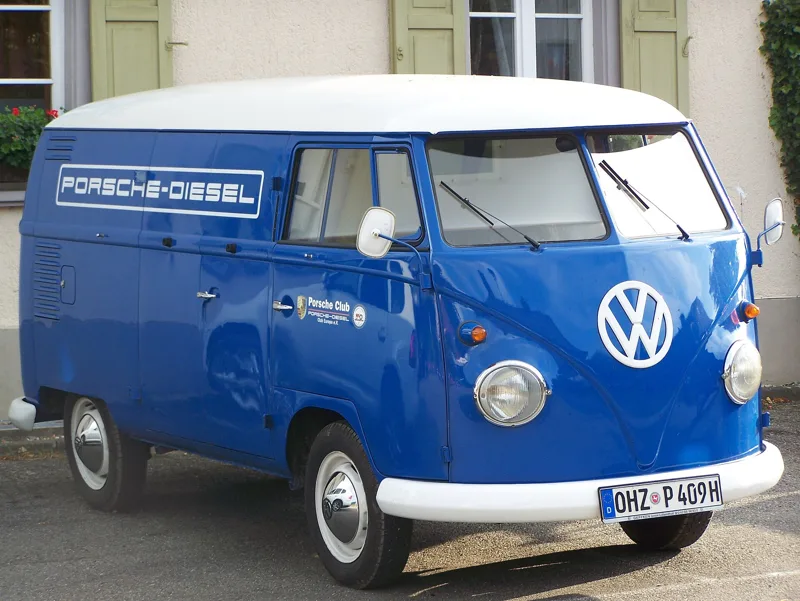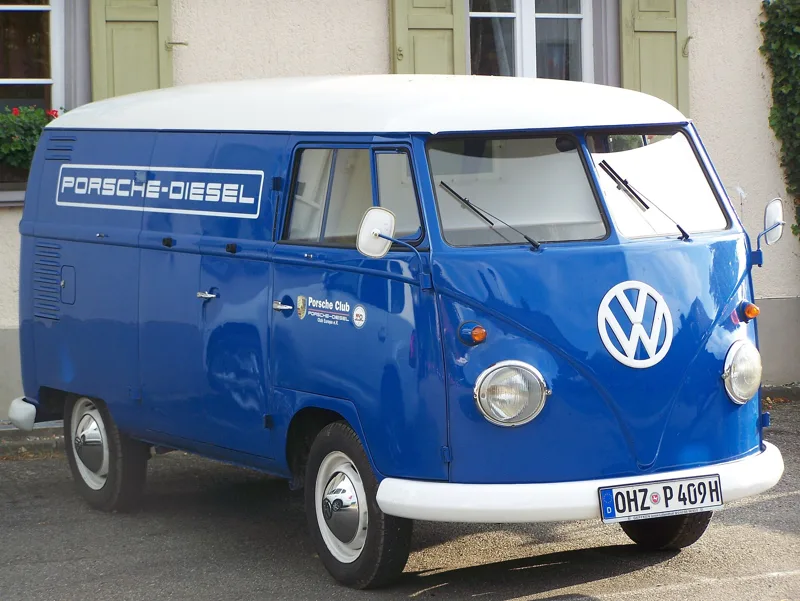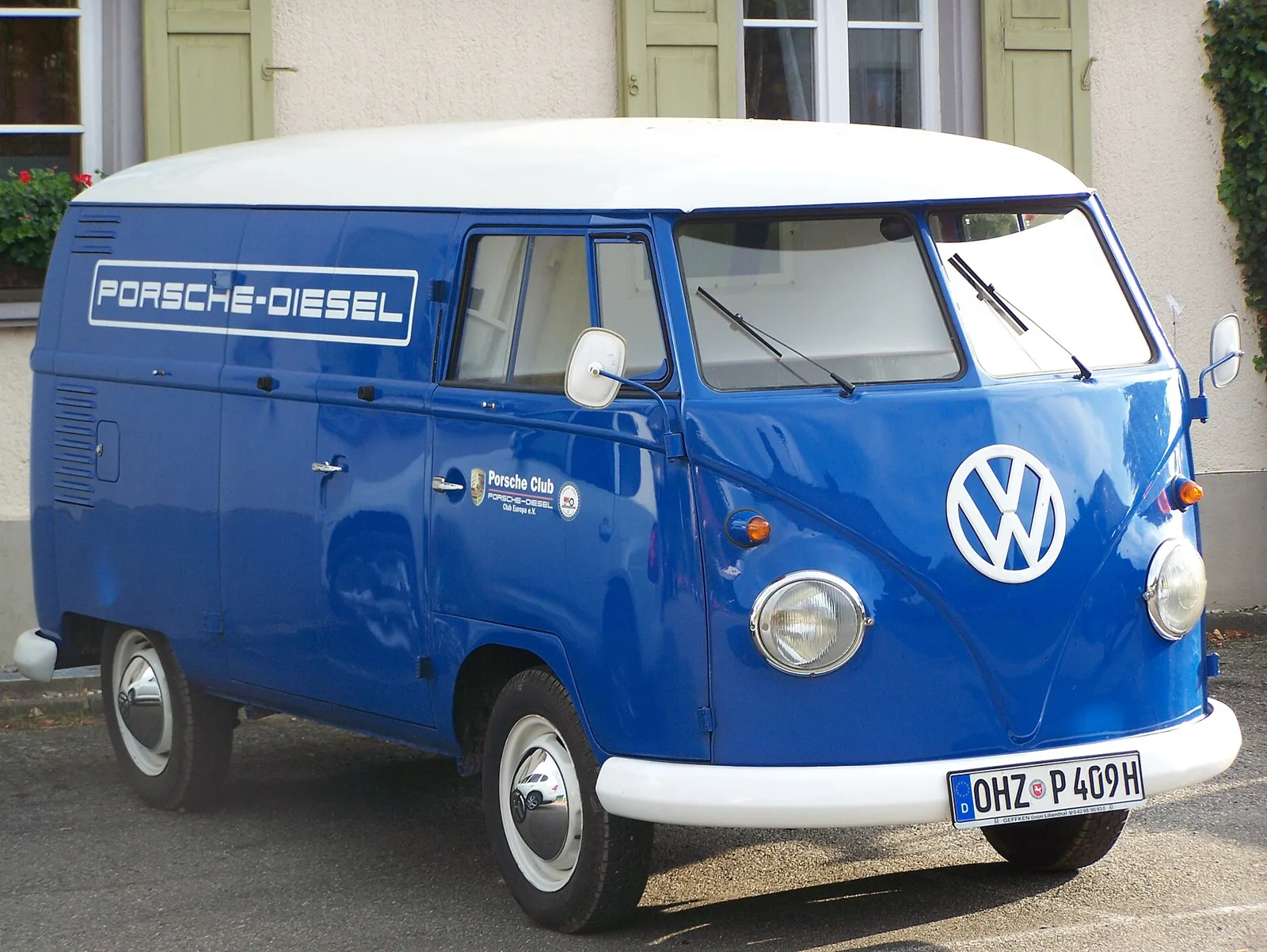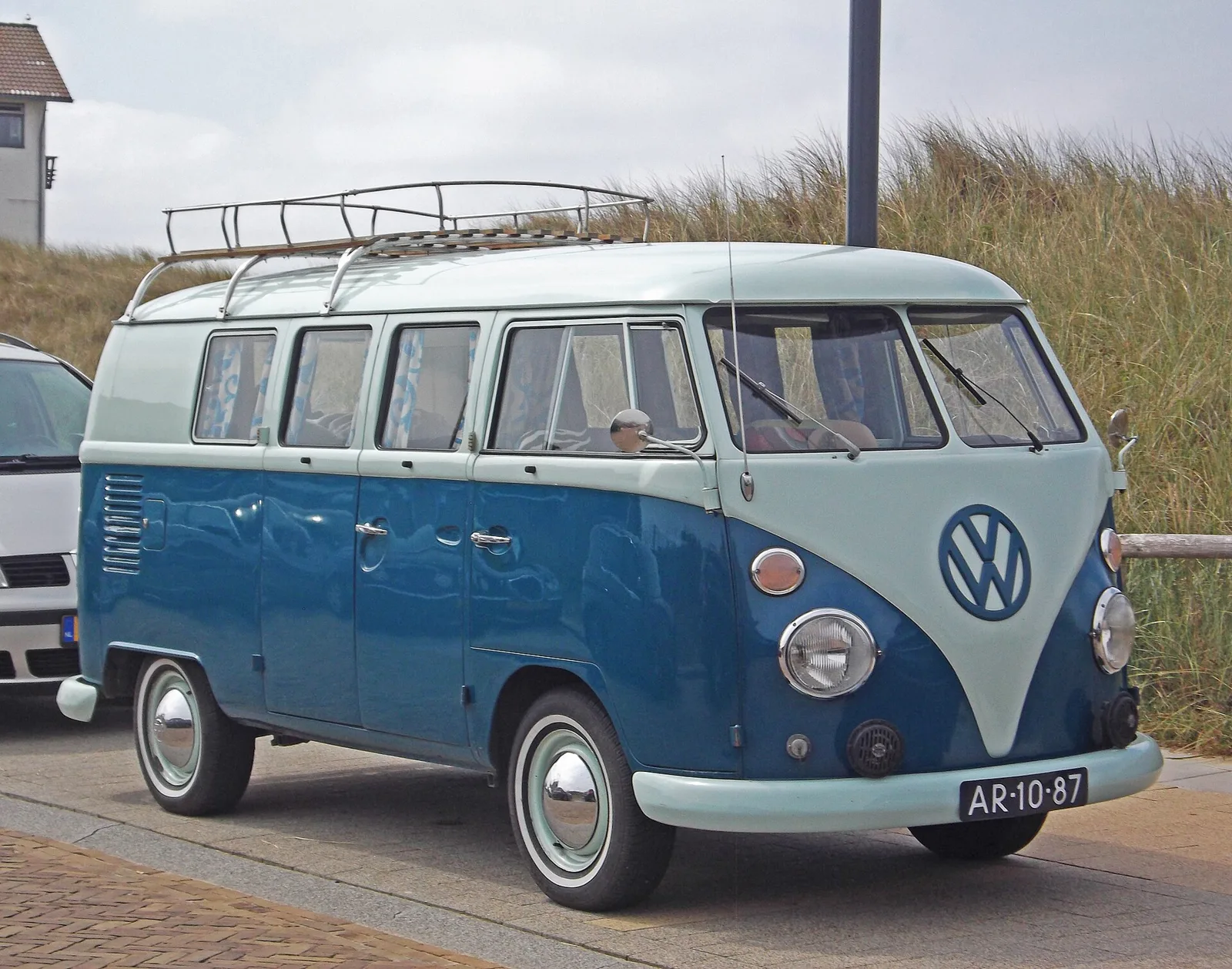
The first VW Transporter, developed from 1949 with its engine at the rear, split windscreen and a production run that ended in Germany in 1967.
The VW T1 was the first VW Transporter, a small commercial van built in Wolfsburg from March 1950 and in Hannover from 1956. It had a rear-mounted boxer engine of 1,131 cc (69.0 cu in) and a split windscreen, and 1.8 million units were made before German production ended in July 1967.
The VW T1, also called the Bulli, was the first model of the VW Bus series and a small van from Volkswagenwerk. It was developed from 1949, went into series production in March 1950 and became a symbol of the German economic miracle, as the market leader of its time.
Where did the VW T1 come from?
The T1 grew out of a 1947 proposal by Ben Pon, who wanted a commercial van built on Beetle parts for the Dutch market. Dutch authorities refused an operating permit for a van whose driver sat behind the load, so Pon's sketch showed an enclosed van with the driver up front.
The Wolfsburg works was under British control and short of transport. Major Ivan Hirst borrowed vans and forklift trucks from the British army, and when the army needed them elsewhere they were no longer available to the works. To ease the bottleneck, a flatbed truck was built from parts of the VW Type 82 'Kuebelwagen'.
Pon met Colonel Charles Radclyffe of the military administration's Trade and Industry Division in Minden on 23 April 1947. The sketch he drew there, for an enclosed van with a 750 kg payload and the engine under the load floor at the rear, is now held at the Rijksmuseum.
Radclyffe told Hirst that the lack of production capacity ruled out a van based on the Beetle. Hirst saw a market for small vans in Germany and held out to Pon the prospect of a further development once Wolfsburg improved.
Heinrich Nordhoff became general director in early January 1948. In autumn 1948 he commissioned development chief Alfred Haesner to build a prototype based on Pon's concept, and Nordhoff chose the curved-front design over the flat one.
A rear-engined van that grew out of a postwar works flatbed and became a symbol of the economic miracle.
What did the first wind tunnel tests show?
Early wind tunnel tests gave the scale model of the van a cw value of 0.75. A more streamlined design reached 0.45, a little below the Beetle's 0.48, and fuel use at 70 km/h could be cut by 2 l/100 km.
The first prototype was ready for operation on 11 March 1949. Tests run only at night showed after a month that the Beetle's chassis was not suited to the higher load, and the setback left the engineers baffled at first.
Nordhoff nevertheless insisted on starting production at the end of 1949. The second prototype had a new floor with two longitudinal members instead of a central tube, and Porsche KG, which was commissioned with the further development, changed the gearing. That gave better acceleration but limited the top speed to 80 km/h (50 mph).
Besides the box van, of which six prototypes were built, a bus with windows for passengers was also developed. A partition was planned between the driver and the rear seats. When production moved to machines, the roofs proved the most problematic part.
Journalists saw the new van on 12 November 1949, running a week behind schedule after 51 weeks of development.
Specifications at a glance
| Specification | Detail |
|---|---|
| Length, first series | 4,150 mm (163.4 in) |
| Width, first series | 1,660 mm (65.4 in) |
| Height, first series | 1,900 mm (74.8 in) |
| Wheelbase | 2,400 mm (94.5 in) |
| Kerb weight | 975 kg (2,150 lb) |
| Payload | 750 kg (1,653 lb) |
| Engine, first series | 1,131 cc (69.0 cu in), 25 PS (18 kW; 25 hp) |
| Engine, from 1954 | 1,192 cc (72.8 cu in), 30 PS (22 kW; 30 hp) |
| Engine, from 1960 | 1,200 cc (73.2 cu in), 34 PS (25 kW; 34 hp) |
| Engine, from 1963 | 1,500 cc (91.5 cu in), 42 PS (31 kW; 41 hp) |
| Top speed after the gearing change | 80 km/h (50 mph) |
| Type 2 price, 1950 | DM 5,850 |
How was the first T1 engineered?
The rear-mounted Beetle boxer engine, with 1,131 cc and 25 PS (18 kW; 25 hp), meant the van had no continuous loading floor. The front axle was a double crank-arm design with two torsion bars stacked one above the other, and the rear was a swing axle with reduction gears.
Worm-and-roller steering, as on the VW Type 82, completed the front end. The Beetle's gearbox was adopted, but with a changed second-gear ratio.
The reduction gears meant the differential had to be mounted as a mirror image. As a result the drive shafts in the swing-axle tubes turned the opposite way to those of the Beetle.
Hydraulic drum brakes were fitted to the first series, and duplex brakes at the front followed in 1955.
How did the T1 change through the 1950s and 1960s?
Synchromesh arrived on second to fourth gears in 1953, and the following year a 1,192 cc engine with 30 PS (22 kW; 30 hp) followed. By 1960 the 1,200 cc engine produced 34 PS (25 kW; 34 hp), and the gearbox was fully synchronised.
From March 1955 fresh air was fed into the interior above the windscreens, and the spare wheel moved from the engine bay behind the driver's seat. The bumpers were changed in the 1959 model year.
Indicators became compulsory by law in 1960, so the flashers built into the B-pillar were dropped. Conical indicators sat above the headlights until Volkswagen replaced them with oval units, while the rear lights passed through several designs.
The heating changed in 1962 after an official requirement. Air from the engine cooling fan was now warmed by finned heat exchangers on the exhaust pipes, instead of the cooling air that the cylinders had heated directly and that could carry oil and petrol vapours.
In 1963 the 1,500 cc engine with 42 PS (31 kW; 41 hp) arrived, first for the flatbed truck. The 34 PS engine was dropped from the van in 1964, and in 1965 the 42 PS engine was raised to 44 PS (32 kW; 43 hp) with a different carburettor. The final model year, 1967, brought a 12-volt electrical system.
What were the main T1 body variants?
The T1 came as a panel van, an estate and a minibus. There were high-roof vans, flatbed trucks and ambulance, police, fire and hearse versions, and the Samba, an eight-seat special model, stood out among them.
The enclosed panel van came with a flat or high roof. The estate had three side windows behind the cab, and the minibus seated seven to nine people, with the rear benches removable for carrying loads.
Flatbed trucks arrived in 1952 with a three-seat cab. A double cab with six seats, called the Doka, followed in 1959, and it had a second door on the passenger side for access to the rear bench.
Right-hand-drive versions were built for several export countries. VW also produced variants with other combinations of the presented body features for other markets, and made them to order.
What made the Samba special?
The Samba, officially the Type 24S and later the Type 24G, was an eight-seat special model shown at the first post-war IAA in April 1951 in Frankfurt. Chrome wheel trims, a polished VW emblem on the nose and a fold-back sliding roof were its visible extras.
Its paint was three-coloured until the end of 1951 and then two-coloured or, more rarely, single-coloured, with chrome strips separating the areas. Despite many publications to the contrary, a radio was not standard equipment in the Samba.
The Samba had 23 windows, a dashboard the full width of the vehicle and a rear window larger than on other T1s. The two rear corner windows and the eight roof windows were first made of 4 mm thick Plexiglas.
The Samba was offered until the 1967 model change, and no direct equivalent came with the T2. Output was 269 units in the first year and 6,241 in 1959, while VW built 18,790 in the last year.
Its price in 1955 was DM 8,475, which corresponds to a purchasing power of about 26,500 euros.
How did Westfalia and Brazil extend the T1?
Westfalia offered a camping box from 1950 and a permanent camper conversion from 1961, with a rear bench that folded into sleeping places. In Brazil, VW do Brasil built the T1 from 1953 using imported parts, and local estate and bus versions ran from 1957 to 1975.
The camping box held a gas cooker, room for two gas bottles and a folding table, and it was designed to be removable. That let the bus serve both as a work vehicle and as a leisure vehicle.
On the camper buses the rear bench folded down into two beds, and the fitting also brought a water tank and several cupboards. Two sleeping places for children ran lengthways in the cab, and a two-burner cooker, a cool box and a mobile chemical toilet were available for an extra charge.
Brazil also built a mixture of the T1 and the T2 until 1997. It combined the lengthened T2 front with a one-piece curved windscreen and the T1 rear, and a water-cooled diesel engine was offered from 1982 to 1984.
Where does the Bulli name come from?
The contemporary name was Kombi, which is still used in Brazil. The name Bulli has only come into use for the classic more recently, and its first use is not clearly documented. One account says it joins the first two letters of 'Bus' and 'Lieferwagen', the German word for delivery van.
Another account links the name to the adjective 'bullig', meaning burly, which staff are said to have used while the T1 was being developed.
Until 2007 VW stayed away from the name, since Kaessbohrer Gelaendefahrzeug AG held the rights to it. When the series turned 60, the rights holder Kaessbohrer sold the name to VW.
In the English-speaking world the first generation became known as the Splittie, because of its split windscreen. 'Bully' there means tyrant and carries negative connotations, and 'bullying' means mobbing.
How many T1s were built, and where?
The 100,000th T1 was built on 9 October 1954 at the Wolfsburg works, and the millionth example came off the Hannover line on 2 October 1962. In total 1.8 million units were produced before the T1 was replaced in July 1967.
Shipments abroad started in 1950, going to other European countries, South America and the United States. US imports rose from two cars in 1950 to 3,198 vans in 1955.
The export share was almost 20 per cent in 1950. Of a total of 8,041 vehicles, 1,579 went abroad.
Production moved to the new Volkswagenwerk Hannover in 1956, and the Wolfsburg line was no longer the only place T1s were built.
What did a T1 cost at launch?
The Type 2 cost DM 5,850 in 1950, which was DM 150 more than a fully equipped Beetle. In inflation-adjusted terms that corresponds to about 20,100 euros.
The roomier Tempo Matador, a front-wheel-drive van offered at about the same time, cost DM 7,100.
By 1955 the panel van cost DM 5,925, the estate DM 6,600 and the flatbed DM 5,725. The van was the market leader during its production run.
What rail trolleys used the T1 body?
In 1955 the Deutsche Bundesbahn received 30 Klv 20 rail trolleys with VW Transporter bodies, built by Beilhack and by WMD. Those trolleys were the railway version of the T1 body.
The seven-seat trolleys kept a rigid front axle with no steering, and their wheels carried flanges. A hydraulic lift, fitted centrally beneath each one, could raise the vehicle so that it could be turned or taken off the rails.
Its operating mass climbed to 1,500 kg (3,307 lb), and the top speed allowed was 70 km/h (43 mph). The trolleys remained in use until the mid-1970s.