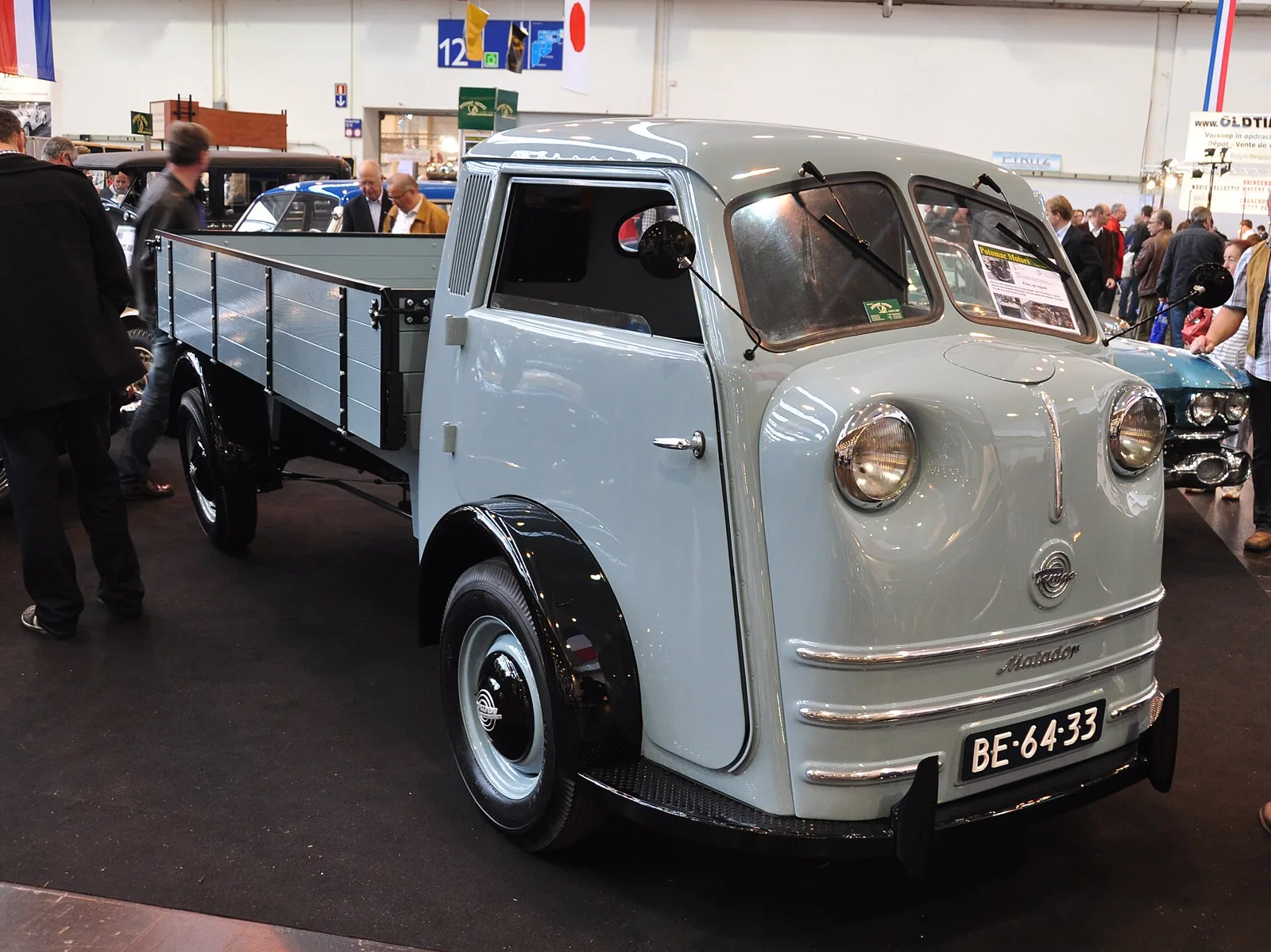
A small German van built on Volkswagen mechanicals, a troubled early 1950s run of engines and a later life under Hanomag and Mercedes-Benz badges.
Designed by Dietrich Bergst, the Tempo Matador was a small van built on Volkswagen Beetle mechanics. Sold under Tempo, Hanomag and Mercedes-Benz badges, it ran from 1949 to 1978 and was built in larger numbers as the Matador E in the 1960s.
The Tempo Matador was a small commercial vehicle series, designed by the engineer Dietrich Bergst, that was sold under the Tempo-Werke name until 1966, then under Hanomag and Hanomag-Henschel badges until 1970, and finally as a Mercedes-Benz from 1970 to 1978. It began life with a Volkswagen Beetle package.
The Matador's story runs through the post-war German motor industry, from a port firefighting company in Hamburg to a licence deal in India that lasted decades. The vehicle's history is a catalogue of teething troubles, rescue engines and recall campaigns, followed by a long run of vans that kept the name alive.
Where did the Tempo Matador come from?
The Matador came out of the Vidal family's search for new work after the German economy was crushed by war reparations in 1927. The company Vidal und Son had been set up in Hamburg in 1883, offering firefighting for the port trade, much of it tied to coal. By 1927 coal imports had dropped to a very low level.
Max Vidal and his son Oskar chose to test their fortunes in motor vehicles. Their aim was a plain work vehicle, close to the Blitzkarren, a popular cart that Carl Borgward had launched in 1924.
The outcome was the Tempo T1, a tricycle whose tipping body sat at the front, with a single-cylinder two-stroke of 198 cc (12.1 cu in) underneath. A larger model, the T2, carried a 400 cc (24.4 cu in) engine. The Tempo-Werke company dates from 1924, and the T1 was its first tricycle.
The timing suited them. In 1928 Germany legislated that vehicles with fewer than four wheels and an engine under 200 cc needed no driving licence and paid no tax. That provision greatly increased demand for this type of vehicle in Germany.
A van that Tempo had to recall twice in the early 1950s, first for its Volkswagen gearbox and then for its engine.
Why did the Matador start with a Volkswagen heart?
The Matador was developed by Dietrich Bergst, chief designer at Tempo-Werke, and it used the mechanical package of the Volkswagen Beetle. The engine was an air-cooled flat-four of 1,131 cc (69.0 cu in) producing 25 PS (18 kW; 25 hp) at 3,000 rpm, dating from 1937.
The engine sat behind the front axle, which made it easy to develop various bodywork variants. The Volkswagen transmission drove the front wheels, and VW delivered those core mechanical parts itself, as set out in a contract between the two firms.
Series production began on 23 February 1949, after pre-series vehicles had been delivered to dealers as demonstration vehicles. The first returns allowed the last details to be settled before the production run started.
The Matador enjoyed some success thanks to the different variants the factory offered, including flatbed, sheet-metal van and bare chassis versions. The Volkswagen gearbox was weak, and the differential frequently gave way under load. It was not until late 1950 that Tempo fixed this with a stronger differential.
To restore the vehicle's poor reputation, Tempo replaced the unsynchronised and very fragile gearbox with a new ZF model from September 1951. It then launched a recall campaign to swap the Volkswagen gearbox for the ZF on every vehicle in circulation.
Volkswagen was not happy with the competition. The company's own T1 "Bulli" had a payload of 800 kg (1,764 lb), against the Matador's 1,000 kg, and the Matador offered better use of space. From 1952 Volkswagen stopped supplying its engines to Tempo, and the last Volkswagen-engined Matador was produced in October 1952.
What went wrong with the Matador 1000 and 1400?
The Matador 1000/1400 was presented in haste in May 1952 with a new JLO engine, and it was a debacle for Tempo. The main cause was the disastrous JLO three-cylinder, which was too poor in quality to be reliable.
A rule change from 1 April 1952 also forced a redesign. The fuel tank was no longer allowed under the front bonnet and had to go at the rear, which called for a fuel pump. Tempo then had to replace the JLO with a Heinkel engine, built under licence from SAAB, a two-stroke three-cylinder of 672 cc (41.0 cu in).
A second recall campaign followed, in which every Matador delivered was offered an engine exchange. Other major problems were not resolved.
The Matador 1400 was the real heir to the Volkswagen-engined Matador 50. Its chassis was barely altered, but it had wider rims (5Jx16), which allowed approval with a higher payload and a gross weight of up to 2.8 tonnes.
From September 1952 the Matador 1400 was offered with a Heinkel four-stroke: a water-cooled unit with four cylinders and 34 PS (25 kW; 34 hp). That was 9 PS more than the former Volkswagen engine, and it was more economical and more robust than the JLO two-stroke.
The Matador 1400 was produced in a final special series for the federal border guards in early 1956, and production stopped after only 5,724 examples had been built in a little over three years. By 1955 sales had fallen to just 503 Matador 1000s and 1,041 Matador 1400s.
How did the Wiking and the Matador 56 change the range?
The Tempo Wiking was meant to succeed the three-wheeled Tempo Hanseat, whose sales had fallen sharply. Three-wheelers looked outdated, even laughable, during the German economic boom. The Wiking was cheap and sat below the Matador in the range, which let it be sold for less.
To keep the price down, the tubular chassis, taken from the Matador, was stripped back and had no shock absorbers, and the cheapest gearbox was used. The Wiking's engine was a two-stroke with 448 cc (27.3 cu in) delivering 17 PS (12.5 kW; 17 hp), a clear improvement on the earlier three-cylinder.
The Wiking's success was mixed, with 12,590 vans sold between 1955 and 1963. It won back part of the customers Tempo had lost, but the company's difficulties persisted.
In 1955 Tempo-Werke undertook a deep restyling of its four-wheeled range, and the Wiking I and the Matador 56 were presented. The cab was more spacious, with a more pleasant design in an Italian style that was very fashionable at the time, and the glazed areas were considerably enlarged.
The Matador 56 kept the Heinkel four-cylinder of 1,092 cc (66.6 cu in), delivering 34 PS (25 kW; 34 hp), while its payload was raised to 1,300 kg (2,866 lb). Only 1,959 examples were built during its two years of production.
Who controlled Tempo after 1955?
Oscar Vidal sold 50% of his company, Vidal und Sohn KG, to the Hanomag group in 1955. That allowed him to launch the Wiking I and the Matador 56, and when Hanomag entered Tempo-Werke's capital, its managers imposed a unified chassis and cab across the range.
In 1955 Hanomag took a 50% stake in Tempo-Werke, and Hanomag was in turn bought by the Rheinstahl group in 1959.
The Tempo brand disappeared at the end of 1965. Hanomag branding took over from 1966, and from 1967 to 1970 the badge read "Hanomag-Henschel".
What was the Tempo Rapid?
By 1956 Tempo's buyers were signalling that the two-stroke engine had had its day. With the Austin A50 engine in the Matador I, presented in 1957, a gap had opened in the range that the Wiking I and its two-stroke could not fill.
To keep a competitive and inexpensive van, Tempo proposed a model fitted with the four-stroke engine of the Austin A35, a robust unit of 948 cc (57.9 cu in) rated at 34 PS (25 kW; 34 hp). It was first sold as the Tempo Wiking-Rapid, but very quickly it became simply the "Rapid".
The Rapid was profoundly modified and improved compared with the Wiking I, which remained on sale with the more powerful two-stroke. The chassis was adapted to the higher power, and the propeller shafts in particular were much more robust.
Specifications at a glance
| Model | Engine | Power | Payload or weight |
|---|---|---|---|
| Matador 50 | 1,131 cc (69.0 cu in) flat-four | 25 PS (18 kW; 25 hp) at 3,000 rpm | 1,000 kg (2,205 lb) payload |
| Matador 1000 | 672 cc (41.0 cu in) two-stroke three-cylinder, Heinkel | - | - |
| Matador 1400 | Heinkel four-cylinder | 34 PS (25 kW; 34 hp) | Gross weight up to 2.8 tonnes |
| Wiking | 448 cc two-stroke | 17 PS (12.5 kW; 17 hp) | 750 kg (1,654 lb) payload |
| Matador 56 | 1,092 cc (66.6 cu in) four-cylinder | 34 PS (25 kW; 34 hp) | 1,300 kg (2,866 lb) payload |
| Rapid | 948 cc (57.9 cu in) Austin A35 | 34 PS (25 kW; 34 hp) | - |
| Matador I | 1,489 cc (90.9 cu in) Austin A50 | 48 PS (35 kW; 47 hp) | - |
What did the Matador E change?
On 4 August 1963 Oscar Vidal gathered the press at the Tempo factory and spoke about the company's troubles following a 1962 storm in Hamburg that wrecked every Tempo prototype. Engineers had drawn up an all-new van to replace the Matador. The idea paid off both technically and commercially.
The Matador E was much more economical to build and could be produced in greater quantity. Its chassis was derived from the old one, but every joint had been completely redesigned and improved, so the new vehicle resembled its predecessor only in appearance. It replaced all the earlier models, the Matador I, Wiking I and Rapid.
In Germany 47,362 Matador Es were built between 1963 and the end of December 1966. Between January 1966 and 1967 the van was sold without any change under the Hanomag brand.
Why did the Tempo name disappear?
Excessive economic difficulties and huge losses led Oscar Vidal to sell, on 1 January 1966, the stake he still held in Vidal und Sohn KG and the Tempo factory to the Rheinstahl group. He was probably also a little frightened by the bankruptcy of Borgward of Bremen, his oldest competitor, at the beginning of 1963.
That sale ended the Tempo-Werke era. From 1 January 1966 the Hanomag logo adorned the cab of the Matador E, although the Tempo logo had been on the front of the vehicle alone for two years before that.
In 1969 Rheinstahl merged its Hanomag and Henschel subsidiaries into Hanomag-Henschel. Rheinstahl was declared bankrupt in 1970, and Daimler-Benz bought the group at low cost in 1971.
What was the Harburger Transporter?
The Harburger Transporter, launched in 1967, was a light commercial vehicle that was merely an evolution of the Tempo Matador E of 1963. It received a less rounded front end and a grille into which rectangular headlamps were integrated, and it was sold as the Hanomag F20, F25, F30 and F35.
The vehicle had a front-mounted engine and front-wheel drive on a tubular chassis, and the front wheels were fixed to double wishbones with torsion-bar suspension.
The rear axle had trailing arms with torsion bars, which made possible a flat, low loading floor. From 1969 the model was built at the former Borgward factory in Bremen, because the Hamburg factory was occupied with the production of the other vans.
In 1971 Daimler-Benz kept the model and sold it under the Mercedes-Benz L206D, L207, L306D and L307 names, one of the many rebadgings by the German maker.
Where did the Matador live on abroad?
The Matador was built under licence in four countries, from Spain and Uruguay to the United Kingdom and India. In India the Tempo Hanseat and Matador were extremely popular, and they were widely used for carrying goods.
In India the company Bajaj Tempo Motors came into being in 1958, with Tempo-Werke holding 26%, to build the Matador I and what followed it. In 1968 the Firodia group, India's leading van maker, bought Bajaj Tempo, which was renamed Force Motors in 2005.
In Spain, Tempo Onieva was later bought by Barreiros, and its Matador-based 1.5-tonne versions were the first vans on the Spanish market fitted with a diesel engine. Their limited success meant a total production of about 4,000 examples over four years.
In the United Kingdom, Jensen Motors built the Tempo Matador from 1958, known as the Matador 1500 or the Jensen Front Wheel Drive, while Uruguay had its own licence builder for the Viking and Matador models.