From catapult-launched mail planes and the He 177 bomber to the first jet and rocket flights and a postwar bubble car.
Heinkel was a German aviation firm established at Warnemunde in 1922 by Ernst Heinkel. Its bombers served the Luftwaffe in the Second World War, its engineers pioneered early jet and rocket aircraft, and the postwar years brought the Kabine microcar before the 1965 absorption into VFW.
Heinkel was a German aircraft manufacturer founded by Ernst Heinkel at Warnemunde in 1922. It is best known for the bombers it supplied to the Luftwaffe in the Second World War, but it also contributed to rocket and jet flight, and after the war its name reached the microcar and scooter markets.
The story runs from catapult-launched mail planes in the early years, through a wartime programme that pushed the limits of jet and rocket power, to postwar bicycles and small vehicles. The company was absorbed into Vereinigte Flugtechnische Werke in 1965.
How did Heinkel get started after the First World War?
Before founding his own firm, Ernst Heinkel had served as lead designer at Hansa-Brandenburg through the First World War. He established his company at Warnemunde in 1922, once the Versailles-era limits on German flying had eased. Its early work centred on mail planes and sea-launch systems.
By 1929 compressed-air catapults built by the company were in service on the Norddeutscher Lloyd liners Bremen and Europa, where they launched short-range mail planes from the decks. That early work gave the company a presence at sea as well as in the air.
The headquarters was at Rostock, later known as Heinkel-Nord. A factory airfield roughly three kilometres north-north-west of the main offices served the works. After the 1938 Anschluss a second engineering and manufacturing site, Heinkel-Sud, opened at Schwechat in Austria.
A maker of catapult-launched mail planes that pushed jet and rocket flight during the war, then turned to microcars.
Which designers shaped the early aircraft?
The twin Gunter brothers, Siegfried and Walter, and Heinrich Hertel were the company's most important designers at this point. Their work produced the He 70 Blitz, a single-engined high-speed mail plane and airliner that Deutsche Luft Hansa flew from 1932.
The He 70 was all-metal and set several speed marks for its category. The two-engined He 111 Doppel-Blitz came next, and it became a bomber mainstay of the Luftwaffe in the Second World War.
What did Heinkel build for the Luftwaffe?
Heinkel is most closely associated with Luftwaffe aircraft from the Second World War. The He 70 and, above all, the He 111 were adapted as bombers, and the company also supplied the Luftwaffe with its only operational heavy bomber, the He 177.
The He 177 was never deployed in significant numbers, and it became one of the most troublesome German wartime designs. Engine fires traced to its nacelle design and to its airframe plagued it. Its wingspan class of 30 metres (100 ft) was meant to allow moderate-angle dive bombing, a requirement approved by the RLM in early November 1937 and rescinded in September 1942.
Heinkel's bombers also carried navigation aids. The Z-Gerat, Y-Gerat and Knickebein systems, developed by Johannes Plendl, made these aircraft among the first to feature advanced night navigation devices.
Why did Heinkel struggle to sell fighters?
The company had less luck with fighters. The He 112 lost out to the Messerschmitt Bf 109 before the war, and the He 100 failed after political interference within the Reich Aviation Ministry, known as the RLM. Its He 219 night fighter was also hampered by politics and built in small numbers.
The He 219 Uhu nevertheless had notable firsts. It was the first Luftwaffe front-line type with retractable tricycle undercarriage, and it pioneered ejection seats for operational military aircraft.
What were Heinkel's jet and rocket firsts?
Heinkel's name is tied to some of the earliest jet and rocket aircraft. In 1939, flown by Erich Warsitz, the He 176 and He 178 were the first aircraft to fly with rocket and turbojet power respectively. The He 178 is regarded as the world's first jet-engined aircraft.
The He 280 was the first jet fighter to fly and the first Heinkel design to use retractable tricycle gear. Photo interpreters at RAF Medmenham first spotted it in early 1942, in pictures taken after a raid on the Rostock factory, and the Allies then began intensive reconnaissance of the German jet programme.
The He 280 never reached production. The RLM preferred bomber output and backed the Messerschmitt Me 262 instead. The single-jet He 162A Spatz finally flew late in the conflict, but it barely entered service before the surrender.
What did Heinkel do with engines and landing gear?
The firm combined with the engine maker Hirth in 1941, creating Heinkel-Hirth. The merger therefore gave the company the means to build the engines for its own aircraft. That gave Heinkel the capability of making its own powerplants, including through its Heinkel Strahltriebwerke turbojet engine firm.
Pioneering work in jet engines and rocket development carried the Heinkel name. The company also attempted to popularise retractable tricycle landing gear, which was a relative rarity in early wartime German airframe design.
How did Heinkel use forced labour in the war?
The company drew heavily on forced labour from the Sachsenhausen concentration camp, where between 6,000 and 8,000 prisoners were put to work on the He 177. That is a grave part of its wartime record, and the workforce was used directly on the bomber programme.
That labour was used on the He 177, and the scale of that use is part of the historical record of the aircraft.
What happened to Heinkel after the war?
After the war the company could not build aircraft, so it turned to bicycles, motor scooters and its own microcar. By the mid-1950s it was back in the air business, building Lockheed F-104 Starfighters under licence for West Germany's air force, and its aviation work later passed through several mergers.
Entwicklungsring Sud, a research venture formed with Bolkow and Messerschmitt, produced the EWR VJ 101A, known as the He 231. The VSTOL aircraft was meant to defend West German airfields from a Soviet strike.
The firm's independent life ended in 1965, when Vereinigte Flugtechnische Werke (VFW) took it over. VFW passed into Messerschmitt-Bolkow-Blohm in 1980, and later it became part of Airbus.
What was the Kabine microcar?
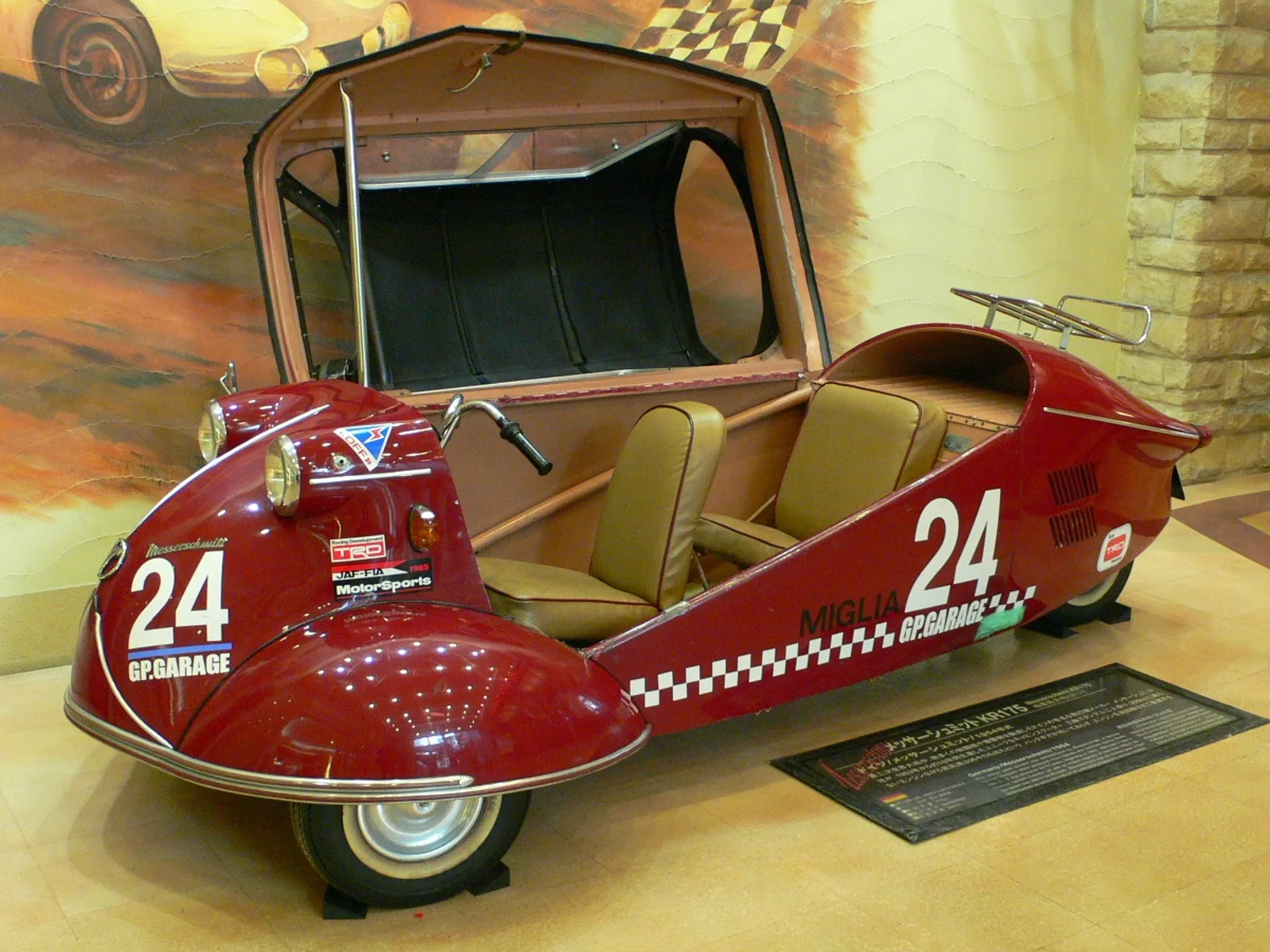
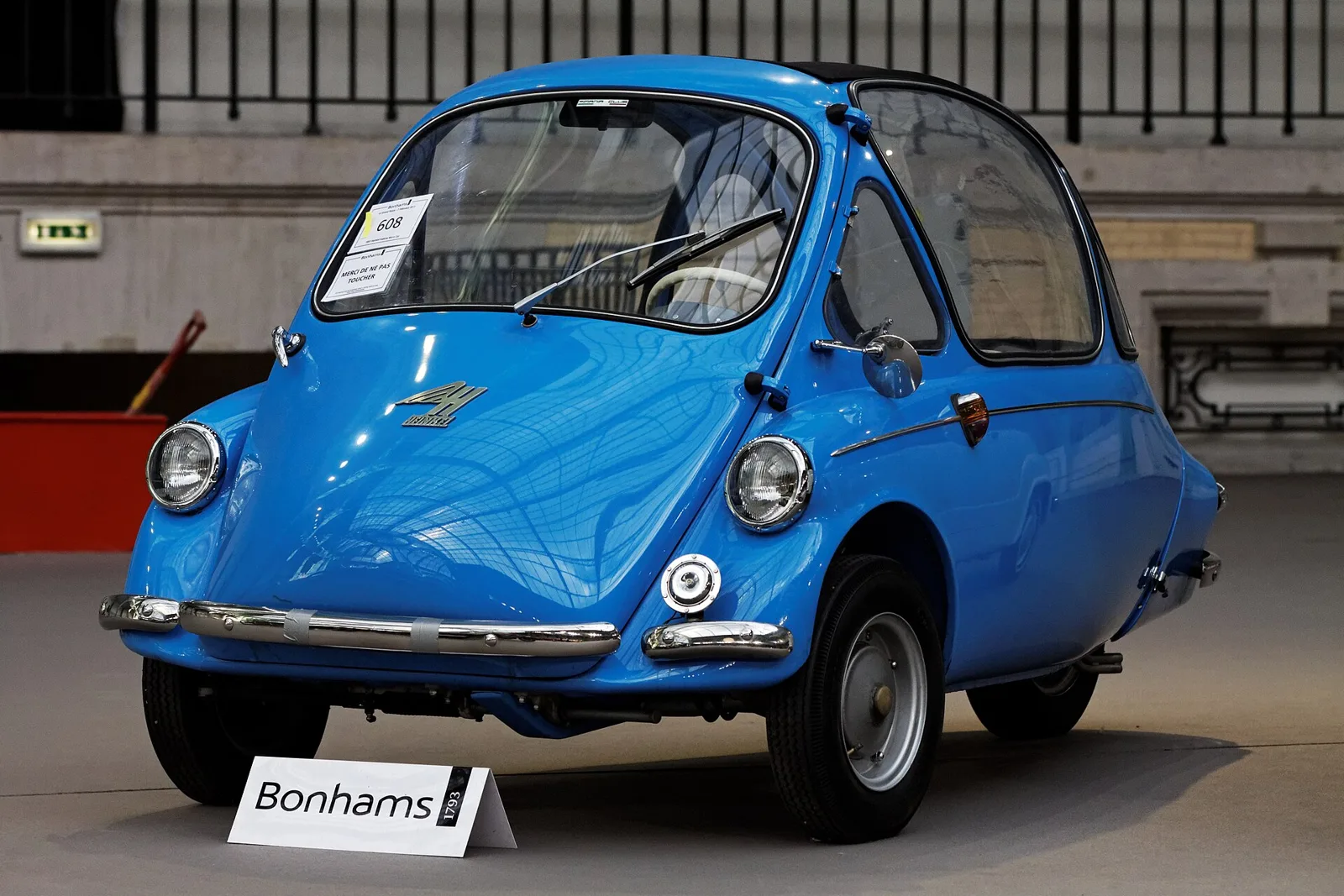
The Kabine bubble car arrived in 1956, and its rivals included the BMW Isetta and the Messerschmitt KR200. Its body was a single unit, and a four-stroke single-cylinder engine drove it. It competed in the small-car segment alongside those rivals.
Heinkel ended its own Kabine output in 1958, yet licensed builders carried on. Dundalk Engineering in Ireland came first, followed by Trojan Cars Ltd, which stopped in 1966.
What scooters and mopeds did Heinkel make?
The Tourist motor scooter of the 1950s was known for its reliability. It was a large, relatively heavy touring machine with a full fairing for weather protection, and its front wheel turned under a fixed nose extension. Its 174 cc, 9.5 bhp four-stroke engine gave an official top speed of 58 mph (93 km/h).
The Tourist had effective streamlining, perhaps unsurprising given its aircraft ancestry, and it could sustain up to 70 mph (110 km/h) given time to get there. A lighter 150 cc scooter, the Heinkel 150, was also made.
The Perle moped, built from 1954 to 1957, had a cast alloy unit frame, rear suspension and a fully enclosed chain, with interchangeable wheels. Its sophistication came at a high cost, and about twenty-seven thousand Perles were sold. Its 50 cc two-stroke engine ran on a mixture of petrol and lubrication oil.
Who were the key figures at Heinkel?
Ernst Heinkel founded the company and gave it his name. Its most important designers were the twin Gunter brothers and Heinrich Hertel, while Johannes Plendl's navigation systems and Erich Warsitz's flights gave the firm two more notable names. Their work spanned bombers, jets and microcars.
Warsitz is remembered as the world's first jet pilot, and his own website covers his flights, including videos and audio commentaries. Those flights linked the company's name to the earliest jet-powered flight.
What were the early Heinkel biplanes?
Early output was dominated by biplanes, built under the HD (Heinkel Doppeldecker) and He designations. They included the HD 24 seaplane trainer of 1926, the He 45 light bomber, the He 51 fighter developed from the He 49, and the He 59 multirole biplane.
The HE 57 Heron, a passenger flying boat prototype, was Heinkel's last flying boat and its first all-metal aircraft. The He 72 Kadett was a trainer, and the He 100 fighter was undermined by the political process rather than by its design alone.
How did flying boats and seaplanes fit into the range?
Flying boats and seaplanes were a steady thread in Heinkel's range. The He 114 and He 115 were reconnaissance and military seaplanes, while the He 120 and He 220 four-engine passenger flying boat projects were cancelled in favour of the BV 222.
What jet projects never flew?
Heinkel designers produced a long run of jet fighter projects in the closing years of the war. Designs in the P.1078 and P.1079 series explored tailless layouts, two-engine night fighters and all-weather flying wings, and the P.1080 was a ramjet fighter.
Some of these projects fed the Emergency Fighter Program. The Lerche and Wespe were VTOL concepts, a ground attack fighter and a tail-sitting interceptor, respectively, and both remained on the drawing board.
How were Heinkel designs exported and licensed abroad?
Heinkel designs were exported and adapted across Asia and Europe. An export He 70 variant, the He 170, went to Hungary, while the He 61 was built for China and the He 66 for Japan. The HD 56 was built in Japan as the Aichi E3A.
The He 62 was a reconnaissance seaplane, and the He 64 was a sports plane whose lines fed into the He 71, a single-seat monoplane that was a shrunken He 64. Several designs were built under licence or in shrunken form rather than as a single standard type.
What were the He 177 derivatives that never flew?
Several He 177 derivatives stayed on paper. The He 179 was a variant with four separate engines and was never built, while the He 277 was a paper-only heavy bomber developed from the He 177 and known as the Amerika Bomber, with four BMW 801E radial engines.
Other heavy bomber ideas also stayed in the project files. The He 274 high-altitude version was developed from the He 177, and two prototypes were completed after the war in France. The He 275 four-engine heavy bomber and the He 278 four-engine turboprop bomber never reached production, and the He 343 four-engine jet bomber was another 1944 project.
What are the key dates in Heinkel's history?
Heinkel's history runs from its 1922 founding at Warnemunde to its 1965 absorption into VFW and the 1980 merger into Messerschmitt-Bolkow-Blohm. Many milestones are tied to the Second World War, when its designs were central to the Luftwaffe. The table below marks the main dates.
| Year | Milestone |
|---|---|
| 1922 | Firm established at Warnemunde |
| 1932 | He 70 Blitz flies for Deutsche Luft Hansa |
| 1939 | He 176 and He 178 fly under rocket and turbojet power |
| 1941 | Merger with Hirth to form Heinkel-Hirth |
| 1956 | Kabine bubble car introduced |
| 1958 | Kabine production stops |
| 1965 | Company absorbed by VFW |
| 1980 | VFW absorbed by Messerschmitt-Bolkow-Blohm |