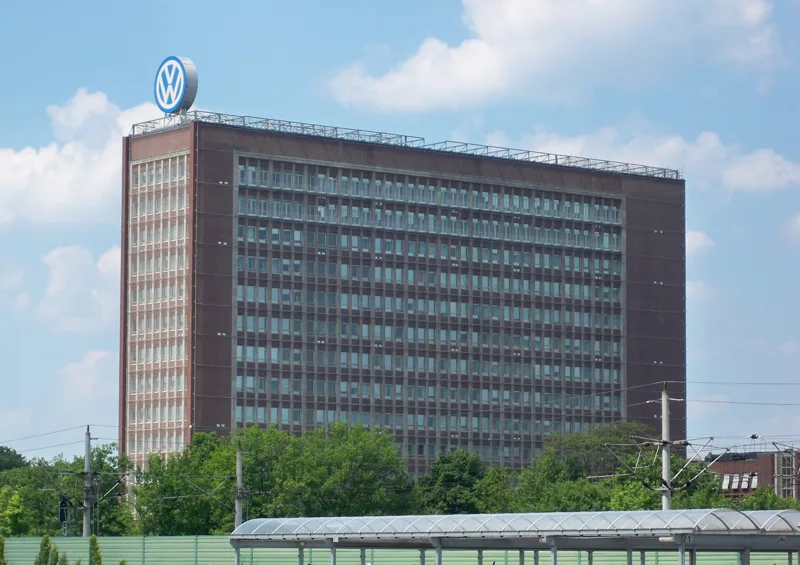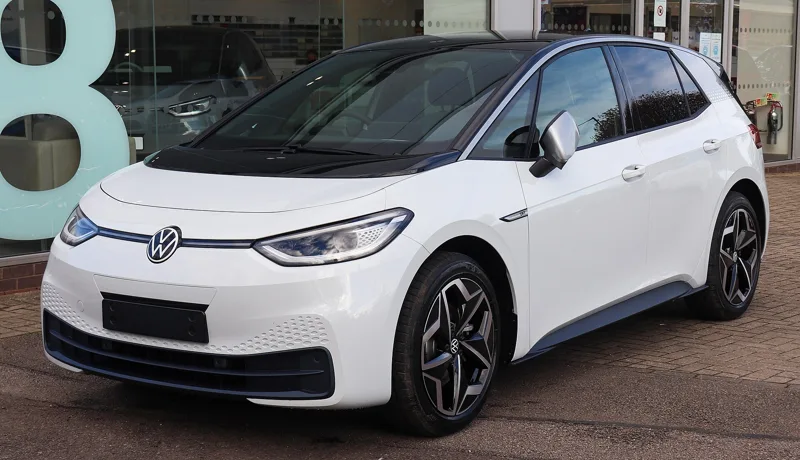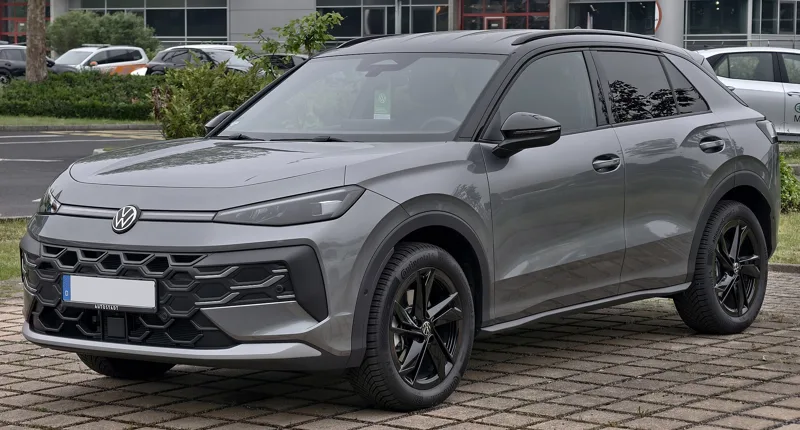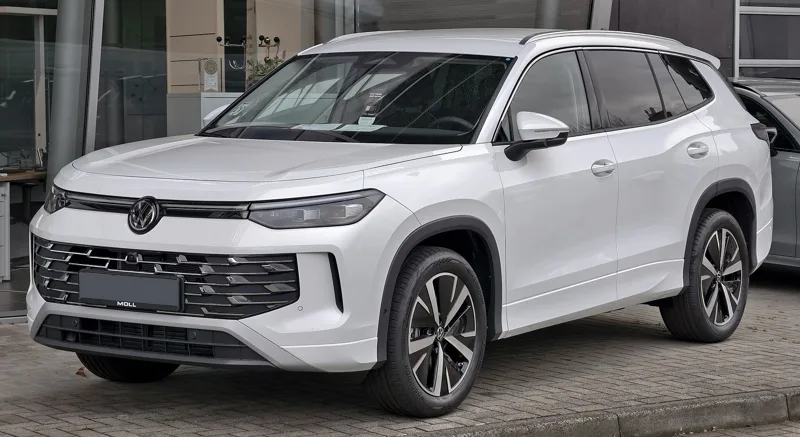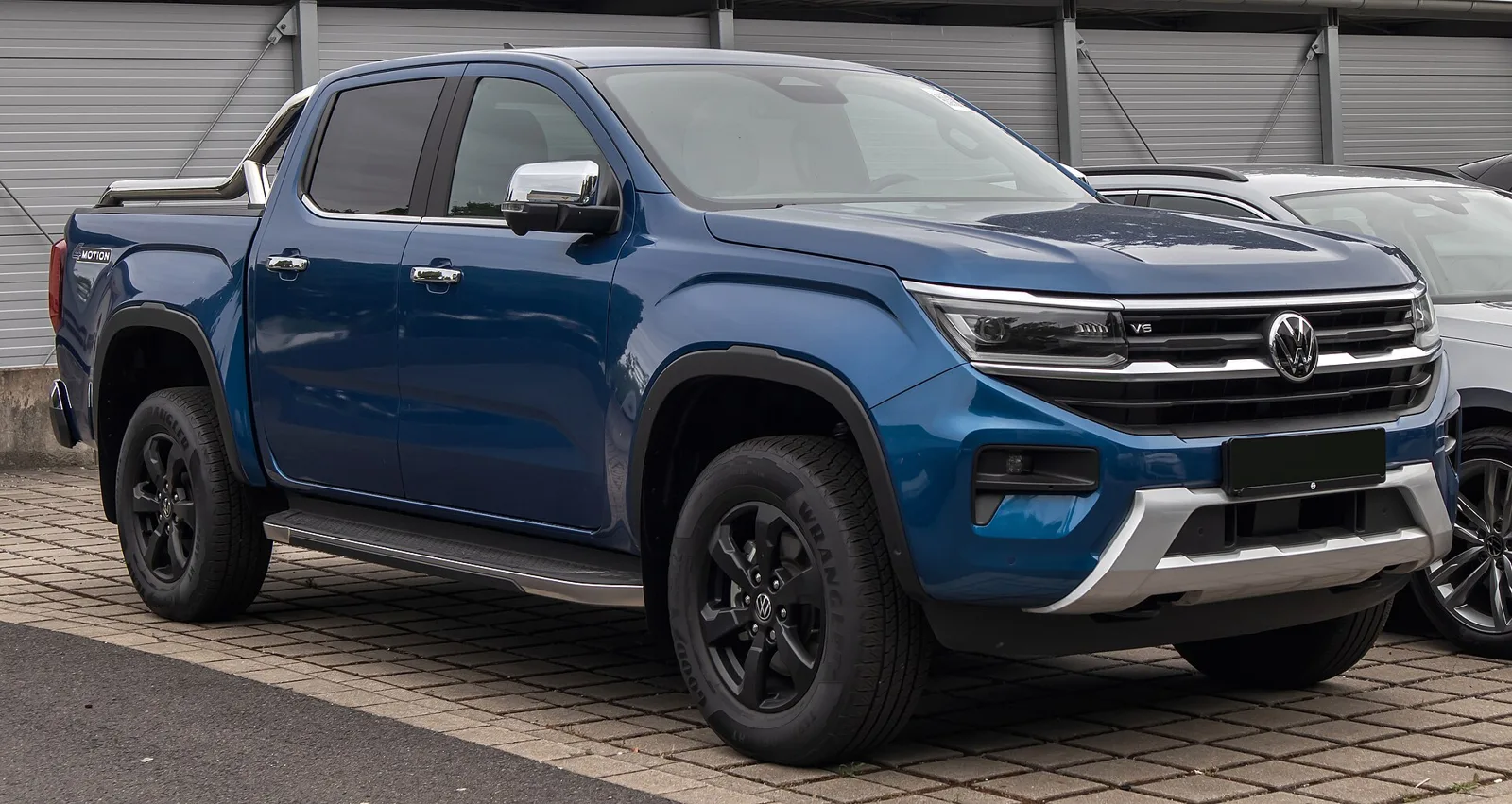
A body-on-frame pickup born in Argentina and an electric liftback built to replace the Passat and Arteon, set side by side.
Built since 2010, the Amarok is Volkswagen's diesel and petrol pickup, and its second generation shares the Ford Ranger's basis. The ID.7, launched in 2023, is a battery-electric liftback that replaces the Passat and Arteon, rides on the MEB platform and is the brand's most aerodynamic ID model.
The latest Volkswagen Amarok is, underneath, a Ford Ranger. Yet in Argentina, where the first one was built, Volkswagen gave the original truck a second facelift in 2024 rather than retire it, citing the old model's reputation and its handling, comfort and off-road ability. The other half of this story is the ID.7, an electric liftback that took over from both the Passat and the Arteon.
What are the Volkswagen Amarok and the Volkswagen ID.7?
The Volkswagen Amarok is a mid-size pickup made since 2010, a body-on-frame truck sold with single or double cabs, petrol or diesel power and either rear-wheel drive or 4motion four-wheel drive. The Volkswagen ID.7 is a five-door battery-electric liftback made since 2023 and sold in the E-segment, the class of big executive cars.
They share a badge and a parent company, and almost nothing else. The Amarok is a working truck with a separate chassis. The ID.7 is a motorway cruiser that uses its shape to save energy.
The Amarok is a ladder-frame working truck; the ID.7 is the most aerodynamic electric Volkswagen yet.
How did the Volkswagen Amarok come about?
The Amarok was the first pickup from Volkswagen Commercial Vehicles, the division that builds the brand's vans. The project goes back to 2005, when the division announced its intention to build a robust pickup and a family of off-road vehicles around it.
A concept appeared in September 2008 under the name Robust Pick-Up, painted in a search and rescue colour scheme. Volkswagen said its design was 95 percent like the production truck. The same year, at the IAA Commercial Vehicle Show, the search and rescue study was fitted out for lifeguards, with four mobile CB radios, a defibrillator in the first aid kit, binoculars, a pair of safety helmets, hard-wearing neoprene seats and a blue light roof module with a searchlight built in. It measured 5.18 m in length and 1.90 m in width, and its 1.55 m cargo bed could take a Euro pallet sideways.
The production truck was presented to the public at General Pacheco, Argentina, on 7 January 2010. Soon afterwards it went to work in the 2010 Dakar Rally, where 45 of them served as support vehicles.
The name comes from a wolf deity in Inuit mythology. Interbrand, the brand consultancy that chose it, also says it echoes a phrase meaning "he loves stones" in Romance languages, a hint at the all-terrain job the truck was meant to do.
Where is the Amarok built, and where is it sold?
Production centres on General Pacheco in Argentina, a Volkswagen Group plant that supplies buyers across South America, Mexico, Oceania, South Africa, Russia and Europe. At full capacity the plant was expected to produce 90,000 a year, and as of 2022 some 70 percent of Argentine-built trucks were exported.
Germany nearly missed out. Hanover was first dropped from the list of possible sites because of the 2008 financial crisis and rising costs in Europe in 2009. In September 2010 that was reversed, and 40,000 trucks a year were to be built there from mid-2012 for Europe and small-volume markets. The 100,000th Amarok was completed on 8 October 2011, and between 2010 and 2022 the first generation found 830,000 buyers.
The truck has been sold across Latin America, from Argentina, Brazil, Chile and Colombia to Costa Rica, Ecuador, Peru, Paraguay and Mexico, as well as in Mongolia, Australia, New Zealand, South Africa and Europe. North America is the gap. Volkswagen met Canadian and American dealers in 2012 to discuss the idea, but a sale in the United States would probably have meant moving production or building a plant in North America, so as to avoid the chicken tax, the duty on imported light commercial vehicles.
What engines does the Volkswagen Amarok use?
The first Amaroks used two 2.0-litre turbodiesel engines borrowed from the Transporter T5 van and retuned for more torque and less power. The entry version made 90 kW (122 PS) and 340 Nm from 2,000 rpm; the bi-turbo made 120 kW (163 PS) and 400 Nm between 1,500 and 2,500 rpm.
Volkswagen quoted combined fuel use as low as 7.6 L/100 km for the rear-drive truck and 8.1 L/100 km for 4Motion, which on paper gave a range of 1,000 km between fill-ups. For the 2012 model year the 90 kW engine rose to 103 kW, and the Bi-TDI could be had with an optional eight-speed ZF automatic.
On 22 September 2014 came the limited Dark Label, using a 180 PS (133 kW) BiTDI with 420 Nm and a towing limit of up to 3,200 kg.
The V6 arrives
The facelift swapped the four-cylinder for a 3.0-litre V6 TDI, offered in three states of tune: 121 kW, 150 kW and 167 kW. The strongest produced 550 Nm and reached 100 km/h in 8 seconds. In Britain the lowest tune was dropped in favour of 201 and 254 bhp versions; the latter has an overboost to 268 bhp and covers 0-62 mph in 7.4 seconds.
Against the old 2.0 BiTDI, Volkswagen claimed up to 23 percent more power and 28 percent more torque, with lower emissions and fuel use. Deliveries were scheduled for the third quarter of 2016. In late 2018 a stronger version appeared with 190/200 kW and 580 Nm, built to take on the Mercedes-Benz X-Class V6 CDI, and in 2019 the 580 Nm engine became more widely available while the 550 Nm one stayed in lower-spec trucks.
How does Amarok four-wheel drive work?
Buyers choose between plain rear-wheel drive, a Shiftable 4Motion system and a Permanent 4Motion system. The shiftable one can send drive to either axle, while the permanent one is always on and splits power 40:60 between front and rear through a Torsen differential, a mechanical unit that shifts torque towards whichever axle has grip.
The Amarok has long drawn criticism for lacking a low-range transfer case. Off-road drivers prefer one because it is simpler and stronger than all-wheel-drive systems in severe going, acting like a bottom gear for crawling over rocks. Volkswagen Australia lobbied its parent for one, citing strong demand and the fact that Australia was the biggest importer of V6 Amaroks.
The result was the V6 Core, launched in January 2020, the only V6 Amarok with a true low-range box, paired only with the six-speed manual. Its engine is detuned to suit that gearbox, hence the TDI500 name. It is a base model, with cloth seats, a rubber floor, a leather-covered wheel, 17-inch alloys and a touchscreen with Apple CarPlay and Android Auto. The Core V6 Enduro adds a sports bar and decals for the same price as the standard manual.
Which Amarok body styles and special editions exist?
The Double Cab came first, with the Single Cab following in late 2011 in South Africa and Europe. An XXL version offers a bed 2.21 m long on a slightly longer wheelbase, and cab-chassis versions of both cabs arrived with the 2012 model year.
The Sochi Special Edition was the official vehicle of the 2014 Winter Olympics and was sold only in Russia, adding extra chrome, navigation and an updated interior. The Polar Expedition was more serious. Three trucks carried nine people 16,000 km from Moscow to Petropavlovsk-Kamchatsky in 66 days, crossing the glacier-covered Sredinny Range, and the team earned a Guinness record for the longest off-road journey in a single country.
Those trucks received long-travel heavy-duty shocks, tyres with deeper treads and cut-out wheel arches, and a roll cage inside. The 2.0-litre diesel stayed mostly standard because reliability mattered most. Armies took notice too: the Dutch Ministry of Defence announced plans to buy 1,667 Amaroks for its Army, Navy, Air Force and Marechaussee, to cut its fleet to a single type of truck and phase out vehicles such as the Mercedes-Benz G-Wagen.
How safe is the Volkswagen Amarok, and what has it won?
Euro NCAP gave the Amarok 4 stars in November 2010, and ANCAP awarded 5 stars in February 2011. The facelifted first generation in its most basic Latin American specification received 3 stars from Latin NCAP in 2024, a test that Latin NCAP says is similar to the 2014 Euro NCAP standard.
Prizes have been plentiful. The truck was Pickup of the Year 2011 in Brazil, Argentina and Germany, Ute of the Year 2011 in Australia, and a winner of the International Ute of the Year title in 2018. It also took the Tow Car Awards category for pickups in 2018.
What is the Volkswagen ID.7?
The ID.7 is a battery-electric five-door liftback produced since 2023 that replaces both the Passat and the Arteon as the brand's flagship. It rides on the MEB platform it shares with the ID.4 and the Audi Q4 e-tron, and Volkswagen compares it with D-segment cars such as the BMW i4 and the Tesla Model 3.
It is larger than the Passat and Arteon it replaces and uses a standard rear-wheel drive layout, where they were front-wheel drive, which is why it sits further upmarket. Volkswagen calls it the most aerodynamic ID model so far, with a CdA of 0.23 x 2.46 m2, or roughly 0.57 m2. CdA is the drag coefficient multiplied by frontal area, so it describes how big a hole the car punches in the air.
Production is split by region. Emden in Germany builds the cars for Europe, while Foshan and Anting handle China.
What is inside the ID.7?
The dashboard carries a compact digital instrument display, a head-up display with augmented-reality navigation and a 380 mm (15 in) central touchscreen. Volkswagen reworked the software and touch controls after complaints about the system in its other models, and the voice control can now handle complex requests such as finding a high-speed charging station.
Options include a panoramic sunroof that switches from transparent to opaque electrically and can be operated by voice, and a 700-watt Harman Kardon audio system with 14 speakers. Automatic parking is standard and can park the car from more than 16 m away. Travel Assist is due on European cars.
The front seats are a new design with optional Climatronic massage and sensors for temperature and moisture that adjust to driver and passenger. The air vents are also unusual: they ventilate through dynamic movement, so air does not blow straight at faces.
How do the Volkswagen Amarok and ID.7 compare?
| Feature | Amarok | ID.7 |
|---|---|---|
| Body | Mid-size pickup, single or double cab | Five-door liftback, plus Tourer estate |
| Built since | 2010 | 2023 |
| Construction | Body-on-frame | MEB electric platform |
| Drive | Rear-wheel drive or 4motion four-wheel drive | Standard rear-wheel drive |
| Energy | Turbocharged petrol or TDI diesel | Battery electric |
| Main rivals | Hilux, Ranger, Navara, D-Max, L200 | BMW i4, Tesla Model 3 |
| Plants | General Pacheco, Hanover | Emden, Foshan, Anting |
| Lineage | Second generation based on the Ford Ranger | Replaces the Passat and Arteon |
What follows the Argentine Amarok and the ID.7 Tourer?
Argentina's first-generation Amarok is due to give way to a model built on the Maxus Terron 9. Elsewhere the second-generation Amarok already rides on the Ford Ranger. Volkswagen has also been linked to a rumoured five to seven-seat SUV spin-off from the first-generation platform, to be built in Brazil for South America and Europe, aimed at the Nissan Xterra and Toyota Hilux SW4. That remains a rumour.
For the ID.7, the Tourer estate was officially unveiled on 20 February 2024. It matches the liftback for length. A sister model for China, previewed as the ID.Next in April 2023, will be made by SAIC-Volkswagen, while FAW-Volkswagen will build the ID.7 Vizzion. A North American launch was once confirmed, then delayed, and finally cancelled.