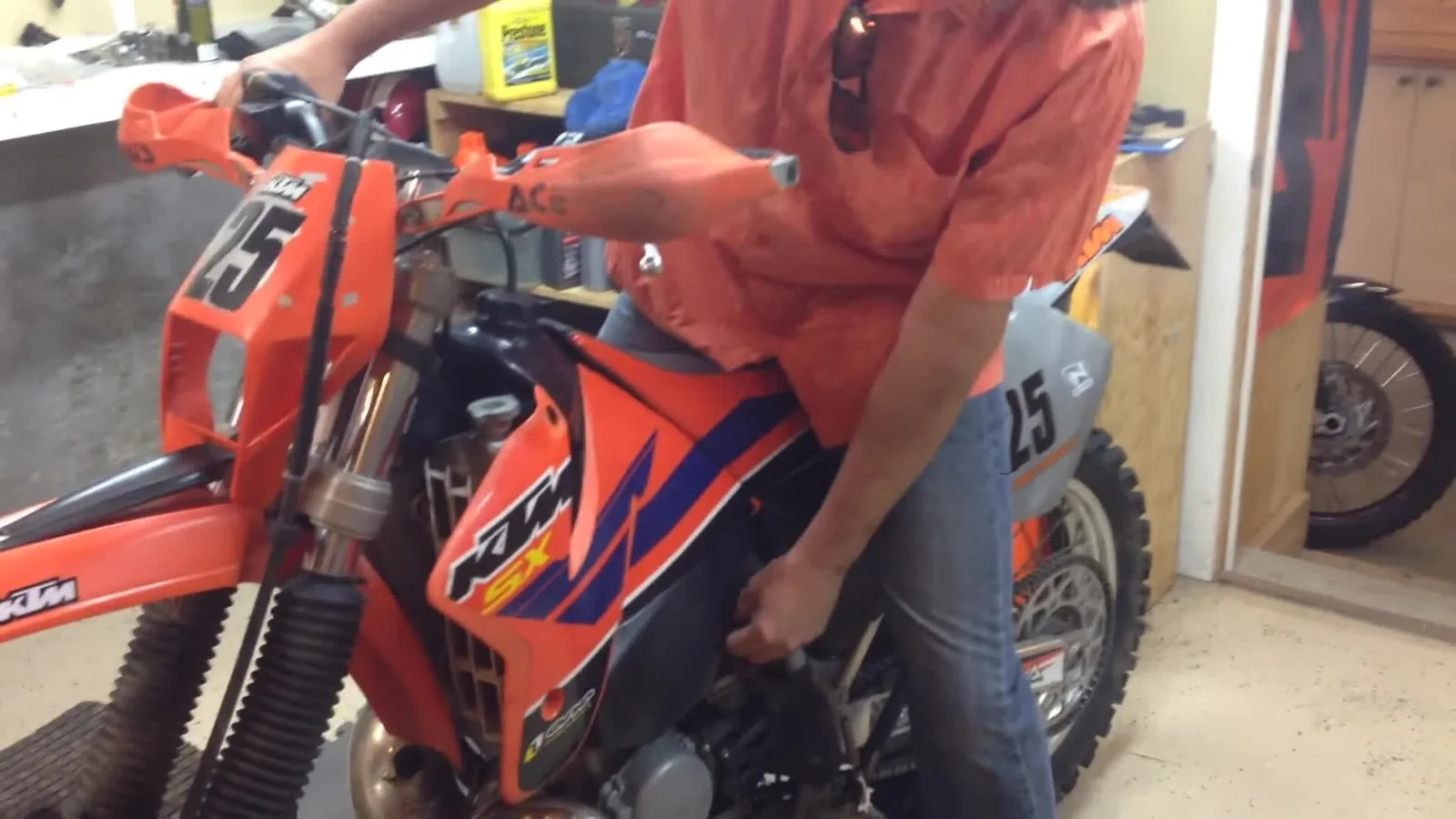
How the two cycles differ, why Saab, DKW and the Trabant makers chose the simpler one, and where it still earns its keep.
A two-stroke engine fires once every crankshaft turn, while a four-stroke fires every second turn. That gives the two-stroke more power for its weight and fewer parts, but historically higher hydrocarbon emissions, which is why Western car makers dropped it in the 1980s and why it lives on in chainsaws and some outboards.
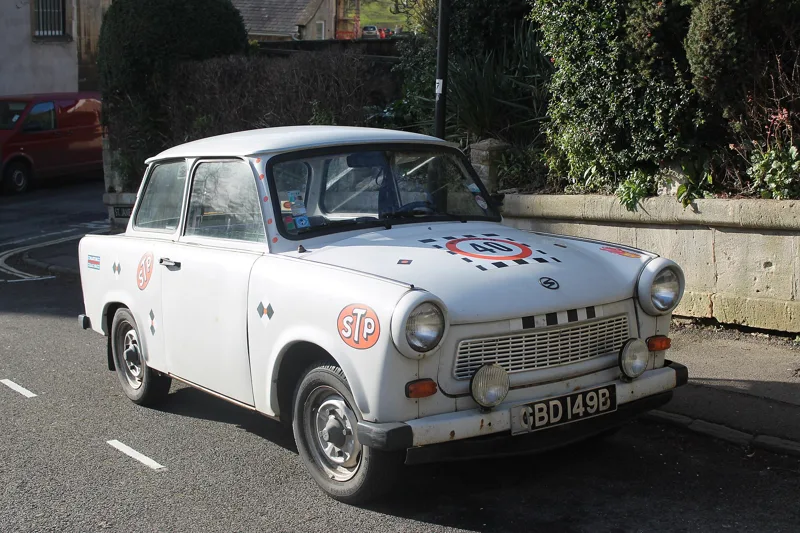
The last Western road car with a two-stroke engine left production in the 1980s, but Trabants and Wartburgs kept coming out of East Germany until around 1991. That long gap says more about two stroke vs four stroke engines than any dyno chart: the cheaper, lighter design never lost on merit alone, it lost to the exhaust pipe.
How does a two stroke engine work compared with a four-stroke?
Every piston engine turns fuel into motion by repeating one sequence: draw in a mixture, squash it, burn it, clear out the waste. The difference is how many trips the piston makes to get through that list.
A four-stroke engine gives each job its own stroke. On intake the piston travels down while the intake valve is open and pulls the mixture in. On compression it travels up with both valves shut. Then the mixture is lit, by a spark plug in a petrol engine or by the heat of compression in a diesel, and the burning gas drives the piston back down. On the exhaust stroke the piston rises again with the exhaust valve open and pushes out the spent gas. Four strokes, two turns of the crankshaft, and only one of them delivers power.
A two-stroke squeezes the same sequence into one turn. On the upward stroke the cylinder finishes clearing out exhaust and filling with fresh mixture, a job known as scavenging, and compresses what is left. On the downward stroke the mixture burns, the gas expands and, near the bottom, scavenging begins again. The piston does not need valves to manage the traffic in many designs. It covers and uncovers ports in the cylinder wall as it moves.
Think of two rowers in a boat. One pulls on every stroke, the other pulls on every second stroke and spends the rest of the time recovering. The first has more drive per minute; the second takes it easier. That is the broad character of the two engines.
The cheaper, lighter design never lost on merit alone. It lost to the exhaust pipe.
Why do two-strokes make more power for their size?
The power stroke comes twice as often, so a two-stroke often gets more power out of each kilogram. With fewer moving parts it is also cheaper to build and lighter.
The petrol version has a quirk that suits it to hand tools. Oil is mixed into the fuel beforehand, at a ratio of around 32:1, and the sealed crankcase doubles as a pump for the incoming charge, so the oil supply does not depend on gravity. The engine therefore runs in any orientation. That is why a chainsaw can be held at any angle.
What did the two-stroke cost in emissions?
This is where the ledger turns. Because the oil is burned along with the petrol or carried out in droplets, small crankcase-compression engines have historically produced more exhaust emissions than four-strokes of similar power, hydrocarbons above all. In some designs the intake and exhaust ports are open together for a moment, which lets unburned fuel vapour slip out with the exhaust. Small air-cooled engines run hot, and that heat may also form nitrogen oxides.
Fuel use is part of the same story. In a simple port design some of the incoming pressurised mixture crosses the top of the piston and goes straight out of the exhaust pipe. Racing engines tune the exhaust into an expansion chamber to send a strong reverse pulse that blocks the escape. On the road, none of that was enough once pollution rules tightened.
How do engineers get more out of each design?
The simplest two-stroke is the piston-port engine, where the piston alone covers and uncovers the ports. Yamaha worked out basic principles for it in the 1970s. Widening the exhaust port raises power by as much as lifting it does, without narrowing the power band, but the width tops out at about 62% of the bore diameter before the piston rings bulge into the port and wear fast. Racing engines, which get fresh rings every few races, can go to 70%.
A reed valve in the intake, a simple one-way flap, lets the charge in unevenly, which helps power and economy and gives a broader power band. A rotary disc valve, as fitted to Vespa scooters, makes the intake timing asymmetrical, which the plain piston-port layout cannot do. Big diesels use uniflow scavenging, where fresh charge enters at one end of the cylinder and exhaust leaves at the other, so the gas moves one way only. Detroit Diesel, Electro-Motive Diesel locomotives and large Wartsila marine engines use the layout.
The four-stroke has its own limits. Maximum power depends on the most air the engine can swallow, and engine speed is capped by material strength and lubrication. Push too far and valve springs cannot shut the valves in time, a fault called valve float that can bring piston into contact with valve. One way round is to force more air in with a supercharger, which raises the power limit relative to displacement. Many modern four-strokes also use gasoline direct injection, with the injector nozzle poking into the combustion chamber to spray petrol in at very high pressure.
A side-by-side look
| Feature | Two-stroke | Four-stroke |
|---|---|---|
| Piston strokes per power cycle | Two | Four |
| Crankshaft turns per power cycle | One | Two |
| Power stroke | Every turn | Every second turn |
| Build | Fewer moving parts, lighter and cheaper | Valves manage intake and exhaust |
| Exhaust emissions | Historically higher hydrocarbons | Lower for similar power |
| Outboard record | Simple and cheap, louder, more pollution | Less noise, lower pollution, better fuel economy, more low-speed torque |
Who built two stroke cars, and why did they stop?
A surprising list of mainstream makers used the cycle. Saab in Sweden, DKW, Auto-Union and the state factories at Zwickau and Eisenach in Germany, and the Polish makers FSO and FSM all did. Suzuki and Subaru followed in the 1970s. Western production ended in the 1980s because air pollution rules had become increasingly strict. The Eastern Bloc carried on until around 1991, with the Trabant and the Wartburg in East Germany.
Saab's story shows how much engineering went into making the cycle behave. The original Saab 92 used a two-cylinder engine that was fairly inefficient. At cruising speed a reflected pressure wave blocked the exhaust port, but at too low a frequency to help. Saab then built three-cylinder engines of 750 cc and 850 cc, derived from a DKW design and loop charged, and fitted the asymmetrical three-port exhaust manifold already used on the identical DKW engine, which improved fuel economy. Depending on the year, the standard 750 cc unit made between 36 and 42 hp (27 to 31 kW). The Monte Carlo Rally version, with a filled crankshaft to lift base compression, made 65 hp (48 kW), and the 850 cc engine arrived in the 1966 Saab Sport.
Loop scavenging deserves a word, because it is the idea that made these engines work. Shaped transfer ports steer the fresh mixture up towards the cylinder head, where it follows the curve of the combustion chamber and turns downward. It cannot shoot straight out of the exhaust, and the swirl helps combustion. It also lets the piston crown be nearly flat, so the piston is lighter and stronger, tolerates higher revs and suffers less from uneven heating and seizure. The method is credited to German inventor Adolf Schnuerle in the mid-1920s, spread widely in Germany in the 1930s and further afield after World War II. Paired with disc valves and expansion chambers, it lifted the output of two-strokes from Suzuki, Yamaha and Kawasaki, and the extra power helped Suzuki and Yamaha win in Grand Prix motorcycle racing during the 1960s. Work published by the SAE in 2012 points to loop scavenging as more efficient than the older cross-flow layout in every circumstance.
Where did the four-stroke come from?
The four-stroke has a longer pedigree than the car. Jean Joseph Etienne Lenoir built a gas engine in Paris that reached only 4% efficiency in 1860, and its 18 litre displacement produced 2 horsepower. Nicolaus Otto tested a replica in 1861 and saw the effect of compression on the charge. By 1876 Otto and Eugen Langen had built the first engine to compress the mixture before burning it, and its efficiency was far above anything before it. An atmospheric engine ran at about 12%, a compressed-charge one around 30%.
Gottlieb Daimler and Wilhelm Maybach left Otto's company, and in 1883 they produced the first Otto engine able to run at speed. Their Reitwagen of 1885 was the world's first vehicle driven by an internal combustion engine, and the following year Karl Benz produced a four-stroke car that is regarded as the first car. Rudolf Diesel produced a working compression-ignition engine in 1893, and that design can be either four-stroke or two-stroke. For many decades the four-stroke diesel has handled most heavy-duty work.
Today the four-stroke is the most common internal combustion design for land transport, from cars and trucks to diesel trains, light aircraft and motorcycles.
Why do two strokes survive in chainsaws and outboards?
Because the things that count against them in a car count for less elsewhere. Petrol two-strokes are preferred where simplicity, low weight and a high power-to-weight ratio matter most, and the any-angle lubrication helps. They remain common in leaf blowers, chainsaws and string trimmers, and in mopeds, motor scooters, tuk-tuks, snowmobiles, go-karts and model aircraft. In regions where regulations are looser, small ones are still popular in mopeds and motorcycles. Honda ended US sales of its two-stroke off-road motorcycles in 2007, long after dropping its road-going ones.
At the other end of the size range, big two-stroke diesels power ships, locomotives and generating plants, where weight does not matter and the efficiency potential of the cycle does. In a two-stroke, the exhaust gases pass less heat into the cooling system than in a four-stroke, which leaves more energy to drive the piston and a turbocharger if one is fitted.
Outboard motors show the full arc of the argument. An outboard is a self-contained engine, gearbox and propeller unit that bolts to the back of a boat, and it is the most common way to power a small boat. Historically most were carburetted two-strokes because of their simplicity, reliability, low cost and light weight, with the drawbacks of more pollution from unburned petrol and oil, and more noise. Ole Evinrude created the most successful early example in 1909.
Four-stroke outboards had been on sale since the late 1920s, but they took off later. Homelite introduced a 55 hp (41 kW) four-stroke in 1962, based on a four-cylinder Crosley car engine, and Honda introduced its first four-stroke powerhead in 1964. Yamaha followed in 1984 with low-power models, and in 1990 Honda launched four-strokes of 35 hp and 45 hp. US and European emissions rules such as California's CARB led to a spread of four-strokes through the 1990s. They brought less pollution (above all, less oil in the water), less noise, better fuel economy and more torque at low engine speeds. Direct-injected and four-stroke outboards measure from 10 percent to 80 percent better on fuel than conventional two-strokes.
Where this goes next
Two-stroke makers have not stood still. Mercury, Tohatsu, Yamaha, Nissan and Evinrude each built computer-controlled, direct-injection two-stroke outboards, and the gap in fuel economy against four-strokes is beginning to narrow as manufacturers introduce new technologies. In developed countries, though, pollution regulations are phasing out the cycle in many small applications.
Elsewhere in boating, other power units are arriving. Electric outboards date back to 1973, and recent designs can produce 10 kW or more, enough to stand in for a petrol engine rated at 15 HP and up. Propane outboards from several manufacturers offer lower emissions, and Lehr introduced small propane models in 2012.