A hydrogen wagon rolled 100 metres in 1813. It took until 1864 for an engine to sell, and the road engine came from stationary machines.
The internal combustion engine developed from early gas experiments through Lenoir's 1860 gas engine and Otto's 1864 atmospheric and 1876 four-stroke engines. Gas engines and slow hit-and-miss flywheel engines served industry and farms, while Daimler, Maybach and Benz adapted Otto's design for vehicles in 1885.
In 1813 a crude four-wheeled wagon rolled 100 metres under its own power, driven by an engine that burned hydrogen and oxygen. It was the first car-like vehicle known to run on internal combustion, built by the Swiss engineer Francois Isaac de Rivaz. A commercially successful internal combustion engine did not arrive until 1864, and the engines that finally reached the road were descended from the slow, heavy stationary machines of the late nineteenth century.
That line of descent runs through three kinds of engine: the Otto engine, the gas engine and the humble hit-and-miss engine, set within the wider history of the internal combustion engine. Each solved a problem that made the car engine possible, and each left something behind.
Who invented the internal combustion engine?
There is no single inventor. The first commercial steam engine, from Thomas Savery in 1698, set engineers wondering whether the fire could be moved inside the cylinder. In 1791 John Barber patented a design for a gas turbine. In 1794 Robert Street built a piston engine that was the first to use liquid fuel, drawing in outside air on the intake stroke and igniting the mixture with an external flame. Thomas Mead patented a gas engine the same year, and in 1798 John Stevens drew up America's first internal combustion engine.
The Niepce brothers ran a prototype called the Pyreolophore in 1807, using controlled dust explosions to power a boat upstream on the Saone. The same year de Rivaz built his hydrogen engine, which used spark ignition of the kind Alessandro Volta had shown in his 1780s electric pistol. Samuel Brown patented a gas vacuum engine in 1823, and one of his engines pumped water at a London canal from 1830 to 1836. In 1826 Samuel Morey's patent included the first known carburettor design, and in 1838 William Barnett proposed compressing the charge inside the cylinder, an idea every later engine would use.
Eugenio Barsanti and Felice Matteucci received a patent in London on 12 June 1854 for an engine they had invented in 1853, and in 1860 Jean Joseph Etienne Lenoir produced a gas-fired engine.
The engines that reached the road were descended from slow, heavy stationary machines.
The Lenoir engine and the problem of compression
Lenoir's engine was an atmospheric design built like a horizontal double-acting steam engine, burning gas without compressing it first. Its efficiency was about 4%, and its 18-litre capacity yielded only 2 hp (1.5 kW). Roughly 280 had been built by 1867. Pierre Hugon improved on it in 1865 with flame ignition, better economy and water injection for cooling.
Nicolaus Otto, then a travelling salesman for a grocery firm, met the Lenoir engine in Paris. Testing a replica in 1861 he noticed how much compression changed what the fuel did. In 1862, working with Michael Zons, he built a compression engine from a modified Lenoir. It ran for a few minutes and then destroyed itself. Many engineers were stuck on the same problem.
The Otto engine
Otto went at it another way first. In 1864 he and Eugen Langen founded NA Otto & Cie, often described as the first engine factory in the world, and built an atmospheric engine. A piston rose on a gas explosion, creating a vacuum underneath, and the real work was done when the piston and its toothed rack fell under atmospheric pressure, turning the shaft. It could be started and stopped at will, which made it ideal for intermittent work such as loading barges. At the 1867 Paris exhibition it used less than half the fuel of the Lenoir and Hugon engines, ran at 12% efficiency, produced 0.5 hp (0.37 kW) at 80 rpm, and won a gold medal.
Sales funded more research. By 1875 the firm, which had moved to Deutz in 1869 and become Gasmotoren-Fabrik Deutz, was making 634 engines a year. But the atmospheric engine had reached a dead end: it made only 3 hp (2.2 kW) and needed 3 to 4 metres (10 to 13 ft) of headroom. Deutz stopped making it in 1882 after building 2,649.
The engine that mattered arrived in 1876. After 14 years of work, Otto succeeded in building a compressed-charge engine on 9 May 1876. He had found a way to layer the mixture in the cylinder so it burned progressively rather than exploding, the stratified charge. Two men Daimler had recruited, Franz Rings and Herman Schumm, helped him turn it into the Otto Silent Engine. It was a single-cylinder unit of 6.1 litres rated at 3 PS (2,206 W) at 180 rpm, with a horizontal cylinder, a slide valve and gas flame ignition, which avoided the unreliable electric ignition that had defeated Lenoir. Maybach later reworked the piston and connecting rod, moving from a trunk layout to a crosshead one, which made series production possible.
Power climbed quickly. In the 15 years before the Otto engine, output never exceeded 3 hp (2.2 kW); within a few years engines reached 1,000 hp (750 kW). During the Second World War, Otto-cycle engines ran on more than 62 different fuels, including wood gas, coal gas, propane, hydrogen and benzene.
From the Otto engine to the car engine
Otto had no interest in transport. Daimler did. After a disagreement about direction, Daimler left Deutz in 1882 and took Maybach with him. In 1883 they built a small, efficient engine of 0.5 hp (0.37 kW), and in 1885 the high-speed Grandfather Clock engine, which turned at 600 rpm and made 0.37 kW (0.50 hp). Fitted to a two-wheeled frame, it became the Daimler Reitwagen, ridden first by Daimler's son Paul. The Reitwagen is often considered the first motorcycle, and its engine was the first high-speed petrol engine.
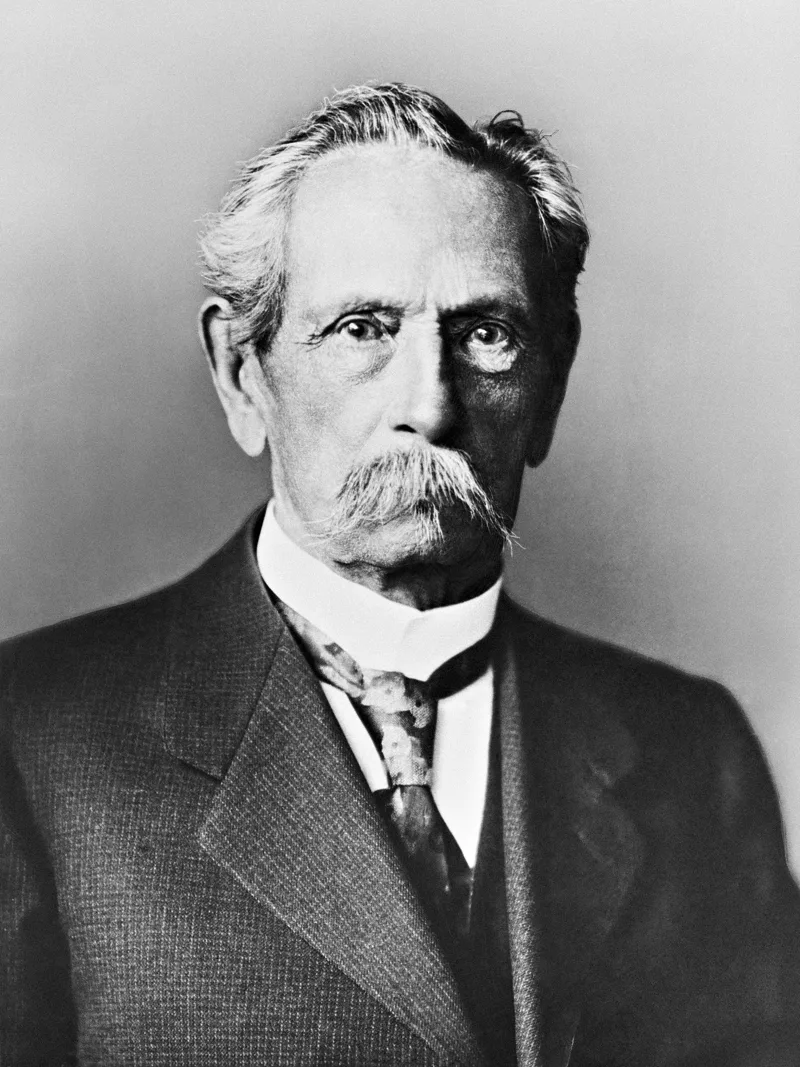
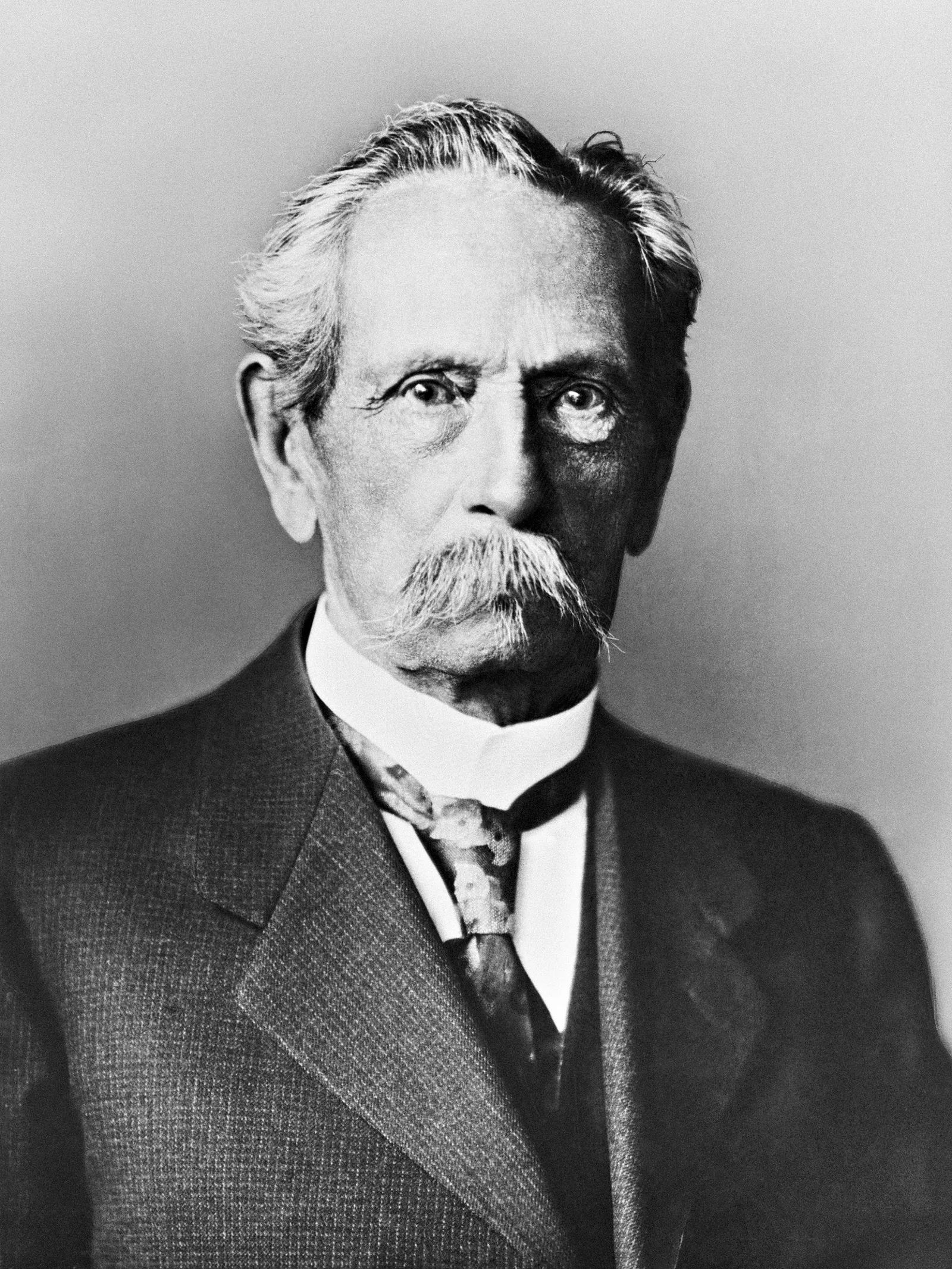
Deutz had its own part in making petrol practical. In 1884 it developed a carburettor and a reliable low-voltage ignition, which allowed liquid fuel for the first time and made vehicle use realistic. Daimler and Maybach worked on a carburettor of their own that replaced hot-tube ignition on the Reitwagen, along with a magneto system that became the basis for Bosch's. Karl Benz's Patent-Motorwagen of 1885, often called the first automobile, was powered by a single-cylinder four-stroke rated at 0.55 kW (0.74 hp). Deutz stayed with large stationary engines and is the world's oldest engine producer. The firm Daimler founded merged with Benz and adopted Mercedes-Benz as its car brand.
Patent trouble had a hand in the spread. In 1886 the German patent office cancelled Deutz's four-stroke patent, which would have run to 1891, because Alphonse Beau de Rochas had described a four-cycle engine earlier. By 1889 more than 50 companies were building Otto-type engines.
The gas engine
A gas engine is one that burns fuel gas: coal gas, producer gas, biogas, landfill gas, natural gas and hydrogen all count. In British English the term is unambiguous, while Americans, who shorten gasoline to gas, sometimes say gaseous-fuelled engine. Today it usually means a heavy-duty industrial machine designed to run at full load for most of the 8,760 hours in a year. A petrol car engine is built light and made to rev high, and will rarely see more than 4,000 hours of use in its whole life. Typical outputs range from 10 kW (13 hp) to 4 MW (5,364 hp).
Lenoir built the first practical gas-fuelled engine in 1860, but it had low power and high consumption. Otto improved it, and the Otto-Langen atmospheric engine was followed by his four-stroke. The switch was remarkably quick. In the UK, Crossley of Manchester bought the British and world rights, except for Germany, to the Otto and Langen patents in 1869, and added the four-stroke rights in 1876. The Birmingham-area firm Tangye, based at Smethwick, sold its first gas engine in 1881, a two-cycle unit rated at 1 nominal horsepower, and began making four-cycle gas engines in 1890. Liquid-fuelled engines followed soon after, burning diesel from around 1898 and gasoline from around 1900. The Anson Engine Museum in Poynton keeps the biggest Crossley atmospheric engine still running.
The modern gas engine is a serious competitor. Natural gas engines typically reach a thermal efficiency of 35 to 45% on a lower-heating-value basis, and by 2018 the best managed up to 50%. Output runs from about 10 kW micro combined-heat-and-power units to 18 MW (24,000 hp), and high-speed gas engines compete with gas turbines up to about 50 MW (67,000 hp). Uses include landfill and mine gas, biogas, small standby generators below 150 kW, liquefied natural gas ships, compressed natural gas buses and propane forklift trucks. The weak point compared with a diesel is the exhaust valve, because gas engine exhaust is much hotter for a given output, which caps power.
The hit-and-miss engine
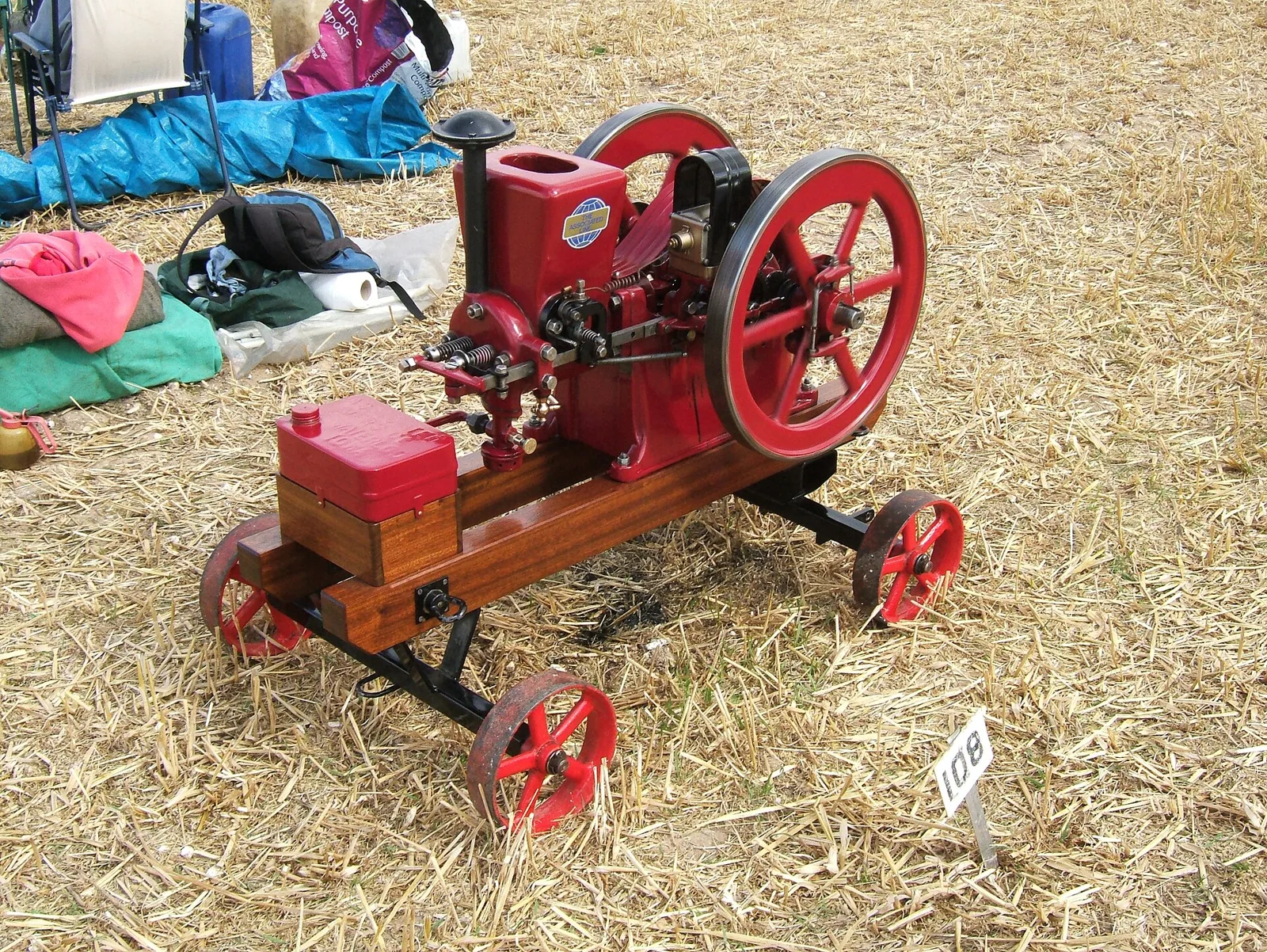
A hit-and-miss engine is a stationary internal combustion engine whose governor lets it fire only at a set speed. It is usually a four-stroke, though two-stroke versions existed. Makers built them from the 1890s until about the 1940s, and their peak ran from about 1910 to the early 1930s. They fire (hit) when running at or below the set speed and coast without firing (miss) when above it, which gives a distinctive pattern of snorts and pops. Fairbanks Morse, Maytag, John Deere, McCormick Deering, International Harvester, Hercules, Stover and Landini were among the makers. In Newfoundland and the Atlantic provinces of Canada they were called make-and-break engines and drove skiffs and fishing boats.
The engine is built around a heavy flywheel. The flywheel stores energy on the combustion stroke and releases it over the other three strokes, so a typical 6 hp (4.5 kW) cast-iron engine weighs about 450 kg (1,000 lb). The intake valve has no actuator: a light spring holds it shut until a vacuum in the cylinder pulls it open. When the engine is running fast, the governor props the exhaust valve open, so no vacuum forms, the intake stays shut and that cycle burns no fuel. When it slows to its set speed, the governor allows the exhaust valve to close, the vacuum opens the intake and the engine fires again.
Lubrication was by hand, with grease cups and drip oilers, and the crank ran open to the air. Most engines were cooled by an open hopper of water that boiled off in use. Forgetting to drain it in winter could crack the cast iron, though New Holland's patented V-shaped reservoir gave freezing water somewhere to expand. The engines produced from 1 to about 100 hp (0.75 to 75 kW) at 250 to 600 rpm, and powered pumps, saws, rural generators, farm equipment, cement mixers and early washing machines, usually through a wide flat belt.
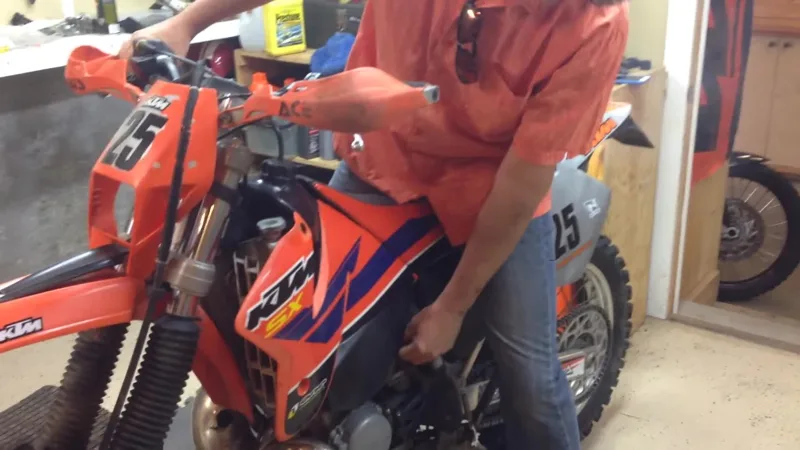
The engine's weaknesses explain why cars looked different. Flywheel engines were extremely heavy for the power they made, slow and demanding of maintenance, and did not suit moving machines. In the late 1920s International Harvester built the enclosed model M, then the fully enclosed model LA with oil in the crankcase, spark plug ignition and speeds up to about 750 to 800 rpm. The LA made 1.5 hp (1.1 kW) at about 68 kg (150 lb), far lighter than the M's 136 to 159 kg (300 to 350 lb). Briggs & Stratton built air-cooled engines of 0.5 to 2 hp (0.37 to 1.5 kW) turning at 2,000 to 4,000 rpm. Output of flywheel engines mostly stopped in the 1940s. Modern versions survive in oil field pumpjacks, and thousands of old ones, scrapped for iron and steel in the Second World War, have been restored by enthusiasts.
Milestones that led to car engines
| Year | Engine or advance | Maker | Why it mattered |
|---|---|---|---|
| 1813 | Hydrogen wagon | Francois Isaac de Rivaz | First car-like vehicle known to use internal combustion |
| 1860 | Gas engine | Jean Joseph Etienne Lenoir | First practical gas-fuelled engine |
| 1864 | Atmospheric engine | Otto and Langen | First commercially successful engine |
| 1876 | Otto Silent Engine | Otto, Rings and Schumm | Compressed charge, four-stroke cycle |
| 1885 | Reitwagen engine | Daimler and Maybach | First high-speed petrol engine |
| 1885 | Patent-Motorwagen | Karl Benz | Often called the first automobile |
| 1897 | Motor 250/400 | Rudolf Diesel | First functional diesel engine |
| 1904 | Overhead valves | Buick Model B | First in a mass-production car |
After the first car engines
The pace of change after 1885 was rapid. Wilhelm Maybach built the first V engine in 1889 and an aluminium engine block appeared the same year. Rudolf Diesel wrote his essay on a rational heat motor in 1892, and the first functional diesel, the Motor 250/400, came from Maschinenfabrik Augsburg in 1897. Carl Benz built the first flat engine that year, later known as the boxer, and Robert Bosch adapted an ignition magneto for motor vehicles. In 1902 Leon Levavasseur's Antoinette 8V, built for early aircraft, was the first V8.
The Buick Model B of 1904 was the first mass-production car with overhead valves, and Alfred Buchi patented the exhaust-driven turbocharger in 1905. The Isotta Fraschini Tipo KM of 1910 was the first mass-production car with an overhead camshaft, and the Sunbeam 3-litre was the first production car with twin overhead camshafts in 1926. Jonas Hesselman built the first gasoline direct injection engine in 1925. The Mercedes-Benz OM 138, in 1935, was the first mass-production diesel for a passenger car, and in 1954 Felix Wankel patented his pistonless rotary design.