Forced induction promises more power from less engine, but turbo lag, heat and a mixed reliability record are the price.
Naturally aspirated engines respond directly and are simpler and cheaper to maintain. A turbocharged engine uses exhaust energy to force in more air, gaining power and efficiency at the cost of lag, heat and complexity. Reliability is mixed: one Focus test found no major issues at 100,000 km.
In 2012, Ford launched a one-litre three-cylinder turbo engine for the Focus to replace a 1.6-litre unit, with the same 123 bhp (92 kW; 125 PS). That is the case for the turbo in a sentence. The case against is a survey in which downsized engines scored significantly lower for reliability.
What is the difference between a turbocharged and a naturally aspirated engine?
A naturally aspirated engine breathes at atmospheric pressure alone. A turbocharged engine uses a compressor, driven by its own exhaust, to push extra air into the cylinders. More air allows more fuel to be burnt, which means more power from the same displacement.
The naturally aspirated engine relies on suction. When a piston moves down on its intake stroke it leaves a partial vacuum, and the air pressure around the car pushes the charge in. The inlet tract is never free of restriction, so the cylinder never quite fills, and engineers describe the result as a volumetric efficiency below 100 percent. The air charge also depends on engine speed and on atmospheric pressure, which falls as altitude rises.
Imagine blowing on a camp fire. A naturally aspirated engine waits for the fire to draw its own air, while a forced induction engine is the person with bellows. Nitrous oxide is a third route: injected as a liquid, it brings far more oxygen into a given volume than air does, since it is 36.3% available oxygen by mass against 20.95% for air.
Naturally aspirated designs are still the norm in cars. Most automobile petrol engines are naturally aspirated, while turbocharging is nearly universal on diesels used in rail, marine and stationary work, and most modern highway diesels are turbocharged for better power-to-weight, a higher torque curve, improved efficiency and lower emissions.
Both designs answer the same question: how much air can the cylinders be made to hold?
How does a turbocharger work?
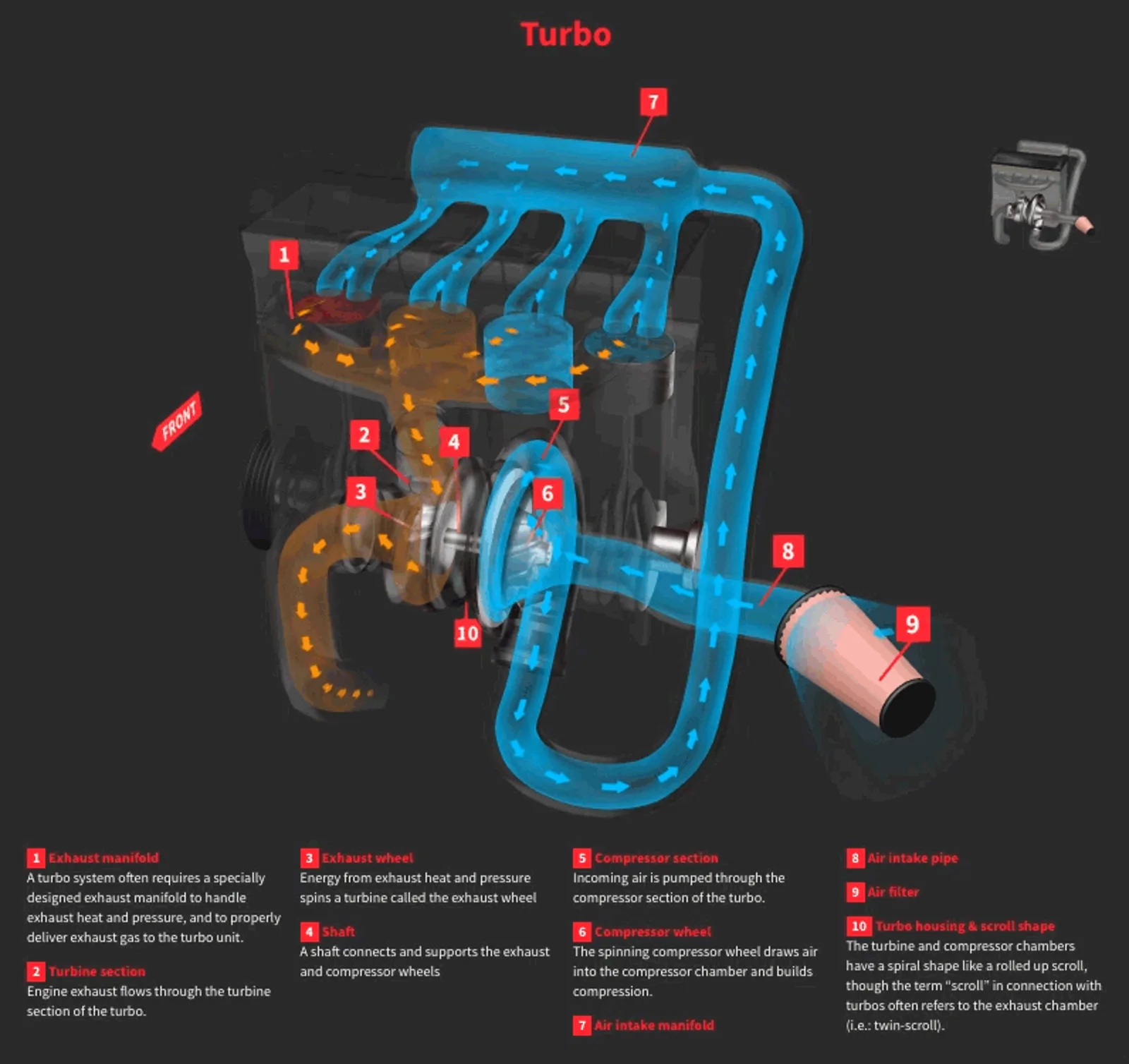
Exhaust gas spins a turbine on the hot side of the unit. A shaft carries that rotation to a compressor on the other end, which draws in outside air, pressurises it and feeds it to the engine. Nothing extra is taken from the crankshaft; the energy comes from gas that would otherwise leave the tailpipe.
The speeds involved are extreme. The turbine can spin at up to 250,000 rpm, so the centre housing that carries the shaft needs a bearing that runs with minimal friction. Some of these housings are water-cooled, partly to stop the lubricating oil from overheating. A lighter shaft also helps reduce lag.
Size is a trade-off. A large turbine wants a strong flow of exhaust before it does anything, which brings more lag and a higher boost threshold. A small turbine builds boost quickly at low flow because it has less rotational inertia, but it can cap peak power. Most of the clever hardware is aimed at getting the benefits of both.
A turbo left to itself would deliver full boost at maximum revs and full throttle, which is no use on a road. So it comes with helpers. An intercooler cools the air after compression, because squeezing air heats it and heat raises the risk of knocking and pre-ignition. A wastegate limits the exhaust entering the turbine, since boost can otherwise exceed what the engine can safely withstand. A blow-off valve stops the compressor stalling when the throttle closes. Higher-octane fuel resists knock better, which allows more boost to be used.
What is turbo lag, and has it been fixed?
Turbo lag is the delay between pressing the throttle and the turbo supplying boost. After the pedal goes down, exhaust flow has to rise and spin the turbine up to useful speed, and that takes time. It is largely cured in some designs and reduced in most, but not removed from every engine.
Boost threshold is a close relative that is often mistaken for lag. It describes an engine running below the rpm range in which the turbo can work at all, where exhaust flow is too weak to spin the turbine enough. Lag is often down to a turbo that is too large for the engine displacement.
The fixes read like a list of the engineer's toolbox. Makers cut rotational inertia with smaller-radius parts and lighter materials, including ceramics, and cut bearing friction with foil bearings in place of oil bearings. They shrink the volume of pipework between the compressor and engine, fit antilag systems, or use several turbos in sequence or in parallel.
Two designs get more attention. A twin-scroll turbo splits the cylinders into two groups and sends each group's exhaust pulses down a separate passage, so they stop interfering with each other. Its two nozzles differ in size, the smaller and steeper one serving low-rpm response. A variable-geometry turbo adjusts vanes inside the turbine housing, keeping the unit working at its best ratio as the engine speeds up. The payoff is usually shorter lag, an earlier start to boost and better efficiency when the engine is working hard.
The latest answer is electric. In the early 2020s, mild hybrid integration made it possible for an electrically assisted turbocharger to start spooling before the exhaust provides enough pressure, which helps most in stop-and-go urban driving. An electric supercharger goes further and uses a motor alone to spin the compressor, for immediate throttle response and no lag.
Is a supercharger a better answer than a turbo?
A supercharger is driven mechanically, usually by a belt from the crankshaft, so it has no lag but takes a constant toll on the engine. That constant load is why supercharged engines tend to use more fuel. Turbos recover energy from exhaust that would be wasted, at the price of lag at low revs.
The choice shows in where each is used. Supercharged engines are common where response matters most, such as drag racing and tractor pulling. A supercharger also has simple pipework, while a turbo must route hot exhaust through a crowded engine bay beside the intake, so the intake air is more exposed to heat soak. That explains why turbo engines use intercoolers more often.
Not all superchargers are equal. Roots blowers, a positive displacement design that gives a nearly constant boost at all engine speeds, tend to be only 40 to 50% efficient at high boost levels. Dynamic superchargers manage 70 to 85%, and their boost rises with engine speed.
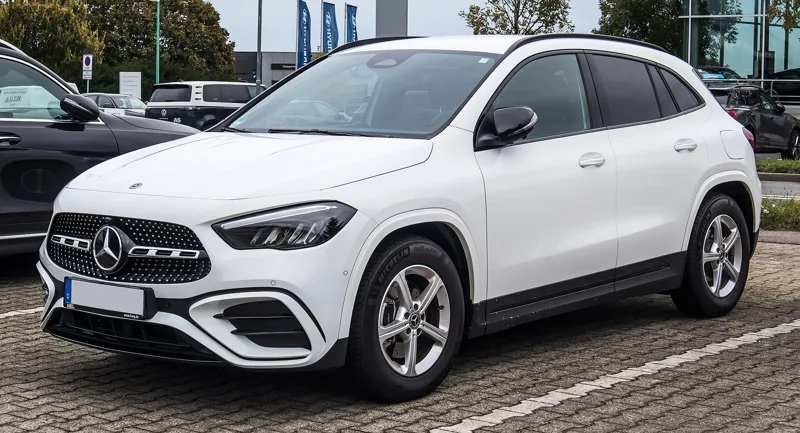
Supercharging is the older technology on the road. Mercedes put the 6/25 and 10/40 into series production in 1923, branded Kompressor, a name used on various models until 2012, and the Blower Bentley followed in 1929. In the 21st century makers have shifted towards turbos for fuel economy and power. Mercedes-Benz replaced its early-2000s Kompressor engines around 2010 with turbocharged ones, although the Audi 3.0 TFSI supercharged V6 and the Jaguar AJ-V8 supercharged V8 both received updates in 2009.
Some makers have tried to combine the two. Lancia's Delta S4 used both a belt-driven supercharger and an exhaust turbo in the 1985 and 1986 World Rally Championships, switching between them with an electromagnetic clutch and a web of valves. It added complexity, weight and reliability problems in competition. Production twincharged engines have been rare: a Volkswagen 1.4 litre from 2005 to 2013 and certain Volvo 2.0-litre B4204T units from 2014.
How do the three approaches compare?
| Feature | Naturally aspirated | Turbocharged | Supercharged |
|---|---|---|---|
| How air gets in | Atmospheric pressure against a partial vacuum | Compressor driven by exhaust gas | Compressor driven mechanically, usually by belt |
| Throttle response | Direct, no lag | Lag and boost threshold | No lag |
| Efficiency | Lower than a same-size forced induction engine | Makers shifted to turbos for lower fuel consumption | Typically less efficient because of constant drive load |
| Complexity | Fewer moving parts; easier to maintain and repair | Complicated piping; heat soak; intercooler | Relatively simple piping |
| At altitude | Greater power loss | Offsets some of the loss | Offsets some of the loss |
| Earliest marks | The original arrangement | 1905 Buchi patent; first cars in 1962 | First engine in 1878; series cars in 1923 |
How did the turbo end up in everyday cars?
Alfred Buchi's 1905 patent is often seen as the birth of the turbocharger. His first prototype in 1915 was unreliable and never reached production, and the first commercial unit was delivered in June 1924. A year later, Buchi turbochargers lifted a ten-cylinder diesel from 1,300 to 1,860 kilowatts (1,750 to 2,500 hp).
Aircraft and trucks came first. The Boeing B-17 used turbos in 1938, and Saurer offered them as an option on truck engines from 1931. Car makers started research in the 1950s but ran into lag and bulk. The first turbocharged cars were the 1962 Chevrolet Corvair Monza and Oldsmobile Jetfire, both short-lived.
Racing proved the case. The 1968 Indianapolis 500 was the first large race won on a turbo, and the Porsche 935 and 936 won both Sportscar World Championships and Le Mans in 1976. Porsche turbocharged its air-cooled flat six in 1973. In Formula One, turbos delivered the first race wins in the late 1970s and the 1983 world title, with a BMW four-cylinder whose design dated to 1961. The Mercedes 300 D brought the turbodiesel to passenger cars in the 1970s, and from the 1980s turbocharging spread as a way to extract more from smaller engines.
Why did car makers downsize their engines?
Downsizing means fitting a smaller engine where a larger one of similar power would have gone. Emissions and efficiency legislation drove it. Add a turbo or supercharger and direct injection and a small engine can match a much larger one while burning less fuel and emitting less carbon.
The logic has a second leg. Smaller engines are often lighter, so less energy goes into moving the car, and fewer cylinders mean less internal friction. Examples came quickly. Volkswagen showed a 1.4 TSI at the 2005 Frankfurt Motor Show, with 125 kW (170 PS) from a turbo and a supercharger together and fuel consumption 5% lower than the 2.0 FSI it replaced. BMW has fitted 2.0-litre four-cylinders in place of 3.0-litre sixes since 2011, with the N20 replacing the N52 and N53. Mercedes-Benz uses small 1.8-litre fours instead of larger V6s, and Renault's R-Type 1.6 diesel took over from a 1.9.
Not everyone is persuaded. Some observers doubt the manufacturers' efficiency claims, and some tests have found the smaller engine thirstier on ordinary roads than the bigger one it replaced. Research from the University of Bath showed that engine capacity could be cut by 60% while keeping the torque curve of a modern large naturally aspirated engine.
Are turbo engines less reliable?
Reliability is a mixed picture. Naturally aspirated engines are said to gain reliability partly from having fewer separate moving parts, and they are less prone to overheating and knocking. For turbo engines, one magazine inspection found a clean bill of health, while other reports and a survey point the other way.
Auto Bild examined a 1.0 EcoBoost Ford Focus after 100,000 kilometres (62,000 mi) and found no major issues, only minimal oil sweating between cylinder and block. In contrast, the turbocharged Audi 2.0 TFSI has often been reported with worse oil leaks at the cylinder seals, burning as much as one litre of oil every 300 kilometres (190 mi), and Volkswagen Group's 1.4 and 1.8 TFSI units have drawn comparable complaints. A J.D. Power survey rated downsized engines significantly lower on reliability than older designs.
Which should you choose?
- Naturally aspirated: more direct throttle response, easier maintenance and repair, lower development and production cost, and less chance of overheating or knocking. The price is lower efficiency, a lower power-to-weight ratio, less scope for tuning and a bigger power loss at higher elevation.
- Turbocharged: more power and torque from a small, light engine, better fuel efficiency in many cases and smaller loss at altitude. The price is lag, extra heat to manage, complex plumbing and a patchier reliability record.
- Diesel: in practice there is no choice, because almost all diesels today are turbocharged.
Where this goes next
The direction of travel points to electrification of the boost itself. Electrically assisted turbochargers, enabled by mild hybrid integration in the early 2020s, are designed to cut lag and improve efficiency, mainly in urban driving. Mechanical supercharging has become less common this century, though it has survived in a few engines.