From a 1984 Volkswagen deal to 100 million vehicles delivered by SAIC, three of China's four big state-owned carmakers and the foreign brands that share their factories.
Three of the four big state-owned carmakers in China are SAIC Motor, FAW Group and Dongfeng Motor. SAIC owns MG, FAW builds Hongqi and Dongfeng backs Voyah, and each runs joint ventures with foreign makers such as Volkswagen, General Motors, Toyota and Nissan to produce and sell cars in China.
On 28 May 2026 an IM LS9 Hyper was handed over in Shanghai as the 100 millionth vehicle delivered by SAIC Motor, the first Chinese automotive group to pass that mark in cumulative production and sales. SAIC, FAW Group and Dongfeng Motor are three of China's four big state-owned carmakers, and between them they stand behind MG, Hongqi and Voyah.
Who are the biggest Chinese car companies?
The "Big Four" label takes in SAIC Motor, FAW Group, Dongfeng Motor and Changan Automobile. SAIC is the largest, with sales above 4.5 million vehicles in 2025. FAW is described as the second largest. Dongfeng is the smallest of the four, at 671,000 sales in 2023, a figure that sits below SAIC, Changan and FAW.
Ownership differs a little between them. FAW and Dongfeng are central state-owned enterprises, controlled through SASAC, the State Council body that acts as their investor under Chinese law. SAIC is state-owned too, but its rise owed a great deal to Shanghai's municipal authorities, and at one time it was simply an extension of the city government.
The order has not always looked like this. In 2010 SAIC made 3.58 million vehicles, the most of any China-based maker, while Dongfeng sold 2.72 million and FAW 2.56 million. By 2012 SAIC held its lead with around 3.5 million, Dongfeng built over 2.76 million and FAW 2.3 million.
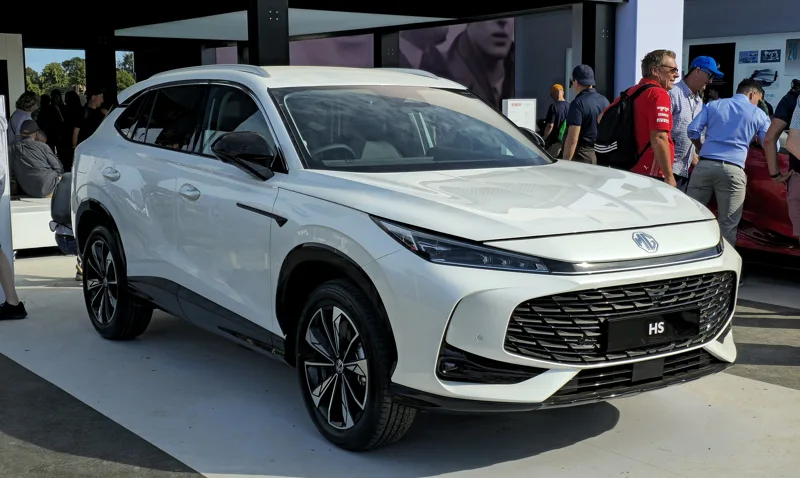
A Roewe at home is an MG abroad, and behind both badges sits a state-owned group in Shanghai.
SAIC, FAW and Dongfeng side by side
| Item | SAIC Motor | FAW Group | Dongfeng Motor |
|---|---|---|---|
| Founded | 1955 | 15 July 1953 | 1969 |
| Headquarters | Anting, Shanghai | Changchun, Jilin | Wuhan, Hubei |
| Place among the Big Four | Largest | Second largest | Smallest |
| Own brands | MG, Roewe, IM, Maxus | Hongqi, Bestune, Jiefang, Yueyi | Voyah, M-Hero, Aeolus, Nammi, Forthing |
| Foreign partners | Volkswagen, General Motors | Volkswagen, Toyota, General Motors | Nissan, Honda, Peugeot-Citroen, Stellantis, Volvo (trucks) |
| First foreign joint venture | Volkswagen, 1984 | Volkswagen, 1990 | Citroen, 1992 |
What is SAIC Motor and how did it get so big?
SAIC Motor, formerly the Shanghai Automotive Industry Corporation, grew out of an assembly plant set up in Shanghai around the Second World War, and it was still small in the 1970s. What changed its fortunes was a 1984 cooperation agreement with Volkswagen, followed in March 1985 by the formal creation of Shanghai Volkswagen, which let it build competitive cars with foreign technology.
Growth was fast. In the 11 years to 1996, annual capacity rose ten-fold to 300,000 units, helped by guidance from the city authorities. Shanghai's government also set a goal of building a local parts industry, and it worked. In 1987 the Volkswagen Santana carried only a radio, an antenna and tyres from local suppliers; by 1998 more than 90% of its components were sourced locally. The city's share of national component output more than doubled between 1990 and 1996.
A second partnership followed. Shanghai General Motors was agreed in June 1997 and began operations in 1998, and SAIC's vehicle production doubled between 2000 and 2004. The group also went shopping abroad. It took a 10% stake in GM Daewoo for US$59.7 million in 2002, then paid US$500 million in 2004 for 48.9% of South Korea's SsangYong. That one soured: another US$45 million could not stop receivership in January 2009, the stake fell from 51.33% to 10% by 2010, and workers staged a 77-day sit-in.
British MG Rover was the next target. In 2005 SAIC was outbid by Nanjing Automobile, but it came away with some MG Rover technology, which went into a new line of luxury saloons sold as Roewe, and it later bought the company that had beaten it.
Who owns MG?
SAIC does. MG sits on the list of brands SAIC calls self-owned, alongside IM, Maxus, Roewe, Baojun, Wuling, Hongyan and Sunwin. Roewe, introduced in 2006, goes by the MG Motor name in most export markets, so a Roewe at home is an MG abroad.
The British link is mostly historical now. Assembly resumed at the Longbridge plant on 13 April 2011, when the first UK-built MG 6 came off the line, and it stopped in 2016 once SAIC shifted output to China. A technical subsidiary, SAIC Motor UK, remains on the site.
Elsewhere MG runs through local partnerships. SAIC makes MG vehicles in Thailand through a joint venture with Charoen Pokphand. In India, JSW MG Motor India dates from 2019; in 2023 the former wholly owned subsidiary became a venture with the JSW Group, and it took its current name in 2024.
What is the European tariff on SAIC's electric cars?
The European Commission opened an anti-subsidy investigation in September 2023 into Chinese electric vehicle makers, including SAIC, which was exporting electric cars to Europe in high volume under the MG name. The duties took effect on 4 July 2024. SAIC's rate was the highest of the Chinese makers affected: 37.6 percent, cut from a proposed 38.1 percent.
That sits on top of the existing 10 percent tariff on all foreign-made vehicles, whatever powers them. SAIC called the decision unfair market discrimination that went against free trade. In July 2024 it asked the Commission for a hearing, saying the investigation had demanded commercially sensitive information, including battery chemical formulas, which it declined to hand over as outside the scope of a normal inquiry. State subsidies to SAIC in 2023 came to the equivalent of US$560 million.
What else does SAIC build?
The range runs from luxury electric cars to city runabouts and heavy trucks. IM, launched on 13 January 2021 and known in Chinese as Zhiji, was developed alongside Alibaba and the Pudong New Area government in Shanghai, and SAIC says the name stands for "Intelligence in Motion".
Another big name is SAIC-GM-Wuling, based in Liuzhou in southwestern China, in which SAIC is the largest shareholder alongside General Motors and Guangxi Automobile Group. The Wuling Hongguang Mini EV city car sold more than any other electric vehicle in China in 2021. Counting that venture, SAIC was the third-largest plug-in company in the world that year with a 10.5% share, and the second-largest for battery-electric vehicles with 13%.
In April 2025 SAIC and Huawei unveiled a fifth brand under HIMA, called Shangjie in Chinese. In July 2023 SAIC and Audi announced that IM's electric platform would be used in Audi's electric models. SAIC's own brands made up 52% of its sales in 2021, and the group stood 84th in the 2023 Fortune Global 500.
How did FAW Group start?
Ground was broken on the first factory in 1953, the opening year of China's first five-year plan, and FAW, First Automotive Works, was founded on 15 July that year. Its first product was the Jiefang CA-10 truck in 1956, based on the Soviet ZIS-150. The Soviet Union supplied technical help, tooling and machinery, and 39 FAW employees trained at the Stalin Truck Factory before their own plant opened.
Cars came in 1958 with the Hongqi, the first passenger car made in China. Built mainly for the party elite, its design changed little over a thirty-year run, and FAW's Audis later became the traditional choice of senior state officials.
Which brands does FAW build today?
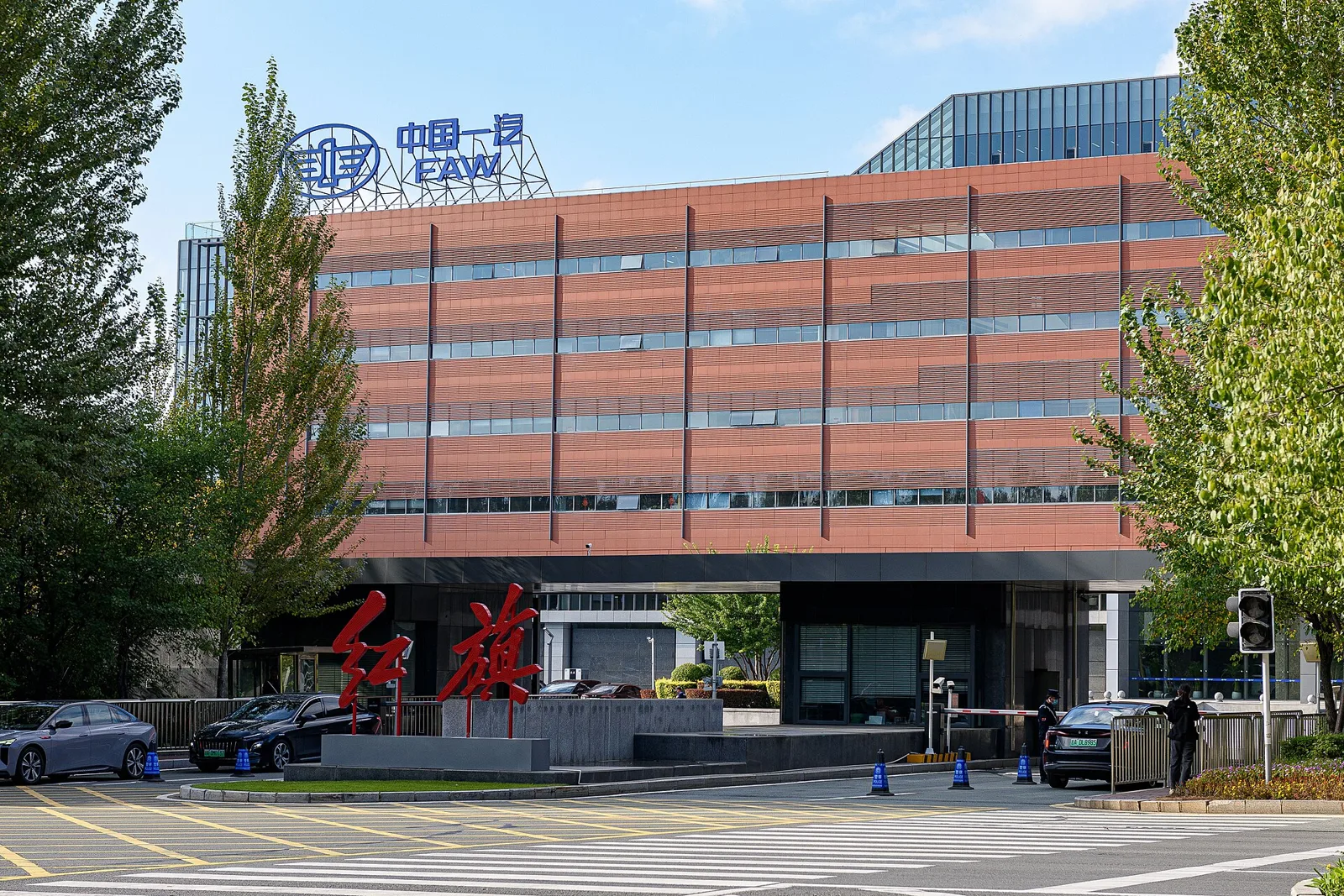
Hongqi, meaning "red flag", is FAW's luxury marque and the oldest Chinese passenger car brand, launched in 1958. Bestune, set up on 18 August 2006, is the main passenger car name, and Jiefang covers medium and heavy trucks. Yueyi started as a Bestune line after Yueda Group invested in 2023 and was promoted to a stand-alone new-energy brand in June 2026 at the Yueyi 08 launch.
British designer Giles Taylor took on design leadership at the group in September 2018, with the title of chief creative officer for Hongqi. FAW once sold under at least ten brands, but by 2024 most had been liquidated or merged, leaving Hongqi and Bestune as the passenger car names. Haima began in 1992 as Hainan Mazda Motor, came to FAW when it bought Mazda's share in 2006, and in July 2021 FAW handed 49% of it to Hainan Development Holdings at no charge. Oley, aimed at young buyers, was defunct by 2015, and the electric brand SiTech was set up in 2018. Trucks and buses stayed a big part of the mix: passenger cars were only 64% of FAW's output in 2012.
How do the foreign joint ventures work?
A joint venture is a company owned in shares by a Chinese state group and a foreign maker, set up to build and sell the foreign maker's vehicles in China, rather like two families co-owning one house. SAIC-Volkswagen, begun in 1984, is the oldest that survives. Stakes can be lopsided or even: FAW-Volkswagen was 60% Chinese and 40% German as of 2003, while Dongfeng's truck venture with Volvo is split 55-45.
Each group has its own partner list. SAIC works with Volkswagen, whose joint venture builds Volkswagen and Audi cars, and with General Motors through SAIC-GM, which makes Buick, Chevrolet and Cadillac vehicles for China and for export. FAW's first foreign partner was also Volkswagen, in 1990, and Toyota followed after FAW bought half of Tianjin Automotive Xiali in 2002 and the FAW-Toyota venture was created in 2003. FAW's venture with General Motors, set up in 2009, mainly makes Jiefang light-duty trucks. Audi FAW NEV, formed in 2021 in Changchun, is Audi's first majority-controlled electric-vehicle partnership in China.
Dongfeng collected partners faster than anyone. Its first venture, in 1992, was with France's PSA Group and was the forerunner of today's Dongfeng Peugeot-Citroen. Kia (2002), Honda (2003) and Nissan (2003) followed, and by 2011 it had more such ventures than any other Chinese carmaker. In 2021, foreign-branded cars took 79% of its sales. The Nissan venture, DFL, is the largest and also produces cars under the Infiniti and Venucia names.
Not every tie lasts. In December 2013 Dongfeng and Renault agreed a 50:50 venture with an initial investment of 7.76 billion yuan (US$1.27 billion), Dongfeng's sixth with a foreign maker. In February 2014 Dongfeng Motor Group took a 14% stake in PSA Peugeot Citroen when the loss-making company was recapitalised. Then in 2020 Dongfeng dissolved Dongfeng Renault and Dongfeng Yulon, and in 2021 it withdrew from Dongfeng Yueda Kia.
Where did Dongfeng Motor come from?
Dongfeng was founded in 1969 in a village of 100 residents that later grew into the city of Shiyan. Planning for a military truck plant stretched back to the Korean War, when a copy of the GAZ-51 truck was wanted, and several sites were chosen and dropped, partly over fear of air raids. The remote spot won because more than 40 shallow valleys allowed factories to be hidden.
Progress was slow. With limited equipment, Dongfeng had made only 200 vehicles by 1972. The first EQ240 2.5-ton truck came in 1975, then the EQ140 in 1978, the company's first civilian truck, which at its peak held 66% of the domestic market. Output passed 100,000 vehicles a year in 1986, and in 1992 the company took the name Dongfeng, Chinese for "East Wind".
Reform changed its shape. Between 1978 and 1985 Dongfeng changed from a scattered two-truck producer into one centrally managed enterprise, merging six truck bases. Commercial vehicles made up about 73% of production in 2001; by 2012 passenger cars were 73%, though that count may include microvans.
What is Dongfeng doing with Huawei and Nissan?
Dongfeng now leans on two big relationships for its newer cars. Huawei supplies technology under a "Huawei Inside" arrangement for M-Hero and Voyah models, and Nissan's Chinese venture is being turned into an export base. Voyah, introduced on 17 July 2020, is the electric brand through which much of this runs.
Voyah was launched in September 2020 at the Beijing Auto Show, and its first car, the Free, a mid-size crossover with extended-range or pure electric power, arrived on 18 December 2020. In March 2024 Huawei said M-Hero and Voyah would use its Inside mode, and in November 2024 Dongfeng Nissan signed with Huawei to build a vehicle around its cockpit software, the first Sino-foreign venture to do so. In September 2025 a new company with Xiangyang state investors was agreed with registered capital of RMB 8.47 billion, to share the M-Hero brand for lightweight off-road SUVs. The Yijing brand, with the Western name Epicland, followed in November 2025, and its first model, the X9, was unveiled on 20 April 2026.
The Nissan side moved in 2025. In July Dongfeng and Nissan announced a 60/40 venture to export vehicles and parts made by Dongfeng Nissan, and in November Nissan Import and Export (Guangzhou) was set up, the first joint-venture import and export entity created by a foreign-funded carmaker in China. Two models built around Chinese development, the N7 and the Frontier Pro PHEV, are the first Dongfeng Nissan products aimed at export.
Which badge belongs to which group?
Most of the names on Chinese roads trace back to one of the three groups, either as their own brand or through a venture with a foreign maker.
- MG, Roewe, IM, Maxus and the Shangjie brand: SAIC.
- Wuling and Baojun: SAIC-GM-Wuling, with SAIC the largest shareholder.
- Buick, Chevrolet and Cadillac in China: SAIC-GM.
- Volkswagen and Audi in China: SAIC-Volkswagen and FAW-Volkswagen, with Audi FAW NEV for electric Audis.
- Toyota in China: FAW-Toyota.
- Hongqi, Bestune and Yueyi: FAW.
- Nissan, Infiniti, Venucia and Honda in China: Dongfeng ventures.
- Voyah, M-Hero and Epicland: Dongfeng.
What are the three groups planning next?
FAW's most concrete plan is with Leapmotor. The two signed a memorandum on strategic cooperation in March 2025, and in May 2025 Leapmotor chairman Zhu Jiangming said they would jointly develop a Hongqi model for overseas markets, built on the Leapmotor B10 platform with battery-electric and range-extender versions. Leapmotor's Hangzhou plant is due to start building it in the second half of 2026.
In December 2025 Leapmotor announced that FAW would buy 5% of its shares for 3.744 billion yuan. Half the money is earmarked for research and development, a quarter for working capital and general purposes, and a quarter for the sales and service network and brand awareness. The holding of Zhu and fellow shareholders would dilute from 23.75% to 22.56%, and Stellantis's from 19.99% to 18.99%.
Bestune has been drawing in outside money. A capital increase in September 2023 lifted registered capital from CNY 6.0 billion to CNY 8.4 billion and brought in Yueda Automotive as its first outside investor. A second round in September 2025 raised 8.55 billion yuan, and FAW's combined holding fell from 86.1568% to 79.0394% while Yueda rose to 10.3358%.
Dongfeng's biggest dated plan is with Stellantis. On 15 May 2026 the two signed an agreement with total investment above 8 billion RMB, planning to build new-energy Peugeot and Jeep vehicles at the Dongfeng Peugeot-Citroen plant in Wuhan from 2027, with two Jeep off-road models first and a global market in view. Stellantis would put in 130 million euros, and five local state-owned investors would account for 87% of the total. Exporting through Stellantis's channels could ease pressure from trade barriers and tariffs aimed at Chinese brands in Europe and North America.
Five days later Stellantis and Dongfeng announced plans for a Europe-based, Stellantis-led 51/49 venture to sell Voyah vehicles in designated European markets, and to localise Dongfeng new-energy models at the Rennes plant in France. In September 2026, GAC Group announced a plan to buy a slice of a vehicle venture that FAW holds, paying with newly issued shares; if that completes, FAW would become GAC's second-largest shareholder.