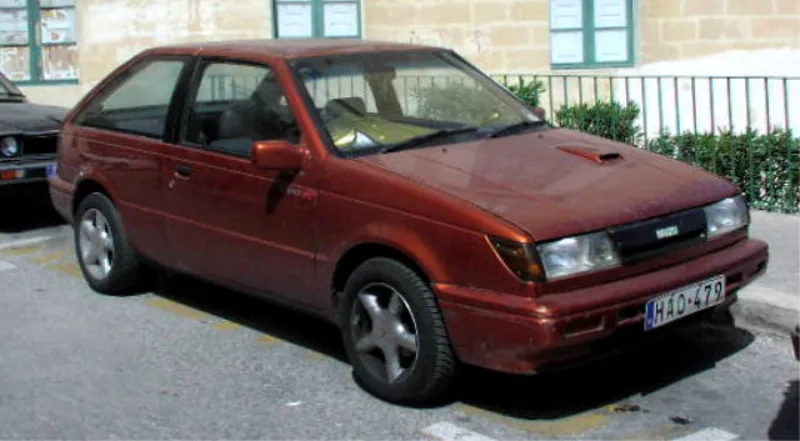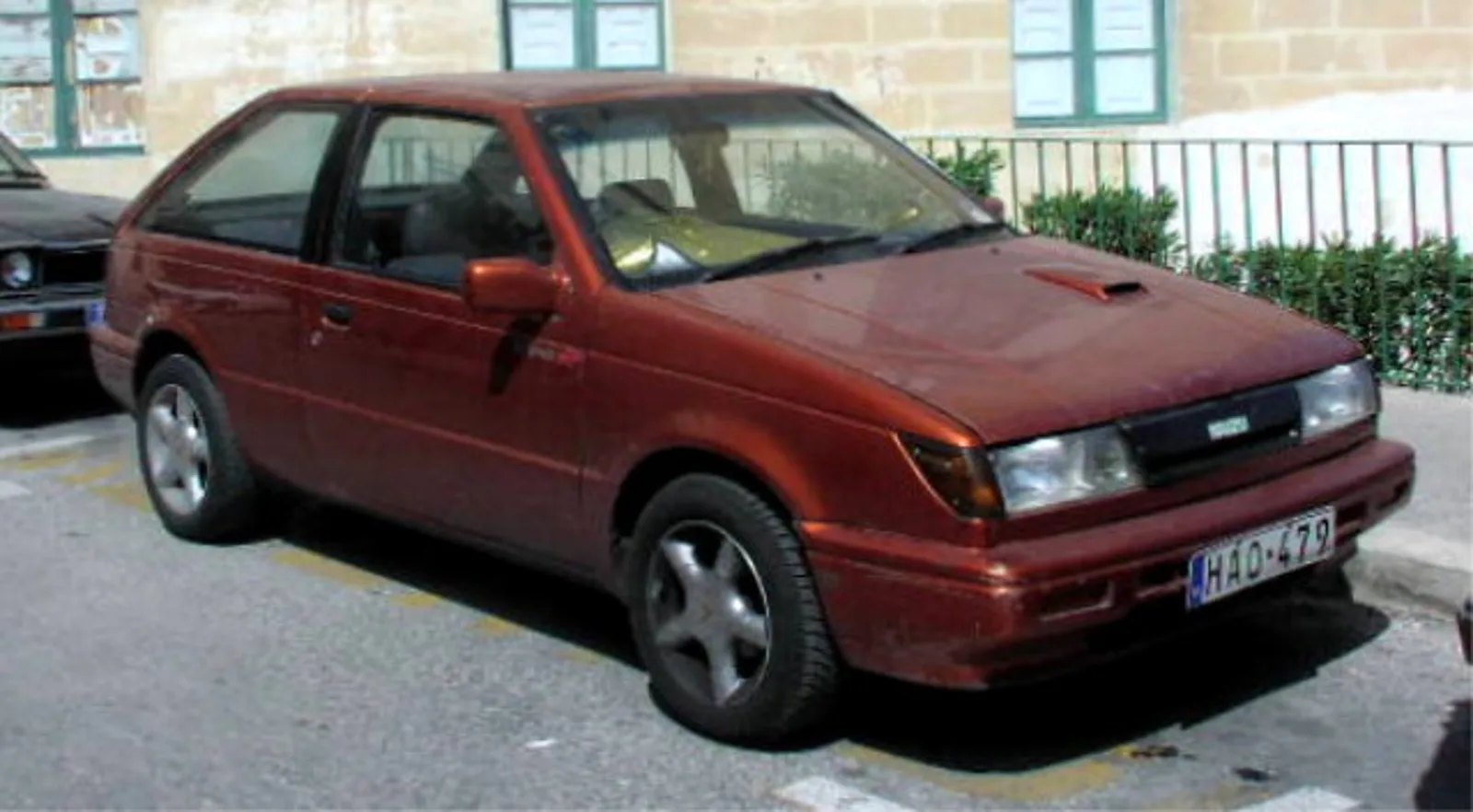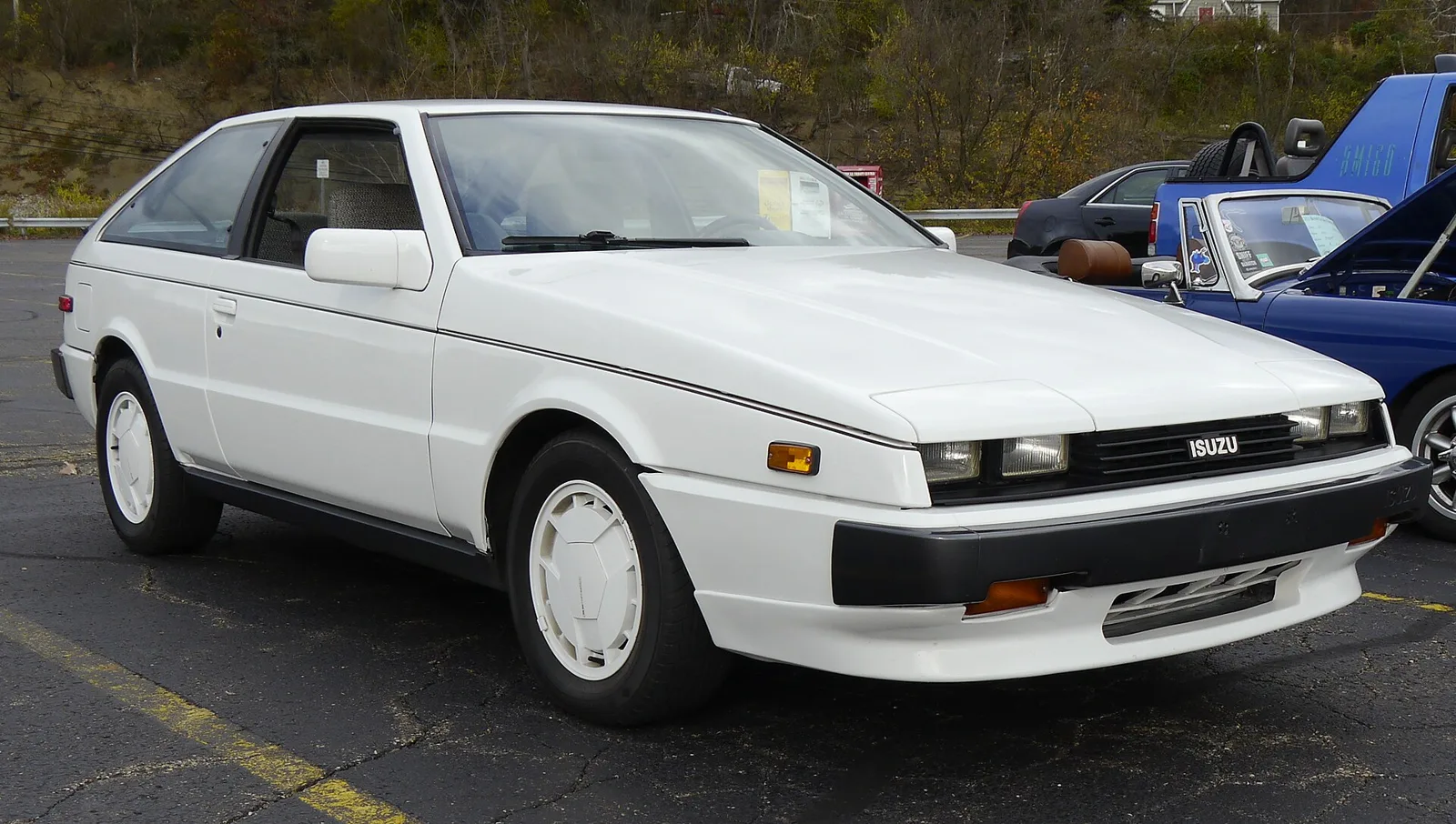
A subcompact built under Rootes licence, a big saloon with a horse for a namesake, a Giugiaro coupe and the Accord-based Aska that ended Isuzu's passenger cars in 2002.
The Isuzu Bellett, Florian, Piazza and Aska were Isuzu's passenger cars from 1963 to 2002. The Bellett and Florian were Isuzu's own designs, the Piazza was a Giugiaro coupe, and the last Askas were rebadged Hondas. Isuzu stopped passenger car sales in 2002.
Isuzu's last passenger car was a Honda Accord with a different grille. When production of that car, the Aska, ended in March 2002, it closed a run of passenger cars that began 49 years earlier. In between came a Rootes-licensed saloon, a big sedan named after a fictional horse and a coupe that Isuzu committed to building within 48 hours of showing it.
What was the Isuzu Bellett?
The Isuzu Bellett was a subcompact built from 1963 to 1973 that replaced the Hillman Minx, which Isuzu had been making under licence from the Rootes Group. Unlike the Minx, the Bellett was Isuzu's own design. A total of 170,737 of the original cars were made before General Motors-based replacements took over.
The word Isuzu translates as fifty bells, and the Bellett name was meant to suggest a smaller Bellel, an earlier and larger Isuzu. The range grew a lot of branches. There were four-door and two-door sedans, a rare two-door wagon sold as a commercial vehicle called the Express and, rarer still, a one-ton commercial called the Wasp. Later came coupe and fastback bodies, and the Bellett B, a four-door sedan with its own rear body and suspension.
The sedan arrived in June 1963 with a 1.5-litre overhead-valve petrol four and a 1.8-litre diesel. The 50 PS (37 kW; 49 hp) diesel had a very low final drive, 4.1:1, which held its top speed to 104 km/h (65 mph). In April 1964 it was joined by the 1.3-litre overhead-cam four already used in the Wasp, and in 1966 a mild facelift brought a revised front. The diesels disappeared with the second facelift of 1971. After General Motors took a stake in Isuzu, the Bellett gave way to GM's global T-car, first called the Bellett Gemini and then simply the Gemini, which had little technically in common with it.
Isuzu's last passenger car was a Honda Accord with a different grille, and it ended 49 years after Isuzu's first.
What was the Bellett B for?
The Bellett B arrived in November 1966 as a stripped-down version with a distinct tail and a bigger boot, aimed mainly at taxi operators. It used a live rear axle on semi-elliptic leaf springs, a cheaper and less bulky arrangement than the independent rear suspension of the regular Bellett.
The rear doors matched the standard car, but the section behind them was squarer, with rounded wheel openings and a rear panel that raked the other way. It had wide rectangular headlights instead of twin round ones. The B's suspension was also used for the bigger Florian that appeared in 1967.
How far did the Bellett travel?
The Bellett was the first Isuzu to go to Europe. Finland took a thousand cars in January 1965, and Isuzu entered Switzerland after showing at the 1965 Geneva Salon. Sweden, too, became a customer, receiving the first Japanese car to arrive there in regular numbers. Between 1963 and 1967 small numbers went to the US West Coast and Hawaii through Trans-Alpac Corporation, and exports to Canada began in March 1965, with local production starting in 1968.
The Finnish importer also sold Alfa Romeos and Jaguars, and so it advertised through racing. A Group 2-tuned four-door Bellett caught European commentators off guard with tenth place in the 1966 1000 Lakes Rally, a result they called sensational. In New Zealand, Campbell Industries assembled a 1.6-litre sedan at Thames from 1968 to 1970 under import rules known as the 300 club.
Why was the Bellett GT such a big deal?
The Bellett GT, launched in April 1964, was the first Japanese car billed as a GT. It was a two-door coupe, 40 mm (1.6 in) lower than the sedan, with a twin-carburettor 1.6-litre overhead-valve engine. A 1.5-litre version with front disc brakes followed in September 1964.
Late in 1966 a 1.6-litre single-overhead-cam engine, the G161, arrived with 90 PS (66 kW; 89 hp), a little after a fastback body joined the line. By 1969 the base engine made 95 PS (70 kW; 94 hp) and the GT-R was added. A 1.8-litre followed in 1970, along with the 115 PS (85 kW; 113 hp) 1800 GT, and after the 1971 facelift the softer 1800 GTN, with 100 PS (74 kW; 99 hp), took the N for Normal.
The GT-R, short for GT Type-R, was a racing version also sold to private buyers. First shown in September 1969, it took the 1.6-litre twin-cam engine from the 117 Coupe, added power brakes and was available only as a two-door notchback. A completely black bonnet set it apart. It had many racing successes, and only about 1,400 were built. In 2006 readers of the Japanese magazine Nostalgic Hero placed it tenth in their poll of the 50 best Japanese cars, and it appears in Gran Turismo 4 and later games in the series.
The Wasp pickup, introduced in 1963, ran until 1972, when the Faster took over, wearing Chevrolet LUV badges in many markets. Isuzu also showed a mid-engined, rear-drive two-seater concept at the 1969 Tokyo Motor Show, the Bellett MX1600, designed by Tom Tjaarda. It never reached production, though it is said to have inspired the Pantera, a car the same stylist drew for De Tomaso.
What was the Isuzu Florian?
The Isuzu Florian was an intermediate car built in Japan from November 1967 until 1983. Its body stayed much the same through that unusually long life, with only two moderate facelifts. It began life as a show car, the Ghia Isuzu 117 Sedan, in Tokyo in 1966, and shared its complete chassis with the 117 Coupe.
The Florian competed against the Toyota Mark II, Mazda Luce and Nissan Laurel. It had an uneasy start as Isuzu's top model, because its 1.6-litre G161 engine was only a downtuned version of the one in the cheaper Bellett. To separate the two, Isuzu added the 1600 Super Deluxe in March 1968, with air conditioning and leather seats. The sportier 1600 TS arrived in March 1969 with the Bellett GT's twin-carburettor engine making 90 PS (66 kW) at 5,400 rpm. In September 1969 the overhead-cam G161S lifted the Super Deluxe from 84 to 90 PS and the TS from 90 to 103 PS (66 to 76 kW).
The first facelift came in October 1970, together with a 1.8-litre engine of 1,817 cc, offering 100 PS in the Super Deluxe and 115 PS in the 1800TS (74 or 85 kW). The nose became longer and more prominent, adding 50 mm (2.0 in) to the overall length. Bodies were a four-door saloon and a five-door estate called the Van, which counted as a commercial vehicle in Japan and enjoyed tax breaks. Its rear doors were shared with the double-cab Isuzu Faster pickup.
How did the Florian fade out?
A further facelift in November 1973 reworked the rear of the sedans. By the 1976 Tokyo Motor Show the 1600 sedan had left the price lists, leaving the 1800 Super Deluxe with 105 PS. In October 1977 the Series II brought a new interior, double rectangular headlights and, from November, a diesel engine. None of that hid the outdated shape of Isuzu's large sedan.
The diesel gave sales a useful boost, but it was short-lived: diesel versions of the Nissan Laurel, Mazda Luce and Toyota Mark II arrived in 1978 and 1979. In May 1979 the petrol engine gained the I-CAS emissions system and reached 110 PS (81 kW). Production ended in October 1982, and stock lasted until April 1983, when the Florian Aska took over.
Isuzu built only 145,836 Florian sedans in 15 years, plus 42,625 Vans. Few were sold abroad, because Isuzu's passenger cars were mostly not sold through General Motors' channels. The pickup built on the same family, the Faster, had far greater reach: it went to North America as the Chevrolet LUV, to Europe as the Bedford KB and to Australia as the Holden Rodeo.
As for the name, it did not honour Saint Florian. It came from the fictional white Lipizzan horse belonging to the Emperor of Austria in Felix Salten's 1934 novel Florian - the Emperor's Stallion. Salten also wrote Bambi. The Series II carried stallion badging.
How did the Aska replace the Florian?
The Aska was the Florian's successor, born as part of General Motors' J-car programme. Launched in March 1983 with carburettor 1.8 and 2.0-litre petrol engines and a diesel, it was a four-door sedan only, because the Florian wagon had never sold well. It was called the Florian Aska in 1983 and 1984 and simply the Aska from 1985.
A turbodiesel with 89 PS (65 kW) joined in August 1983, and in October the LJ Turbo arrived, with a fuel-injected turbocharged 2.0-litre of 150 PS. In November 1985 the German tuner Irmscher added a version with a distinctive body kit, which became a cult object among some Japanese fans. In September 1984 the innovative but ultimately unsuccessful NAVi5 semi-automatic became available. Essentially a manual gearbox with the clutch worked by electronics, it predated Alfa Romeo's Selespeed by many years.
The first-generation Aska ended in March 1989 after 108,512 cars, leaving Isuzu without a contender in the segment for about a year. Abroad, Chile assembled it from kits as the Chevrolet Aska from 1984, Southeast Asia knew it as the Isuzu JJ, and New Zealand received it as the Holden Camira from 1984 to 1987.
Why did Isuzu rebadge the Aska?
Isuzu lacked the means to engineer a mid-size car alone. With the J platform ended outside America, it struck a short-lived alliance with Subaru, supplying Bighorns to be sold as Subarus in return for the Legacy, which Isuzu sold as the Aska from June 1990 in Japan only. The deal ended in May 1993, and so did that Aska.
A broader exchange with Honda followed. The Honda Accord sedan became the Aska in March 1994, once the Legacy-based car's stock had run out, and the only differences were the grille and logos. It carried a two-litre four with a four-speed automatic, and production stopped in September 1997, with sales from stock lasting another two months.
The fourth-generation Aska arrived in November 1997 on the next Accord. It remained a Japanese-only model. The 1.8 and 2.0 versions, coded CJ2 and CJ3, made 140 and 150 PS (103 and 110 kW), and buyers chose between a five-speed manual and a four-speed automatic. Beyond grille, logos and wheels, only the engine cover changed, losing the Honda logo and keeping VTEC. A light facelift came in June 2000, production ended in March 2002 and sales from stock ran until September. That closed Isuzu's passenger car story, 49 years after its first car was presented.
What was the Isuzu Piazza?
The Isuzu Piazza was a small, sporty three-door liftback coupe built from 1981 to 1993 across two generations. North America knew it as the Impulse, and Australia as the Holden Piazza. Rear-wheel drive on the first generation, it was also the first Isuzu passenger car to be widely sold in Britain.
In 1978 Isuzu asked Giorgetto Giugiaro to design a sporty replacement for the 117 Coupe, another of his designs. It supplied several Chevette T Series cars to his Italdesign studio and gave him free rein. The wedge-shaped result, the Asso di Fiori, or Ace of Clubs, drew rave reviews in Tokyo in 1979. Within 48 hours Isuzu had fast-tracked it into production with minimal changes. The single-blade wiper and a steering wheel adjustment that moved the instrument cluster with it both survived.
The first Piazza was assembled at Fujisawa in September 1980 with a 120 PS (88 kW) 2.0-litre single-cam engine from the 117 Coupe or a 135 PS (99 kW) twin-cam version. All were rear-wheel drive with five-speed manual or four-speed automatic gearboxes. A 180 PS (132 kW) turbo followed in April 1984. Trims ran from Bella through to Nero, and buyers could pick standard, Irmscher or Lotus suspension tuning.
How did the Piazza and Impulse do abroad?
The United States got the car as the Impulse in 1983, with a 90 hp (67 kW) 2.0-litre, and a turbo with 140 hp (104 kW) followed in 1985. In 1988 a 2.3-litre engine of 110 hp (82 kW) replaced the plain 2.0, offered only in the US because the larger engine would have cost Japanese buyers more road tax. Isuzu sold it with everything standard and just two trims. Magazines found the Turbo within 0.1 to 0.2 seconds of the Mitsubishi Starion and Dodge Conquest.
Britain saw the Piazza from 1985 in a single trim with the 147 bhp (110 kW) turbocharged 4ZC1-T engine. A gentlemen's agreement capped Japanese imports at 11 percent of the market, which limited Isuzu to 600 cars in the first year. The first importer, Isuzu GB of Maidstone, went out of business in 1986, mainly because of the high price, and London dealer Alan Day bought the remaining stock cheaply. From 1987 International Motors Group of West Bromwich held the franchise and sold only the updated Lotus car. The press had derided the earlier cars for poor handling, especially the antiquated live rear axle. Lotus kept the axle but changed the suspension layout, brakes, dampers and tyres, and added a hoop spoiler and Handling by Lotus badges.
The Lotus car stayed on sale until 1989, after which the importer concentrated on the four-wheel-drive Trooper. The second-generation car never went on sale in Britain or elsewhere in Europe. In Australia the Holden Piazza arrived in April 1986, turbo only, and was priced too high and flawed in handling. It left the market in the second half of 1987 after only 379 sales and was later replaced by the Holden Calibra.
What was different about the second-generation Piazza?
The second generation, JT22, used the R-body world car platform, GM's second version of it. GM had asked Isuzu for a Spectrum successor that would include a sportier model, the Storm, called the Gemini Coupe in Japan. Isuzu's design head, Shiro Nakamura, first designed the third-generation Gemini sedan on this platform, then turned to a coupe.
In the US it debuted as the Impulse XS for 1990, front-wheel drive only, with a twin-cam 1.6-litre (1588 cc) of 130 hp (97 kW). The Impulse RS of 1991 had a 160 hp (119 kW) turbo and all-wheel drive, and a wagonback joined that year. For 1992 the Turbo went and a 1.8-litre (1809 cc) engine of 140 hp (104 kW) became the base unit. Slightly over 13,000 were produced, including the Isuzu Stylus.
General Motors owned nearly half of Isuzu and also owned Lotus, which chose the 1.6-litre engine and gearbox for the Lotus Elan M100 and tuned the Impulse's suspension. Isuzu's own contribution was Nishiboric passive rear-wheel steering, which altered the toe of the rear wheels through the range of suspension travel. Japan received the Piazza from July 1991 through spring 1992, in front-drive 1.8 form only.
Why did Isuzu stop making passenger cars?
The fate of the Impulse shows why. A collapsing Japanese economic bubble, tougher emissions and crash-safety rules, and continued General Motors restrictions on the market segments Isuzu could build for pushed the company out of car making. The Aska rebadges kept the passenger-car badge alive in Japan until 2002. By 2010 only 2,300 Impulses were registered in North America.
Four nameplates at a glance
| Name | Years | Type | Numbers |
|---|---|---|---|
| Bellett | 1963 to 1973 | Subcompact, with GT and GT-R coupes | 170,737 originals |
| Florian | 1967 to 1983 | Intermediate sedan and Van | 145,836 sedans, 42,625 Vans |
| Aska | 1983 to 2002 | Mid-size sedan, from 1990 a rebadged Subaru or Honda | 108,512 first-generation cars |
| Piazza | 1981 to 1993 | Three-door liftback coupe | Slightly over 13,000 second-generation Impulses |