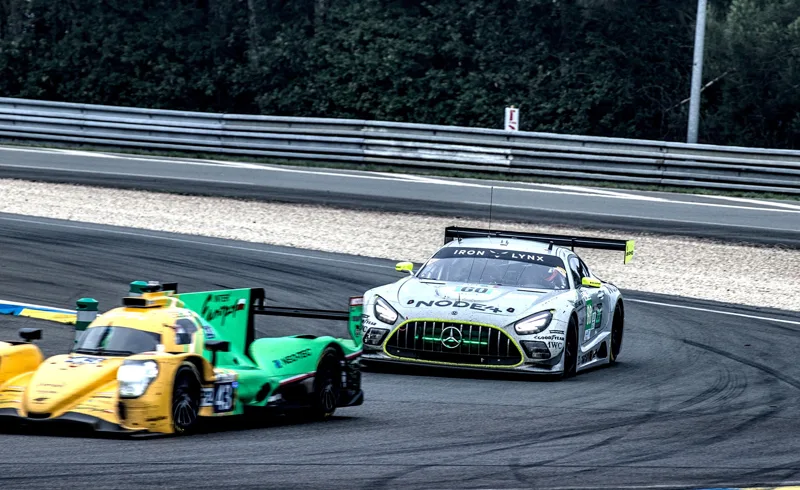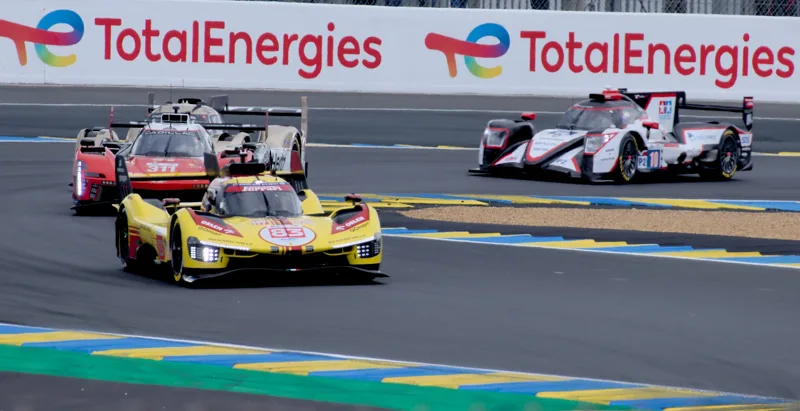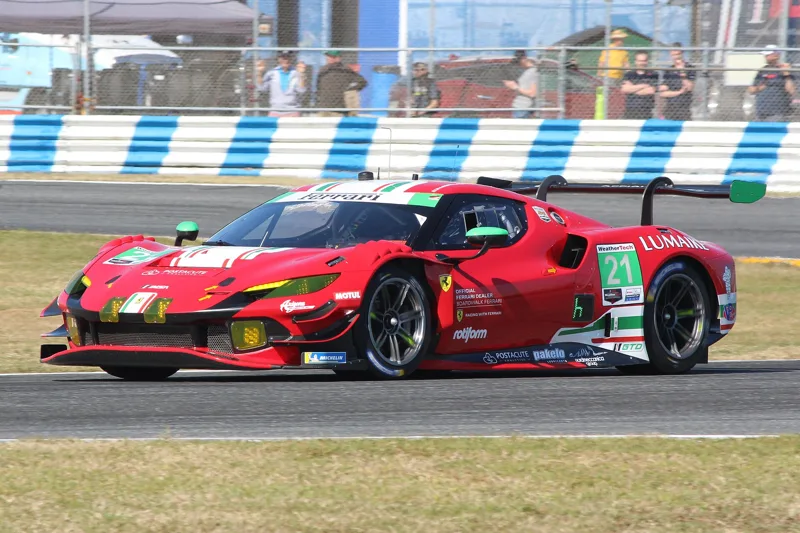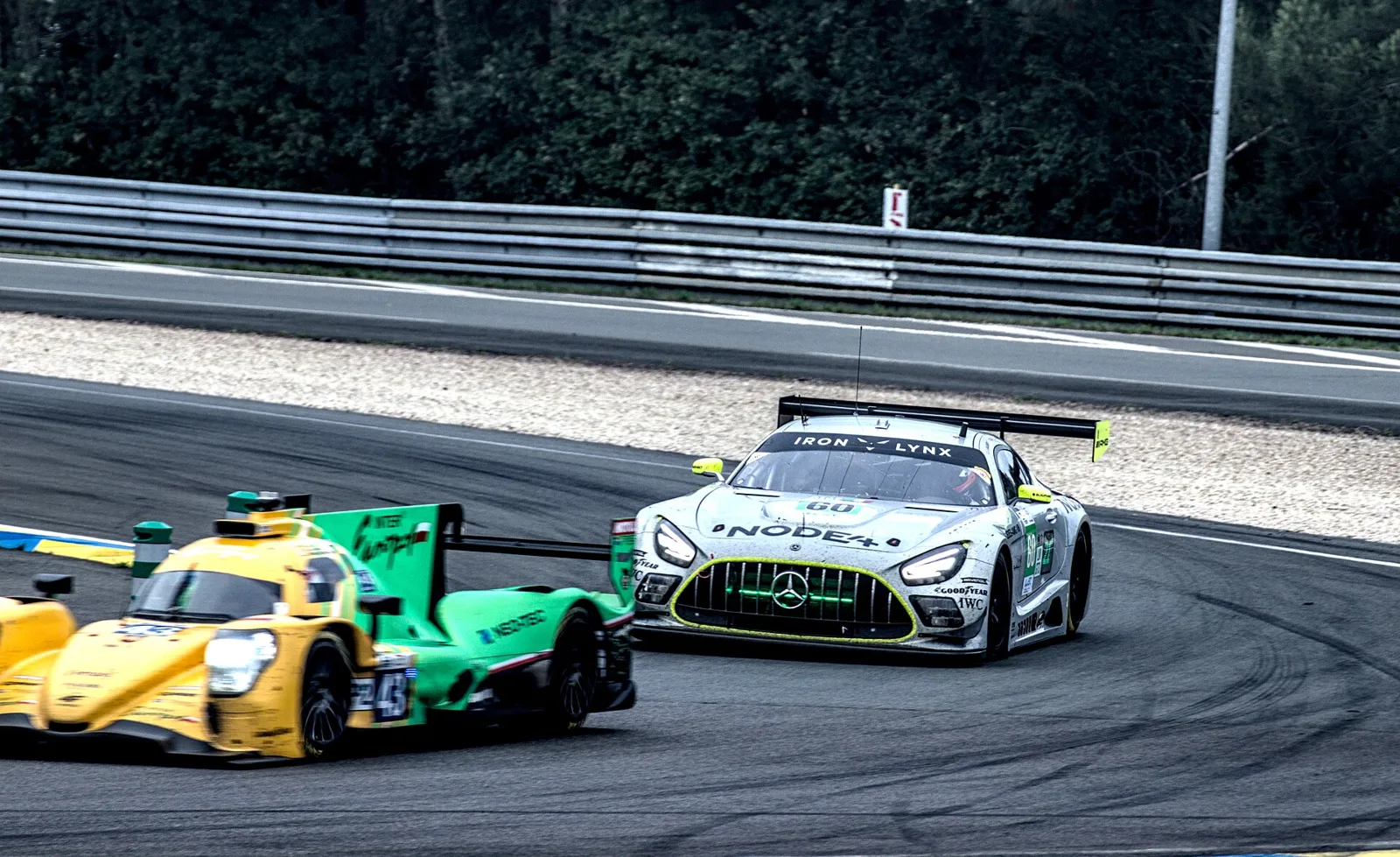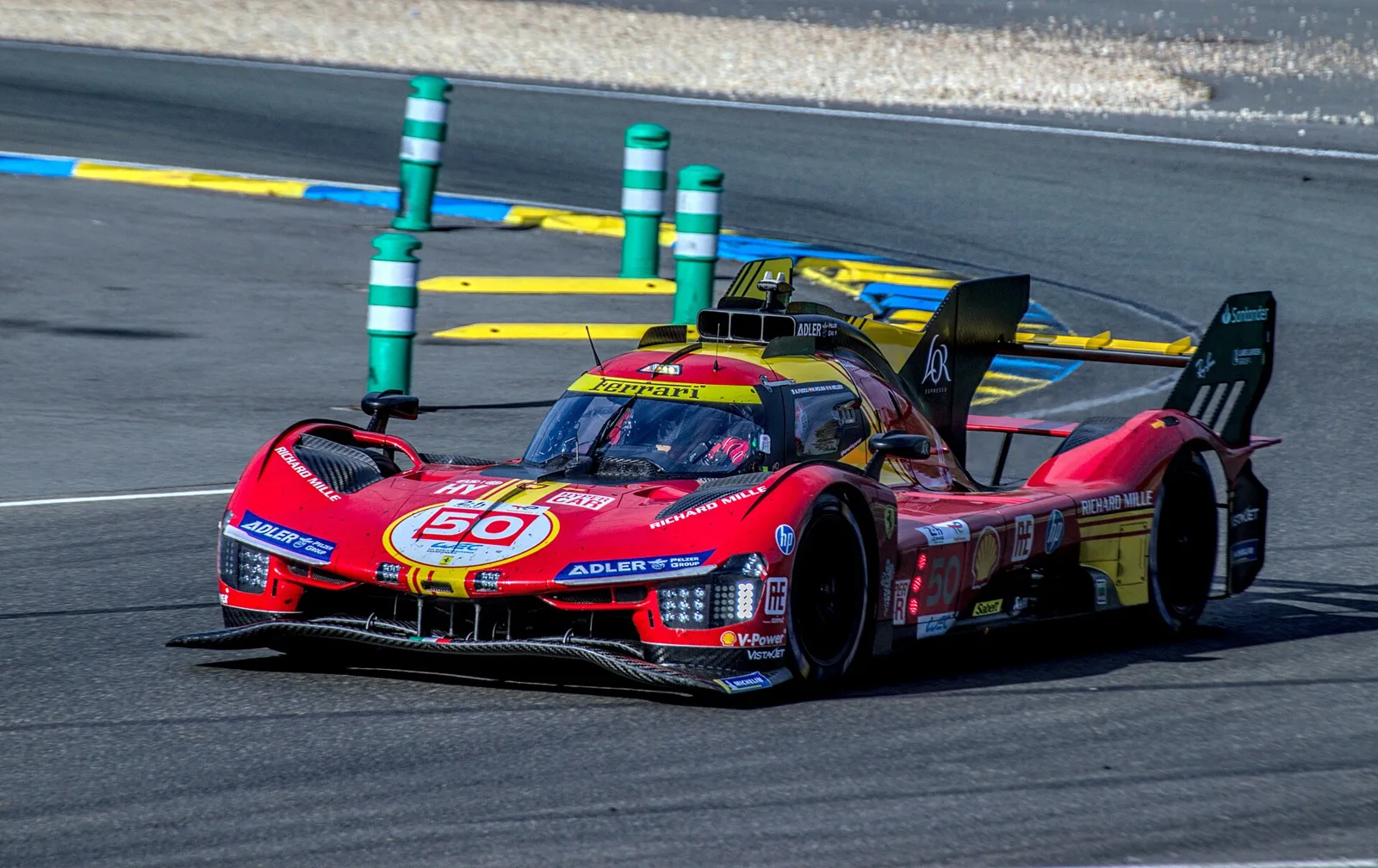
A V12 prototype built for an American series, a GT car that could switch to GT3 trim, and a hybrid hypercar that won on its first visit to La Sarthe.
Ferrari returned to sports car racing with the 333 SP in 1994, built the 488 GTE for the GT classes in 2016 and came back to the top class with the 499P in 2023. The 499P won Le Mans on its first attempt, Ferrari's first overall win there since 1965, and repeated the feat in 2024 and 2025.
Ferrari's new hypercar won the 2023 24 Hours of Le Mans on its very first visit, giving the marque its first overall victory at the race since 1965 and ending a streak of five wins by Toyota Gazoo Racing. The 499P marked the return of a factory-backed Ferrari prototype fighting for the outright win after a half-century away.
Ferrari's modern endurance story runs through three cars: the 333 SP of the 1990s, the 488 GTE of the 2010s and the 499P itself.
What was the Ferrari 333 SP?
The Ferrari 333 SP was a sports prototype designed by Ferrari and built first by the Italian firm Dallara and later by Michelotto. It was unveiled at the end of 1993 and was Ferrari's formal comeback to sports car racing after a gap since 1973, aimed at the new WSC class of the IMSA series, which replaced the older GTP cars.
The push came from Giampiero Moretti, an amateur racer who also owned MOMO, the auto parts firm. Forty chassis were built, and it is believed that 27 of them raced between 1994 and 2003.
Dallara supplied the transmission and suspension, handled the aerodynamics and built the bodywork. The gearbox used mechanical parts from Hewland inside a casing made by Dallara. Ferrari kept the chassis tub and the engine for itself. British race-car engineer Tony Southgate joined in early 1994 and stayed through 1995, helping to design and run the cars.
The engine, the Tipo F130E, was an adapted form of the 65-degree V12 from the 1990 Ferrari 641 Formula One car. It was enlarged from 3.5 to 4.0 litres and made 650 PS (478 kW; 641 hp) at 11,000 rpm, still roughly 41 to 71 PS (30 to 52 kW) down on the original. Southgate later rated it among the most reliable racing engines he had ever worked with.
The 499P won Le Mans on its first attempt, Ferrari's first overall victory at the race since 1965.
How successful was the 333 SP?
In the United States the car was an immediate winner, taking the first two places on its debut at Road Atlanta in April 1994. In Europe it stayed the car to own for years. At Le Mans , which it first visited in 1995, it never matched that form, with a best overall finish of sixth in 1997.
Four cars ran in three teams that first weekend: Euromotorsport with chassis 002 and 005, Momo Corse with 004 and Team Scandia with 003. At the next round, Lime Rock, the Italian cars occupied the whole podium, and they won three more races before the year ended. But Ferrari had skipped the opening rounds at Daytona and Sebring, and Oldsmobile took the makes championship. Ferrari's top driver was Andy Evans, fifth overall.
The 1995 season brought revenge. The car was unreliable at the 24 Hours of Daytona but won the 12 Hours of Sebring and four further races. Ferrari took the makes championship, Fermin Velez the drivers' title, with Mauro Baldi third and Wayne Taylor fourth. In 1996 the 333 SP tied Oldsmobile for the constructors' crown and lost on a tie-break, even though it won only two races. Max Papis finished second in the drivers' standings and Didier Theys fourth.
By 1997 the design was four years old and giving way to the more modern Riley and Scott. It still won at Sebring and took four more victories, finishing second in the makes table, but the best drivers' placings were fourth, fifth and sixth. A slight update in 1998 revived it. In the International Sports Racing Series (later the FIA Sportscar Championship) it won every race and took the top two places for Emmanuel Collard and Vincenzo Sospiri, with Theys and Fredy Lienhard runners-up. In America it won three IMSA rounds, Sebring among them, and Ferrari won the makes title with Taylor second in the drivers' standings. In the rival USRRC Can-Am series, the 333 SP finally took the Daytona 24 Hours.
From 1999 the car settled into European racing. The newly created American Le Mans Series was dominated by factory-backed Audi and BMW entries, which outclassed privateer Ferraris so consistently that in 2000 Doran Racing fitted a Judd engine to keep up. Across the Atlantic the 333 SP stayed the car to beat: Collard and Sospiri renewed their title in 1999, edging Christian Pescatori, who won it in 2000 with David Terrien, giving the JMB Racing-entered Ferrari three championships in a row.
The car faded as its chassis, engine and aerodynamics aged. No Ferrari prototype turned up in the American Le Mans Series in 2001. Risi Competizione's car did make a few Grand-Am starts, and a Judd-powered Doran chassis won the six-hour race at Watkins Glen. Marco Zadra took the 2001 FIA Sportscar Championship, but without the old dominance. After a year's absence in 2002, Giovanni Lavaggi's GLV-Brums team ran a Judd-powered example a few times, and the final appearance came at the 2003 500km of Monza.
What was the Ferrari 488 GTE?
The Ferrari 488 GTE was a grand touring race car from Ferrari's own Competizioni GT department, made for endurance racing. It replaced the 458 Italia GT and was based on the 488 GTB road car, built to the LM GTE rules that came into force for 2016.
It raced in the FIA World Endurance Championship, the European Le Mans Series and the IMSA SportsCar Championship's GTLM class, making its debut at the 2016 24 Hours of Daytona with Scuderia Corsa and Risi Competizione. Spy photographs taken on 30 August 2015 at the ACI Vallelunga Circuit had shown a heavily camouflaged test car with major differences from the outgoing 458. Ferrari launched the car at the 2015 Finali Mondiali at Mugello alongside its GT3 counterpart, revealing little beyond the fact that the engine carried over from the 488 GTB. It can be switched from LM GTE to Group GT3 trim.
On 13 November 2017, technical coordinator Ferdinando Cannizzo confirmed that the GTE and GT3 versions would both receive Evo kits to improve reliability and aerodynamic efficiency. The 488 GTE Evo had its shakedown at Ferrari's Fiorano Circuit on 30 March 2018. After a test in the WindShear wind tunnel, the front dive-planes were removed. Cannizzo suggested that a second evolution could keep the car racing until 2021, rather than Ferrari building a new one.
| Car | Category | Power | Debut |
|---|---|---|---|
| 333 SP | WSC prototype | 4.0-litre V12, 650 PS (478 kW; 641 hp) | 1994 IMSA round at Road Atlanta |
| 488 GTE | LM GTE | Engine carried over from the 488 GTB | 2016 24 Hours of Daytona |
| 499P | Le Mans Hypercar | 2,992 cc twin-turbo V6 plus a 200 kW front motor | 2023 1000 Miles of Sebring |
How does the Ferrari 499P work?
The 499P is a Le Mans Hypercar built by Scuderia Ferrari for the FIA World Endurance Championship, racing in the top class since 2023. Its project code is F255. A twin-turbocharged V6 and a front-axle electric motor share the work, and the car first appeared in October 2022 at Ferrari's Finali Mondiali.
Ferrari designed the car to the Le Mans Hypercar regulations. That means it avoids the standardised parts that rivals built to the other top-class rulebook, known as Le Mans Daytona h, must use, although Dallara still manufactures the chassis. Aerodynamic work was shared between Ferrari's Styling Centre, led by Flavio Manzoni, and the sports car engineering department under Ferdinando Cannizzo.
The 2,992 cc (182.6 cu in) twin-turbocharged V6 shares its basic design with the Ferrari 296 road car and its 296 GT3 racing sibling. In the road car the engine hangs from a subframe. In the 499P it is a fully stressed member, a load-bearing part of the structure that the rest of the car bolts to, so it needed various modifications. Four-wheel drive is semi-permanent: an electric motor on the front axle adds 200 kW (272 PS; 268 hp) above 190 km/h (118 mph), a threshold set by the regulations. It feeds from a purpose-built 900 V battery, which Ferrari's own Energy Recovery System recharges.
There is also a 499P Modificata, shown at the 2023 Finali Mondiali to celebrate the Le Mans victory. It is a non-competitive, unrestricted version for track use only, and it appeared at the opening Sport Prototipi Clienti event at Mugello on 18 March 2024.
How did the 499P win Le Mans in 2023?
It won first time out. James Calado, Antonio Giovinazzi and Alessandro Pier Guidi took the 499P to victory at the 2023 24 Hours of Le Mans, in Ferrari's first appearance at the race with the car. Ferrari's last overall win there had come in 1965.
Ferrari drew its drivers from three pools: AF Corse's own programmes, its Driver Academy juniors and one Scuderia reserve. The number 50 crew was Antonio Fuoco, Miguel Molina and Nicklas Nielsen, and the number was a tribute to the 50 years since a factory prototype last chased the outright win. Calado, Giovinazzi and Pier Guidi drove the number 51.
The car was quick in its first race, the 1000 Miles of Sebring. Fuoco took pole position in the number 50 ahead of both Toyota GR010 Hybrids from the defending champions. Mistakes dropped the car from the lead, and it finished third, two laps down, while the number 51 ended 11 laps behind. The 499P went on to reach the podium in every race of 2023 apart from Fuji, and Ferrari finished second in the Manufacturers' Championship.
How the 499P kept winning at Le Mans
Ferrari kept both lineups for 2024, and AF Corse added a non-factory number 83 car for Robert Kubica, Robert Shwartzman and Yifei Ye. The 499P took two wins that year: at Le Mans, where Fuoco, Molina and Nielsen's number 50 gave Ferrari its eleventh victory and second in a row, and at the Lone Star Le Mans through the number 83. Both were narrow, holding off the chasing number 7 Toyota. Podiums became rarer, because Porsche grew more competitive with its 963, and Ferrari finished third in the manufacturers' standings, with Porsche and Toyota ahead. The number 51 came third at Le Mans.
The 2025 season opened with a triple podium at the Qatar 1812km: pole for Giovinazzi in the number 51, victory for the number 50, with the number 83 second and the number 51 third. At the 6 Hours of Imola, the number 51 won from pole position. The number 50 had a bad day, losing a qualifying time to a track-limits ruling and then picking up a puncture after contact with the number 8 Toyota of Sebastien Buemi, and finished 15th. At Spa the number 51 won and the number 50 was second, a result that gave Ferrari a record 11 overall victories in the endurance championship's Spa race, overtaking Porsche.
Le Mans completed a hat trick for Ferrari. The number 83 customer car from AF Corse, crewed by Phil Hanson, Robert Kubica and Yifei Ye, won the 2025 race, with Kubica and Ye becoming the first Le Mans winners from Poland and China. The factory cars were third and fourth, although the number 50 was later disqualified for a technical infringement. Ferrari ended the season with the top three places in the standings.
Where the 499P stands in 2026
A new rule in the World Endurance Championship required every Hypercar to be homologated again in the WindShear tunnel at Concord, North Carolina. For the 499P that meant a revised aerodynamic package: front dive planes 60 to 70% smaller, a new engine cover, an altered underfloor and rejigged gurney flaps in several places.
Ferrari took pole position at the season opener, the 2026 6 Hours of Imola, but lost to Toyota in the race. At Le Mans the team hoped for a fourth win in a row and did not get one. For the first time with the 499P, Ferrari failed to win or reach the podium at the 24 Hours, and its best entry finished fifth.