A Cadillac-powered Le Mans podium, a quick-change differential and an Italian-bodied Bristol that lost weight and gained pace.
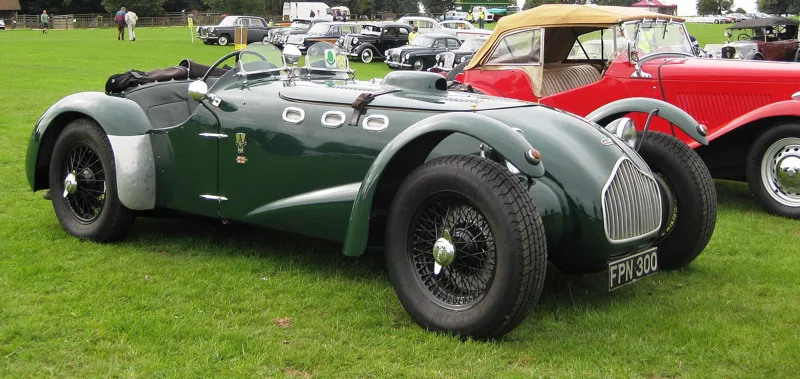
The Allard J2 was a British sports roadster built from 1949 to 1951, usually fitted with an American V8, and it took third at Le Mans in 1950. The Bristol 406 Zagato was an Italian-bodied, lighter Bristol 406 offered by Tony Crook in 1959, with six built.
Sydney Allard and Tom Cole finished third at the 1950 24 Hours of Le Mans in an Allard J2 with a Cadillac V8, and they did it with the first and second gears of the three-speed gearbox broken.
Nine years later, Bristol dealer Tony Crook asked an Italian coachbuilder for the opposite of a big, plush saloon: a smaller, lighter and faster car on the same chassis. That car was the Bristol 406 Zagato.
Allard J2: a British chassis for American engines
The Allard J2 was a sports roadster aimed mainly at the American market. Allard made 90 of them between 1949 and 1951, and the clever part was how they were powered. In Britain the standard engine was the 3.6-litre flathead V8 from the Ford Pilot, giving 85 hp, and a 4.4-litre Mercury V8 with 110 hp was also on the list. Cars sent to the United States left the factory with no engine at all. The buyer chose one locally, and American enthusiasts reached for Oldsmobile, Chrysler or Cadillac V8s. The approach worked well. Because the engines were domestic, parts were easy for Allard's customers to find.
The chassis was more advanced than the cheerful engineering around it. The front suspension used a swing axle with coil springs. At the rear a De Dion tube with coil springs kept the wheels upright, the brakes sat inboard, and a quick-change differential let owners swap final-drive ratios.
Racing results for the J2
Beyond the 1950 Le Mans podium, Bill Pollack drove a Cadillac-engined J2 to victory in the 1951 Pebble Beach Road Race. Zora Duntov, known as the father of the Corvette, and Carroll Shelby, known as the father of the Cobra, both raced J2s in the early 1950s.
From 313 documented starts in major races between 1949 and 1957, J2s took 40 firsts, 32 seconds, 30 thirds, 25 fourths and 10 fifths.
Cars sent to the United States left the Allard factory with no engine at all.
Allard J2X: longer nose, more room
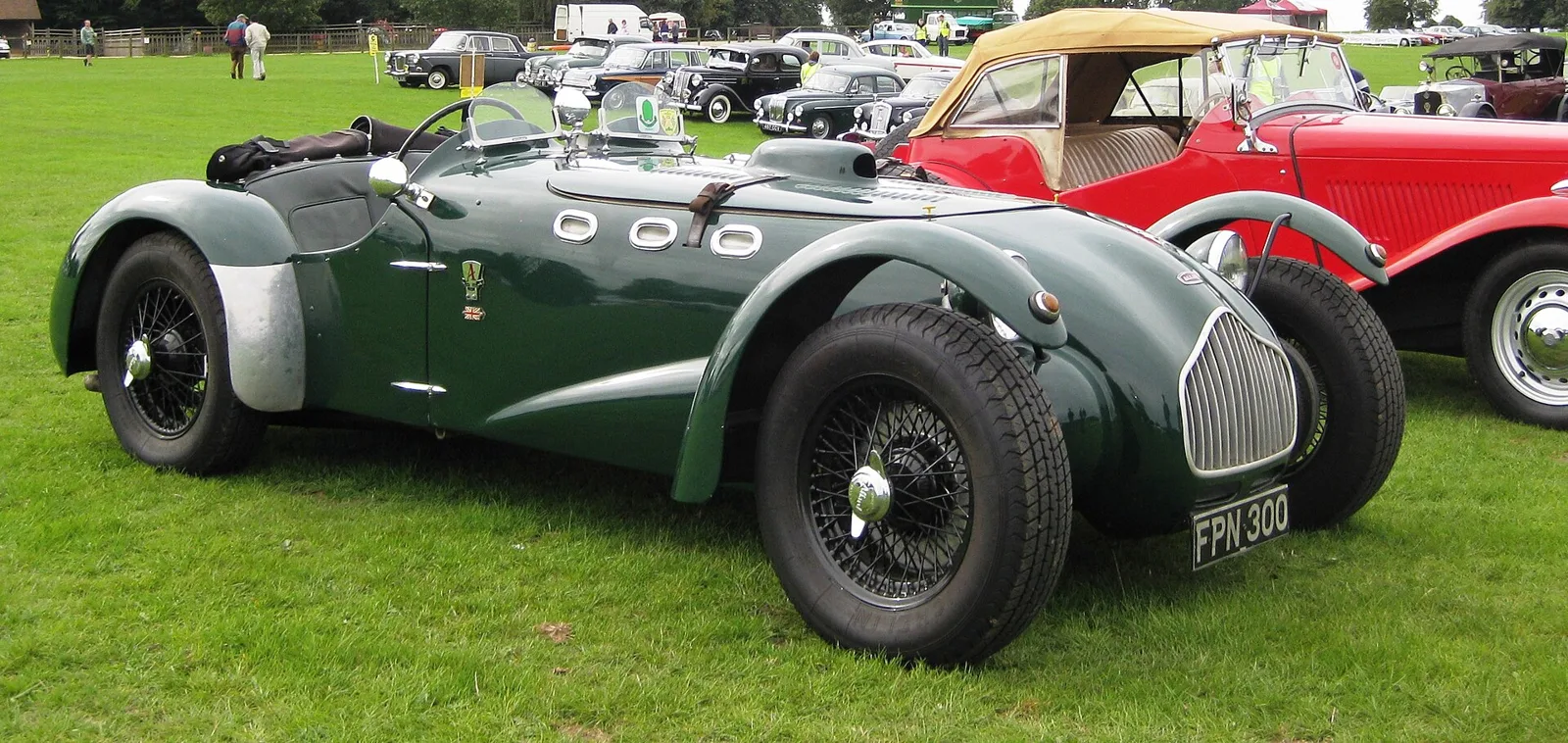
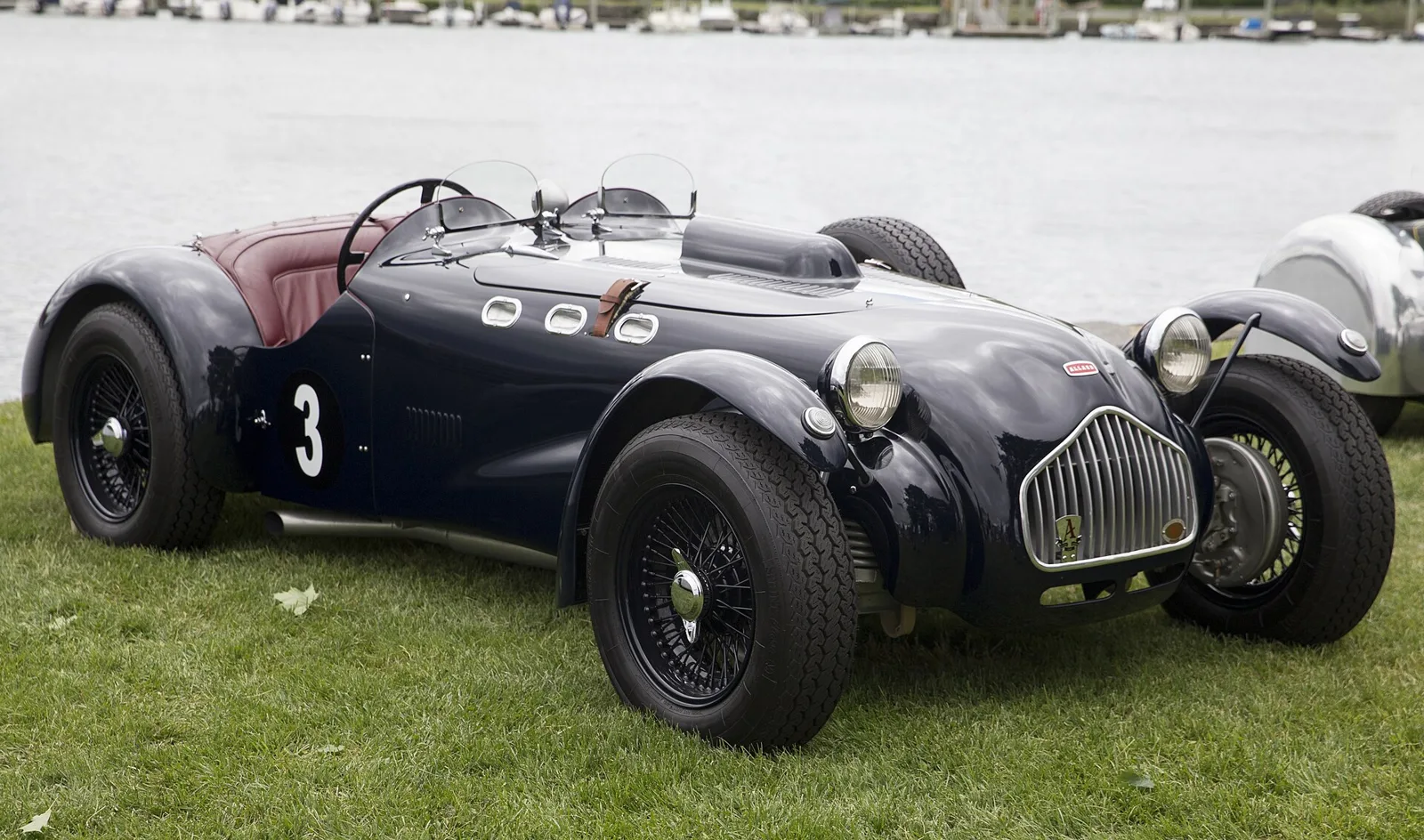
In 1952 the J2X replaced the J2, and it stayed in production until 1954. To improve handling, Allard redesigned the front suspension so the engine could sit about 18 centimetres (7.1 in) further forward. That shifted the weight balance and gave the driver more leg room, and it explains the X, short for extended. It also gives the quickest way to tell the two apart: the J2X nose projects beyond the front wheels, whereas on the J2 it stops level with the front of the tyres.
Other changes followed. The J2X had access panels in the body sides for the engine, and most carried a standard wide, flat bonnet scoop, whereas every J2 had its own custom arrangement. Options included a quick-change differential and a bigger fuel tank. With 170 hp it could reach 60 mph (97 km/h) from rest in 10 seconds and had a top speed of 111.6 mph. The interior stayed spartan, with just a few gauges. Allard built 83 J2Xs.
The J2X Le Mans
New rules for the 1952 Le Mans demanded fully enclosed wheels, so Allard quickly designed a barchetta-style body and called the result the J2X Le Mans. Between nine and fourteen were built, each with whichever American V8 the buyer specified. One of the fastest Allards ever made, it came too late to be fully competitive. Two cars ran at Le Mans in 1952 and both stopped in the fifteenth hour. Its best finishes were second in a 1952 Formula Libre race at Snetterton, plus a few victories in American SCCA events.
The J2X as a whole was less successful in major events than the J2. Sports car design was developing quickly, and the J2X faced more advanced C-type and D-type Jaguars with disc brakes, as well as works entries from Mercedes, Ferrari and Maserati. Across 199 documented major starts between 1952 and 1960, it took 12 firsts, 11 seconds, 17 thirds, 14 fourths and 10 fifths.
Allard models compared
| Model | Built | Power | Production |
|---|---|---|---|
| Allard J2 | 1949 to 1951 | 85 hp Ford Pilot V8 or 110 hp Mercury V8, or a buyer-fitted V8 | 90 |
| Allard J2X | 1952 to 1954 | 170 hp | 83 |
| Allard J2X Le Mans | 1952 | Various American V8s | Nine to fourteen |
Allard J2X revivals and the new British Allards
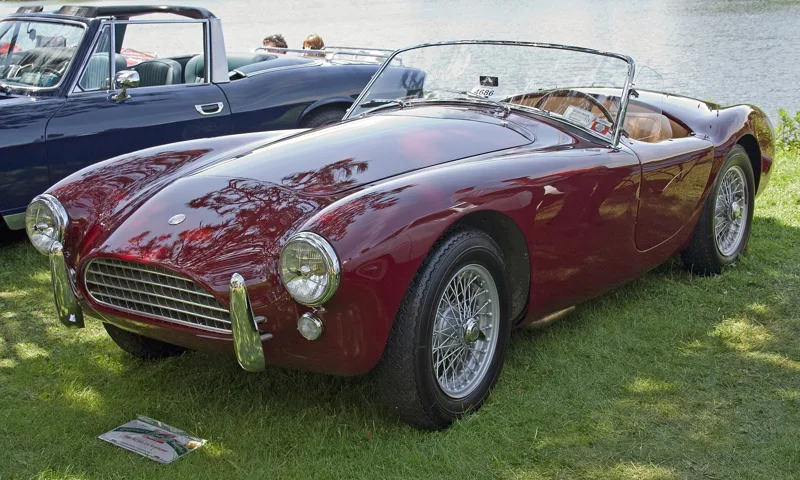
Replicas of the J2X have been built since 1981, and a continuation of the originals is now made in Britain. The first revival began that year in Ontario, where Mel Stein and Arnold Korne, who owned the coachbuilder A.H.A. Manufacturing Company Limited, created the J2X2. They called it a revival rather than a recreation, and it differed from the original in several ways. The wheels were much smaller, the body was part aluminium and part fibreglass, and the car had rack-and-pinion steering and wishbone front suspension. Power-assisted brakes had discs in front instead of drums. It was available as a kit or fully built, with a Chrysler 5.2-litre V8 and four-speed manual gearbox, though an automatic was offered. Weather protection was basic, with loose side windows and a simple hood. There was a competition version with a shorter windscreen and no modern bumpers, and a right-hand-drive version for British buyers. Allard's son Alan approved of the car and took on European distribution. A total of 250 units were planned.
Allard Motor Works of Montreal, run by Roger P Allard, builds the J2X MkII. It has no connection with the original company or with Sydney Allard. The fibreglass body resembles the 1951-1954 J2X but is dimensionally different, and the chassis and drivetrain are entirely new, so few parts besides the badges would swap with a car built by Sydney Allard. The company says it builds 100 a year by hand while meeting modern safety standards. The standard engine is a GM RAM Jet V8 with about 350 hp and 400 lb ft, linked to a Tremec TKO five-speed manual. Other choices include a 600 hp 6.1-litre Hemi, a Chevrolet 350, a Cadillac Northstar or a Ford 351. The maker quotes 0-60 mph in 4.5 seconds, a quarter mile in 12 seconds at 110 mph, and a price of $138,500.
In Britain, Lloyd Allard formed Allard Sports Cars in 2012 and announced new J2X cars. The Canadian cars are fresh designs inspired by the original, but the British ones continue the original designs. The company officially reopened and began production in September 2018.
Bristol 406 Zagato: the Italian-bodied Bristol
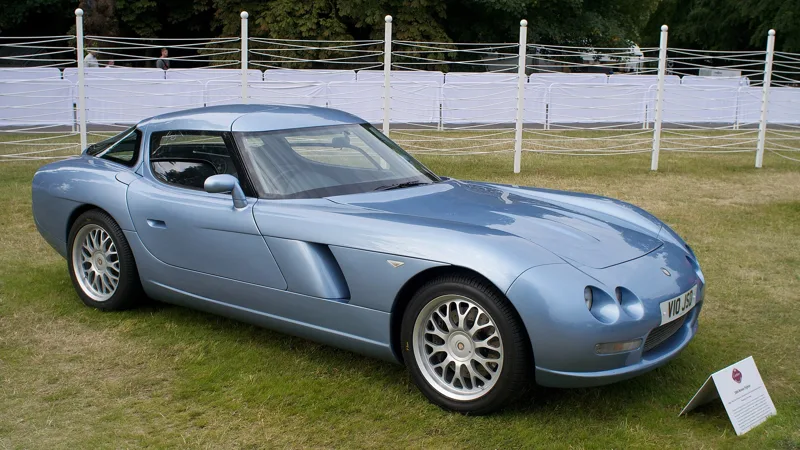
Under the skin, the Bristol 406 Zagato is a 406 Saloon, but Zagato of Milan designed and built the body, which makes it half British and half Italian. Dealer Tony Crook commissioned it, and few were made. Compared with the saloon it is smaller, lighter and quicker. A few older Bristol chassis later got similar Zagato bodies, and the 406 Zagato ranks today among the most desirable classic Bristols.
From BMW designs to the 406 Saloon
Bristol Cars, the car division of the Bristol Aeroplane Company, began building luxury cars on BMW technology in 1946. The chassis and engines came from the pre-war BMW 326, 327 and 328. The designs were reportedly brought to Britain as war reparations, though others doubt that. Before the war, Aldy Aldington of AFN, the maker of Frazer Nash cars, had secured British sales rights to the six-cylinder BMWs and the right to build cars and parts from them. Shortly after the war ended, Aldington and his brother Don went to Germany and came back with a Mille Miglia 328 and BMW blueprints. In July 1945 Bristol Cars acquired AFN, the BMW licences passed to it, and former BMW engineer Fritz Fiedler joined.
The first car, the 400, had bodywork based on a BMW coupe. Touring-bodied 401, 402 and 403 models followed, and the 404 and 405 appeared in 1953 and a year later. In the mid-1950s production ran at about half its early level. Then, in autumn 1958, Bristol launched the four-seat 406 Saloon. It was larger, heavier and more luxurious, and it lost the agility Bristols were known for. Despite a bigger engine, it was slower than earlier models, and some buyers found it underpowered.
Bristol had considered a shorter, faster two-seater version at the factory and built a prototype in 1958, but dropped full production on cost and because the company's prospects were uncertain. In spring 1959 Crook, a Bristol Cars director and the marque's biggest dealer, revived the idea. The 406 Zagato was an independent project by Anthony Crook Motors, not an official Bristol model. Crook said it was for drivers who would give up comfort and space for sporting performance, and he judged that a light, compact body mattered most. He commissioned Zagato, whose British importer he had long been, to design and build it, and Abarth was asked to raise the engine's power.
Launch, sales and name
The prototype was unveiled a year after the 406 Saloon, at the Earls motor show in London, which ran from 21 to 31 October 1959. Regular production began in autumn 1959 and ended a year later, and only Anthony Crook Motors sold the car.
It did not sell well. Of a production goal of ten, six were built, and even those were hard to place. It did start a long collaboration with Zagato, though. A compact 406-based car with a Zagato hatchback body, the 406S Zagato, appeared in 1960, and a 1961 car on the Bristol 407 with a Chrysler V8, the 407 GTZ Zagato, followed. Both stayed one-offs. From 1975 to 1993 Bristol sold about 90 of the 412 Targa coupe and its successor, the Beaufighter, bodied to a Giuseppe Mittino design for Zagato.
It was sold as the 406 Zagato. Later writers also use 406 Z, 406 GTZ or 406 GT Zagato, none of them used in 1959.
Bristol 406 Zagato engine, chassis and performance
The frame is a steel box structure shared with the 406 Saloon, and its basic layout goes back to the 1936 BMW 326. The front suspension is independent, using upper wishbones and a lower transverse leaf spring, while the rear has a rigid axle on a Watt's linkage and trailing arm, sprung by torsion bars. Four Dunlop disc brakes slow the car.
The engine is Bristol's inline six-cylinder, here in 2.2-litre form (2,216 cc), with a bore and stroke of 68.69 mm by 99.64 mm. It is a development of the engine in the 400, which traces to the 1938 BMW M328. Bristol designed its version in inches, not metric sizes. It has hemispherical combustion chambers and two inclined overhead valves per cylinder. A camshaft in the block drives the inlet valves through tappets, pushrods and rocker arms, and a second set of pushrods passes across the head to operate the exhaust valves. Three Solex 32 PBI/7 downdraft carburettors feed it.
Two states of tune existed. The prototype and a few other cars used the Type 110 engine, as in every 406 Saloon, with 105 bhp (78 kW) and 175 Nm (129 lb ft) at 4700 rpm. Most cars had the Type 110S, not offered in the saloon, making 130 bhp (97 kW; 132 PS) and 166 Nm (122 lb ft) at 3750 rpm. Higher compression of 9.0:1, a modified camshaft and a new exhaust with an Abarth manifold produced the gain.
The gearbox is a four-speed manual with overdrive, and first gear has no synchromesh. The Laycock de Normanville overdrive works in fourth and disengages automatically on a downshift.
With the same chassis, the Zagato is 280 mm (11.0 in) shorter than the saloon. It weighs about 1,100 kg (2,425 lb), against 1,350 kg (2,976 lb), which is close to the 1946 Bristol 400. In period tests a 110S car reached 122 mph (196 km/h), where the saloon managed 102 mph (164 km/h).
How the Zagato body was designed and built
The notchback body has no stylistic or technical link to the saloon's body, which Dudley Hobbs and Dennis Sevier designed. Gianni Zagato, son of founder Ugo Zagato, shaped the design. The front takes ideas from the Lancia Flaminia Sport, another Zagato car, and the grille is borrowed from Lancia, with some cars even wearing a Lancia crest ringed by the Bristol emblem. The roof is trapezoidal, with a horizontal roofline and a C-pillar set well back, which met Crook's demand for four full-size adult seats, although the cabin is tighter than the saloon's. It has Zagato's typical double bubbles at the rear. The 1959 prototype and the car after it have slightly lower roofs than the next four. Doors are frameless, headlights sit in the wings under Plexiglas, and the tall engine needs a central bonnet bulge that doubles as an air intake. In Bristol tradition, the spare wheel stands upright in a compartment in one front wing, with the battery in a matching one on the other side.
Trim varied from car to car, including the grille and side strips. On some the side trim runs to the rear wheel opening or onto the rear wing, on others it has a Z-shaped bend, and some have no trim at all. Some cars have three horizontal strips on the C-pillar. Reviews of the shape are mixed, with some calling it eccentric.
Zagato aimed for lightness throughout. The saloon had a heavy steel substructure made by the London coachbuilder Jones Brothers. The Zagato used a frame of thin steel tubes with aluminium sheet panels. The shorter body helped, and the interior was stripped back, with a dashboard in thin painted aluminium sheet rather than walnut. At least one car had the saloon's comfortable armchairs.
The body had faults. The rear wheel arches were too small, so tyres often struck the top of the arches over bumps. Crook admitted 40 years after production ended that build quality fell short, and that his mechanics often had to adjust fits, gaps and finishes.
Bristol 406 Zagato price and production process
Several sites handled each car. Chassis were built at Bristol's Filton plant, then trucked to Zagato in Milan, where Italian mechanics fitted the hand-built bodies and completed assembly. Crook sent two employees to supervise and enforce Bristol's quality standards. The finished cars came back to Britain under their own power for more work at his Hersham workshop in Surrey.
Anthony Crook Motors offered the car in late 1959 at 4,792 pounds, made up of 3,380 pounds plus 1412 pounds in purchase tax. That was 550 pounds more than a factory-bodied 406 Saloon at 4,244 pounds including tax, and equal to seven Triumph Heralds. Production never reached the planned ten. The agreed figure is six, although a count of seven includes the short-wheelbase 406S Zagato as a separate model.