From Clapham trials specials to the J2 at Le Mans, the V8 sports cars Sydney Allard built until the firm ceased trading in 1958.
Sydney Allard founded this Clapham firm in 1945, and it built roughly 1,900 cars that paired American V8 power with British bodies. A J2 finished third at Le Mans in 1950, and administration in 1957 ended car manufacture, closing the marque's run of V8 sports cars.
Allard Motor Company was a London maker of low-volume cars founded by Sydney Allard in 1945. It fitted large American V8 engines into light British bodies, raced at Le Mans and produced approximately 1900 cars before production ended in 1957 and the firm ceased trading in 1958.
How did Allard start with trials cars?
Sydney Allard's first cars were built for trials events, which were timed rally-style contests over ground that most wheeled vehicles could barely cross. The first machine was built in under three weeks, using a Ford flathead V8 in a body borrowed mainly from a Bugatti, and it debuted at the Gloucester Cup Trials.
The V8 was moved backward in the chassis to improve traction, which let the American engine's high torque work well in slow-speed competition. The car later won the 100 miles (160 km) event at Southport Sands. Leslie Ballamy's method for independent front suspension was crude but effective: he cut the beam axle in half and mounted the halves as swing axles, a layout used on nearly all later Allard specials.
Orders followed. Allard's brother Leslie was a customer, and the racer Ken Hutchinson bought a version powered by a 4.4-litre Lincoln-Zephyr V12. The pair raced it as the Tail Waggers, and the car set a new record at the Prescott hillclimb.
By 1937 Allard was building modified Fords and selling them for 450 pounds each. Twelve Allard Specials had been built by the outbreak of war in 1939, but wartime Ford truck work pre-empted volume production, and the company was left with a substantial stock of Ford parts.
American V8 power in a light British body, raced at Le Mans and built in Clapham until administration in 1957.
What were the first post-war Allards?
After the war Sydney Allard set up in Clapham High Street in 1945. The first post-war cars, the J, K and L, shared a steel chassis, aluminium bodies by Godfrey Imhof and an 85 hp Ford sidevalve V8 of 3,622 cc that was largely stock.
All three models were based on the Ford Pilot chassis. The engine had a single carburettor and 6:1 compression, and it drove a three-speed transmission with low-geared rear axle for strong acceleration. The front suspension was the Ballamy swing axle, with a Ford solid axle at the rear.
Letters defined the body styles. J meant short-wheelbase two-seat competition cars, K meant two- or three-seat tourers and roadsters, L meant four-seat tourers, M meant drophead coupes and P meant fixed-head cars. As models were replaced, the next model took the next number in sequence.
Demand for cars was high for the period, and that led to larger models, the drophead coupe M and the P saloons, which broadened the line in the years that followed.
How did the J2 take Allard to Le Mans?
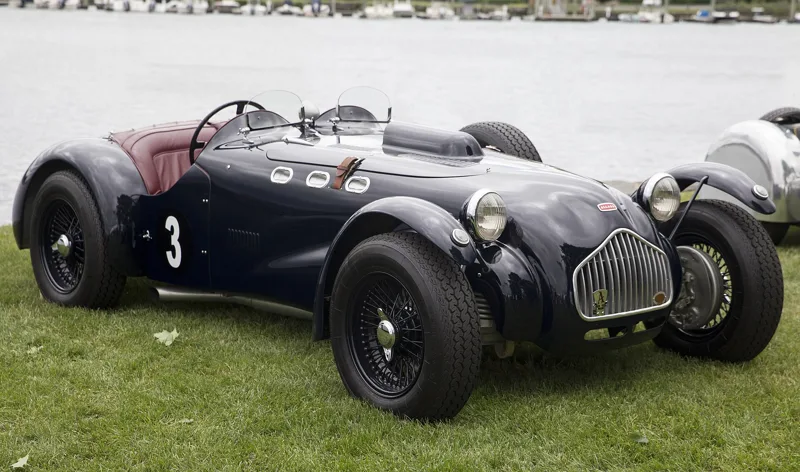
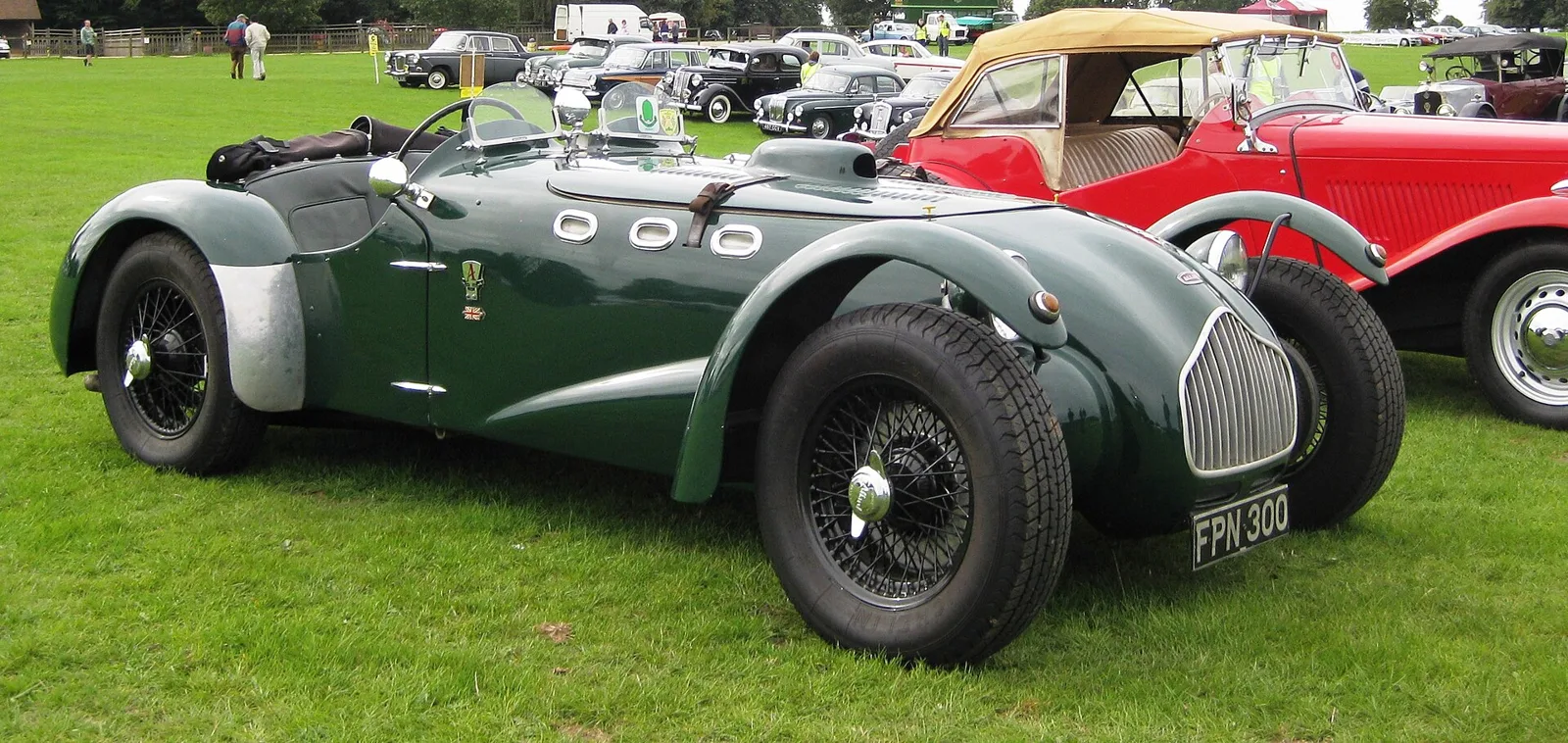
The J2 was Sydney Allard's bid for the American market, a lightweight aluminium roadster that weighed 2,072 pounds (940 kg) and used a 110 hp (82 kW) Mercury flathead V8. Fitted with American overhead-valve engines, it became a competitive race car, finishing third overall at Le Mans in 1950.
The J2 had coil-spring front suspension with inclined telescopic dampers, plus a de Dion rear axle and inboard rear brakes. It also had a disturbing tendency to catch fire when it was started, which was a serious problem for an otherwise promising car.
Importing American engines only to ship them back across the Atlantic proved awkward. U.S.-bound cars therefore left England without engines and were fitted with Cadillac, Chrysler, Buick and Oldsmobile overhead-valve units. The most common choice was a 331 cu in (5.4 L) Cadillac V8, while English cars used Ford or Mercury flatheads.
At Le Mans in 1950 a J2 finished third overall, co-driven by Tom Cole and Sydney Allard, averaging 87.74 mph (141.20 km/h) with its Cadillac V8. Two J2s returned in 1951, and one jumped an embankment while the other broke. In 1952 both cars failed to finish.
The wider racing record shows the J2's reach. Of 313 documented major race starts between 1949 and 1957, J2s took 40 wins, with 32 runners-up finishes, 30 third places, 25 fourth places and 10 fifths. Ninety J2s were produced between 1950 and 1952.
Zora Duntov was employed by Allard between 1950 and 1952, racing for the works team at Le Mans in 1952 and 1953. Carroll Shelby also raced J2s in the early 1950s, so both men later became known for American performance cars.
What did the J2X and JR change?
The J2X arrived in late 1951 with redesigned front suspension that moved the engine forward by 190 mm and gave more cockpit room. The JR was a 1953 lightweight racer with a Cadillac engine, and it was the marque's last major effort at Le Mans.
The J2X lengthened the nose by about 170 mm to fit the new layout. Its results were weaker than the J2's, because it was up against the more advanced C- and D-type Jaguars and the works Mercedes, Ferrari and Maserati entries. Of 199 documented major starts between 1952 and 1960, the J2X recorded 12 first-place finishes.
The JR of 1953 used a Cadillac unit rated at 300 hp (220 kW; 300 PS). At Le Mans that year one entry broke its rear suspension and the Duntov car retired. Seven JR cars were built in total, and the last one was finished in 1956.
Why were the K and L models important?
The K1 of 1946 to 1948 used a 106 in (2,700 mm) wheelbase and a tuned version of the 221 cu in V8, producing 95 hp (71 kW; 96 PS). It was the first K model on sale, and it gave the line a sports tourer that could reach 86 to 90 mph (140 to 145 km/h).
The K1 frame was made from stamped steel channel sections by Thomsons of Wolverton, with side rails and cross members designed to suit the Allard trailing link and independent front suspension. Production totalled 151 cars, and the K1 was fitted with the same engine options as the J1.
The K2 of 1950 to 1952 was a two-seat sports car offered with Ford and Mercury V8s at home and with Chrysler and Cadillac V8s in America. 119 were built. The four-seat L, on a 112-inch (2.8 m) wheelbase, came with a choice of Ford or Mercury V8 and was built from 1946 to 1950.
The K3 of 1952 was an attempt to offer a more civilised variant of the J2 and J2X. It used the 331 cu in (5,420 cc) Chrysler hemi with a pair of four-barrel carburettors. Only 62 were built, and 57 went to the United States, where Dodge dealers had hoped for a rival to the Corvette. Today one can fetch the better part of US$250,000 at auction.
What were the P models and the Monte Carlo win?
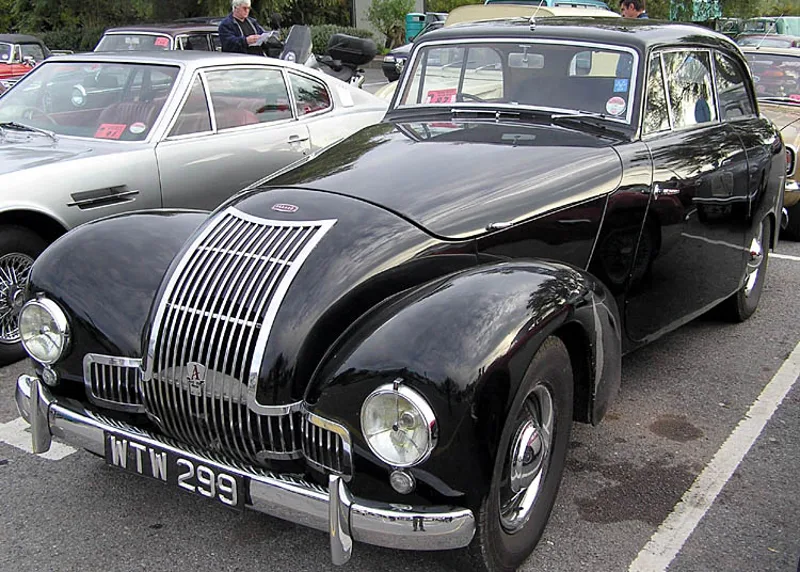
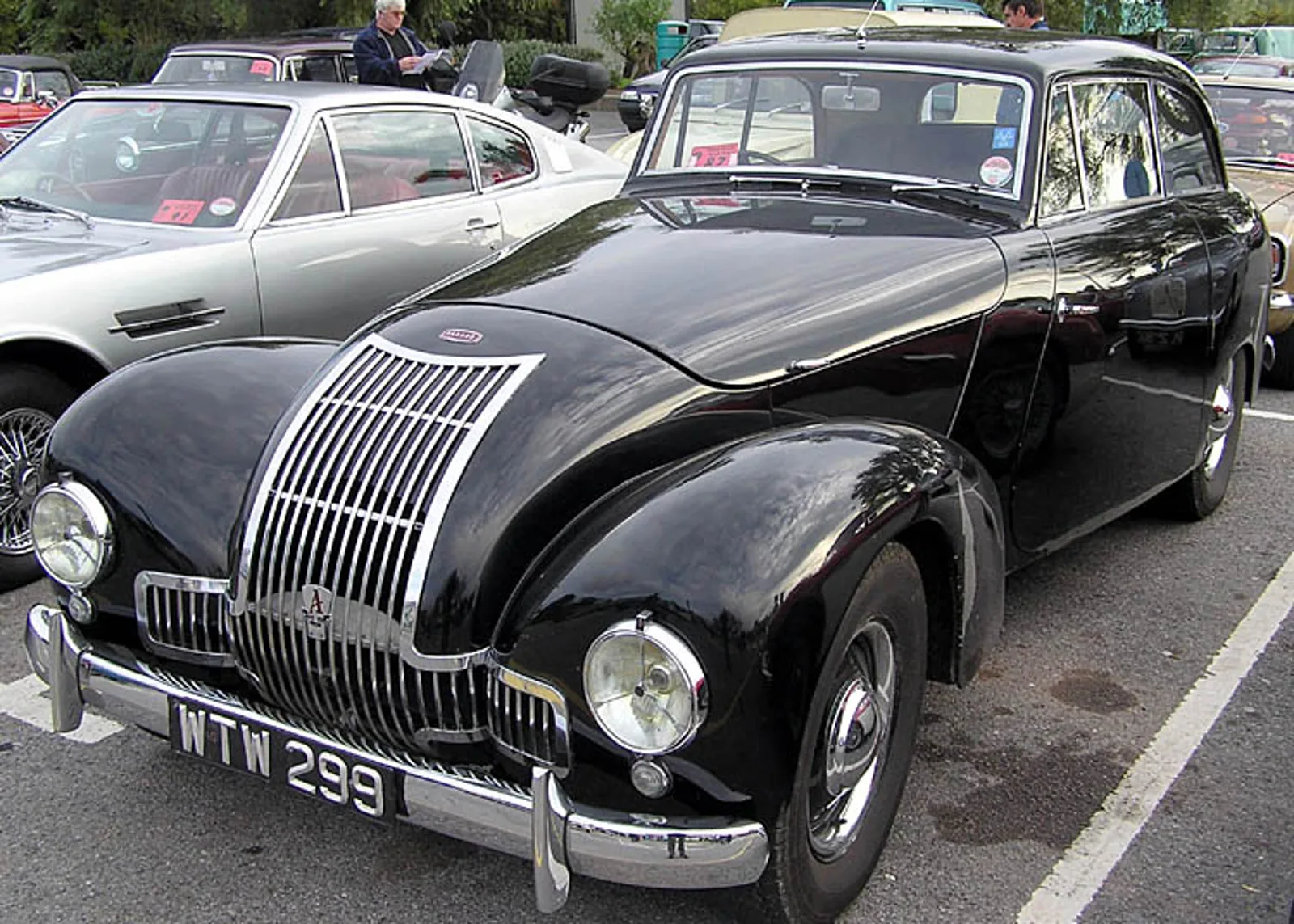
The P1, known as the Allard 3.6-litre Saloon, was a five-seat, two-door sports saloon built from 1949 to 1952, and 559 were produced. In 1952 Sydney Allard and Guy Warburton won the Monte Carlo Rally in a P1, with Tom Lush as navigator.
The P1 was popular with professionals who wanted something different, including doctors and solicitors. It used Ford engines and transmissions, and a Sports model was also offered. Fewer than 45 are believed to survive worldwide today.
The P2 Monte Carlo was a two-door saloon variant of the K3, built from 1952 to 1955. It used a wood frame with aluminium panels on a 112-inch wheelbase, with 3.6-litre Ford Pilot or 4.4-litre Mercury V8 engines, and only 11 were built.
The P2 Safari was an 8-seater estate with wood sides and a V8, an attempt to extend the range that also found weak sales, with 13 built in total. Other attempts were just as small. The 1953 Clipper was a tiny glass-fibre microcar with a rear-mounted 346 cc Villiers twin, of which about 20 were made.
What was the Palm Beach?
The Palm Beach was Allard's 1952 roadster, with a 96 in (2,400 mm) wheelbase and a choice of a 1,508 cc Ford Consul four or a 2,622 cc Ford Zephyr six. Priced under 1200 pounds, the Mark I was built until 1958, but it sold poorly.
A Mark II arrived in 1956 with more modern bodywork and a choice of a 2,553 cc Zephyr or a 3,442 cc Jaguar XK120 six. The Mark II replaced the split front axle with torsion bars, and the rear received coil springs.
The Palm Beach was about a year behind its competitors, which shows how far Allard had fallen. Its problems were a lack of research and development, a failure to keep pace with cheaper and more advanced cars, and a line of models that did not win buyers.
How did Allard end in 1957?
A weak market in the late 1950s, including a US recession, pushed the firm into administration in 1957, which ended car manufacture. The business ceased trading in 1958, after building roughly 1,900 cars over its short life.
In 1961 the company offered a Dragon dragster with a Shorrock-supercharged 1.5-litre Ford engine, and it took over production of the superchargers. Alan Allard, Sydney's son, marketed the Allardette 105, 109 and 116, which used the straight-four engine from the Ford Anglia.
Sydney Allard died in 1966, on the same night that a fire destroyed the Clapham factory and some of the company's records. The Clapham site is now social housing apartments, and the showroom and workshop in Putney became a trade products showroom.
Did Allard return after 1958?
There was a limited revival. Chris Humberstone licensed the Allard name from Alan Allard in the 1990s, and a new company, Allard Sports Cars Limited, was set up in 2012. Production restarted in September 2018 after a J8 model had been announced in 2017.
Humberstone's J2X-C prototype used a 3.5-litre Cosworth V8 and a transmission borrowed from a Formula One car. He also developed the P4, a Lexus-based car that used the LS400's 4.0-litre V8 with 250 horsepower to the rear wheels, with Allard handling the styling and Lexus the performance.
The P4 did little for the J2X-C programme, which folded after the prototype missed its performance goals while the parent firm was itself being liquidated. The new company later built a period-correct continuation of chassis 3408, the JR, which kept the name in production.
What did the main Allard models look like?
| Model | Years | Key figure |
|---|---|---|
| J1 | 1946 to 1947 | 12 built for rally buyers, 140 hp Mercury V8 |
| J2 | 1950 to 1952 | 90 built, third overall at Le Mans in 1950 |
| J2X | 1951 onward | 199 documented major starts from 1952 to 1960 |
| K1 | 1946 to 1948 | 151 built, 95 hp tuned V8 |
| K2 | 1950 to 1952 | 119 built |
| K3 | 1952 | 62 built, 57 to the United States |
| L | 1946 to 1950 | 191 built, a little over 1000 pounds |
| P1 | 1949 to 1952 | 559 built, Monte Carlo winner in 1952 |
| P2 Monte Carlo | 1952 to 1955 | 11 built |
| Palm Beach | 1952 to 1958 | Mark I priced under 1200 pounds |