From Gordon Murray's Brabham BT49 in 1979 to the Red Bull RB5 and the 2022 rules, a look at how pull-rod and push-rod layouts lower the centre of gravity and clean up airflow.
Pull-rod suspension is a double-wishbone variant that moves its springs and dampers into the body, lowering the centre of gravity and improving airflow. Gordon Murray first used it on the 1979 Brabham BT49, and it has returned to Formula One in 2009 and 2022.
Pull-rod suspension, and its close relative the push-rod system, is a specialised type of automotive suspension largely based on the double-wishbone layout, with elements of the MacPherson strut. It moves the springs and dampers away from the wheels and into the body, where they can be lower and closer to the centre of gravity. That makes it a performance tool, and it has spent most of its life in racing cars rather than on the road.
What is pull-rod suspension?
In a car, suspension maintains contact between the wheels and the ground, usually through dampers and springs that push down on the wheels against impact shocks. In a push-rod or pull-rod system, the damper is mounted across the chassis, parallel to the ground, rather than in the upright position used in most cars. That arrangement moves essential components out of the direct airflow and closer to the centre of gravity.
The result is a lower centre of gravity and a more efficient distribution of weight, which helps manage body roll. The price of that performance is everyday drivability, practicality and comfort, which is why these systems are mostly confined to competition cars, especially in Formula One.
Move the springs out of the airflow and into the centre of the car, and the same racing car can be lower, cleaner and more stable.
Where did pull-rod suspension start?
During the 1960s Brabham Automotive built more open-wheel racing cars than any other maker, and it took championships in Formula Two and Formula Three. Through the 1960s and into the 1980s Brabham was locked in a fierce rivalry with the Lotus and McLaren teams, and that rivalry pushed the sport to innovate.
In 1979 the engineer Gordon Murray, working under Brabham, introduced pull-rod suspension in Formula One on the BT49. The design replaced the hydro-pneumatic arrangement used before, and the lower stance it allowed improved aerodynamic efficiency. Brabham won the championship over four seasons, from 1979 to 1982,.
| Period | Development | Note |
|---|---|---|
| 1960s | Brabham leads open-wheel production | Formula Two and Formula Three titles |
| 1979 | Gordon Murray debuts pull-rod on the BT49 | Lower ride height and better aerodynamics |
| 1979 to 1982 | Brabham title run | Four seasons of success |
| Mid 1990s to early 2000s | Usage drops | Ride height and aerodynamic rules change |
| 2009 | Red Bull Racing RB5 returns the layout | Wider front wings and tighter diffusers |
| 2022 | Pull-rod returns at the front | Red Bull RB18 and McLaren MCL36 |
Why did pull-rod suspension fall out of use?
The popularity of pull-rod suspension in formula racing rose and fell over the next two decades. It increased steadily, driven by the teams that continued to use it, who kept refining the design. A notable drop-off came from the mid 1990s to the early 2000s, caused by changing regulations on ride height and aerodynamics, and by teams shifting their performance priorities.
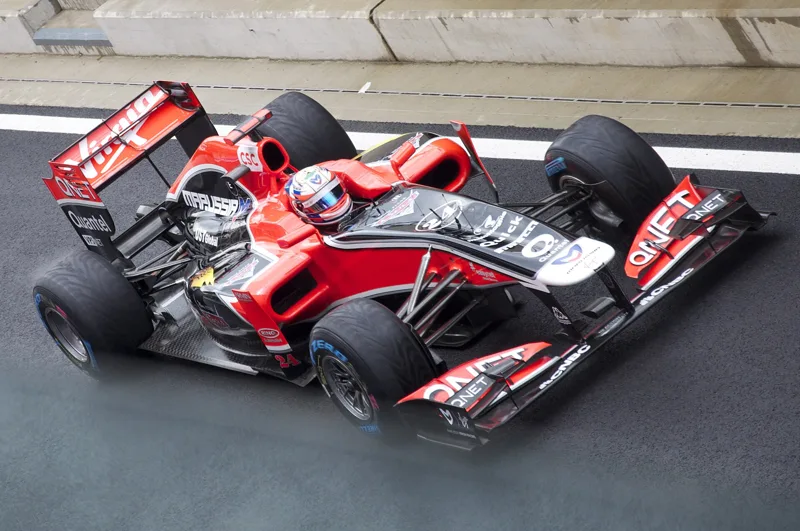
The system returned in 2009, after a regulation change that allowed wider front wings, narrower and taller rear wings and more tightly limited diffusers. Adrian Newey, Red Bull Racing's chief technical officer, engineer and aerodynamicist, saw a niche for pull-rod suspension in that rulebook. As the diffuser moved further towards the rear on the RB5, he realised pull-rod could help optimise airflow under the car. The revised RB5 went on to win in Shanghai, Abu Dhabi and at the British Grand Prix during the 2009 season.
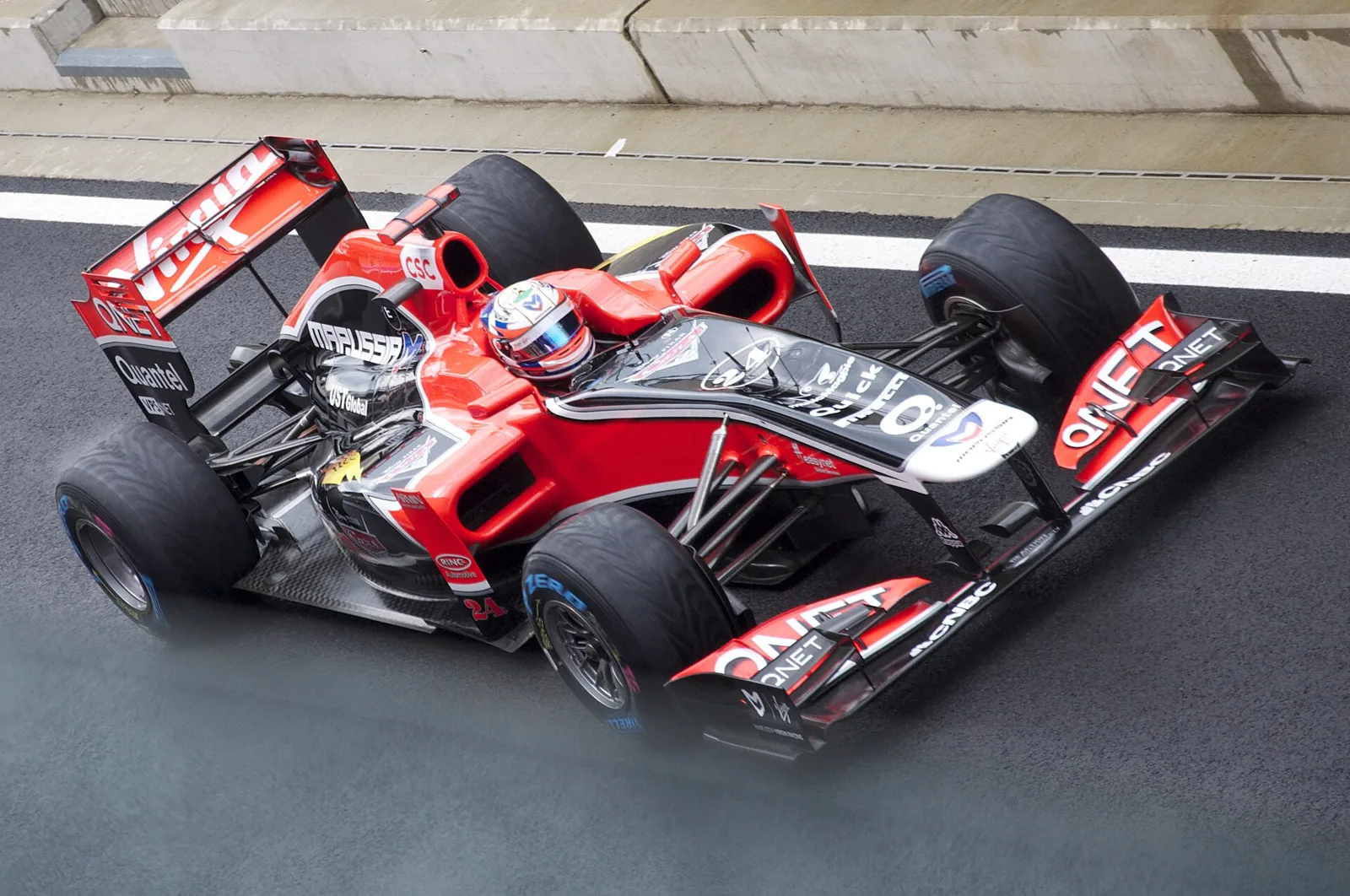
The pull-rod system was adopted again in the 2022 Formula One season. It had last appeared in 2015 on the Ferrari SF15-T, and in 2022 it featured on the front suspensions of the Red Bull Racing RB18 and the McLaren MCL36.
How do push-rod and pull-rod systems differ?
Push-rod and pull-rod suspensions are similar but distinct. The main difference is where the rocker arm sits relative to the upper control arm, which controls the shock damping. In effect both are functionally the same design, which is why they are usually discussed together.
In a push-rod layout there is an upper and lower control arm, similar to a double wishbone, which provide a structurally integral connection between the wheel hubs and the chassis. Those arms pivot inwards towards the centre of the car, so the wheels can move up and down. A rigid push rod connects each hub to an oscillating rocker arm, which converts the lateral movement of the wheel into longitudinal forces inwards towards the chassis.
The rocker arm acts on a transversely mounted shock damper, a coil-over similar to the MacPherson struts used on production cars. Because the forces pass into the monocoque chassis rather than upwards into the body, the layout offers greater high-speed stability, lower body roll and a lower centre of gravity.
In a pull-rod system the orientation of the rocker arms changes. In a push-rod layout they sit at the highest point of the assembly, so the rod is under compression as it pushes upwards into them. In a pull-rod layout they sit between the upper and lower control arms, at the centre of the assembly, so the rod is under tension as it pulls against them.
Steering also works differently in push-rod cars. Instead of a steering column and rack, ball joints at the ends of the control arms allow the wheel hubs, and so the car, to turn. Because the layout does not depend on a conventional steering linkage, engineers can place components closer to or further from the centre of gravity.
What are the advantages on a race car?
On a track-focused race car the main gains come from moving suspension components closer to the ground, lowering the chassis and the centre of gravity. That improves cornering, body roll control and high-speed stability. Formula racing rules often specify low-displacement, low-power engines with lightweight chassis, to keep the emphasis on the driver rather than on engineering.
Those small engines are sensitive to drag, weight and friction, and small increases can have a large effect on the engine's workload. By moving components away from the essential air channels, pull-rod suspension reduces that workload and improves acceleration across the power band.
Streamlining is another gain. A conventional suspension places shock dampers and similar parts under the car, where they disturb the air and create drag. Moving the suspension away from the underside improves airflow, and that air can then be channelled into the splitters, diffusers and wings to produce downforce, which increases tyre grip and cornering stability.
Body roll is the third limit on cornering. In conventional designs the dampers extend perpendicular to the body, which increases the capacity for roll because forces act straight upwards into the coils. In a pull-rod design the wishbones and dampers sit transversely and in line with the body, which turns those forces into longitudinal loads, leaves less room for roll and lowers the centre of gravity significantly.
What are the disadvantages for road cars?
The main drawbacks for production cars are cost, practicality and manoeuvrability in daily use. Road cars are built for comfort and usability, and manufacturers need to keep them profitable. Leaf springs and MacPherson struts are simple and cheap, while push-rod suspension has many moving parts that increase both cost and the chance of breakage.
Ride quality is also a problem. Push-rod systems work well on maintained and smooth tracks, but they do little to soften impacts on public roads, because a transversely mounted damper is inefficient at absorbing vertical forces. The result is a rough, uncomfortable ride.
Pull-rod frames often extend beyond the body of the chassis, which makes the car harder to judge for size and so harder to manoeuvre in traffic. As a result, the system is seen as impractical for daily use, and it appears in road cars rarely, mostly in exotic supercars such as the Lamborghini Murcielago concept.