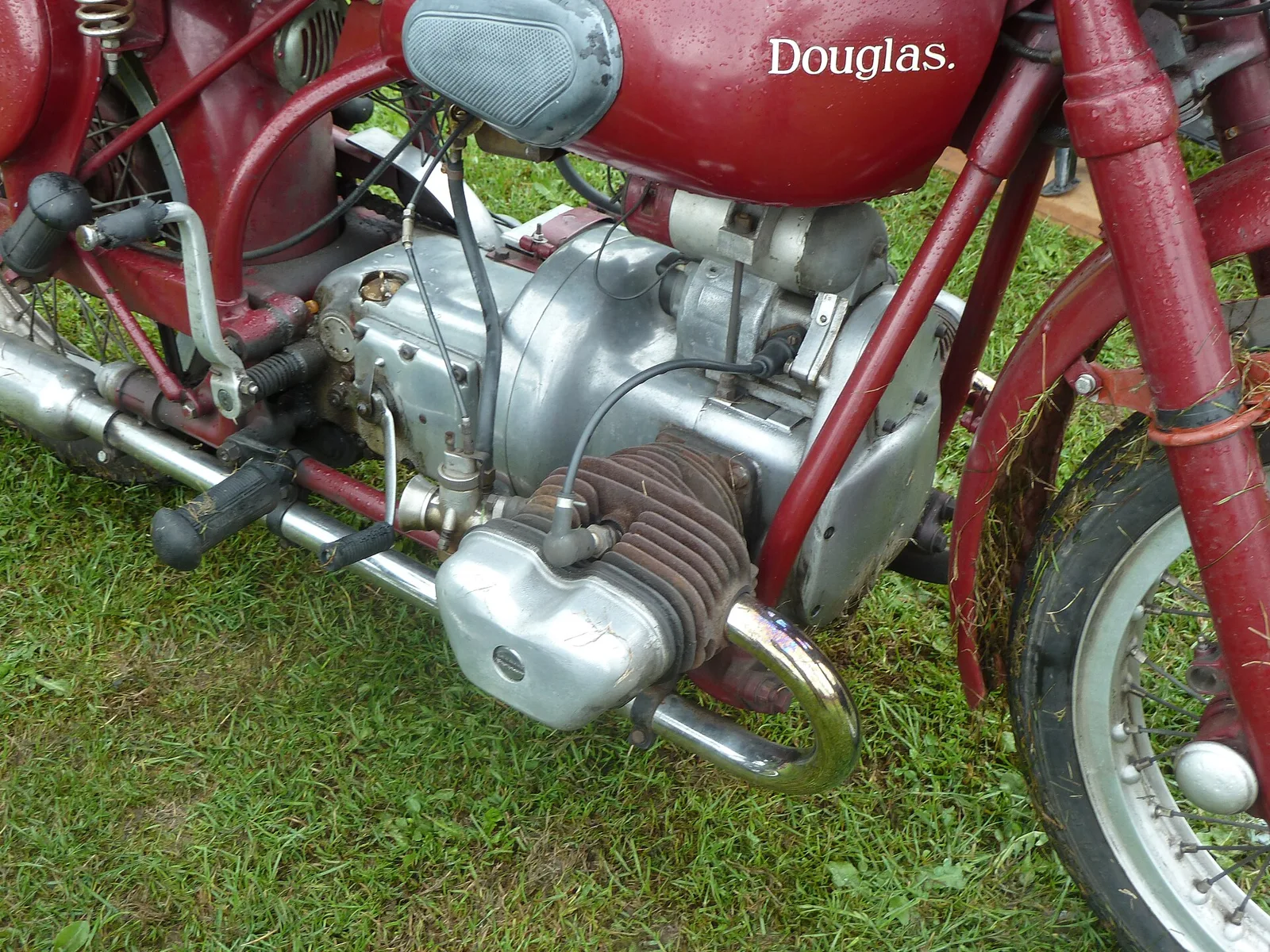
From Karl Benz's 1896 patent to the Citroen 2CV and BMW motorcycles, the boxer-twin layout balanced vibration in a compact package.
Most flat-twins are boxer designs, with each pair of opposed pistons moving in and out together. Karl Benz patented the layout in 1896, and it later powered cars, motorcycles, aircraft and garden machinery.
A flat-twin engine has two cylinders on opposite sides of a shared crankshaft, which makes the layout wider than it is tall. Engineers used it for motor cars, motorcycles, aircraft and stationary machinery across more than a century. Its low profile and smooth running explain why designers kept returning to it.
What is a flat-twin engine?
The flat-twin is a two-cylinder internal combustion engine in which the cylinders sit opposite one another across the crankshaft. The most common form is the boxer-twin, where both pistons move inwards and outwards at the same time. That shared motion separates the boxer from other twins, including the upright parallel-twin.
Because the pistons travel together, the crankshaft throws are arranged to suit. Most boxer-twins use a crankshaft set at 180 degrees, so the two pistons rise and fall in step. That arrangement shapes the engine's character and explains many of the design choices that follow.
Two cylinders lying flat and moving together gave engineers a balanced, compact engine that outlasted many of the cars it powered.
Why do boxer-twins run so smoothly?
A boxer-twin with a 180 degree crankshaft gives excellent primary balance, because the forces produced by one piston are cancelled by the other. The firing order is evenly spaced, which further reduces vibration. The result is an engine that feels calmer than a single cylinder or an upright twin of similar size.
Balance is never perfect. The equal and opposite forces produce a rocking couple, because the pistons sit at different points along the crankshaft. Designers manage that couple through the mounting and the surrounding structure, and the effect is usually small enough to live with.
Ignition was also simpler on many examples, and that simplicity was part of the appeal. A common arrangement is the wasted spark system, in which a double-ended coil fires both plugs on each revolution, once during compression and once during exhaust. It needs only a single coil and contact breaker, and it does away with a distributor.
Mounting a boxer low in a chassis or frame keeps the centre of mass close to the ground, a point that matters most on motorcycles. Designers who wanted a low machine often reached for the boxer, even when packaging the engine was difficult.
Who invented the flat-twin?
Karl Benz obtained a patent for the flat-twin design in 1896, and a year later his company Benz and Cie unveiled the first flat-twin, a boxer design it called the contra engine. Those early engines set the pattern that later designers followed, even when they changed the details.
Benz described a layout that later engineers refined rather than replaced. The basic logic of opposed pistons stayed the same across the following century, even as materials, ignition and cooling systems changed around it.
The first production flat-twin to reach a car came from the Lanchester Engine Company. From 1900 its 8 hp Phaeton used an unusual engine with two counter-rotating crankshafts. Each piston was tied to its own crankshaft by a thick connecting rod, and two thinner rods linked it to the other crankshaft so that the pistons moved along the same axis.
In that layout the torque reaction of one crankshaft cancelled the torque reaction of the other, so the engine produced very little twisting force on the car. Lanchester used this design until 1904. It was an ambitious answer to a problem that most designers of the period had not yet solved.
Which early cars used flat-twin engines?
Early flat-twins appeared in several cars during the first decade of the twentieth century. Ford's Model A, Model C and Model F all used them between 1903 and 1906, and Jowett built flat-twin cars from 1910 to 1937. Lanchester used its counter-rotating layout until 1904.
Ford's early flat-twins were modest machines, and their short production runs show how quickly designers moved on from the layout. Jowett's much longer run demonstrates the opposite: the flat-twin could remain in production for decades when a manufacturer stayed with it and refined it.
How did post-war cars use boxer-twins?
After the Second World War, the boxer-twin became a favourite for air-cooled and front-wheel-drive cars. The Citroen 2CV used one from 1948 to 1990, and the Panhard Dyna X arrived in 1948 with front-wheel drive and an air-cooled boxer-twin of its own.
Among the first front-wheel-drive cars to adopt a flat engine was the 2CV. Its air-cooled boxer-twin was simple and light, which suited a car built around economy and load carrying. The car's production run from 1948 to 1990 shows how long that combination could remain relevant.
Other post-war examples included the Jowett Bradford van, the DAF Daffodil, which used the layout from 1961 to 1976, and the Toyota Publica. The Publica carried the Toyota U engine, an air-cooled flat-twin produced from 1961 to 1976. The Toyota Sports 800 used the same engine family from 1965 to 1969.
Rear-engined cars also used boxer-twins derived from motorcycle designs. The Puch 500 ran from 1957 to 1975, and the BMW 600 followed from 1957 to 1959, with the BMW 700 taking over from 1959 to 1965. In Brazil, Gurgel Motores built its own water-cooled boxer-twin and used it from 1988 to 1994.
How does a boxer-twin handle crankcase pressure?
A boxer-twin pumps air in and out of its crankcase, since both pistons move in the same direction at once. Most engines deal with this effect using a breather. The Citroen 2CV made use of it, holding a partial vacuum in the crankcase to reduce oil leaks when a seal failed.
The 2CV's method was a one-way valve made from leather or rubber, fitted over a hole in the crankcase. Air could leave through it but could not return, so the pumping action left the crankcase at a partial vacuum. That made it harder for oil to push past worn seals, a neat solution to a common problem.
How were flat-twins fitted to motorcycles?
Motorcycle designers fitted flat-twins in two ways. A transverse installation puts the crankshaft across the frame, which gives a low centre of gravity and allows belt or chain drive. A longitudinal layout runs the crankshaft along the frame, so each cylinder is cooled in the same way.
Transverse mounting had its drawbacks. The front cylinder was cooled more heavily than the rear one, and a longer wheelbase was often needed to fit the engine. Longitudinal mounting left the cylinders exposed to collision damage and limited how low the engine could sit, but it made air cooling more even.
The Light Motors Company of the United Kingdom produced the first flat-twin motorcycle engine in 1905. Named the Fee and renamed the Fairy soon after, it was designed as a bicycle engine system that drove a rear pulley by chain. Douglas, a supplier, took over manufacture in 1907 and switched to belt drive taken directly from the engine.
Chain drive was simple and cheap, but the engine had to sit where a chain could reach the rear wheel. A belt driven straight from the engine removed that constraint, which was one reason the flat-twin could be packaged into a more compact motorcycle.
Longitudinal layouts became more common over time. The 1916 ABC was an early UK example, and BMW's 1923 R 32 used a shaft drive. Harley-Davidson's XA showed the cooling advantage: its oil ran 100 F (56 C) cooler than a V-twin with cylinders in line with the frame. Ural and Dnepr later carried the layout forward.
Where else were flat-twin engines used?
Flat-twins also worked in aircraft and industrial machines. Early examples flew in 1902 and 1908, and later designs served light aeroplanes and auxiliary power units. Other uses included washing machines, generators, lawnmowers and outboard motors.
The Pearse monoplane of 1902 used a flat-twin with one crank pin shared by both pistons, which were double-acting. Dutheil-Chalmers, a French firm, started making flat-twin aero engines in 1908, with two counter-rotating crankshafts. Aeronca and Bristol built flat-twins for light aircraft in the 1920s and 1930s, and the HKS 700E, an oil-cooled unit for ultralight aircraft, is still being made.
Stationary and industrial uses were just as varied. The Maytag Model 72 flat-twin, made from 1937, drove washing machines. Norman Engineering built flat-twin generators from 1932 to 1968, and the Victa Twin 500 push mower used a flat-twin that ran from 1975 to 1980. Two-stroke flat-twins were also used as outboard motors because they ran more smoothly than single cylinders.
Aircraft designers valued the same low profile for different reasons. A compact engine that could sit close to the airframe helped with packaging, and the small group of flat-twin aero engines shows how varied the designs were, from the Bristol Cherub to the Praga B2.
How does a boxer compare with an upright twin?
Compared with an upright twin, a boxer sits lower and wider. The lower position helps the centre of gravity, while the opposed cylinders give a different pattern of vibration and cooling. Both layouts face the same basic problem of crankcase pumping, which is usually handled with a breather.
Crankcase pumping is found on single-cylinder and parallel-twin engines as well as boxers. The boxer simply makes it more pronounced, because both pistons push and pull the crankcase in the same direction at once. That is why the 2CV valve was such a practical answer.
What does the flat-twin timeline look like?
| Year | Milestone | Setting |
|---|---|---|
| 1896 | Karl Benz patent for the flat-twin | Automotive design |
| 1900 | Lanchester 8 hp Phaeton with a flat-twin | Motor car |
| 1905 | First flat-twin motorcycle, the Fee | Motorcycle |
| 1908 | Dutheil-Chalmers flat-twin aero engines | Aviation |
| 1937 | Maytag Model 72 flat-twin | Washing machines |
| 1948 | Citroen 2CV and Panhard Dyna X | Front-wheel-drive cars |
| 1961 | Toyota U engine in the Publica | Compact car |
| 1975 | Victa Twin 500 mower engine | Lawnmower |
What is the flat-twin's legacy?
The boxer-twin's influence lasted longer than many of the cars that used it, and its distinctive shape and sound remain part of the identity of several motorcycle makers. BMW's long history of flat-twin motorcycles shows how the layout carried through the twentieth century, while the 2CV is remembered for combining simple engineering with air cooling.
Two-stroke flat-twins gave way in the 1940s to straight-twin two-strokes, which were simpler to start and smoother running. The layout's appeal in aircraft and machinery, however, went well beyond the car and the motorcycle.