From an 1879 sawmill invention to the 1958 DAF 600 and today's hybrids, the belt, chain and cone designs that swap fixed gear steps for a smooth range of ratios.
A continuously variable transmission is an automatic gearbox that changes ratio smoothly rather than in fixed steps. Most use a steel belt or chain between cone pulleys, letting the engine hold its best speed as the car accelerates. It suits many small and mid-sized vehicles.
A continuously variable transmission, or CVT, is an automatic gearbox that moves through an unbroken range of ratios instead of a set of fixed steps. That lets the engine hold a steady speed while the road speed changes, which usually improves fuel economy in petrol vehicles. The most common design uses a steel belt or chain running between two cone-shaped pulleys whose halves move together and apart.
What is a continuously variable transmission?
A CVT is an automatic transmission able to change through a continuous range of gear ratios, unlike conventional gearboxes that offer a limited number of fixed steps. With suitable control, the engine can run at a constant angular speed while the vehicle moves at varying speeds. The design is simpler than a conventional automatic and can last longer in theory, which makes it attractive for manufacturers.
You will find CVTs in passenger cars, farm tractors, utility vehicles, motor scooters, snowmobiles, pedal bicycles and construction machinery. Compared with a standard automatic, they generally offer lower fuel consumption and a lower environmental footprint, which is why carmakers have adopted them so widely in small and mid-sized vehicles.
A transmission with no fixed steps, so the engine can sit at its best speed while the car speeds up or slows down.
How does a belt-driven CVT work?
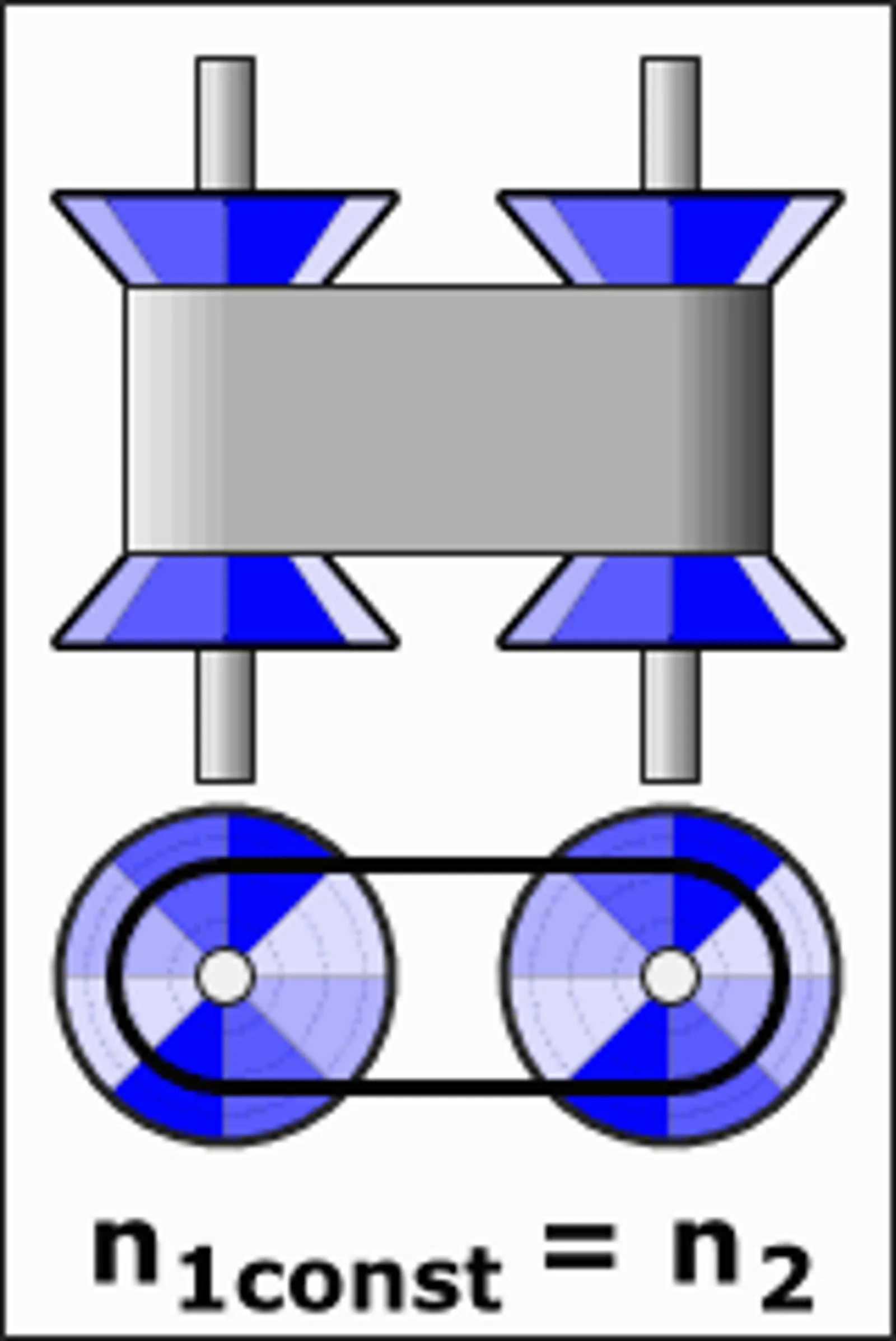
In a belt CVT, a V-belt runs between two variable-diameter pulleys. Each pulley has two cone-shaped halves that move together or apart, so the effective diameter depends on the spacing. Because the belt rides higher on one pulley and lower on the other, moving the halves of one pulley closer while opening the other changes the gear ratio.
Both pulleys must change together so the belt keeps the right tension, and simple designs use belt tension itself to adjust the driven pulley. Steel-reinforced V-belts suit low-torque machines such as snowmobiles, but automobiles need a chain built from small conical elements. A belt-driven design reaches about 88 percent efficiency, which is below a manual gearbox, yet the engine can run at its most efficient speed regardless of road speed.
Chain CVTs use numerous elements arranged along several thin steel bands. The bands slide over one another and need lubrication, and a thin film of lubricant on the pulleys stops metal contact without wasting power. Some chains transmit power by tension and others by compression, pushing the output pulley from the input side.
What are the main CVT designs?
Pulley and chain systems are only one family. Positively infinitely variable chain drives lock onto conical pulleys with radial grooves, using stacked plates that slide side to side. They transmit significant torque, which is why they were widely used in industry, but their top speed is well below other pulley designs, and they need constant lubrication.
Toroidal CVTs use pairs of discs with rollers that tilt to change the ratio, and they handle higher torque than pulley designs. Ratcheting CVTs use one-way clutches to add up forward motion, and they can produce zero output speed. Hydrostatic CVTs pump oil to hydraulic motors, and the gear ratio depends on the displacement of the pump. Cone CVTs slide a wheel or belt along conical rollers, and electric variable transmissions blend engine and motor power through planetary gears.
| Design | How the ratio changes | Notable example |
|---|---|---|
| Pulley belt or chain | Conical halves move closer or farther apart | Most small cars, scooters and snowmobiles |
| Positively infinitely variable chain | Interlocking plates in radial pulley grooves | Industrial drives |
| Toroidal | Rollers move across a pair of discs | Nissan Cedric Y34 (1999) |
| Ratcheting | One-way clutches and linkage geometry | Designs for low-speed electric motors |
| Hydrostatic | Pump displacement sets oil flow to motors | Wheel Horse garden tractors (1965) |
| Cone | Wheel or belt slides along conical rollers | Evans Variable Speed Countershaft (1920s) |
| Electric (eCVT) | Planetary gears blend engine and motor | Toyota Prius |
Who invented the CVT and when?
The first CVT in the United States was built by Milton Reeves in 1879, when it was called a variable-speed transmission and used for sawmilling. In 1896 Reeves began fitting it to his cars, and several other manufacturers used the design afterwards. Early cars and motorcycles soon followed with their own versions.
The 1911 Zenith Gradua 6HP motorcycle used a pulley-based Gradua CVT, and the Rudge-Whitworth Multigear arrived a year later with an improved design. Other early vehicles included the David cyclecars built in Spain between 1913 and 1923, the Clyno of 1923 and the Constantinesco Saloon of 1926.
William Evans and Paul Knauf applied in 1903 for a patent on a two-roller cone design, and the Evans Variable Speed Countershaft of the 1920s used a leather cord between two rollers to set the ratio. Those early designs showed the principle, but they lacked the strength and control that later steel belts provided.
When did CVTs reach mass-production cars?
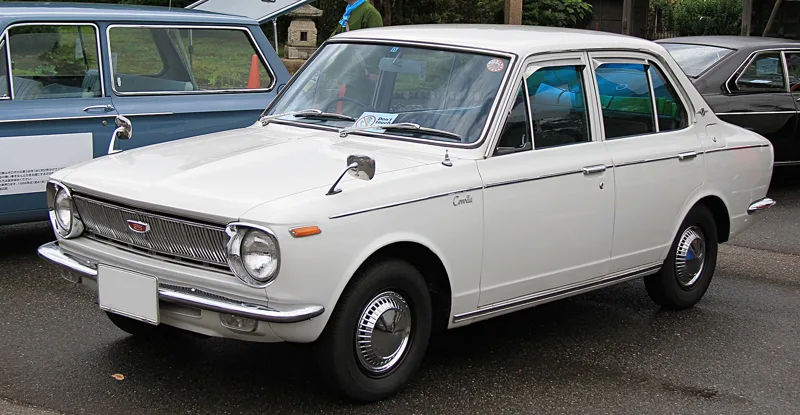
The Dutch DAF 600 became the first mass-production car with a CVT in 1958. Its Variomatic transmission served several DAF and Volvo models until the 1980s, and Van Doorne Transmissie later took over the patents. That early step set the pattern for the belt CVT that carmakers still use.
In 1987 the Subaru Justy offered the ECVT, the first electronically controlled steel-belted CVT, as an option. Production started at 500 units a month, then rose to 3,000 a month, and Subaru later fitted its CVTs to models from other makers. Ford and Fiat introduced steel-belted CVTs that year as well, called CTX and Unomatic.
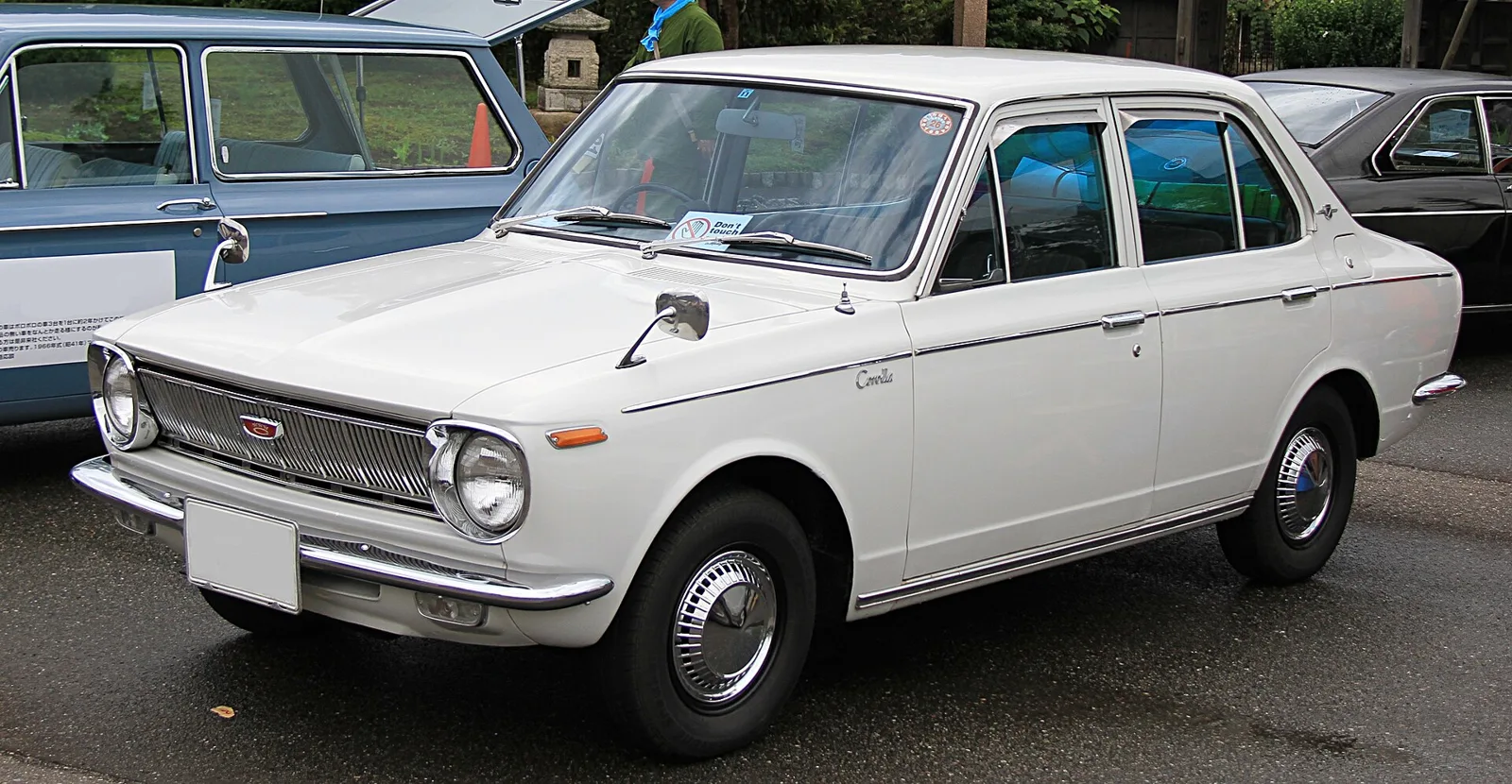
Honda's 1996 Civic used a pulley-based CVT with a multi-plate clutch instead of a torque converter to prevent idle creep. Nissan switched its Cedric to a pulley design named Xtronic in 2003 after using a toroidal Extroid design from 1999. The 2019 Toyota Corolla added a physical launch gear that works below 40 km/h (25 mph) to improve acceleration and spare the belt.
Why do hybrids use a different kind of CVT?
Hybrid electric vehicles use electric variable transmissions, often called eCVTs, which combine an electric motor and an engine through planetary gears instead of a belt. The Toyota Hybrid System, introduced on the 1997 Prius, uses an epicyclic gear set with the electric motor on one input, the engine on the other and the output to the wheels. Changing the motor speed changes the effective ratio.
The arrangement avoids belts and chains, which Toyota said gave the system much better reliability than belt CVTs. It needs a higher-power electrical system and more sophisticated electronics than a conventional car carries. Toyota later called the system the Hybrid Synergy Drive, and Ford, Mitsubishi and others have used similar eCVTs in their hybrid models.
Where are CVTs used beyond passenger cars?
CVTs are widely used on small and utility vehicles. Snowmobiles, golf carts and motor scooters use pulley CVTs with rubber belts, and some scooters add a centrifugal clutch for idling. The first all-terrain vehicle with a CVT was the Polaris Trail Boss in 1985, and the 1974 Rokon RT340 TCR off-road motorcycle used a snowmobile CVT.
Farm and earthmoving machines use CVTs for different reasons. Combine harvesters used variable belt drives from the 1950s, and hydrostatic CVTs are common on larger units because they let forward speed change independently of engine speed. Wheel Horse brought hydrostatic CVTs to garden tractors in 1965 with its 875 and 1075 models, the first vehicles of that kind, and the Fendt Vario 926 of 1996 was the first heavy-duty tractor with an IVT, with more than 100,000 built.
CVTs have also served in aircraft electrical systems since the 1950s, and some use flywheels to govern the speed of a generator. Drill presses and milling machines use simple belt CVTs for spindle speed, and winches and hoists adapt the ratio to the load.
Why were CVTs kept out of Formula One?
Open-wheel Formula 500 cars in the United States have used CVTs since the early 1970s, but the design never became standard in top-level racing. Formula One banned CVTs in 1994 together with several other electronic systems and driving aids. The reasons were the rising cost of research and development and a wish to keep the driver closely involved in controlling the car.
What are the drawbacks of CVTs?
A belt CVT gives up some efficiency compared with a manual gearbox, and the chain needed for a car is built from many small elements. Hydrostatic designs are weaker still, with few systems exceeding about 65 percent efficiency, because losses occur in the pump, the motor and the piping and valves. Gears can reach about 90 percent efficiency in many cases, which is a clear gap.
Hydrostatic systems also cost more than an equivalent geared unit, because they need pumps, motors, a reservoir, piping and often an oil cooler. Their components are heavy because they run at high oil pressure. Ratcheting designs can vibrate during the speed transitions that drive them, and some lightweight CVT bicycles added noticeable weight, which limited their commercial success.
How do belt and chain CVTs handle wear and lubrication?
Chain CVTs depend on steady lubrication. The sliding plates of a positively infinitely variable chain wear slowly over the years, so the plates are made longer than needed to allow for that wear before the chain must be refurbished or replaced. The housing is usually partly filled with oil, and constant lubrication is part of the design.
Chain belts need many very small elements, because the contact area between the chain and the pulleys shrinks as the chain moves into them and contact area scales with the number of elements. Engineers therefore balance the thickness of the belt between the maximum gear ratio and the torque it must carry, and steel-reinforced belts suffice for lighter machines.
Can a CVT favour power over economy?
Yes. When power matters more than economy, the ratio can be changed so that the engine turns at the speed where it produces its greatest power. The same hardware can therefore serve economy-minded and performance-minded drivers, depending on how the control system is set.
What makes a hydrostatic CVT attractive?
Hydrostatic CVTs offer capacity scalability, because a correctly sized pump and matching hydraulic motors suit the application. Hoses can carry oil to motors mounted in awkward places, which simplifies all-wheel-drive articulated vehicles. Operation through forward and reverse can be controlled with a single lever or foot pedal, and the potential for high torque multiplication at very low speeds allows precise movement under load.
The Integrated Hydrostatic Transaxle combines the hydraulic and gear-reducing elements in one housing, and it appears in some mini-tractors and ride-on lawn mowers. On agricultural machines, AGCO has split power between hydrostatic and mechanical paths through a planetary gear, so that a significant share of torque travels through efficient fixed gears when moving forward.
How do friction-disk and magnetic CVTs work?
A friction-disk transmission has an output disk that rolls across the face of an input disk. When the output disk sits at a distance equal to its own radius, the ratio is 1:1, and moving it toward the centre changes the ratio until the output stops. Lambert and Metz automobiles used such drives in the early 20th century, and snow blowers still use them today.
The magnetic CVT is still in development. The design relies on magnetic coupling rather than contact, with permanent magnets on two rings and steel pieces between them acting as a planetary gearset. Its developers claim a 3 to 5 percent reduction in fuel consumption compared with a mechanical system.
Why are ratcheting CVTs unusual?
Ratcheting designs rely on a row of one-way clutches that sum only the forward motion. Because a typical ratchet switches on and off, many of these designs are not continuous in operation, yet they can still produce zero output speed from any input speed, as an infinitely variable transmission would. In a well-designed system their friction increases with torque, so slippage is avoided and efficiency is generally high.
Historians trace the principle to before the 1930s, when roller clutches were used to turn spinning motion into back-and-forth motion and then back again. The design remains in production for low-speed electric motors, and a bicycle transmission prototype using the principle was patented in 1994.