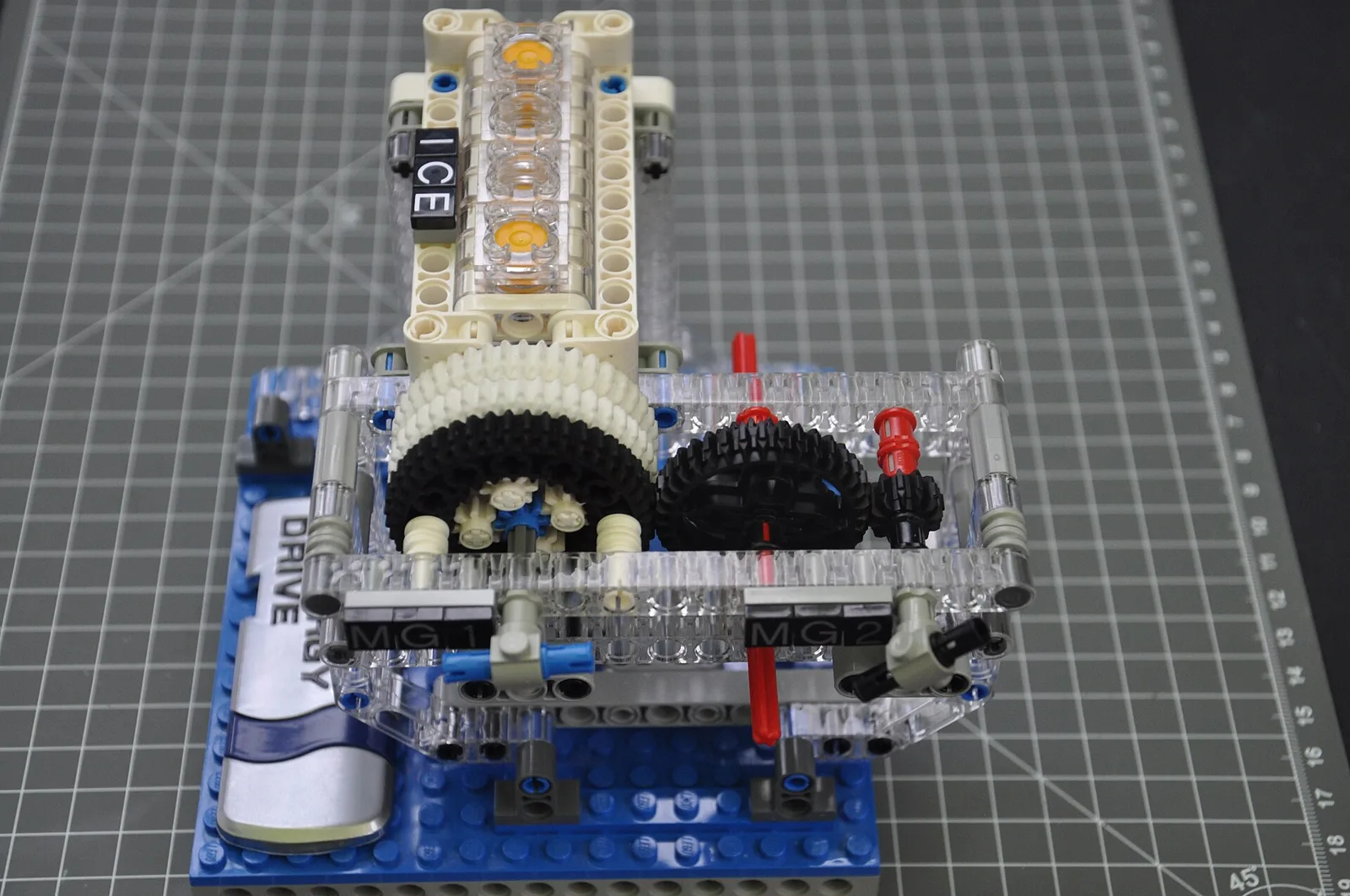
A planetary gearset, two motor-generators and a battery that lets the car run on electricity alone, from the 1997 Prius to Generation 5.
Hybrid Synergy Drive is Toyota's hybrid drivetrain, built around a planetary power-split gearset and two motor-generators. It debuted on the 1997 Prius, is used across Toyota and Lexus models, and in its Prius form can return 55 mpg (US) on longer drives at modest speeds.
Hybrid Synergy Drive is the hybrid system Toyota uses in Toyota and Lexus vehicles. Its planetary gearset splits engine power between the wheels and a generator, letting the car run on electricity alone for short distances. It debuted on the 1997 Prius and has since spread across much of the Toyota range.
What is Hybrid Synergy Drive?
Hybrid Synergy Drive, or HSD, is Toyota's brand name for its hybrid drivetrain, also known as Toyota Hybrid System II. It produces a full hybrid, which can run on the electric motor alone, unlike most other brand hybrids that are described as mild hybrids. The name was chosen in anticipation of use beyond the Toyota brand.
The system is drive-by-wire, with no direct mechanical connection between the engine and the controls. Both the accelerator and the gear selector send electrical signals to a control computer, which decides how the engine and motors work together.
Toyota also licensed the technology to Nissan for the Altima Hybrid, and its parts supplier Aisin offers similar hybrid transmissions to other car companies. The technology has been adapted for the electric drive of the hydrogen-powered Mirai and for a plug-in version of the Prius.
A planetary gearset and two motor-generators let the engine work where it is most efficient, while the battery takes up the rest.
Why does a conventional gearbox limit efficiency?
An internal combustion engine delivers power most efficiently over a small speed range, but the wheels must be driven across the vehicle's full speed range. A conventional gearbox offers only four to six fixed ratios, which forces the engine to run at speeds where it wastes more fuel. Manufacturers then have fewer options for improving the engine itself.
A continuously variable transmission removes that constraint, because the ratio can be chosen for any speed or power. Toyota describes HSD cars as having an e-CVT, meaning an electronic continuously variable transmission, for classification and regulatory purposes. The engine can then run close to its most efficient point and shut off when power is not needed.
How does the power split device work?
The power split device is a planetary gearset that divides engine power three ways: extra torque at the wheels, extra rotation speed at the wheels, and power for a generator. A computer directs the flow from the engine and motors, and this arrangement delivers CVT behaviour without a belt or set of gear trains linking the engine to the wheels.
The arrangement uses two motor-generators. MG1 starts the engine and charges the battery, and by varying its torque and speed it effectively controls the continuously variable transmission. MG2 drives the wheels, and it regenerates energy during braking. The planetary gear is housed in one transaxle that bolts to the engine.
Typical power flows show how the parts combine:
- Battery or electric drive: the battery feeds MG2, which drives the wheels on its own.
- Moderate acceleration: the engine and MG2 drive the wheels together.
- Highway driving: the engine drives the wheels while MG1 charges the battery.
- Steep hills: the engine and MG2 both drive, and MG1 still charges the battery.
- Regenerative braking: energy flows from MG2 back into the battery.
The HSD also manages auxiliary power. A DC-DC converter feeds the 12-volt battery that runs the car's electronics when the high-voltage system is off, and the engine can be run to recharge the battery or warm the catalytic converter after a cold start.
What components does the system use?
The system replaces the geared transmission, alternator and starter motor with a set of electronic parts. Each part has a defined role in the power split, and removing any one of them changes how the car behaves on the road in everyday use.
- MG1, an AC motor-generator with a permanent magnet rotor, which starts the engine and charges the battery.
- MG2, an AC motor-generator that is the primary drive motor.
- Power electronics with three DC-AC inverters and two DC-DC converters.
- A computerized control system with sensors that monitor shaft speed and torque.
- A high-voltage battery that supplies energy on acceleration and absorbs it during regeneration.
- A 12-volt lead-acid battery that powers the low-voltage electronics and accessories.
The car has no reverse gear in the usual sense. The computer reverses the phase sequence to MG2, applying negative torque to the wheels. Early models lacked enough reverse torque on steep hills, a problem that was later fixed.
How has the hybrid battery changed?
The traction battery is a sealed nickel-metal hydride or lithium-ion pack, and its design has changed with each generation. The first Prius battery had 228 cells packed into 38 modules, while the second generation used 28 modules of six 1.2 volt cells each. That gave a nominal pack voltage of 201.6 volts.
A dedicated computer keeps the battery at its optimum temperature and charge level. The discharge power of the second generation pack was about 20 kW at 50% state of charge, and that capability rises in heat and falls in cold. Third generation cars use a boost converter to produce 500 volts for the inverters.
To prolong battery life, the car allows only 40% of the rated capacity of 6.5 ampere-hours to be used, so the state of charge varies between 40% and 80%. Some larger models, including the Highlander Hybrid and the Lexus RX 400h, used a different casing with 240 cells that delivered 288 volts.
Which generations of Hybrid Synergy Drive exist?
HSD has now gone through five generations since the original Prius in 1997. Each step kept the same basic power split, but refined the motors, gearing and battery. The table below summarises the changes that matter most to drivers and owners.
| Generation | Introduced | Notable change |
|---|---|---|
| Generation 1 (THS) | 1997 Prius | P110 transaxle with a 276 to 288 volt battery |
| Generation 2 (THS-II) | 2004 Prius | MG2 output raised from 33 to 50 kW |
| Generation 3 (HSD) | 2006 model year RX 400h | Second planetary gearset gives MG2 2.5:1 torque multiplication |
| Generation 4 | 2016 model year, announced 13 October 2015 | Mechanical friction losses cut by 20 percent |
| Generation 5 | 2023 model year | Lighter, more powerful motors and some lithium-ion packs |
Generation 2 also brought a DC-DC converter that lifts the battery to 500 volts or more, allowing smaller packs and more powerful motors. From the 2004 Prius onwards, every HSD vehicle has used an electric air conditioning compressor, so cabin cooling no longer depends on running the engine.
Generation 3 introduced a second planetary gearset that gives MG2 a 2.5:1 torque multiplication. That allows a smaller but more powerful MG2, and it also keeps MG1 from overspeeding as often. Generation 4 returned to a single planetary gearset and used helical gears in the P610 transaxle for smoother, quieter running.
How efficient is Hybrid Synergy Drive in practice?
The Prius is known for high efficiency in a midsized four-door sedan. It typically returns 40 mpg (US) (5.9 L/100 km) on brief city trips, and 55 mpg (4.3 L/100 km) is not uncommon on longer drives at modest speeds. That is roughly twice the efficiency of a similar sedan with a conventional drivetrain.
The HSD is not the only reason. The Atkinson cycle engine uses an offset crankshaft to reduce drag during the power stroke, plus an intake system that limits pumping losses. The Atkinson cycle also recovers more energy per cycle, but it produces much less torque at low speed, which MG2 makes up for with its strong low-speed output.
Efficiency depends on how the car is driven. Gentle acceleration keeps the engine in its efficient range, and gradual braking recovers more energy. Heating the cabin can keep the engine running, since the system is designed to create as little waste heat as possible.
How quick is a Hybrid Synergy Drive car?
The Highlander Hybrid offers better acceleration than its non-hybrid version. It accelerates from 0-60 mph in 7.2 seconds, nearly a second quicker than the conventional model. Its net power is 268 hp (200 kW), against 215 hp (160 kW). Its top speed is limited to 112 mph (180 km/h).
Fuel economy for the Highlander Hybrid is rated between 27 and 31 mpg (8.7 to 7.6 L/100 km). The conventional Highlander is rated at 19 city and 25 highway mpg, which shows how much the system changes running costs. The Prius itself has modest acceleration, so its appeal is economy rather than speed.
Can a Hybrid Synergy Drive car run on electricity alone?
Yes, within limits. The EV button keeps the car in electric mode at low loads below 25 mph (40 km/h), if the battery has enough charge. That allows all-electric driving with no fuel use for up to 1 mi (1.6 km), and the software switches to EV mode automatically whenever it can.
The Prius Plug-in Hybrid offers a longer blended electric range, rated at 11 mi (18 km) by the EPA. Its 4.4 kWh lithium-ion batteries weigh 80 kg (180 lb), compared with the 1.3 kWh nickel-metal hydride pack of the third generation Prius, which weighs 42 kg (93 lb). The larger pack allows electric running at higher speeds and longer distances.
What are the advantages and drawbacks of Hybrid Synergy Drive?
The system delivers strong efficiency in city driving, and it lets the engine be sized for average load rather than peak demand. Its drawbacks are mostly about battery capacity, heating and driving style. The trade-offs are different from a conventional car, so owners should understand them before buying.
Advantages:
- Significant efficiency advantages in city driving, with the engine switched off in traffic.
- Regenerative braking recovers energy and reduces wear on the conventional brakes.
- Strong low-speed torque from MG2 offsets the Atkinson cycle engine.
- A smaller engine can be designed to run efficiently across its load range.
Drawbacks:
- Battery capacity can be exhausted by repeated demand, which cuts performance on long climbs.
- Running the heater can keep the engine running, reducing the economy benefit.
- Neutral mode drains the battery, and a flat battery leaves the vehicle inoperable.
- Lithium-ion packs have a higher energy-to-weight ratio but raise safety concerns if poorly made.
Who developed the technology and who licensed it?
Toyota developed the system, and it has licensed or supplied it to others. Nissan used it in the Altima Hybrid, and Aisin Seiki, in which Toyota holds a minority stake, supplied its HSD-style transmission to Ford for the first Escape Hybrid. Ford also licensed 21 patents from Toyota in exchange for emissions technology, after developing similar systems itself in 2004.
Legal challenges have also surrounded the design. In autumn 2005 Antonov sued Toyota over key drivetrain components in the RX 400h and Prius. On 1 September 2006 the Federal Patent Court in Munich did not uphold the German part of Antonov's patent, and a Dusseldorf court later found that the Prius and RX 400h drivelines did not breach it.
Paice held patents relating to hybrid vehicles, and Toyota agreed to license them in 2010. Terms were not disclosed, but the settlement states that Toyota developed the Prius independently of Paice's inventions.