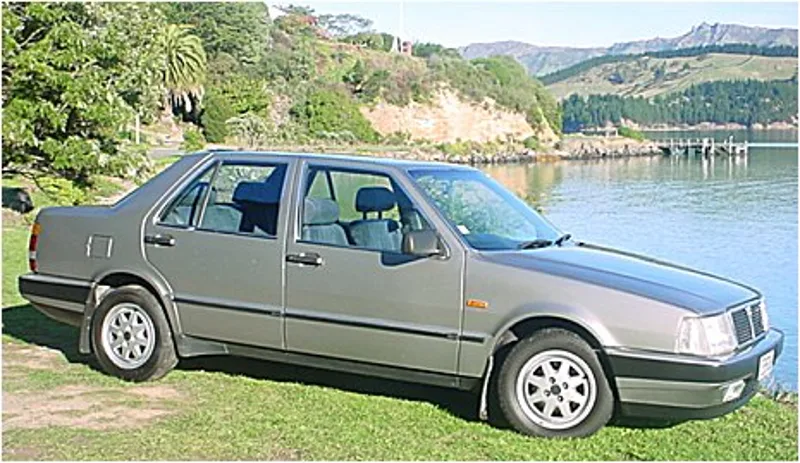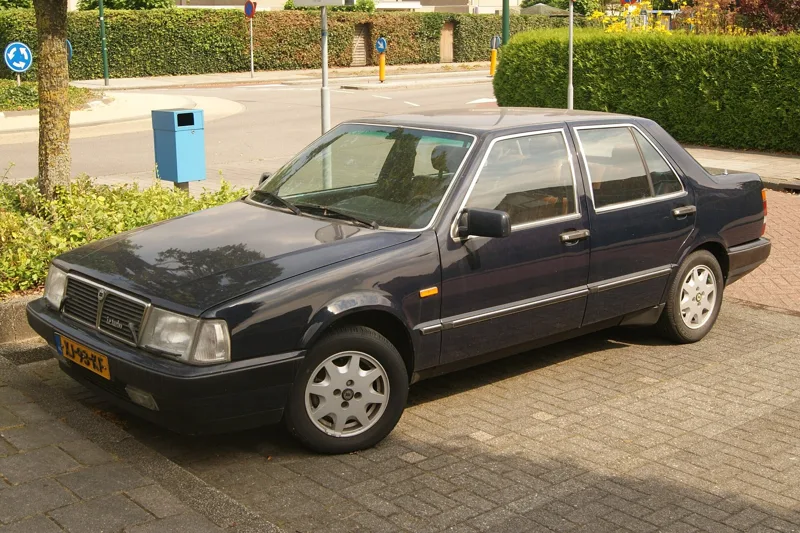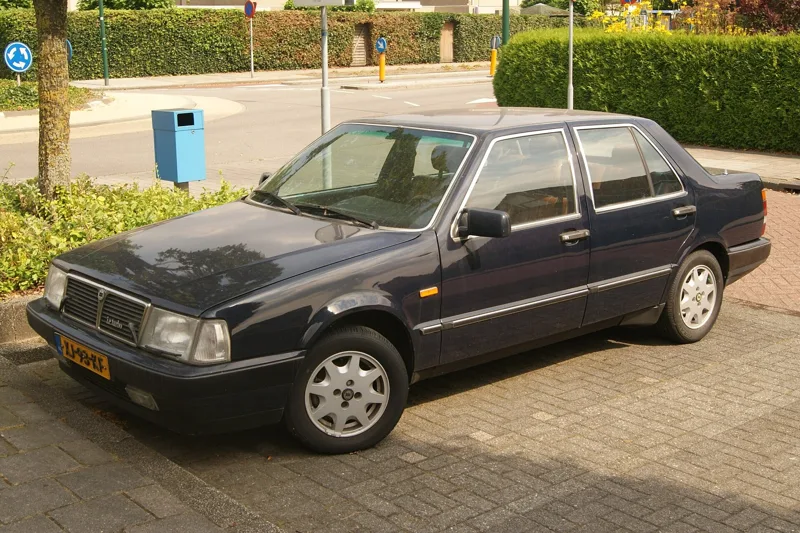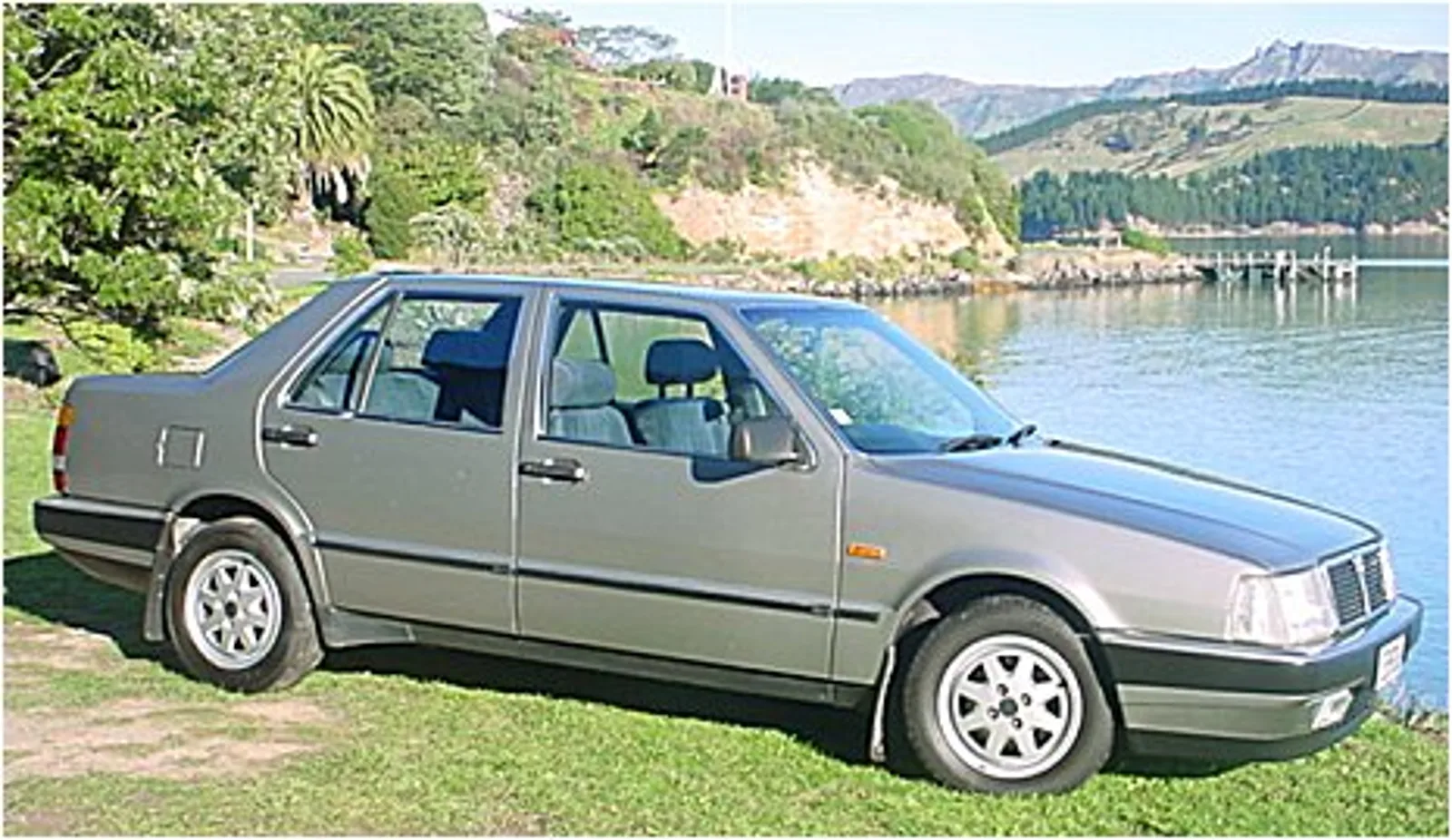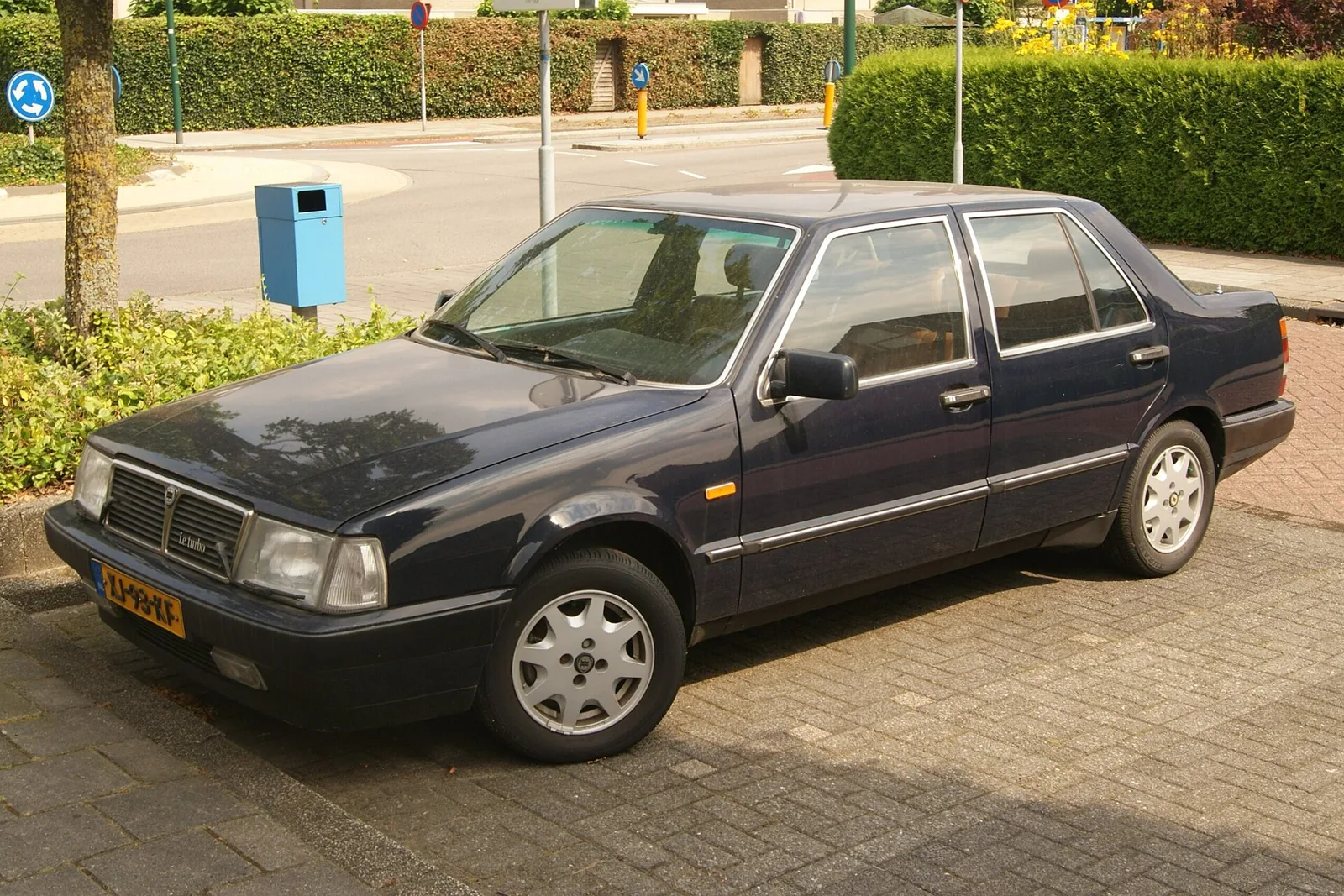
Both sold performance flagships, but the Thema's came from a Ferrari-based V8 and the Omega's from a Lotus-tuned twin-turbo six.
The Lancia Thema was built from 1984 to 1994, and its 8-32 flagship used a 2.9-litre Ferrari V8. The Opel Omega ran from 1986 to 2003, won the 1987 European Car of the Year award and gained a Lotus-tuned flagship. The two met most directly at the top of their ranges.
The Lancia Thema and the Opel Omega were executive saloons that arrived within two years of each other, and each had a performance flagship with a famous name behind it. The Thema 8-32 used a Ferrari V8, while the Omega's most potent model used a Lotus-tuned six.
Where did the Thema and Omega come from?
The Thema went on sale in 1984, built by Lancia on the Type Four platform it shared with the Alfa Romeo 164, the Fiat Croma and the Saab 9000. The Omega followed in September 1986 as the replacement for the Opel Rekord, and it was built until 2003.
Announced in May 1984, shown to the press in Vienna that October, and introduced to the public at the Turin Motor Show that November. It came in saloon and station wagon forms, and Pininfarina designed and produced the wagon.
Opel designed the Omega as an evolution of its earlier styling, with aerodynamics the priority as fuel prices rose. Sales began in November 1986, and the car later won the European Car of the Year award for 1987.
The Thema's headline came from Ferrari's V8, while the Omega's came from Lotus and a pair of turbochargers.
Why were the Thema and Omega rivals?
At the sharp end, the Thema 8-32 listed the Opel Lotus Omega among its key rivals, alongside the Audi 100 Quattro, the BMW M535i and the Ford Sierra RS Cosworth.
The Thema came first. It was announced in May 1984, so it had about two years on sale before the Omega reached showrooms in November 1986.
Road & Track called the 8-32 one of the weirder sleepers of its era. Enzo Ferrari owned one towards the end of his life as his personal transport.
The Omega's pitch was different. It was a volume executive car from a mainstream maker, sold as a saloon or estate, with a fleet-oriented LS version at the bottom of the range. Its performance models, the Omega 3000, the Evolution 500 and the Lotus Omega, sat on top of that range.
How did the Thema's design compare with the Omega's?
The Thema's second series was presented at the Paris Motor Show in September 1988. The grille gained vertical bars in place of horizontal ones, the turn indicators moved beneath the headlamps, and the rear lenses were tinted red. The side rubbing strips, skirts and wheel covers were redesigned.
Badging changed as well. All model badging came off the rear, and the Thema range grew to nine models across the saloon and station wagon, though most looked almost identical aside from wheels and badges. The 8-32 was the only model with clear visual differences.
The Omega's design was built around aerodynamics, with a drag coefficient of 0.28 and 0.32 for the Caravan estate. Its electronic extras included engine management, ABS, an on-board computer and a self-diagnosis system, and it was among the first cars to fit individually heated rear seats.
What engines did the Thema and Omega use?
Apart from the Ferrari V8, the Thema's engines originated from a Fiat series designed by Aurelio Lampredi, including a 2.0-litre four, a 2.8-litre PRV V6 and a 2.4-litre turbo diesel in the first series. The third series replaced the V6 with a 3.0-litre Alfa Romeo unit. The Omega used rear-wheel drive and a range of 1.8 to 3.0-litre petrol engines.
The first-series Thema's two-litre four came in naturally aspirated and turbocharged forms, rated at 120 PS (88 kW; 118 hp) and 165 PS (121 kW; 163 hp). The top model, the Thema 6V, had a 150 PS (110 kW; 148 hp) V6 tuned for smoothness, and a turbo diesel rated at 100 PS (74 kW; 99 hp) was also offered.
The second series brought 16-valve two-litre engines at 147 PS (108 kW; 145 hp), or 185 PS (136 kW; 182 hp) in turbo form. The diesel grew to 2.5 litres and 118 PS (87 kW; 116 hp). Third-series cars then gained the 175 PS (129 kW; 173 hp) Alfa Romeo V6.
The Omega's petrol range ran from 1.8, 2.0 and 2.4 litre fours up to 2.6, 3.0 and 3.0 litre 24-valve sixes. The 3.0-litre Omega 3000 made 177 PS (130 kW), and the 1989 upgrade lifted it to 204 PS (150 kW).
How was the Thema station wagon built?
The estate was a joint project between Lancia and Pininfarina, developed at Grugliasco. A prototype appeared at the Frankfurt Motor Show in September 1985, and the definitive car followed at the Geneva Motor Show in March 1986.
Lancia's own factory made the body-in-white parts shared with the saloon. The incomplete bodies then went to Pininfarina's Borgo San Paolo plant, where they were completed, painted and assembled. Between 1986 and 1994 Pininfarina built 21,074 station wagons.
Zagato had shown a station wagon proposal at the 1985 Geneva Motor Show, a design study with more glass at the rear and more discreet D-pillars. The production wagon was never offered in right-hand drive, so British buyers could not order one.
On the Omega side, the Caravan estate had a drag coefficient of 0.32, against 0.28 for the saloon. Both cars therefore offered a load-carrying body, but the Italian wagon was the more purpose-built of the two.
How fast was the Thema 8-32?
The Thema 8-32 reached 100 km/h in 6.8 seconds in non-catalysed form and topped out at 240 km/h (149 mph). The Lotus Omega could reach 280 to 300 km/h, so the Omega's flagship had the higher top speed, but it was a turbo six rather than a V8.
The 8-32's 2.9-litre Ferrari V8 produced 215 PS (158 kW) at 6,750 rpm without a catalyst. The catalysed version made 205 PS (151 kW), reached 100 km/h in 7.2 seconds and topped out at 235 km/h (146 mph).
Its engine was based on the unit used in the Ferrari 308 GTB, but it had a cross-plane crankshaft, smaller valves and a different firing order. All of that was aimed at making the engine suit a four-door luxury saloon.
The 8-32 came with a five-speed manual as its only transmission, plus Bosch KE3 Jetronic injection, ABS, ZF's Servotronic steering and a retractable rear spoiler. The spoiler was there to aid high-speed stability, and the driver operated it with a rotary switch on the right stalk. Visually, the 8-32 stood out through yellow badges, a silver eggcrate-type grille, twin exhaust outlets and a double hand-painted pinstripe. Options included automatic climate control, an electric sunroof, provision for a car phone and rear individual power seats.
The Lotus Omega combined a 3.6-litre engine with two Garrett T25 turbochargers and produced 377 bhp (281 kW). It was described as the world's fastest production sedan of its time, which was controversial because other German makers limited their high-performance cars to 250 km/h.
Which Thema and Omega models were rare?
The Thema Limousine was built only on request for wealthy customers and Fiat Group executives. Only 24 were made, and most had a 2.8-litre PRV V6 before the last examples switched to a 3.0-litre Alfa Romeo V6. The wheelbase ran to 2,960 mm.
The 8-32 was assembled at Lancia's S. Paolo plant in Turin. It had a handmade wood-and-Alcantara interior and a choice of five metallic paint colours, and 2,370 Series 1 cars were built between 1986 and 1988. The Series 2 cars followed from 1989 to 1992, numbering 1,601.
All 8-32s were left-hand drive, although one was converted to right-hand drive by TAK Motor in South Africa in 1987 for its managing director. The 8-32 did not receive the third-series facelift.
On the Omega side, the Evolution 500 was the rare one. Built with Irmscher so that Opel could compete in the DTM, it was limited to 500 examples. Its three-litre straight-six made 230 PS (169 kW) in road trim, and the car reached 100 km/h in 7.5 seconds with a top speed of 249 km/h (155 mph). The racing version used 380 PS (279 kW), but it did not achieve great success on the track.
How did the Thema and Omega sell?
The Thema saloon sold more than 336,000 examples before it was replaced in 1994. The Omega took the 1987 European Car of the Year title and stayed in production until 2003, which made it the longer-lived of the two.
Lancia withdrew from right-hand drive markets, including the United Kingdom, in 1994 as sales fell, so the Thema's British life ended with its production run. The Omega carried Vauxhall Carlton badging in the UK.
Which buyer suits each car?
The Thema suits a buyer who wanted an Italian executive saloon, a Ferrari-engined flagship and a Pininfarina station wagon. The Omega suits a buyer who wanted a mainstream rear-wheel-drive executive car with an award-winning name and a range of Opel and Lotus performance variants.
The Thema's sporting top end was the 8-32, but it was left-hand drive only in its original form, which limited the choice for British buyers. In Vauxhall markets the Omega 3000 was sold as the Carlton GSi 3000, and the Lotus Omega as the Lotus Carlton.
What the Thema offers is character and rarity, while the Omega offers breadth and an award-winning reputation. Neither result is a clear verdict on which car was better.
Lancia Thema and Opel Omega side by side
| Feature | Lancia Thema | Opel Omega |
|---|---|---|
| Production | 1984 to 1994, three series | 1986 to 2003; Omega A 1986 to 1994, Omega B 1994 to 2003 |
| Body styles | Saloon and station wagon by Pininfarina | Saloon and estate |
| Drive layout | None described | Rear-wheel drive |
| Base engines | 2.0 litre four; 2.8 litre V6 in the first series; 2.4 litre turbo diesel | 1.8, 2.0 and 2.4 litre fours; 2.6 and 3.0 litre sixes |
| Performance flagship | Thema 8-32, Ferrari-based 2.9 litre V8, 215 PS (158 kW) | Lotus Omega, 3.6 litre twin-turbo, 377 bhp (281 kW) |
| Flagship top speed | 240 km/h (149 mph) | 280 to 300 km/h |
| Flagship 0-100 km/h | 6.8 seconds, non-catalysed | 5.3 seconds |
| Limited production | 8-32: 2,370 Series 1 and 1,601 Series 2; Limousine 24 | Evolution 500: 500 examples |
| Awards | None described | European Car of the Year for 1987 |
| Right-hand drive | Withdrawn from RHD markets, including the UK, in 1994 | Sold in the UK with Vauxhall Carlton badging |
| Facelifts | Second series 1988; third series 1992 | Omega A facelift for 1991; Omega B2 in autumn 1999 |
| Successor | Kappa in 1994 | Opel Signum |
What became of the Thema and the Omega?
Lancia replaced the Thema with the Kappa in 1994, and the Thema name returned in 2011. Chrysler's 300C was sold as the Lancia Thema across most European markets from 2011 to 2014, while the United Kingdom and Ireland kept the 300C name.
The Omega ended in 2003 and was succeeded by the Opel Signum. Its B platform was also modified to form the basis of the Holden Commodore VT from the 1997 series.
Opel's V8 plans ended with the Omega. The V8.com concept appeared at Frankfurt in September 1999, and the production V8 was cancelled after 32 pre-series cars had been built.