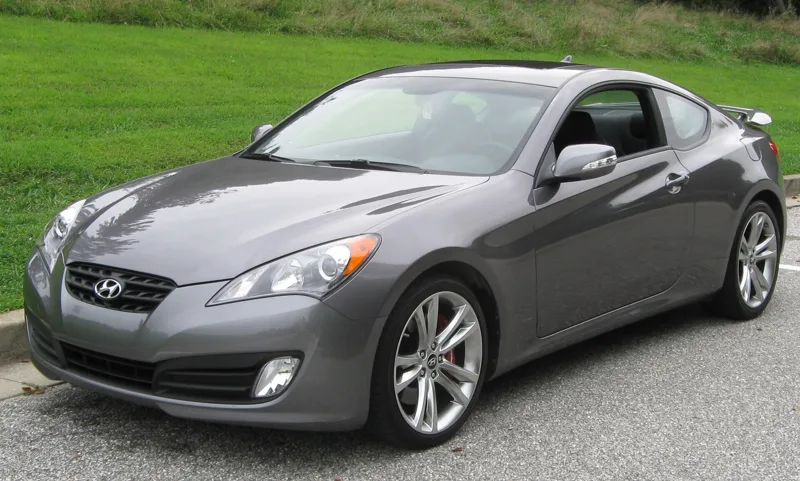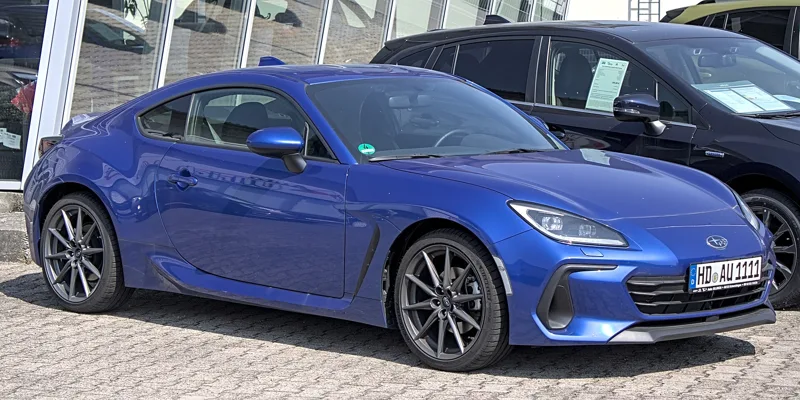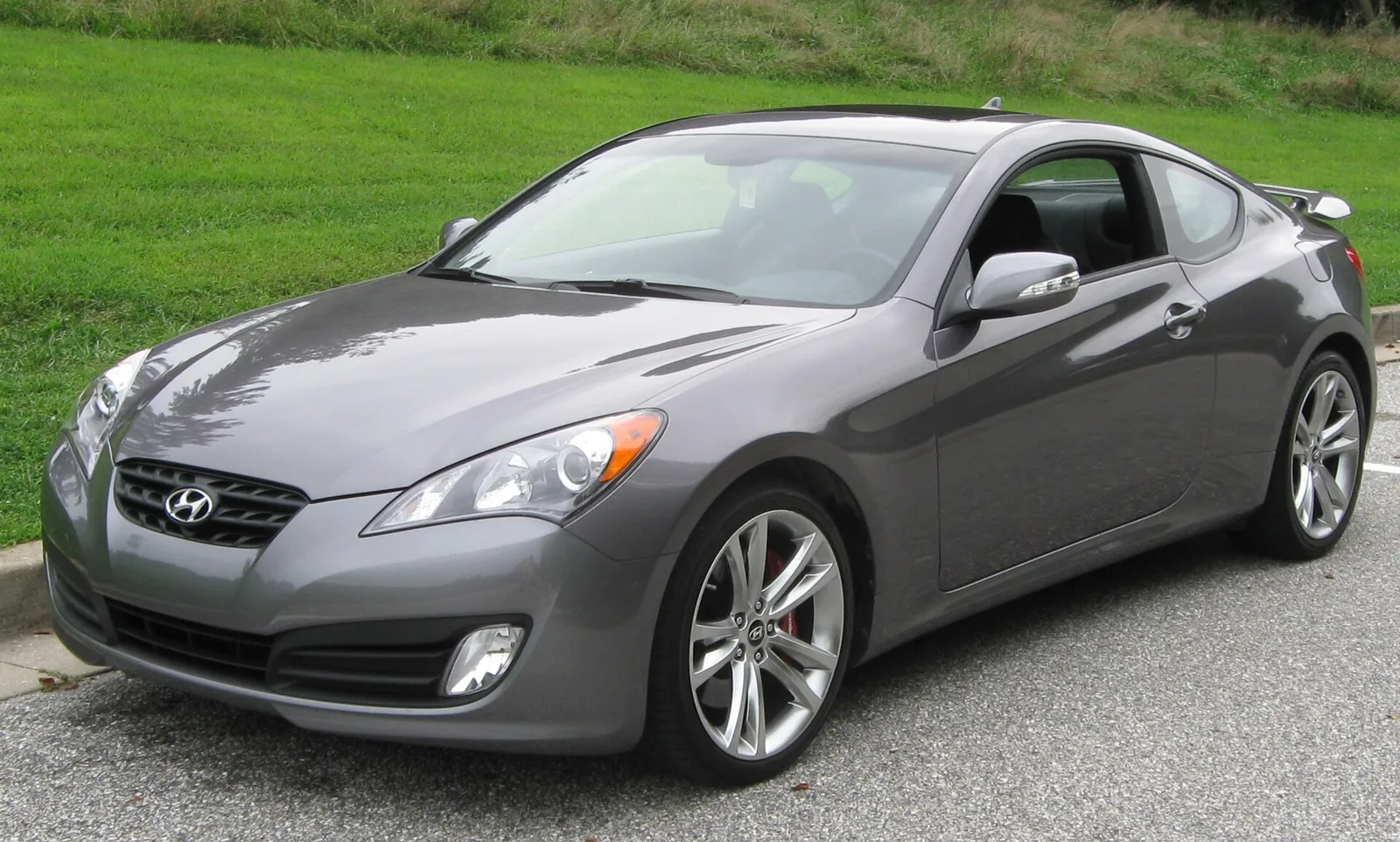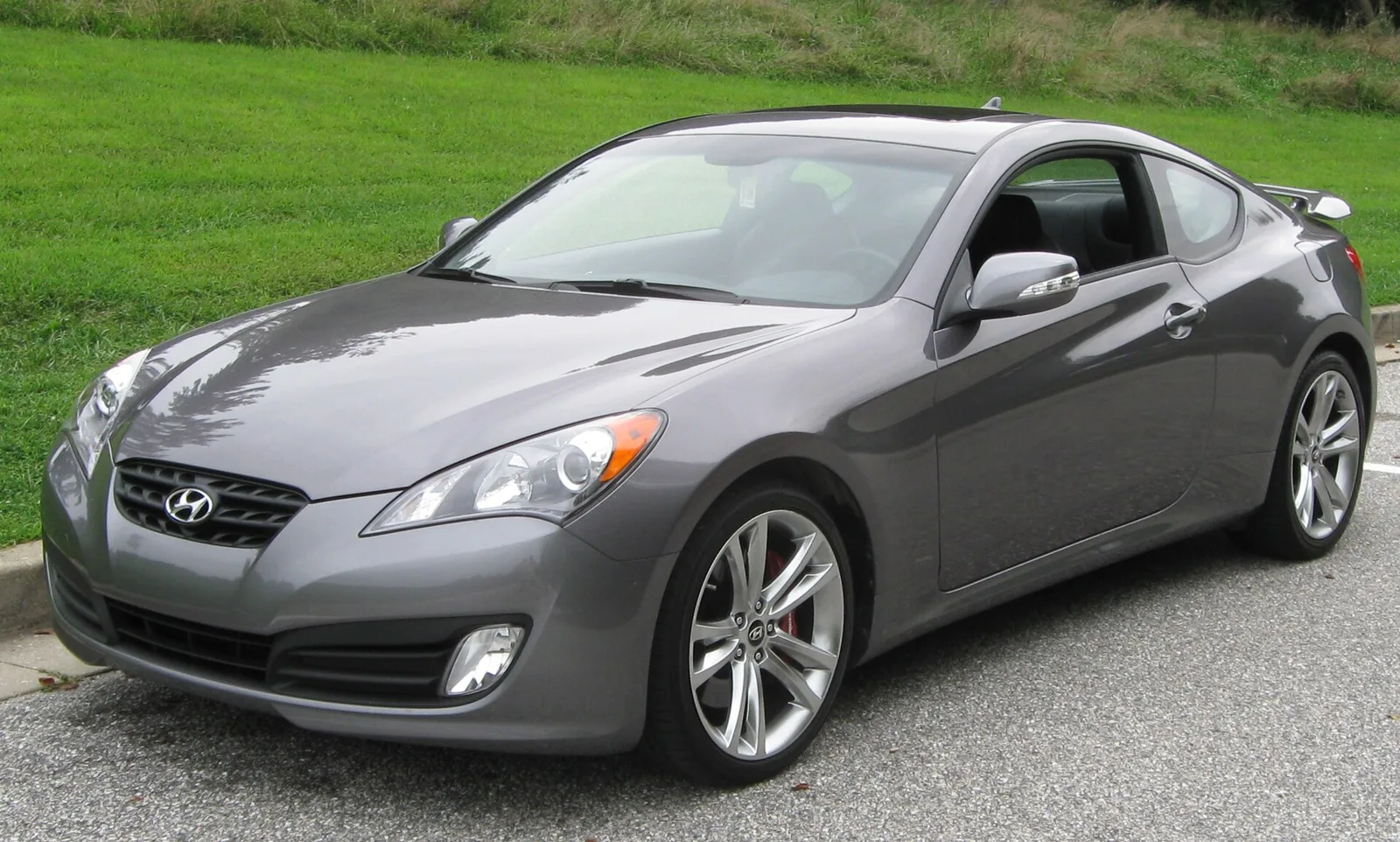
Hyundai's first rear-drive sports coupe against a Toyota and Subaru collaboration with a boxer engine, judged on power, lap times, equipment and what the press made of each.
The Hyundai Genesis Coupe came to Korea in 2008 and to US dealers in 2009 as a 2010 model. The Subaru BRZ, developed with Toyota, arrived in 2012 with a naturally aspirated 200 PS boxer and a 53/47 weight split.
The Hyundai Genesis Coupe and the Subaru BRZ were both affordable rear-wheel drive sports coupes built for buyers who wanted a driver's car without paying premium-car money. The Genesis Coupe was Hyundai's first rear-drive sports car, and it ran until 2016. The BRZ came out of a Toyota and Subaru partnership, with a naturally aspirated boxer engine and a 2+2 body, and it arrived in 2012.
Why were the Genesis Coupe and BRZ compared?
Both were sold as enthusiast cars that prized handling and driving feel over outright luxury. The press set them against each other, and Motor Trend placed the Genesis Coupe 2.0T R-Spec last in a comparison that also included the BRZ.
Hyundai's own target for the Genesis Coupe was clear from the start. John Krafcik, then the acting president and chief executive of Hyundai USA, said the car was designed to challenge the Infiniti G37 on the road.
The BRZ's position was defined by its siblings. It was developed alongside the Toyota 86 and the Scion FR-S in the US, so the same car sat under three badges with only small differences at the grille and bumper.
A Hyundai that wanted to chase the big V8 cars and a Toyota-Subaru twin that chased balance, both rear-drive and both built for the driver.
How did each project begin?
Photos of a camouflaged Genesis Coupe prototype appeared on the internet as early as May 2007. The spy pictures showed a longitudinal engine, which pointed to a rear-drive car, and a four-cylinder with a heat-wrapped turbocharger. Speculation ranged from that turbo four to the V8 Hyundai had developed for the Genesis luxury sedan.
The production coupe was unveiled at the 2008 New York International Auto Show, with a demonstration of powerslides and burnouts. North American models went on sale in spring 2009 as 2010 models.
The BRZ had a longer and more complicated start. Toyota bought a 16.5% stake in Fuji Heavy Industries, the parent of Subaru, in 2008 and then invited Subaru to co-develop the project, including a new D-4S boxer engine. Subaru first rejected the offer, which conflicted with its reputation for all-wheel drive performance cars.
The project paused for six months until Toyota invited journalists and Subaru engineers to test a development prototype. After that test Subaru agreed to take a bigger part, and the FT-86 concept debuted at the Tokyo Motor Show in October 2009.
What layout did each car use?
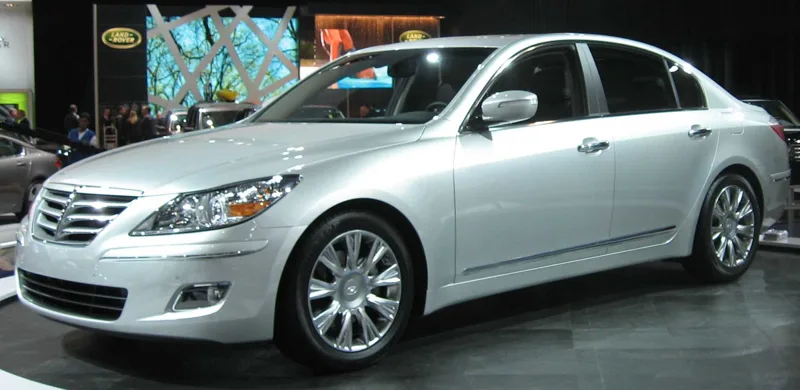
The Genesis Coupe shares its basic platform with the Genesis luxury sedan. It was Hyundai's first rear-wheel drive sports coupe, and it was offered in 2.0-litre turbo and 3.8-litre V6 forms with a range of trims.
The BRZ is a front-engined, rear-wheel drive 2+2 fastback with a naturally aspirated boxer engine. Its weight is split 53% at the front and 47% at the rear, and the engine sits low for a low centre of gravity, which is the design's central idea.
The BRZ's body uses an aluminium bonnet and a fixed roof, with a boot rather than a hatchback. Its drag coefficient is Cd=0.27. Toyota and Subaru drew inspiration from the AE86, the small rear-drive Corolla that was popular in racing and rallying, and the car's development code 086A alludes to that model.
The Genesis Coupe's North American suspension was stiffer than the Korean car's, reflecting American demand. Hyundai Canada offered a proximity key on all V6 models, and a navigation system arrived in autumn 2009.
Specifications side by side
| Specification | Hyundai Genesis Coupe | Subaru BRZ |
|---|---|---|
| Launch | Korea 13 October 2008; US dealers from 26 February 2009 | Production debut December 2011; sales from March 2012 |
| Body | Sports coupe | 2+2 fastback coupe |
| Layout | Rear-wheel drive; shares a platform with the Genesis sedan | Front-engined, rear-wheel drive, 53/47 weight split |
| Engines | 2.0-litre turbo four; 3.8-litre V6 | 2.0-litre boxer with direct injection |
| Power | 306 hp for the 2011 3.8 R-Spec | 200 PS (197 bhp; 147 kW) at 7,000 rpm |
| Torque | Not given | 151 lb-ft (205 N-m) at 6,400 rpm |
| Transmissions | Six-speed manual; automatic options | Six-speed TL70 manual or A960E automatic |
| Brakes | Brembo brakes on R-Spec | Ventilated discs; four-piston front calipers on the Performance Pack |
| Top speed | Not given | 145 mph (233 km/h) as tested |
| Track time | 3:13.9 at VIR for a 2013 3.8 R-Spec | Not given |
| Price | Not given | A$29,990 GT manual; A$37,990 GTS automatic (Australia) |
| End of production | Discontinued in 2016 | First generation sold as the Scion FR-S until 2016; second generation sold as the GR86 |
What trims and variants did the two cars offer?
The Genesis Coupe came as 2.0T Base, R-Spec and Premium, and as 3.8 Base, R-Spec, Grand Touring and Track models. The R-Spec picked up 19-inch wheels, Brembo brakes, a Torsen limited-slip differential, a stiffer suspension and summer tyres, and it lost several comfort items to save weight, including cruise control and the trip computer.
The R-Spec 2.0T was 68 pounds lighter than the 2.0T Base or Premium, and it was sold with the six-speed manual only. The Track models added HID headlights, fog lights with DRLs and a rear spoiler on top of the R-Spec equipment.
Japan's Toyota 86 range started with the RC, which had unpainted bumpers, 16-inch steel wheels and no stereo or air conditioning. The G added painted panels and an automatic option, the GT86 added HID headlights and keyless start, and the GT Limited topped the range with leather and Alcantara seats.
Australia's first cars came in GT and GTS grades, and the limited-slip differential was standard on every model except the automatic GT at launch. A 2013 update made the automatic GT's limited-slip differential standard too, at a price increase of A$300.
Which had the more power?
The Genesis Coupe 3.8 V6 was the more powerful car in road form, with the 2011 3.8 R-Spec rated at 306 hp. Its engine was the Lambda V6, which moved to direct injection with the 2013 model year.
Output peaked at 200 PS (197 bhp; 147 kW) at 7,000 rpm, with torque of 151 lb-ft (205 N-m) arriving at 6,400 rpm. Its compression ratio was 12.5:1, and it ran on 98 RON premium fuel. The 2017 model year raised the manual version to 205 bhp.
Tuners pushed the Genesis Coupe much further. The Cosworth Genesis Racing Series car made 389 hp and 325 lb-ft from the V6, the ARK version reached 395 hp, and Rhys Millen Racing's RM500 used a 5.0-litre Tau V8 rated at 450 hp.
How did the two cars perform on track?
Car and Driver's yearly Lightning Lap session at Virginia International Raceway gave a 2013 Genesis Coupe 3.8 R-Spec a time of 3:13.9 on the Grand West layout. That was 0.1 second slower than the 306 hp 2011 car.
The Hyundai was also slower than the Mitsubishi Lancer Evolution, the Ford Mustang V6, the Chevrolet Cobalt SS and the Nissan 370Z on the same test. Its tendency to power oversteer and its brake fade were the points that unsettled the testers.
The BRZ's published figures are more modest. Subaru and Toyota claimed 7.6 seconds from 0 to 100 km/h, and the estimates for the car were 6.0 to 6.2 seconds to 97 km/h and 14.7 to 14.9 seconds for the quarter mile. Its top speed was 145 mph (233 km/h) as tested.
What were the motorsport results?
In 2009 the Genesis Coupe raced in Formula Drift's professional series, climbed Pikes Peak and entered select Redline Time Attack events. That programme came from a joint venture between Hyundai and the racer Rhys Millen, who drove a Red Bull-sponsored car with a 5.0-litre V8.
In July 2009 Millen and the Genesis Coupe set a record for two-wheel drive production-based cars at Pikes Peak. In June 2011 he set a 2WD Time Attack record of 11:04.912 in the same car family.
GoGoGear Racing started racing a Genesis Coupe in the United States Touring Car Championship in 2012 and won the championship in 2014 with a 3.8-litre V6. The team was the first to win a road racing championship in a Hyundai in the US, and it finished second in 2015.
How did reviewers judge the Genesis Coupe?
Reception was mixed. Edmunds praised the 3.8 R-Spec as the most interesting car Hyundai made, and it liked the improved transmission, the uprated engine and the more balanced suspension. It also noted that a V6 Mustang or Camaro could be had for less money.
Edmunds also disliked the sluggish tachometer and a short power drop after high-revving upshifts. Motor Trend was harder on the 2.0T R-Spec, praising its smooth ride and extra power but criticising its peaky power delivery, vague shifter and interior ambience.
Hyundai responded to criticism of materials with a 2013 model that brought leather on the handbrake, plasmacluster air filtering, a red leather option and LED accents. The 2013 North American car also gained an eight-speed automatic with paddle shifters or a six-speed manual.
How did the two cars get their looks?
The BRZ's design is credited to the 2000GT's influence in the Toyota GT86. Its side profile, windows and dashboard recall the 2000GT, in keeping with a philosophy the designers called Neo Functionalism, in which the car's looks and driving quality were part of one function.
The car carried a number 86 theme. The engine's bore and stroke were both 86 mm, and the exhaust tip diameter was also 86 mm. The BRZ has the same mechanicals as the 86 and differs mainly in its front grille and bumper bars, and the boxer side badge appears on the Toyota and Scion versions but not on the BRZ.
The Genesis Coupe launched with about ten body colours, ranging from white and black to several blues, a yellow and a grey named after circuits. Some colours were tied to specific trims, and the palette changed from year to year.
Hyundai's custom work also took the Genesis Coupe further. The RMR Art of Speed car was a 2.0T with an RMR turbo kit, a wide-body kit, a carbon-fibre wing and an eight-point roll cage, first shown at the 2008 SEMA Show.
How did the BRZ reach the market?
The production car debuted at the December 2011 Tokyo Motor Show. Its first cars were assembled at Subaru's Gunma Main Plant on 2 February 2012, with sales from March and deliveries from April.
Demand was strong from the start. Toyota took 7,000 orders for the 86 in its first month, and Subaru took 3,500. In the United States, Scion was allocated 10,000 units of the 2013 model year, while Subaru received only 6,000.
In Australia the car launched in June 2012 as the GT and GTS, and the Aero pack added A$3,000 to the GTS only. The launch models carried a full-size spare wheel, but that was phased out after the first shipments and replaced by a repair kit.
Which car suits which buyer?
On the figures, the Genesis Coupe suits a buyer who wants the larger engine option, a V6 with a manual gearbox and a body that tuners have taken to 450 hp. The BRZ suits a buyer who wants a light, low-slung rear-drive car with a balanced chassis and a boxer engine that is easy to live with.
The Genesis R-Spec trims were priced about $3,000 less than the Track models, and their weight savings came from removing comfort features. A buyer who wanted that focus would find the R-Spec worth the trade-off, while a buyer who wanted equipment would look at the Premium or Grand Touring.
Neither car is the clear winner. The Genesis Coupe has the stronger power figures and the more successful racing record, while the BRZ has the lighter, more balanced layout. The decision rests on whether a buyer values power and racing pedigree over handling balance and a boxer engine.