Both were rear mid-engined sports cars from makers with very different ambitions, compared on origins, engines, speed, construction, production and what came next.
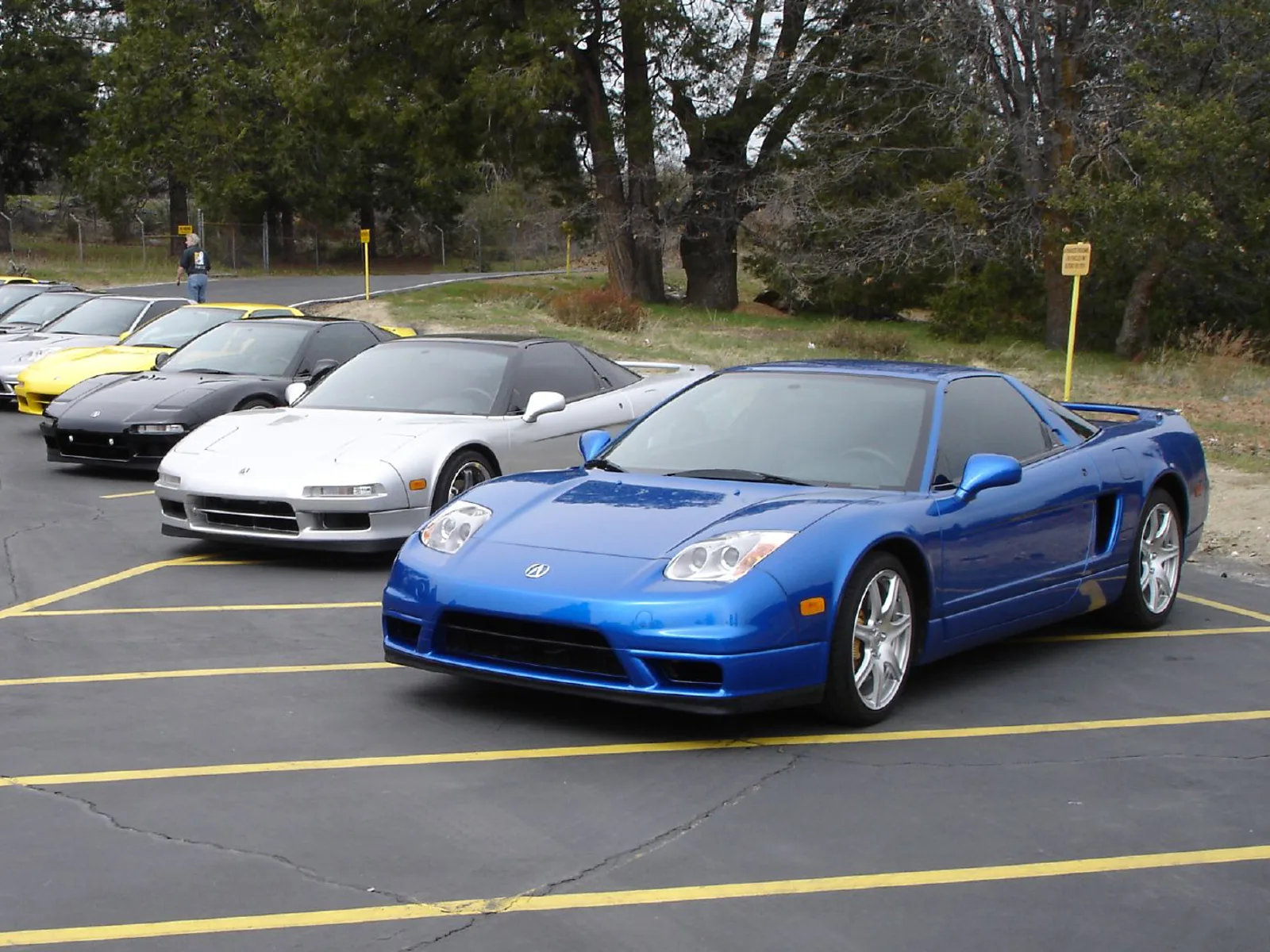
The Honda NSX was a mid-engined sports car built by Honda in two generations, from 1990 to 2006 and again from 2016 to 2022. The Lotus Esprit was a mid-engined sports car built by Lotus from 1976 to 2004, and its power grew across its life.
The Honda NSX and the Lotus Esprit were both rear mid-engined sports cars, built by makers with very different ambitions. The NSX was a Honda flagship sports car from 1990, with a V6 and an all-aluminium body, while the Esprit was a Lotus car from 1976 that grew from four-cylinder power to a twin-turbo V8. Their production overlapped from 1990 to 2004.
This comparison covers origins, engines, speed, construction, production and successors. Where a figure exists for only one car, the gap is shown rather than estimated, and metric figures come first with imperial values in brackets.
Were the NSX and Esprit rivals?
Neither car is described as a direct rival of the other in the material. They share a rear mid-engined layout and a period of production, with the first-generation NSX on sale until 2006 and the Esprit until 2004, so they were contemporaries rather than head-to-head competitors.
The NSX was sold as the Acura NSX in North America and Hong Kong, and it was built in a purpose-made factory in Japan. The Esprit stayed a Lotus sports car throughout, with a steel backbone chassis and a fibreglass body.
Their starting points were very different. Honda began its project in 1984 with the HP-X concept, aiming to meet or exceed the performance of the Ferrari V8 range at a lower price. The Esprit began as a Lotus project to succeed the Europa, after Tony Rudd proposed Project M70 in 1970.
Two mid-engined sports cars from different makers: a Honda built to meet Ferrari on its own ground, and a Lotus that kept evolving for almost three decades.
How did the NSX come about?
The NSX began as the HP-X, a Honda Pininfarina eXperimental concept for a 3.0-litre V6 mid-engined car with rear-wheel drive, shown in 1984, with the aim of reliability and a lower price. The concept evolved into the NS-X, with the name standing for New, Sports car and eXperimental.
The team was led by Chief Designer Masahito Nakano and Executive Chief Engineer Shigeru Uehara. Its styling drew on the F-16 fighter jet cockpit, and Formula One world champion Ayrton Senna drove the car in the final development stages.
How did the Esprit come about?
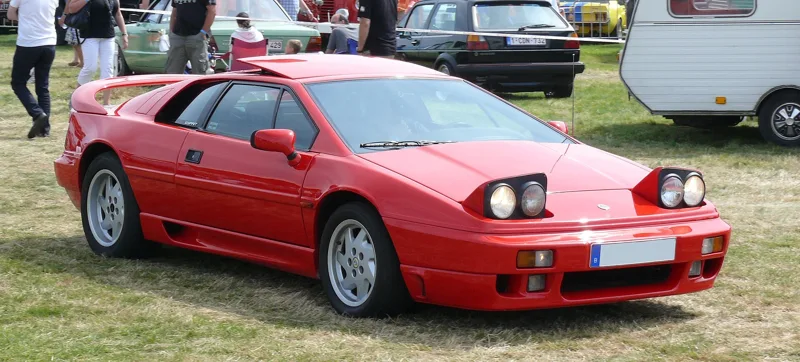
Its backbone chassis was also reused to carry the body of the DeLorean, another Giugiaro-drawn car. The Esprit owed its shape to Giorgetto Giugiaro, whose folded-paper design language gave it straight, hard-edged lines. The car was launched at the Paris Motor Show in October 1975, and it entered production in June 1976, replacing the Europa in Lotus's range.
Giugiaro's team built a 1:4 scale model, then a full-size Silver Car on a stretched Europa chassis that appeared at the 1972 Turin Auto Show. A second prototype, the Red Car, was the functional car that led to production.
What engines did the two cars have?
The first-generation NSX used a 3.0-litre V6 with Honda's VTEC system, which the company had developed in the 1980s. That V6 was transversely mounted, behind the seats, and it gave the car its rear mid-engine layout. A larger 3.2-litre V6 arrived in a 1997 performance update, and the car kept a 5-speed manual, with a SportShift four-speed automatic from 1994.
The Esprit S1 used a 1,973 cc Lotus 907 four-cylinder rated at 160 hp (119 kW; 162 PS) in Europe. The car's 3.5-litre twin-turbo V8 arrived in 1996 and offered 355 PS (350 hp; 261 kW), in a design that Lotus developed in-house rather than borrowing from a low-volume British rival.
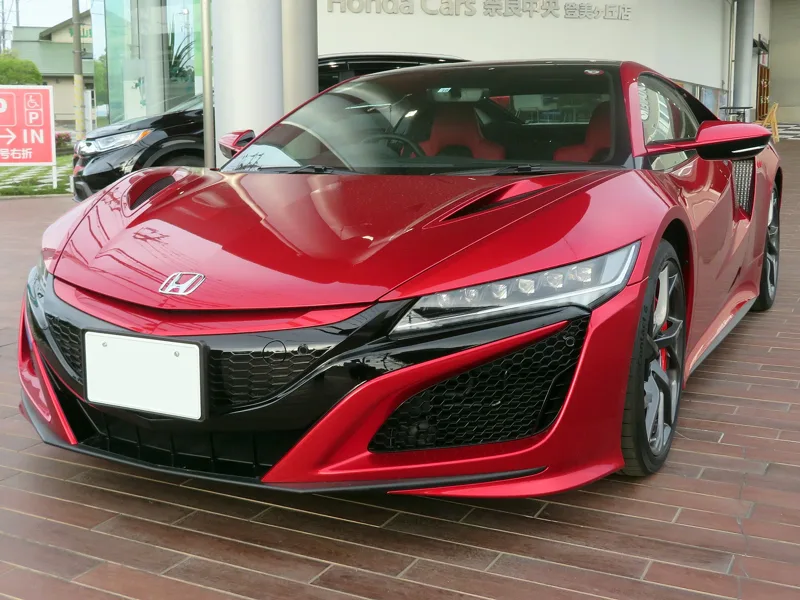
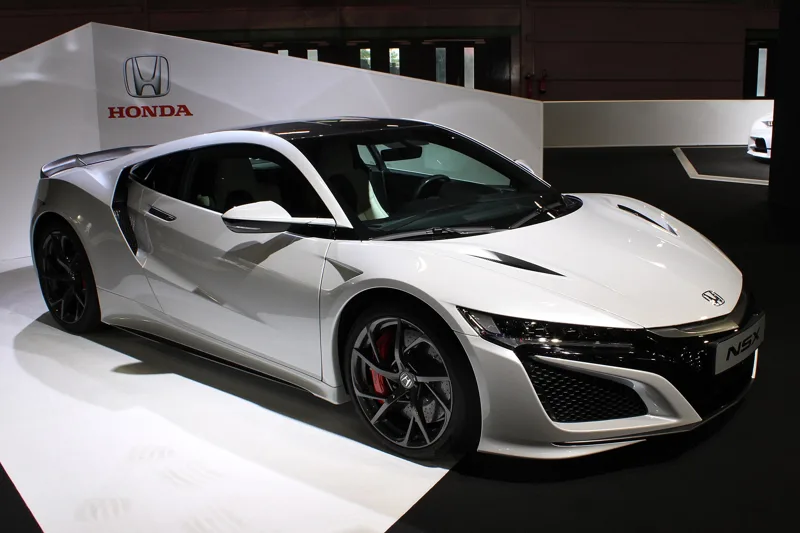
The second-generation NSX used a 3.5-litre twin-turbo V6 with three electric motors in a hybrid system, delivering 573 hp (427 kW; 581 PS) combined. It used a nine-speed dual-clutch automatic, and the record notes that its V6 did not feature VTEC, which marks a clear break from the first generation.
How fast were the two cars?
The S1's claimed sprint was 6.8 seconds to 60 mph, with 222 km/h (138 mph) as the top speed claim. Road tests found 8 seconds and about 214 km/h (133 mph), which suggests Lotus's claims were optimistic for the car's early years.
Top speed rose across the Esprit's life, from around 214 km/h (133 mph) in 1976 to more than 280 km/h (174 mph) for the V8 twenty years later. The record gives no acceleration figure for the first-generation NSX, so the two cars cannot be ranked on sprint times.
How were the cars built?
The first-generation NSX pioneered an all-aluminium semi-monocoque for general production. Its body and chassis were built from aluminium, and the car was made in a purpose-built factory in Japan. The second-generation car used a space frame made from aluminium and ultra-high-strength steel, and the record says some of its materials were the world's first applications.
The Esprit used a wedge-shaped fibreglass body on a steel backbone chassis. Its engine sat longitudinally behind the passengers and drove the rear wheels through a Citroen five-speed transaxle, which was also used in the SM and Maserati Merak. Its 1988 X180 restyle, by Peter Stevens, introduced the VARI moulding process and Kevlar reinforcement to the roof and sides, which raised torsional rigidity by 22%.
How many cars were built?
The first-generation NSX was discontinued in December 2005, and fewer than 20,000 were made, which the record says is why used examples are relatively expensive. The Esprit ran for 28 years, and the record gives no total production figure for it.
Esprit variants included the Essex Turbo of 1980, with 45 cars built, and the S2.2, of which only 88 were produced during its thirteen-month span. Those small runs are a reminder that the Esprit was never built in volume.
What came after each car?
In December 2007 Acura announced plans for a successor by 2010, based on a front V10-engined concept. Prototypes were tested, but Honda reported a year later that the plans had been cancelled. Reports of a successor returned in April 2011.
Acura announced a successor for 2010, but Honda cancelled the plan after one year, citing poor economic conditions. Honda then showed the HSV-010 GT in 2010, which raced in Japan but never became a street car. The second-generation NSX was shown as a concept in 2012 and reached production in 2016, so the project returned after a gap in production.
The Esprit did not receive a named successor in the record. Production ended in 2004 after a Series 4 run that began in 1994, and the record notes that its later changes came from Russell Carr in 2002.
What did the second-generation NSX involve?
The second-generation NSX was designed, engineered and assembled in Marysville, Ohio, led by Chief Engineer Ted Klaus, rather than in Japan. The first production car, VIN 001, was auctioned on 29 January 2016, and NASCAR team owner Rick Hendrick bought it for US$1,200,000 for charity.
The first car came off the line in Ohio on 27 May 2016. The NSX Type S, revealed on 12 August 2021, raised power to 602 hp (449 kW), and the model ended in November 2022, with 300 Type S units for the United States, 30 for Japan and 15 for Canada.
Side-by-side specifications
| Specification | Honda NSX | Lotus Esprit |
|---|---|---|
| Production | First generation 1990 to 2006; second 2016 to 2022 | 1976 to 2004 at Hethel |
| Layout | Rear mid-engine; rear-wheel drive, then all-wheel drive | Rear mid-engine, rear-wheel drive |
| Engine at launch | 3.0 L V6 with VTEC | 1,973 cc Lotus 907 four-cylinder, 160 hp (119 kW; 162 PS) in Europe |
| Later engine | 3.2 L V6 from 1997; 3.5 L twin-turbo V6 hybrid in second generation | 3.5 L twin-turbo V8, 355 PS (350 hp; 261 kW), from 1996 |
| Power | Second generation 573 hp (427 kW; 581 PS) combined | S1 140 hp (104 kW; 142 PS) in US trim |
| Gearbox | 5-speed manual; SportShift 4-speed automatic from 1994; nine-speed dual-clutch in second generation | Citroen five-speed manual on the S1 |
| Weight | not given | Under 1,000 kg (2,205 lb) for the S1 |
| 0-60 mph | not given (first generation) | 6.8 seconds claimed for the S1; 8 seconds on road test |
| Top speed | not given | 222 km/h (138 mph) claimed; 214 km/h (133 mph) on road test |
| Body and chassis | All-aluminium semi-monocoque; second generation space frame | Fibreglass body on steel backbone chassis |
| Styling | F-16 cockpit influence; Senna input | Giugiaro design; Peter Stevens restyle, 1988 X180 |
| Units | Fewer than 20,000 first generation | Not given overall; Essex Turbo 45; S2.2 88 |
| Discontinued | First generation December 2005; second November 2022 | 2004 |
| Successor | Second generation 2016 | Not given in the record |
Which buyer suits each car?
On the figures available, the NSX suits a buyer who wanted a Honda mid-engined sports car with a large aluminium body and a V6 with VTEC, and later a hybrid with all-wheel drive. The Esprit suits a buyer who wanted a Giugiaro-styled Lotus with a choice of four-cylinder, turbo and V8 engines over almost three decades.
Buyers who wanted all-wheel drive would find it only in the second-generation NSX, while those who wanted a rear-wheel-drive mid-engined car would find it in the first NSX and in every Esprit.
Both cars offered a long development story. The NSX had a fixed production run followed by a second generation, while the Esprit ran far longer with many changes and no successor. Neither car is shown to be better overall.
What does the record leave open?
Several points are missing. The record gives no price for either car, no 0-60 mph figure for the first-generation NSX, and no total production figure for the Esprit. The Esprit's top speed in the 1990s is also not given, and the second-generation NSX's top speed is missing too.