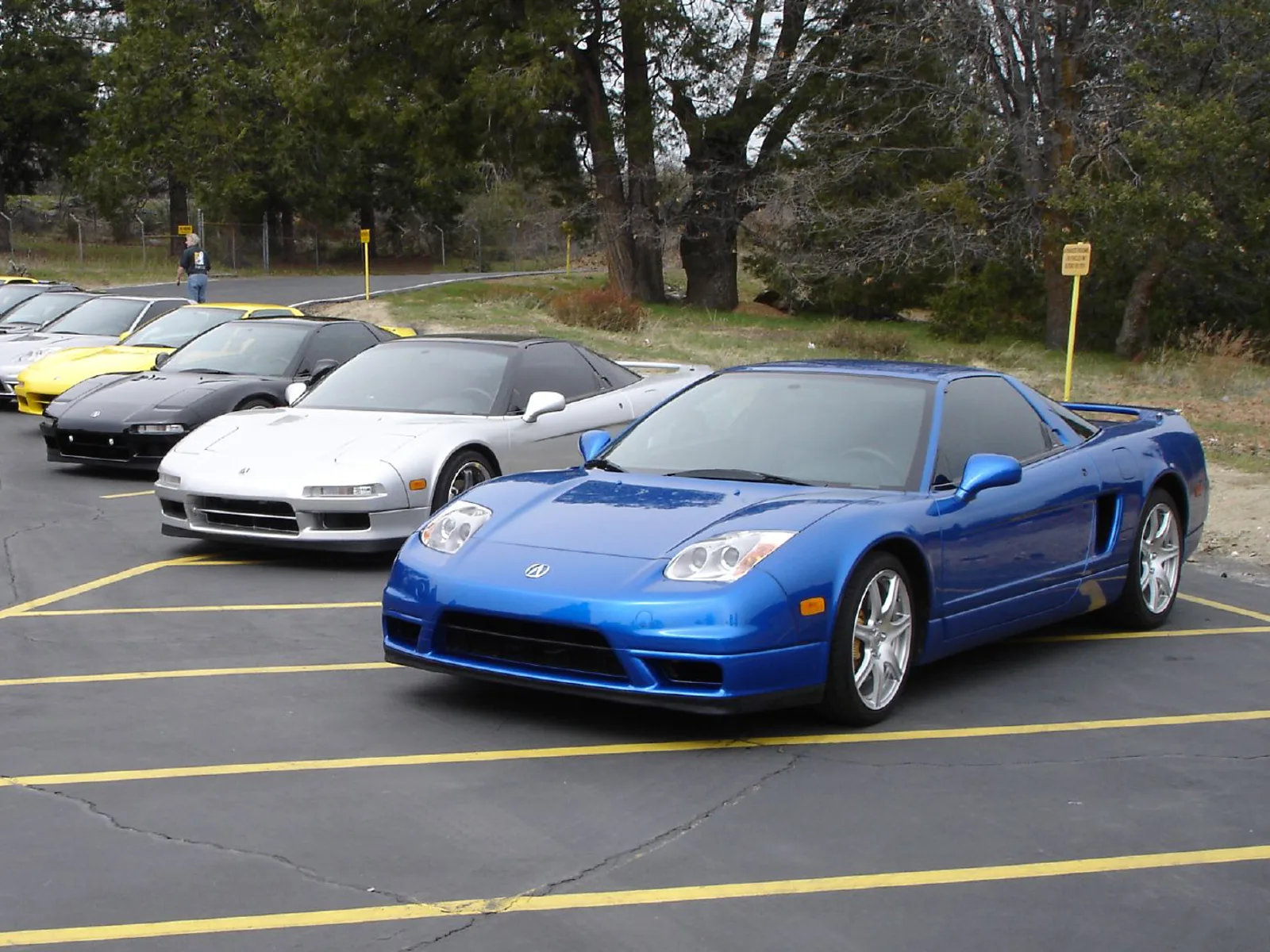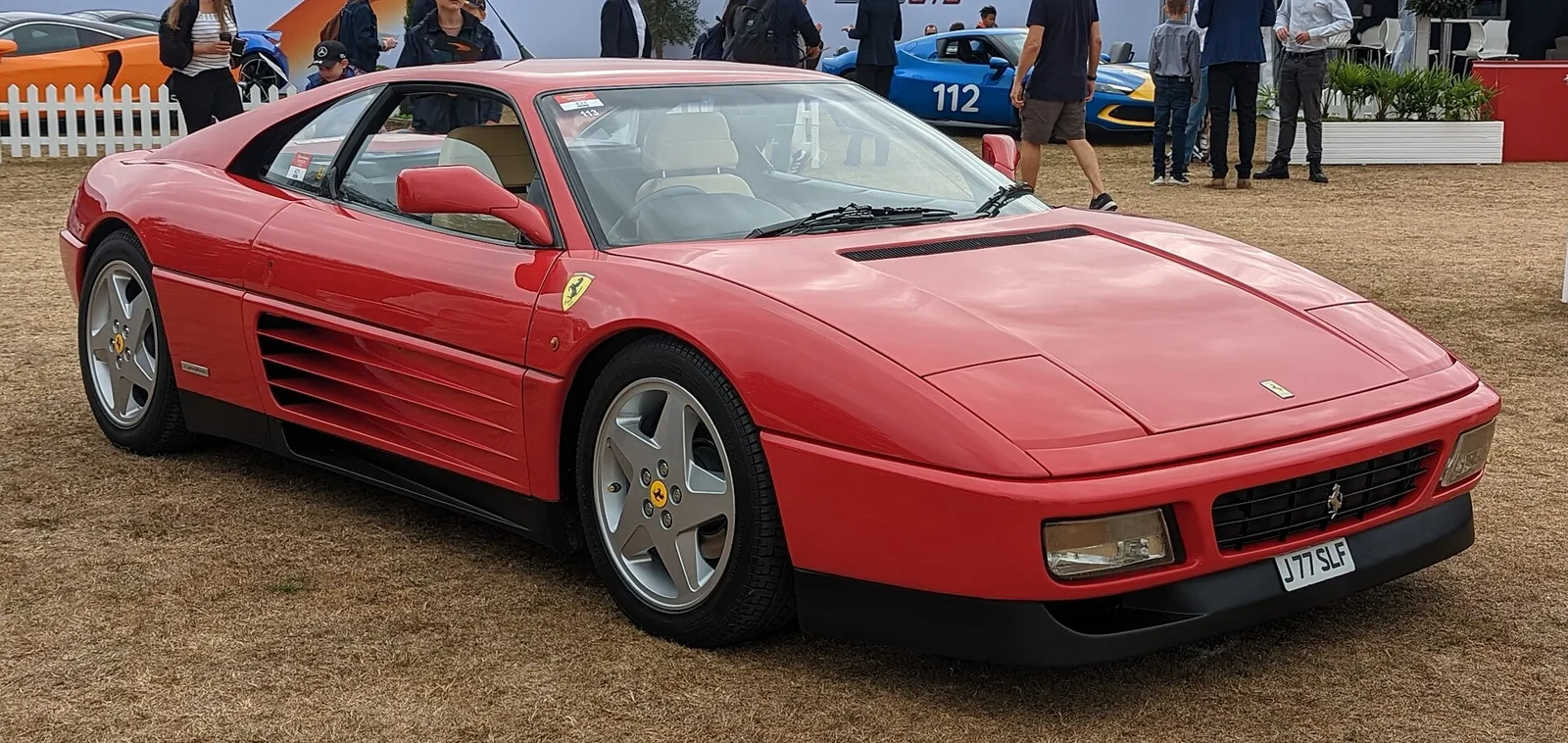
Two mid-engined two-seat sports cars, one Italian and one British, set against each other on engines, speed, styling and motorsport.
The Ferrari 348 and Lotus Esprit are both mid-engined two-seat sports cars, but they took different paths. The 348 had the more consistent V8 and the stronger motorsport record, while the Esprit ran much longer and gained its own V8 in 1996.
The Ferrari 348 and the Lotus Esprit make a useful pairing because both are mid-engined two-seat sports cars, one Italian and one British. The Esprit reached production in 1976 and stayed on sale until 2004, while the 348 ran from 1989 to 1994 as Ferrari's V8 coupe and targa. Their production lives overlapped for five years, which gives the comparison common ground.
Why compare a Ferrari with a Lotus?
Both are mid-engined two-seaters, which makes them a natural pair. The Esprit launched in October 1975 and went into production in 1976, while the 348 replaced the 328 in 1989. The comparison comes down to a British lightweight with a long life against an Italian V8 with a shorter run.
Lotus built the Esprit as a successor to the Europa, and it became one of the company's most enduring models. The 348 came from a marque whose founder had overseen its final V8 project before he died.
Two mid-engined two-seaters, one with a Ferrari V8 and one with a Lotus design that lasted nearly three decades.
Where did the Esprit come from?
The Esprit began life as a project to succeed the Europa with a two-door, fixed-head, mid-engined coupe. Tony Rudd, who had started at Lotus only the year before, proposed the new models in 1970, and Project M70 was the one that became the Esprit.
In 1971 Colin Chapman was introduced to Giorgetto Giugiaro, after designer Oliver Winterbottom proposed that Giugiaro draw on his Maserati Boomerang concept. According to Italdesign, Chapman was disappointed by early wind-tunnel results and halted the project, but the coachbuilder pressed on with a life-size mock-up on a lengthened Europa chassis.
That prototype, often called the Silver Car, appeared at the 1972 Turin Auto Show, and its reception persuaded Chapman to approve further development. The car made its debut at the Paris Motor Show in October 1975, and production began in June 1976. Its first cars, the Series 1, used a wedge-shaped fibreglass body on a steel backbone chassis.
How did the 348 fit into Ferrari's range?
The 348 replaced the 328 in 1989, and it was the last V8 model developed under Enzo Ferrari before his death. It came as the tb coupe and the ts targa, and it stayed in production until mid-1994, when the F355 took its place.
Ferrari's model codes followed a pattern. The first two digits gave the engine's displacement and the third its cylinder count, which put the 348 at 3.4 litres. The naturally aspirated quad-cam V8 had four valves per cylinder and sat longitudinally, with a transverse gearbox that was a first for a Ferrari road car, taken from the 312T Formula One design.
How did the two cars look?
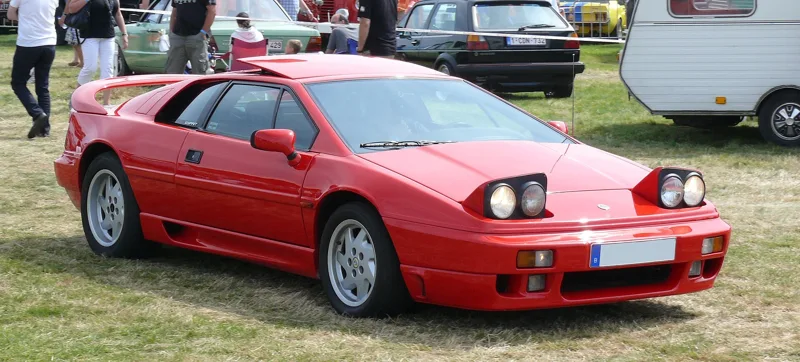
The Esprit was Giugiaro's folded-paper wedge, sharp and low. Peter Stevens softened the shape in 1987 for the X180 cars, which used a new resin-injection panel process and Kevlar reinforcement for roll-over protection. The restyle raised torsional rigidity by 22%.
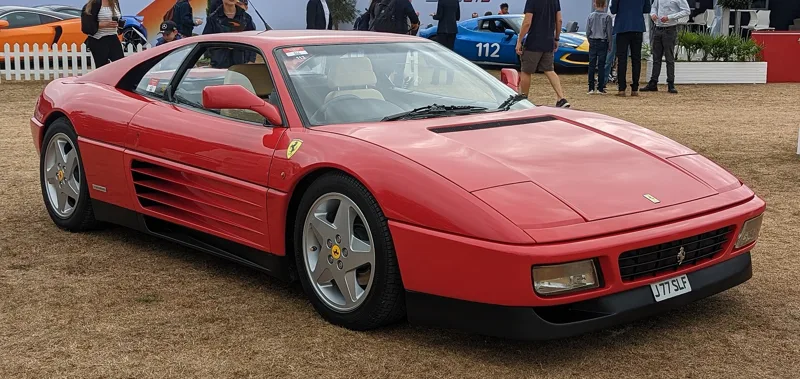
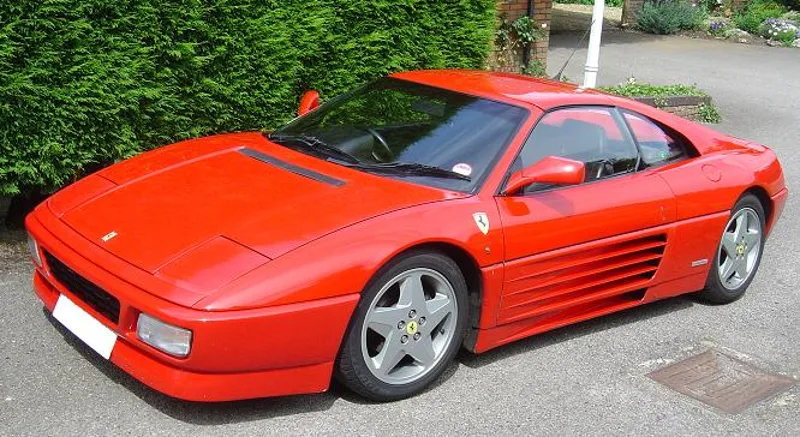
The 348 took a different path. Its straked side intakes and rectangular taillights borrowed from the Testarossa, and its radiators moved from the nose to the sides, which widened the body and made the doors very wide. The design was the last one overseen by chief stylist Leonardo Fioravanti.
The engineering philosophies differed too. The 348 carried dual Bosch Motronic engine management, double-redundant anti-lock brakes and a dry sump. The Esprit followed Lotus's lightweight approach, with a steel backbone chassis and an unassisted rack-and-pinion steering system on the Series 1.
Specifications side by side
| Specification | Ferrari 348 | Lotus Esprit |
|---|---|---|
| Years built | 1989 to mid-1994, replacing the 328 | 1976 to 2004, launched October 1975 |
| Layout | Mid-engined, longitudinal V8, two seats | Rear mid-engine, rear-wheel drive coupe |
| Engine | 3.4-litre, naturally aspirated, quad-cam V8 | 1,973 cc four-cylinder at launch; 3.5-litre twin-turbo V8 from 1996 |
| Power | 300 PS (221 kW; 296 hp) on tb and ts | 162 PS (119 kW; 160 hp) on the Series 1 in European trim; 355 PS (261 kW; 350 hp) on the 1996 V8 |
| Torque | 324 Nm (238 lb ft) at 4,200 rpm | 298 N m (220 lb ft) on the 1986 Turbo HC |
| Top speed | 267 km/h (166 mph) on tb and ts | Over 280 km/h (174 mph) on the V8 |
| 0-97 km/h (60 mph) | 6.0 seconds on tb and ts | 6.1 seconds on the 1980 Essex Turbo |
| Body styles | Coupe (tb), targa (ts), GTB, GTS, Spider | Coupe |
What did the Esprit's middle years bring?
The Series 2 arrived in 1978 with intake and cooling ducts behind the rear quarter windows, taillights taken from the Rover SD1 and a new integrated front spoiler. Its 360 mm (14 in) Speedline alloy wheels were designed by Lotus, and Smiths gauges replaced the old Veglia instrument cluster.
In 1978 Lotus also marked its Formula One World Championship with a Commemorative edition in black and gold JPS livery. Lotus said 300 were built, but reliable estimates put the figure at 149, because its production records were vague.
The Series 3 and Turbo Esprit debuted in April 1981 on a shared chassis, with more headroom and 381 mm (15 in) BBS alloy wheels. The Turbo Esprit kept the body kit first seen on the Essex cars, and the S3 went without a cigarette lighter as standard.
What changed on the 348 in 1993?
A revised GTB and GTS arrived in late 1993 with subtle styling changes and more power, 320 PS (235 kW; 316 hp). The engine switched to the F119H unit, with a compression ratio of 10.8:1 against 10.4:1 for the earlier engines, and taller intake plenums.
The rear track was one inch wider, the suspension geometry was revised for better handling and ride, and the fuel tank shrank to 88 L (23.2 US gal; 19.4 imp gal) to save weight. Later cars also gained Nippondenso generators and a battery moved into the front left fender to help the weight balance.
Which car had more power?
The 348 was the more powerful car until 1996. Its tb and ts made 300 PS (221 kW; 296 hp), and the GTB and GTS reached 320 PS (235 kW; 316 hp), while the Turbo HC Esprit of 1986 managed 218 PS (160 kW; 215 hp).
The Esprit's V8 changed that. The 3.5-litre twin-turbo unit of 1996 offered 355 PS (261 kW; 350 hp), more than either 348 variant listed here. On torque, the 348 made 324 Nm (238 lb ft) at 4,200 rpm, ahead of the 298 N m (220 lb ft) of the 1986 Turbo HC.
The Esprit's power grew slowly at first. Early four-cylinder output sat near 150 PS (148 hp; 110 kW), with torque just short of 200 N m (148 lb ft), and better flow and turbocharging roughly doubled that output over the years.
Which car was quicker in a straight line?
The 348 has the clearer figures. The tb and ts reached 267 km/h (166 mph) and 0-97 km/h in 6.0 seconds, while the GTB and GTS were rated at over 280 km/h (174 mph). The Series 1 Esprit's road test managed 0-60 mph in 8 seconds.
The Esprit's speed improved with the turbo. The 1980 Essex Turbo Esprit ran 0-97 km/h in 6.1 seconds and topped out at 241 km/h (150 mph). On the X180 cars, the 0-97 km/h time dropped from 5.6 seconds to 5.4 or 5.1 seconds.
Lotus's own claim for the Series 1 was 6.8 seconds to 97 km/h and 222 km/h (138 mph). The road test was less kind, showing 8 seconds to 60 mph and about 214 km/h (133 mph), which suggests the claim was optimistic.
How did the Esprit's engines evolve?
The early Series 1 ran a 1,973 cc Lotus 907 four-cylinder, rated at 162 PS (119 kW; 160 hp) in Europe and 142 PS (104 kW; 140 hp) in US trim. The S2.2 of May 1980 used a 2.2-litre engine, and its torque went up from 190 N m (140 lb ft) to 217 N m (160 lb ft).
Turbocharging arrived with the Essex Turbo Esprit in 1980, the first factory turbo Esprit, with 213 PS (157 kW; 210 hp) at 6,250 rpm. The Turbo HC of 1986 made 218 PS (160 kW; 215 hp) and 298 N m (220 lb ft), and the HCi added Bosch fuel injection for markets with strict emissions rules.
The 1989 update replaced the K-Jetronic system with a Lotus/Delco multi-point injection system and added an air-water-air intercooler. The revised engine, the Type 910S, made 268 PS (197 kW; 264 hp).
The V8 arrived in 1996. Lotus designed it in-house, which set it apart from many low-volume British sports cars that used the 3.5-litre Rover V8. It made 355 PS (261 kW; 350 hp).
What one-offs and limited runs did each car produce?
The Esprit's small runs were mostly special editions. The Essex Turbo Esprit was dressed in the colours of the Essex Overseas Petroleum Corporation, a sponsor of Team Lotus between 1979 and 1981. The dealership Bell and Colvill had sold turbo conversions for the S2 from 1978, but the Essex car was the first turbo to leave the factory, and 45 were built.
The S2.2 served as a stopgap from May 1980 with a 2.2-litre engine and a galvanised chassis. Lotus counted only 88 examples built during its brief thirteen-month run, which makes it extremely rare even among Esprits.
Ferrari's 348 limited runs were built on the same platform. The Serie Speciale was a US-only batch of 100 cars with F40-style sport seats and a numbered plaque. The GT Competizione was made in 50 units, and the Zagato Elaborazione, announced at 22, ended with 10 cars.
Which had the stronger motorsport record?
The 348 has the stronger racing story in this pair. Ferrari built a GT Competizione homologation special in 1993, with 50 cars made, and ran a Challenge series that lasted from 1993 to 1995.
The GT Competizione made 320 PS (235 kW; 316 hp) at 7,000 rpm and weighed a dry 1,180 kg (2,601 lb). The Challenge cars used a road-going GT engine with slick tyres, a roll bar and seat belts, and in 1994 the G-spec cars moved to H-spec heads and injection.
The Esprit's competition history is not covered here, so the racing comparison is one-sided. The Esprit's story is better told through its engines, its styling and its long production life.
How did the Esprit's long life end?
The Esprit's last major design was the Series 4 of 1994, drawn by Julian Thomson. It became the longest-lived Esprit body, running from 1994 to 2004, and Russell Carr made its final styling changes in 2002.
Its 28 years of production ended with the Esprit among the last cars to keep pop-up headlights, alongside the fifth-generation Chevrolet Corvette. The 348's run ended in mid-1994 with the arrival of the F355, while the Esprit kept going for another decade.
Which buyer suits which car?
A buyer who wants a mid-engined Italian V8 with a clear line back to the 328 will look at the 348. A buyer who wants a lighter British car with a long production run and a range of engines will find more to like in the Esprit.
Weight favours the Esprit, at least in its first form. The Series 1 was under 1,000 kg (2,205 lb), in line with Lotus's lightweight approach, and the 348's weight figure is not part of this comparison.
The 348 offers the more consistent V8 story. The GTB and GTS kept the same 3.4-litre engine as the tb and ts, and the car came in coupe, targa and Spider forms. The Esprit's V8 arrived later, but it was Lotus's own design.
Neither car is better on every count. The Esprit gives a long-lived British design with a Lotus-built V8 at the top, while the 348 gives Ferrari's V8 and a racing record built on homologation.