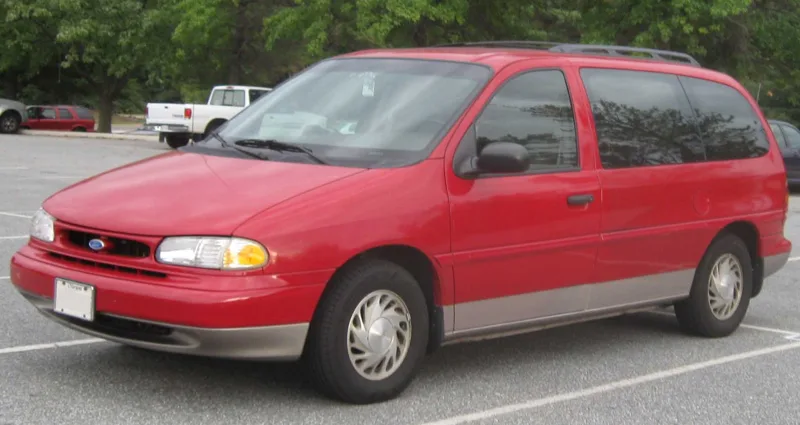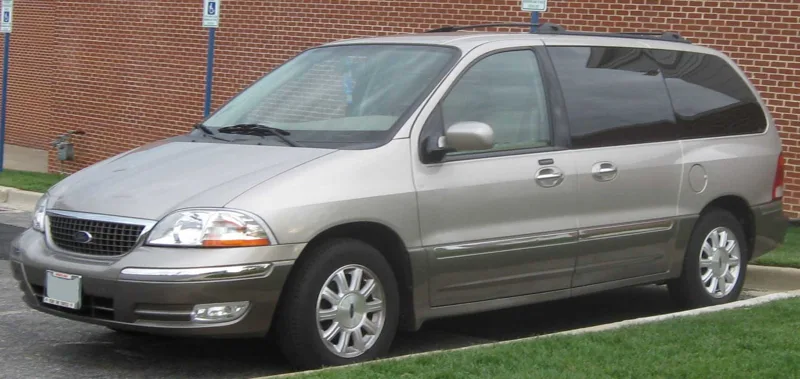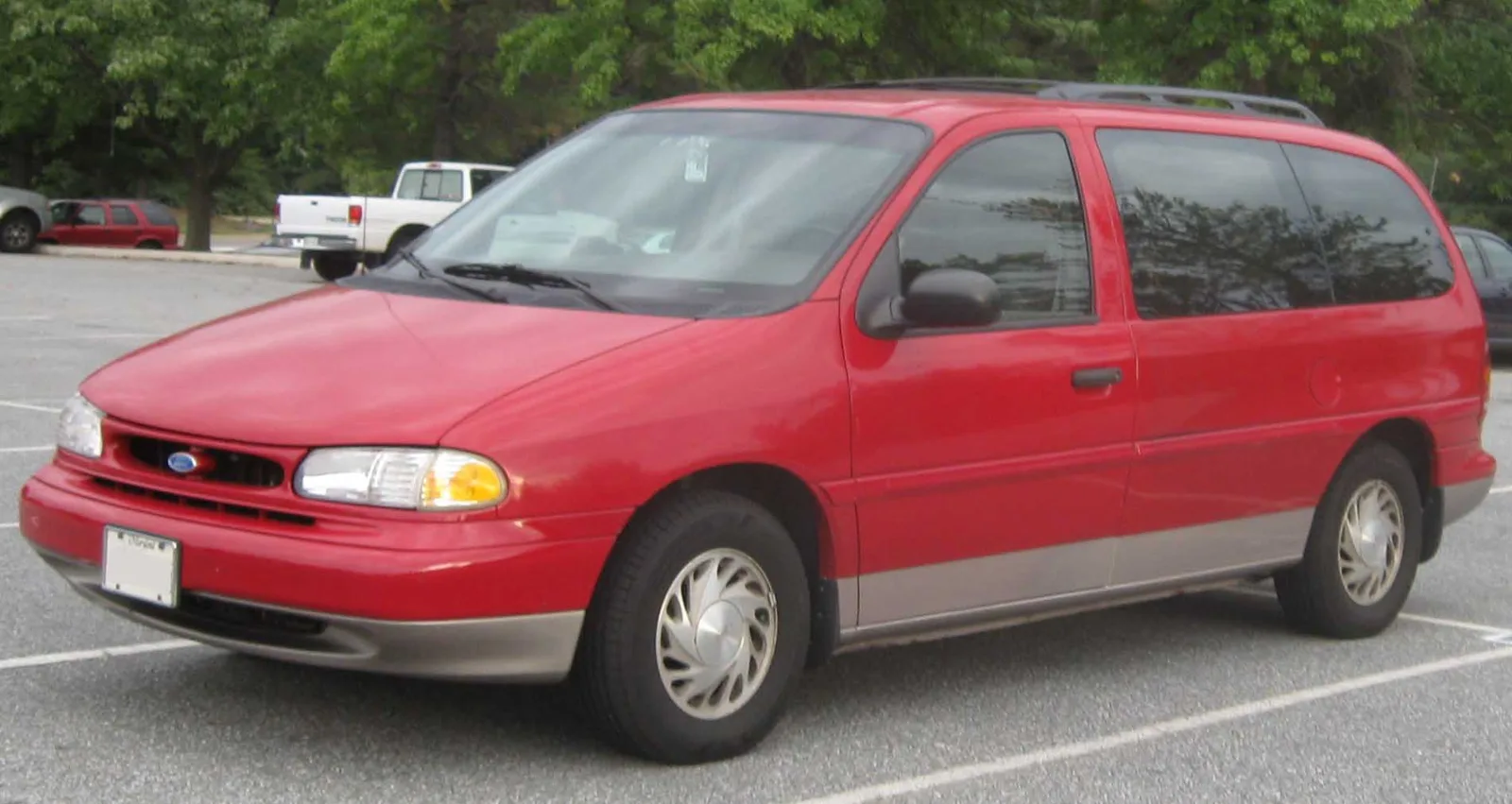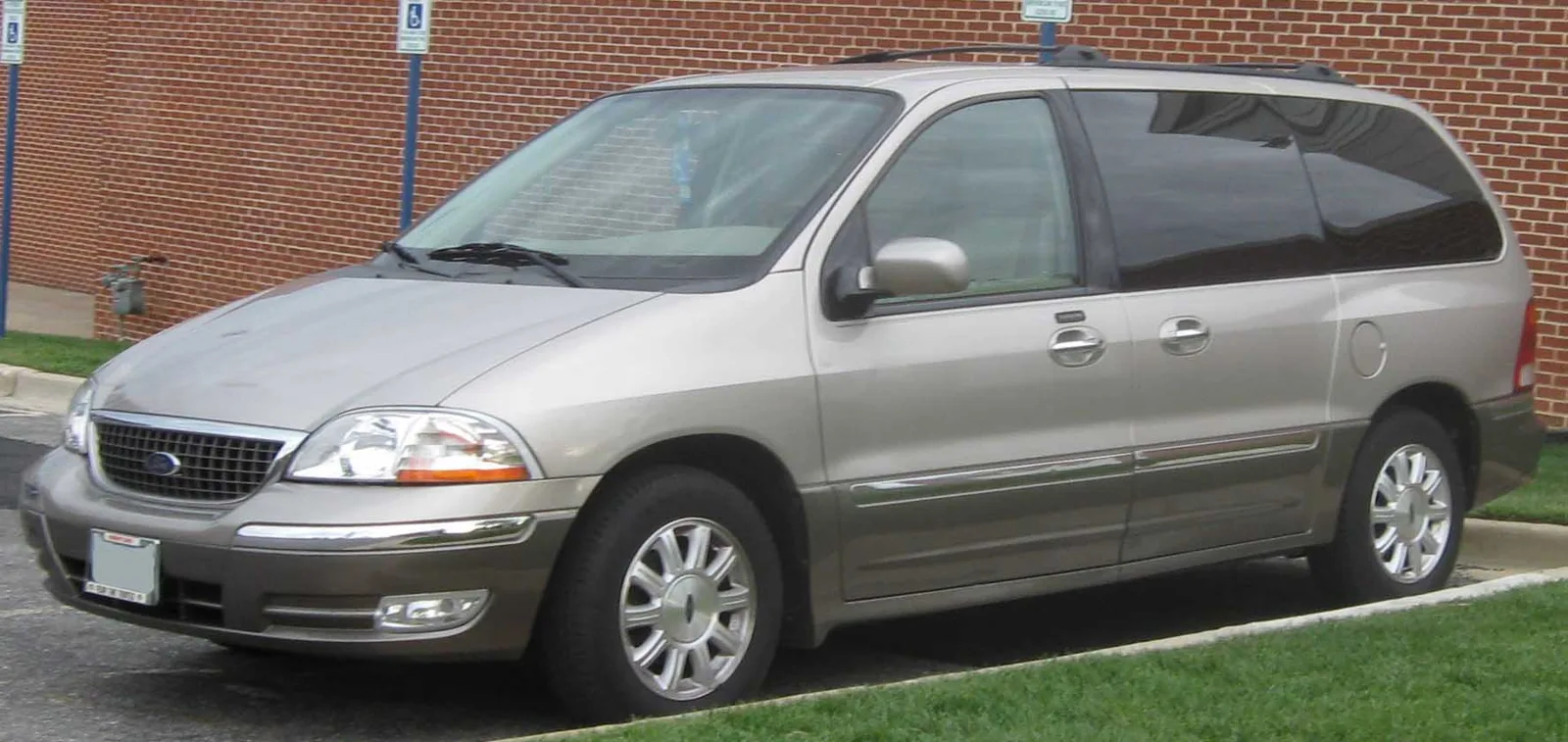
Ford's front-drive Windstar and Mercury's Nissan-built Villager were sold through the same dealer network in the 1990s, with the Windstar the larger of the two.
The Ford Windstar was a long-wheelbase front-drive minivan sold from 1995 to 2007, with 1,984,232 family vehicles built. The Mercury Villager was a Nissan-engineered minivan from 1993 to 2002, smaller in size and sold alongside the Windstar in the Ford family.
The Ford Windstar and the Mercury Villager were both front-wheel-drive minivans sold by the same Ford group in the 1990s, and they were pitched at the same family buyers. The Windstar was Ford's own minivan from 1995, while the Villager was a joint venture with Nissan that Mercury sold from 1993. Their rivalry was internal, which made them unusual competitors.
Were the Ford Windstar and Mercury Villager rivals?
Yes, although they were sold by two brands under the same parent. The Windstar was priced above the Mercury Villager in its first year, and Lincoln-Mercury sold the smaller Villager as a separate product.
The Windstar was a long-wheelbase minivan designed to compete with the larger Chrysler minivans. The Villager was a smaller, unrelated van, developed in a joint venture with Nissan, which meant the two cars were designed for different sizes of family.
The gap narrowed over time. By 1997 the Villager's base price had passed the Windstar's by several hundred dollars, and the top-of-the-line Villager Nautica was priced some $6,000 higher.
Two minivans sold by one Ford family in the 1990s, one a full-size Ford and the other a Nissan-engineered Mercury built to a smaller scale.
When did each minivan go on sale?
The Windstar was released in March 1994 as a 1995 model, and it went on sale ahead of the third-generation Chrysler minivans. It was produced until the 2007 model year, when the Freestar and Monterey were discontinued with no direct replacement.
The Villager was launched in July 1992 as a 1993 model, after its introduction at the 1992 Chicago Auto Show. It was made by Mercury until 2002, when the Ford-Nissan joint venture ended and both companies went their own ways.
The Windstar and the Villager overlapped from 1995 to 2002, when both were sold in the same North American showrooms. The Windstar outlasted the Villager by five model years.
Where did the Villager name come from?
The Villager name first appeared on the Edsel Villager of 1958, a four-door mid-range station wagon without exterior wood trim. After the Edsel brand ended, Mercury adopted the name in 1962 for its compact Comet series, where it denoted wood-trimmed wagons. From 1962 to 1984 Mercury Villager wagons were the counterpart of the Ford Squire trim.
Mercury then used the Villager name for several more models, including the Montego from 1970 to 1976, the Bobcat, the Cougar, the Zephyr and the Lynx. When the 1983 Marquis arrived, the wood-trim wagon name was replaced by Brougham.
The minivan carried that wagon heritage forward. Its two-way liftgate was adopted from the station wagon, which gave the Villager a rear opening that still felt like a wagon.
How were the two vans developed?
The Windstar was codenamed WIN88 and development began in 1988, with trademarks filed for the Windstar name in April 1992. It was designed by a largely women-led engineering and design team, with family-friendly features such as reconfigurable cupholders.
The Villager came from a joint venture agreed at the start of 1988 between Ford and Nissan, codenamed VX54. Nissan did the development and engineering in the United States and supplied the engine and transmission, while Ford made the vehicles at its own plant.
The Villager was the first front-wheel-drive van Ford produced, and it replaced two Nissan lines, the Van and the Axxess, in the program. All-wheel drive was dropped from the Villager's plan because slow sales of Chrysler AWD minivans made it seem unwise.
What are the Ford Windstar and Mercury Villager specifications?
| Specification | Ford Windstar (first generation) | Mercury Villager (first generation) |
|---|---|---|
| Years | 1995 to 2007 model years across three generations | 1993 to 2002, two generations |
| Platform | DN5, shared with the Taurus and Sable | VX54, an evolution of the Nissan Maxima platform |
| Wheelbase | 120.7 inches | 112.2 inches |
| Length | not recorded | 190 inches |
| Engine | 3.8 L V6, 155 hp at launch; 200 hp in 1996; 3.0 L V6 at 150 hp from October 1995 | 3.0 L Nissan VG30E V6, detuned from 160 to 151 hp |
| Transmission | Shared with the Taurus and Sable | Jatco-supplied four-speed automatic |
| Front brakes | Discs, with rear drums; anti-lock standard | Vented discs, with rear drums; anti-lock standard |
| Sliding doors | No driver-side sliding door until the 1998 revision | Single sliding door on the first generation |
| Built at | Oakville Assembly, Oakville, Ontario | Ohio Assembly, Avon Lake, Ohio |
| Trims | GL, LX, and Limited from 1998 | GS and LS, with the Nautica special edition in 1994 |
| Safety | IIHS Excellent, five stars for the 1995 model | Automatic seatbelts at first, then airbags |
| Output | 1,984,232 built across the family | not recorded |
Which van was larger?
The Windstar was the larger van. Its 120.7-inch wheelbase was nearly 15 inches longer than the Taurus, and it was sized against the long-wheelbase Grand Chrysler vans.
The Villager used a 112.2-inch wheelbase and measured 190 inches long. It was produced as a passenger van in a single body length, which made it a more compact choice in the Ford-Mercury range.
The smaller size put the Villager in a different bracket, with the Windstar taking the larger end of the range.
What did the Windstar's trims offer?
The Windstar's base trim was the GL, with the LX as the flagship. For 1998 the Limited trim arrived with monochromatic exterior paint, five-spoke 16-inch chrome wheels and wood interior trim.
The Windstar was also sold as a cargo van from 1995 to 1998, which reflected the Aerostar and Econoline approach. Ford used the car model nomenclature instead of the XL and XLT names used on its trucks and vans.
How did the engines compare?
The Windstar shared its engines with the Taurus and Sable. The 3.8 L V6 was the sole engine in the GL and LX at launch, producing 155 hp, and a 150 hp 3.0 L V6 became the standard engine from October 1995.
The 3.8 L V6 was raised to 200 hp for 1996. In Europe, where the Windstar was sold through Ford Europe, only the 3.0 L V6 and an automatic were offered, with no diesel and no manual.
The Villager's engine came from Nissan, the 3.0-litre VG30E V6 that Ford asked Nissan to modify. Ford required a non-interference design, an oil level sensor and a relocated oil filter before it would use the engine.
Which van had the better doors?
The first-generation Windstar had no driver-side sliding door, a choice that later looked like a design mistake. Ford's focus groups had not identified the door as important, but vans with that door had sold badly in the United States.
The 1998 Windstar revision answered the criticism. Ford extended the driver's door and added an optional tilt-slide driver's seat, a short-term measure marketed as the Family Entry System Door and nicknamed the king door.
The Villager, by contrast, had a single sliding door on the first generation. Its second generation, introduced for 1999, made the driver-side sliding door standard, a feature the Windstar did not standardize until 2002.
What was the Villager's first-generation design?
The first-generation Villager was launched alongside the Nissan Quest and shown at the 1992 Chicago Auto Show. It had a single sliding door on every version, and its front lightbar grille set it apart from the Quest.
Ford had forgone the minivan segment since 1986, when the Aerostar arrived, so the Villager was the first Mercury since 1960 without a Ford or Lincoln counterpart. In 1993 and 1994 an Austrian importer called Sauber sold a small number of Villagers under its own name.
The Villager's rear liftgate was modeled after compact station wagons, and the rear window opened independently of the door. That was a first for a minivan, and it reflected the wagon heritage of the Villager name.
How did the second generations compare?
The second-generation Villager arrived for 1999 with a driver-side sliding door and a larger VG33E engine. It was five inches longer than the previous generation and had two sliding doors on every example.
The second generation offered a three-person second row as an option from 2000, which raised capacity to eight seats. A rear-seat entertainment system with a flip-down LCD screen was also available for $1,295.
The Villager's trims changed to Villager, Villager Sport and Villager Estate. The Sport had a grey lower body with suspension and larger wheels, and the Estate had a gold lower body and wheels.
What problems did the Windstar face?
During and after its production, the first-generation Windstar became known for several notable reliability issues. The 3.8 L Essex V6 in 1995 models was prone to head gasket failure, a flaw it shared with its Taurus and Sable siblings.
The Villager's own problems are not recorded in this comparison, so no reliability verdict can be given for it. What can be said is that its Nissan-sourced engine was shared with the Maxima.
Which van sold more?
The Windstar family produced 1,984,232 vehicles from Oakville, made up of 1,704,786 Windstars, 246,493 Freestars and 32,953 Montereys. That makes it a very large seller in its segment.
The Villager's total production is not recorded in this comparison, so a complete sales race cannot be called. Its second generation's partnership with Nissan kept it in the market until the joint venture ended in 2002.
The Villager, sold in a smaller bracket, never matched the Windstar's place in the family line-up.
Which van suits which buyer?
The Windstar suits a buyer who wanted a full-size front-drive minivan with a choice of V6 power, a long wheelbase and, later, a driver-side sliding door.
The Villager suits a buyer who wanted a smaller Nissan-engineered minivan with a single sliding door in its first generation, a two-door layout in its second, and a more compact footprint.
The figures do not settle which is the better van, because they were sized for different families. The Windstar had the larger reach and the bigger total, while the Villager had the Nissan engineering and the more compact size.