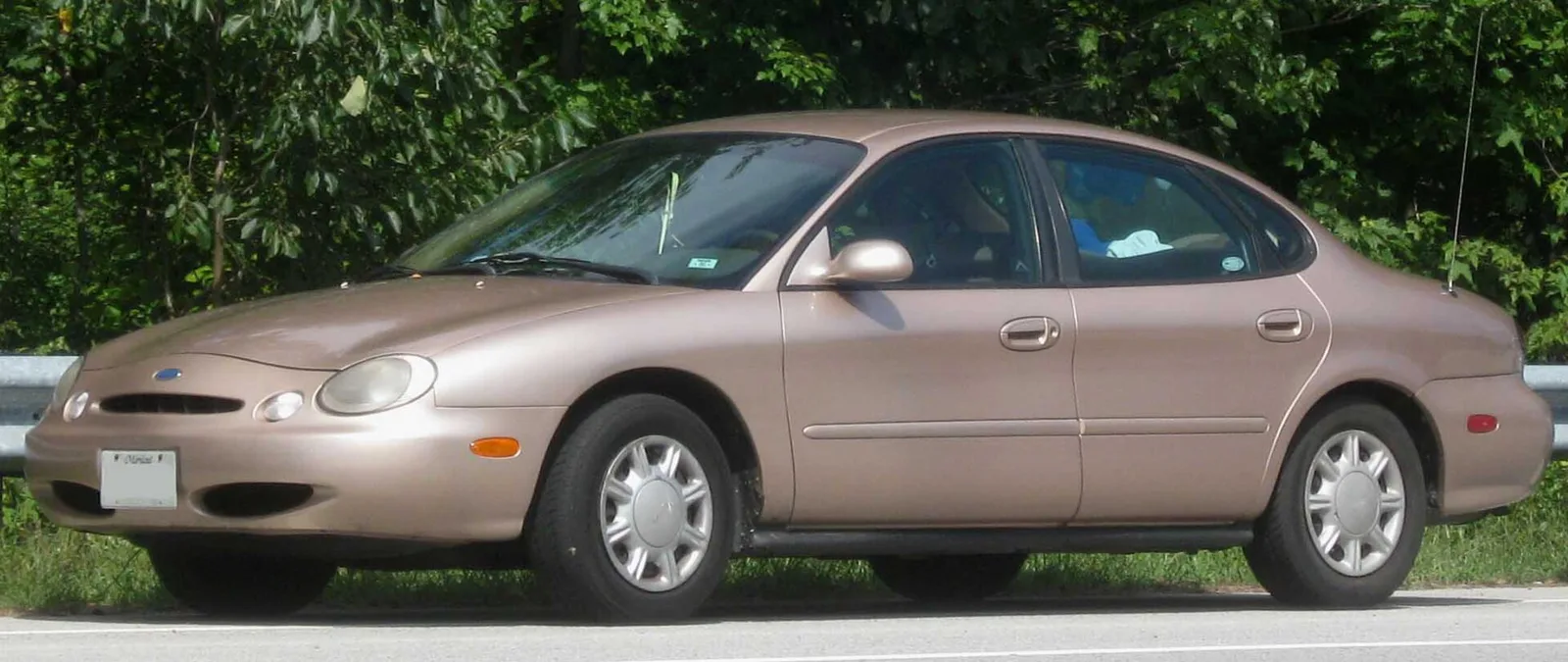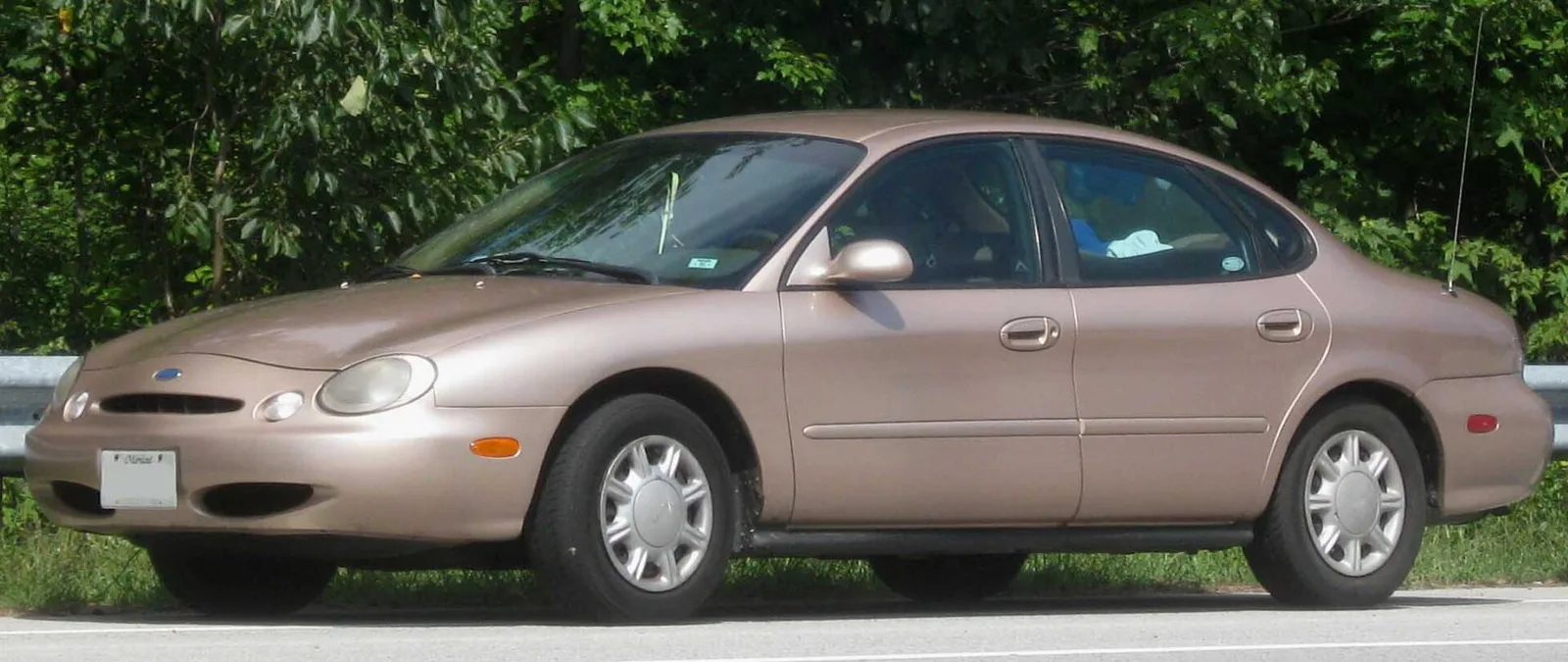
Two American-market midsize sedans from the late 1990s, one a bold Ford redesign that split buyers and one a Honda that kept its reputation while its rival Camry overtook them both.
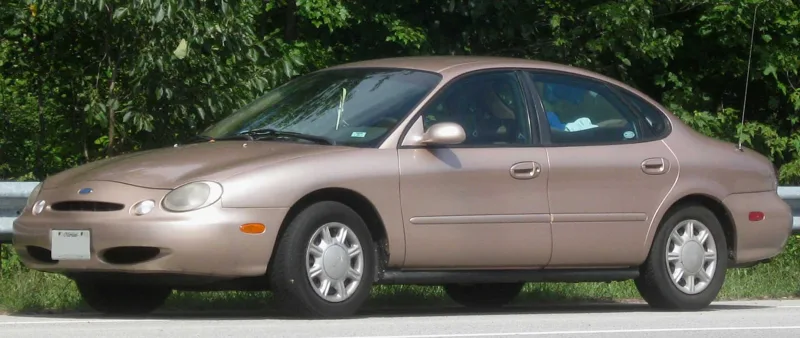
The Ford Taurus third generation ran from 1996 to 1999 with an oval design and was the best-selling US car in 1996, though with heavy fleet sales. The Honda Accord sixth generation was produced from 1997 to 2002 as a conventional sedan and coupe, with the Euro R performance version in 2000.
The third-generation Ford Taurus and the sixth-generation Honda Accord were both midsize sedans sold in the United States in the late 1990s. The Taurus arrived with a radical oval-based design that split buyers, while the Accord was a more conventional family car that had to fend off the Toyota Camry. Their styling, sales and reception tell the story of two cars that took very different paths to the same showroom.
Where did each car come from?
The third-generation Taurus was marketed by Ford for the 1996 to 1999 model years, after entering production in June 1995. It slotted between the compact Ford Contour and the full-size Crown Victoria in Ford's North American range, and it was offered as a four-door sedan and a five-door wagon alongside the Mercury Sable.
The redesign was a response to the 1992 arrival of the Chrysler LH cars, and it aimed to recreate the class-leading design of the 1986 Taurus. The Taurus had by then overtaken the Honda Accord in sales, and it faced the Toyota Camry as well as traditional General Motors and Chrysler rivals.
The Accord's sixth generation was produced from September 1997, for the 1998 model year, until 2002, and in Europe until 2003. Honda split the car into three models for Japan, North America and Europe, with a sedan, a coupe, a five-door hatch in Europe and a station wagon in Japan.
The Accord's Japanese models went on sale on 4 September 1997, narrower than the previous car so that they returned to the compact tax bracket. The Accord sold in Australia from December 1997, first imported from the United States and then, from 1999, from Thailand.
An oval Ford that split buyers against a conventional Honda that kept its retail customers.
How was the Taurus developed?
Development for the third-generation Taurus began in 1991, and its designers compared a complete redesign to repainting the Mona Lisa. The team considered designs from close to the second-generation car to much more radical shapes, and it settled on an oval-derived scheme in April 1992. That choice would prove the car's Achilles heel in the marketplace.
Customer complaints shaped the dashboard. Owners had found the radio and climate control modules cluttered with small, similar buttons that forced them to look away from the road, so the new design gave each control its own shape. That idea led directly to the Integrated Control Panel.
Ford's engineers tuned the sound of the car, from the doors closing to the engine running, and its trim designers chose every interior material for how it felt to the touch. The suspension was designed to emulate the ride and handling of the Camry and Accord, which the team had extensively tested.
How did the Taurus launch?
The sedan and the Sable were unveiled at the 1995 North American International Auto Show in Detroit and drew more attention from journalists than any other car at the show. The wagon followed at the Chicago Auto Show on 9 February 1995, with similar attention.
The first third-generation Taurus came off the line on 12 July 1995 at the Chicago Assembly Plant, where Ford chairman Alexander Trotman and local officials dipped their hands in yellow paint to autograph its hood. The Taurus reached showrooms on 24 September 1995, with sales from 1 October, and it was released almost a week after the Sable, because Ford designers had consulted a $500 astrologer to pick the best solstice date.
How did the designs differ?
The Taurus's exterior was completely redesigned for 1996, and its shape was based on an oval. Chief designer Jack Telnack claimed the car was shaped to stand out to sedan buyers, and he compared the current Taurus to a pair of slippers. The shape gave the car rounded contours in place of the flat, streamlined look of its predecessor.
The oval was used across the car, in the grille openings, taillamps and window openings. The Taurus was the first Ford to combine round headlights with composite-style housings, and its heavily contoured sides took their cue from the Lincoln Mark VIII. The LX came with chrome alloy wheels and a script Taurus badge.
The Accord's design was more restrained. The 1998 Accord Coupe received its own front fascia, rear lights resembling those of the NSX, wheels and body panels not shared with the sedan, and it was marketed as a separate series. The sedan was the largest Accord yet and shared its platform with the Japanese Inspire and the Acura TL.
The Taurus's styling was so distinctive that detractors nicknamed it the Bubble or Submarine Taurus. The Accord's sedan and coupe followed a more familiar line, and its styling changes over the generation were modest in comparison.
How did the interiors compare?
The Taurus's interior was redesigned for 1996 as well. The gauges sat in an oval pod, and the dashboard wrapped slightly around the driver. Radio and climate controls were combined into an oval-shaped Integrated Control Panel in the centre of the dash, a response to owner complaints that they could not operate the controls without taking their eyes off the road.
The Taurus also introduced a Flip-Fold centre console on cars without a standard floor console. A seat between the bucket seats folded out into a console with a lockable bin and cupholders, which reduced the seating count by one.
The Accord's interior was less novel but well equipped at the top. Its EX trim added a CD player, a power moonroof, ABS, alloy wheels, keyless entry and rear disc brakes, and optional leather arrived for the EX for the first time. The base DX had no audio system, manual windows and locks, and 14-inch steel wheels.
The Taurus could seat from five to eight people, depending on the body and console. Wagons could carry up to seven with a third-row bench, while sedans with the flip-fold console seated six.
How did the Accord's performance models compare?
The Accord SiR-T of 1997 was only available with a five-speed manual and a 2.0-litre F20B engine rated at 200 PS (147 kW; 197 hp) at 7,200 rpm. The F20B had an 11.0 compression ratio and an 85 mm by 88 mm bore and stroke, with a 7,400 rpm redline.
The SiR with the S-Matic automatic had its output reduced to 180 PS (132 kW; 178 hp). Its sequential shift mode let the driver choose gears with up and down actions, and the engine would bounce against the rev limiter when pushed, just like a manual.
The Accord Wagon SiR used the only 2.3-litre H23A DOHC VTEC engine in the Honda line-up, rated at 200 hp in front-wheel drive and 190 hp with all-wheel drive. The Euro R, developed in Japan from the European Type R for 2000, used a red-top H22A producing 220 PS (162 kW; 217 hp).
The Euro R also gained a five-speed manual with a helical Torsen limited-slip differential, Recaro seats, a leather-wrapped MOMO steering wheel and a sports exhaust with 4-2-1 stainless headers. In 2002 the car became the Euro-Rx, with an ECU upgrade to fix cold-start hesitation.
Specifications side by side
| Feature | Ford Taurus (third generation) | Honda Accord (sixth generation) |
|---|---|---|
| Model years | 1996 to 1999 | 1998 to 2002 (US); to 2003 in Europe |
| Body styles | Four-door sedan and five-door wagon | Sedan, coupe, five-door hatch (Europe), wagon (Japan) |
| Production start | June 1995; first car built 12 July 1995 | September 1997; Japan 4 September 1997 |
| Design basis | Oval-derived styling | Conventional sedan and coupe lines |
| Base engine (US) | No figure | 2.3-litre non-VTEC, 135 bhp (101 kW) in DX |
| Main engine (US) | No figure | 2.3-litre VTEC, 150 bhp (110 kW) in LX and EX |
| V6 (US) | No figure | 3.0-litre SOHC VTEC, 200 bhp (149 kW) |
| Performance model | No figure | Euro R, 220 PS (162 kW; 217 hp) |
| 1996 US sales | Best-selling car; 49% to retail customers | No figure |
| 1997 US position | Third, behind the Camry and Accord | Behind the redesigned Camry |
| Seating | Five to eight people | No figure |
| Awards | Motor Trend Car of the Year went to Dodge Caravan | No figure |
Which car sold better in the US?
The Taurus was the best-selling car in the United States for 1996, but only 49 per cent of its sales went to retail customers, with the rest mostly to fleets. Fleet sales made up 51 per cent of Taurus sales that year, a figure that flattered its position at the top of the chart.
In 1997 the Taurus fell to third, behind a redesigned Toyota Camry and the Honda Accord. The Camry took the title and has held it since.
Ford had hoped the radical design would repeat the success of the 1986 Taurus, and it predicted that the new car would keep the outgoing model's record of more than 400,000 units a year. Sales were slow at first, and Ford added a low-priced G model in mid-1996.
How did the critics and buyers respond?
Automotive publications were largely positive. Road and Track gave the Taurus a good review and found its handling and refinement impressive, while Motor Trend called the oval styling awkward at first but praised its redeeming qualities. Still, the magazine's Car of the Year went to the redesigned 1996 Dodge Caravan.
Consumers were less sure. The Taurus received mixed reactions, and the design was the reason. Ford offered incentives including a six-month lease for Camry and Accord owners, a cash allowance on lease renewals and a dinner certificate for a test drive.
The Accord had an easier time. Its sales remained steady even though the sixth generation ran an extra year, and Honda kept the car in production for five years rather than the usual four before its redesign.
How did the cars change during their runs?
The Taurus received a slight 1998 facelift that made its shape more mainstream. The front bumper gained a full-length opening, and the Ford logo moved down onto a chrome bar in the grille, similar to the SHO. The rear turn signals changed from amber to red.
The Accord changed too. A minor facelift in September 2000 brought a new front fascia, rear bumper, side skirts, taillights and wheels, and all V6 models gained a traction control system that could be switched off. The 2002 Special Edition returned as the final model year.
In Australia the Accord received a facelift in March 2001, when the manual transmission was dropped, and new colours including Nighthawk Black appeared, the first black offered on an Australian Accord.
Which buyer should choose which?
A buyer who wanted a distinctive, oval-styled midsize sedan with a well-equipped interior, and who was happy to take a bold design, would look at the Taurus. Its Flip-Fold console and five-to-eight seating gave it flexibility that the Accord did not match.
A buyer who wanted a conventional midsize Honda with a choice of VTEC fours, a V6 and the Euro R performance option would find the Accord the safer pick. Its later years added traction control on V6 models.
Neither car takes an overall verdict on these facts. The Taurus had the bigger first-year sales and the more daring design, while the Accord had steadier retail sales and performance variants such as the Euro R.