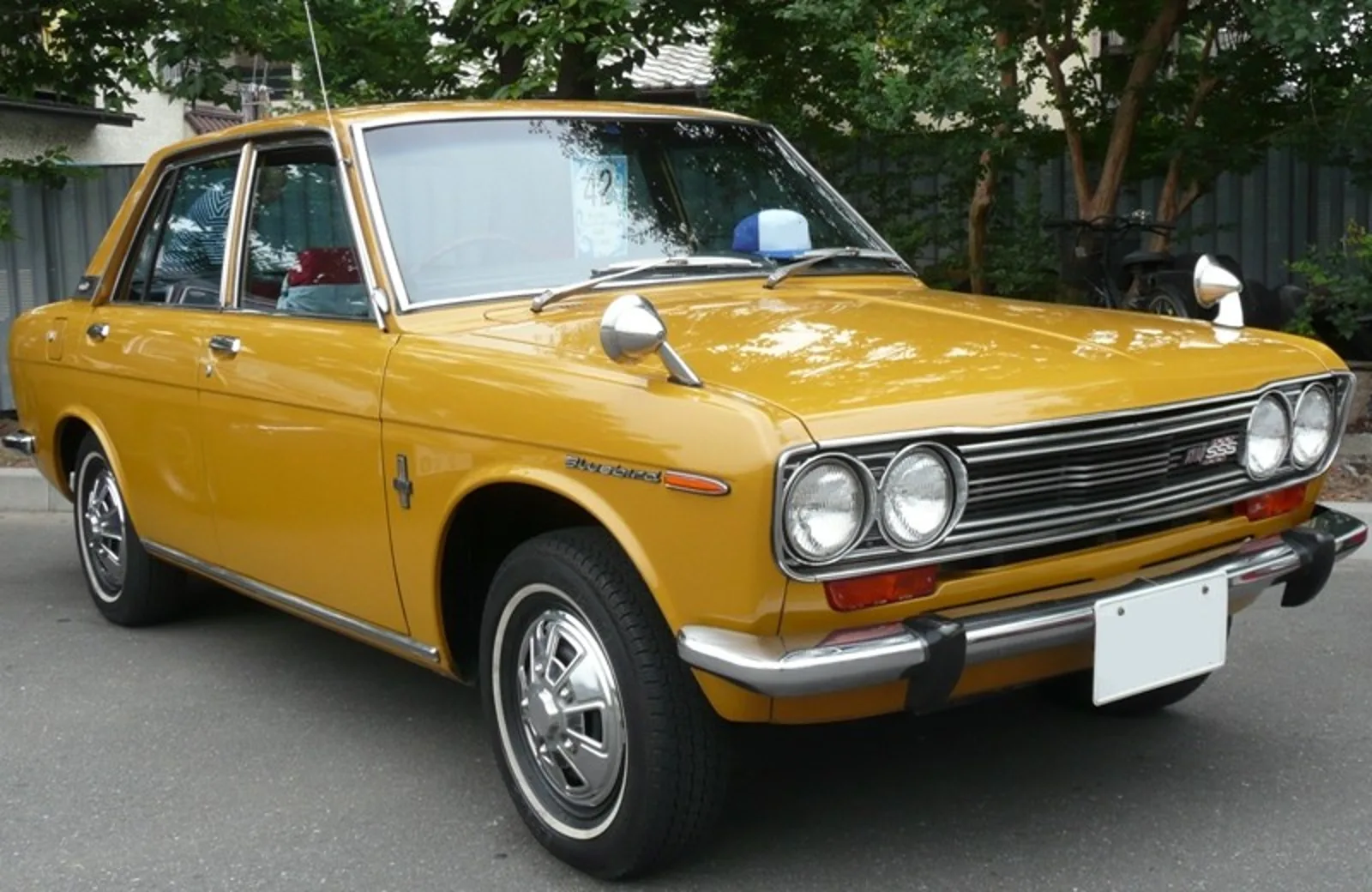
A rear-wheel drive Datsun whose independent rear suspension made it a rally and enthusiast favourite, set against the Ford Cortina that dominated British sales: origins, engines, suspension, sales and the buyer each suited.
The Datsun 510 and Ford Cortina were late-1960s family cars with rear-wheel drive. The 510 brought independent rear suspension and an overhead-cam engine, and it became a rally and enthusiast favourite. The Cortina became Britain's best-selling car of the 1970s.
The Datsun 510 and the Ford Cortina were both rear-wheel drive family cars of the late 1960s, and the Datsun article itself names the Cortina among its contemporary rivals. The 510 was the third generation of Nissan's Bluebird, and it became a favourite for rallying and enthusiasts. The Cortina was Ford's medium-sized family car, and it went on to become Britain's best-selling car of the 1970s.
This comparison covers why the two were rivals, how each came about, their engines and suspension, their rally and enthusiast records, their sales in Britain and North America, and which buyer each car suited on the facts available.
Why were the Datsun 510 and Ford Cortina rivals?
They were rivals in the late-1960s family car market, and the Datsun material names the Cortina as one of the contemporary rivals of the 510. The 510 competed with the Cortina, the Toyota Corona and other mid-size cars of the period, and its engineering was set against theirs.
The two cars were also rivals in the sense that they were both chasing buyers who wanted a simple, affordable car with decent performance. The 510's appeal lay in its engine and independent suspension, while the Cortina's appeal lay in its size, trim and place in the British market.
The Datsun material notes that the 510's rear suspension set it apart, since rivals such as the Ford Cortina and Toyota Corona had live, leaf-sprung rear axles. That single difference became one of the 510's main talking points with enthusiasts.
A Datsun with independent rear suspension, set against a Ford whose live axle was the norm and whose sales made it Britain's favourite.
How did the two cars come about?
In Canada the 510 was sold as the Datsun 1600, rather than under its internal model code. SSS models, not offered in North America, carried upgraded instrumentation and interior trim in other markets.
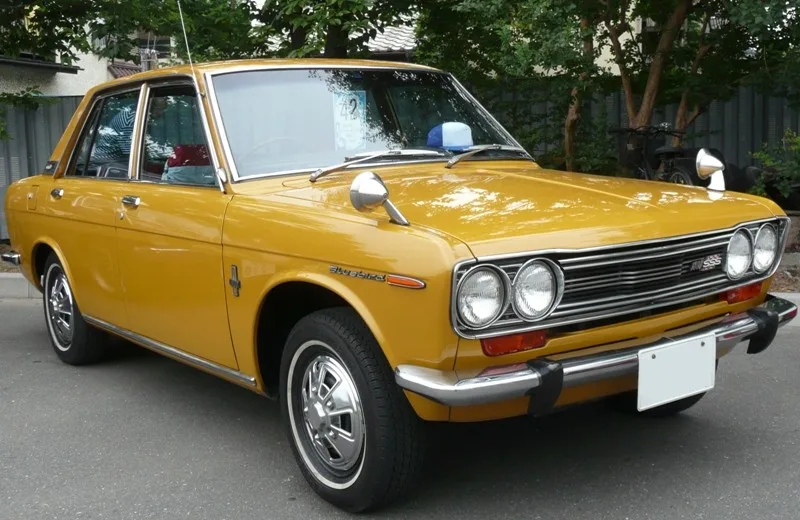
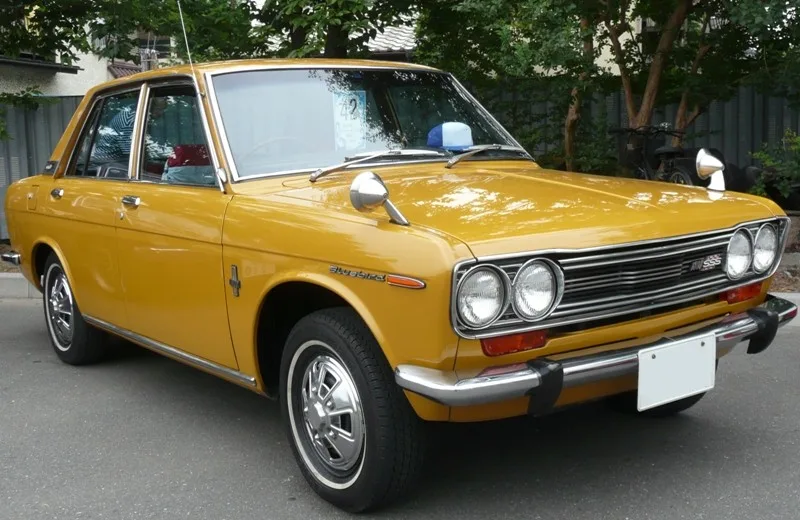
The 510 was engineered with inspiration from contemporary European sedans, particularly the 1966 BMW 1600-2. It had an overhead-camshaft engine and four-wheel independent suspension, with MacPherson struts at the front and semi-trailing arms at the rear. Its styling is credited to Datsun in-house designer Teruo Uchino.
The design originated with the Prince Motor Company, which merged with Nissan in 1966. Nissan USA president Yutaka Katayama pushed for a larger overhead-cam engine with more power than the earlier Bluebirds, and the 510 was released in Japan on 15 August 1967.
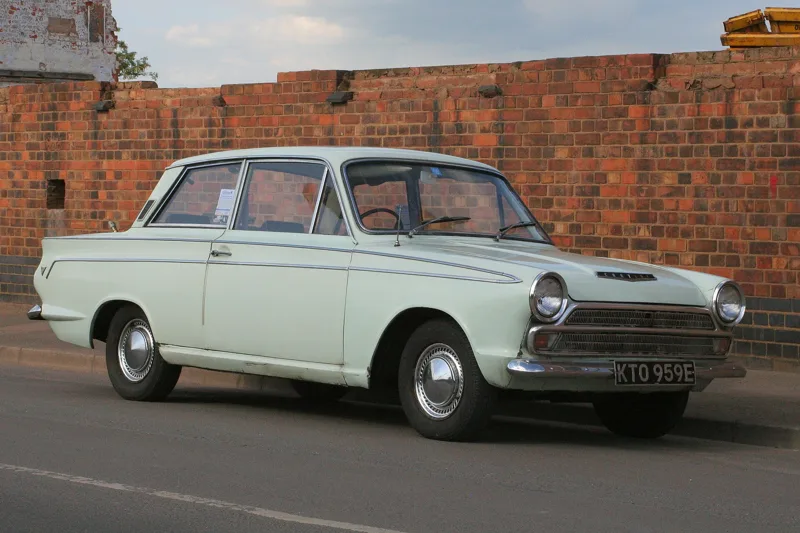
The Cortina began at Ford of Britain's Dagenham plant under the project name Archbishop. Its chief designer was Roy Brown Jr., and it was launched on 20 September 1962 as a family car aimed at buyers of the Morris Oxford Farina and Vauxhall Victor.
The Mark I was designed to be economical to buy, cheap to run and easy to produce in Britain, and its rear-wheel drive layout was chosen over the Taunus P4's front-wheel drive. Standard, Deluxe, Super and GT trims were offered, though not across every body style.
The Cortina was rear-wheel drive by design, even though Ford of Germany's Taunus P4 used front-wheel drive. Its launch name was the Consul Cortina, and the simpler Cortina name followed after a facelift in 1964.
What engines did the two cars use?
The 510's North American engine was a 1.6-litre overhead-cam L16 four with a Hitachi downdraft carburettor, advertised at 96 hp (72 kW) gross. In Japan the car first came with a 1.3-litre overhead-cam at a claimed 72 PS (53 kW), and in some markets twin Hitachi side-draft carburettors were fitted.
The 510 was also easy to modify. Its engines, transmissions and suspension parts were interchangeable across many Datsun models, which allowed owners to move up from the L16 to the larger L18 and later the L20B.
The Cortina's first engines were four-cylinder pushrod units of the early size classes. The 1,500 cc Cortina GT was tuned to a claimed 78 bhp (58 kW; 79 PS), against 60 bhp (45 kW; 61 PS) for the Cortina 1500 Super. The Cortina Lotus had a twin-cam engine from Lotus.
The Mark II Cortina had crossflow 1,300 cc and 1,600 cc engines, and Ford made the Cortina's engine range wide enough for several markets. The 510's engine was the more sophisticated overhead-cam design, while the Cortina's were the more conventional pushrod units of their day.
How did the two cars perform and compete?
The 510's rally record is its strongest story. The Datsun 1600 was also a favourite for modification and racing in Australia, partly because of its independent rear suspension. The series became famous for Nissan's rallying successes outside Japan, which helped open greater international sales for the brand. In Australia the Datsun 1600 was very competitive in the Australian Rally Championship, with outright and class wins.
In the United States the 510 was among the most competitive cars in the Trans Am Series' smaller class, for cars under two and a half litres. John Morton won the 1971 and 1972 championships in a Pete Brock-prepared BRE Racing 510, and the car remains one of the most popular production cars in amateur SCCA racing.
The Mark III Cortina of 1970 shared its platform with the German Taunus, and it replaced both the Mark II and the larger Corsair. In Canada the Cortina was the second most popular imported car of the 1960s, behind only the Volkswagen Beetle.
Ford New Zealand built its own GTE variant of the Cortina, a four-door with a wooden dash and vinyl roof. A four-door estate with class-topping load capacity was launched in the UK on 15 February 1967.
The Cortina's competition record is less prominent in the material available. Its high-performance versions, such as the GT and the Lotus, were the sporting highlights, and the 1600E added luxury and performance in 1967.
The 510's independent rear suspension gave it a clear handling advantage over leaf-sprung rivals, and that edge helped the car build an enthusiast following that remains strong. The Cortina's appeal was more about family practicality and broad market reach.
How did the two cars sell?
In the UK the 510 arrived at the October 1968 Motor Show, with L16 saloons first and the estate shortly after, and L13 models followed in early 1969. It was a modest seller. Nissan imported about 4,000 510 models, and the car never received the marketing or recognition it achieved in other countries, partly because Nissan's dealer network was not established until the 510 was ending.
The Cortina was Britain's most popular new car in 1967, interrupting the long run of BMC's 1100 and 1300 range as the best-selling car, and it went on to be the country's best-selling car of the 1970s. That record places it among the most important British family cars of its era.
In the United States the Mark II managed its best figures in its first two years before sales slumped. Ford then withdrew the model in favour of the American-built Pinto. The 510 name itself carried on in North America until 1981, on quite different cars.
The 510 also left a lasting mark on collectors. Significant numbers survive in the United States, Australia and New Zealand, and Hot Wheels makes several versions of the car. In 2013 and 2014 Nissan showed the Freeflow IDX and NISMO IDX concepts, which were said to be influenced by the 510.
The 510 sold in strong numbers in North America, where the two-door sedan became popular and was imported in large numbers for five model years. The comparison is therefore between a Japanese car that found its audience in the United States and a British-market car that dominated at home.
Period reviews of the Mark II were favourable on both styling and performance. The 1600E, introduced in 1967, is regarded by the Cortina expert Graham Robson as the first Cortina to be recognised as a classic, and it is still sought after today. The Cortina's record in Britain speaks for itself.
Which buyer suits each car?
On the facts given, the 510 suits a buyer who wants an affordable rear-wheel drive saloon with independent rear suspension, a simple overhead-cam engine and a strong enthusiast following. The Cortina suits a buyer who wants a medium-sized British family car with a wide range of trims and bodies and a proven record of popularity.
A buyer who valued handling and a sporting engine would look at the 510. Its independent suspension, its tuneable engine and its rally pedigree made it a car that rewarded an attentive owner.
A buyer who wanted a conventional family car with an estate, saloon or GT option would look at the Cortina. Its broad range and its British market record gave it a clear, familiar appeal.
Neither car is shown to be better across the board. The 510 has the independent rear suspension and the rally record, while the Cortina has the far larger sales record in Britain and the wider range of bodies. The better choice depends on whether the buyer values handling and tuning or family practicality.
Specifications at a glance
| Feature | Datsun 510 | Ford Cortina |
|---|---|---|
| Production | 1968 to 1973 as the Bluebird 510 | 1962 to 1982, five generations |
| Launch | Japan 15 August 1967; US October 1967 | 20 September 1962 |
| Engine | 1.6-litre L16 overhead-cam four | 1,198 cc and 1,498 cc pushrod fours |
| Power | 96 hp (72 kW) gross in North America | 78 bhp (58 kW) in the GT |
| Top speed | Claimed 100 mph in North America | No figure given |
| Rear suspension | Independent, semi-trailing arms | Live leaf-sprung axle |
| Front brakes | Disc brakes | Front discs standard from 1964 |
| Gearbox | Four-speed manual or three-speed automatic | Four-speed manual |
| Sales | About 4,000 in the UK | Britain's best-selling car in 1967 and through the 1970s |
| North American sales | Two-door sedan imported in large numbers | 16,193 Mark II cars in 1967 |
| Motorsport | Trans Am class title in 1971 and 1972 | Cortina GT and Lotus as sporting versions |