A one-off open tourer shown in London in 1903, with a subframe ahead of its time and a near miss with Charles Rolls.
Built by Weller Brothers and shown in London in 1903, this open four-seat car stayed a one-off. Its subframe design set out ideas that later Weller models carried forward, and the partners' later firm led on to AC Cars, a marque that still trades today.
Shown in early 1903 at London's British International Motor Show, the Weller Four Seat Tourer had four seats and an open body. It was built by Weller Brothers in West Norwood, and it stayed a one-off. Even so, today it counts as the origin of AC Cars, the English marque.
Who built the Weller Four Seat Tourer?
The car was built by Weller Brothers Ltd. in West Norwood, now a southern district of London, and developed by the engineer John Weller with financial help from the businessman John Portwine. Both men were partners in the firm. Weller had run the workshop since 1899, at first with his brother Harry.
John Weller brought experience gained as a motor mechanic and engine technician. The workshop mainly maintained and repaired motorcycles, motorised tricycles and cars, both steam and petrol, above all De Dion-Bouton vehicles and cars fitted with engines from that maker.
Portwine owned a butchers' chain whose shops stood across London and nearby towns. His top-ups added to the workshop's income to pay for the car.
A one-off touring car with a subframe ahead of its time, and a backer who turned to Henry Royce instead.
Why did Weller aim at the luxury class?
Weller had concrete ideas about how to improve the vehicle technology of the day, and he wanted to carry them into a luxury model. That class in England was dominated by French firms such as De Dion-Bouton, Peugeot and Renault, alongside Germany's Mercedes from Daimler. English competition barely existed, since Rolls-Royce did not appear until 1904.
Its concept and look borrowed from smaller De Dion-Bouton cars, including the 1902 single-cylinder 8CV Type K and the 1903 1.7-litre twin, the 12CV Type S. A four-cylinder De Dion-Bouton came only in 1904: the 2.5-litre 15CV Type AD, followed by the 24CV Type AI, which was stronger still.
Building the car was slow. Most components were hand-made, one by one, by Weller himself, who could fit the project only around paying workshop jobs. Money had to be found from the workshop's ongoing business and from Portwine's top-ups.
How was the Four Seat Tourer shown in 1903?
Weller Brothers presented the car at the British Motor Show in January and February 1903, held at the Crystal Palace in Sydenham, only a few kilometres from the West Norwood workshop. The car was not yet roadworthy, but it was displayed with the 20hp four-cylinder engine and the smaller 10hp two-cylinder unit.
The owners wanted to test press and public interest in series production, and to find financiers and sales partners. Reviewers called the car advanced and carefully conceived. Without test drives, though, serious buyers and further backers did not come forward.
The Autocar ran the completed 20hp four-cylinder on 6 June 1903, with lavish praise. Weller then intensified his search for financiers for series production that year.
How close did Rolls-Royce come to the Weller car?
Weller came close to preventing the Rolls-Royce car brand from forming. In 1903 and 1904 he met Charles Rolls, who was impressed by the Four Seat Tourer but doubted some of its detail solutions. Rolls then met Henry Royce, the more conservative automobile pioneer.
Rolls and Royce met on 4 May 1904 at the Midland Hotel in Manchester, then drove the new Royce 10. The two shook hands first, and on 23 December 1904 they signed a written contract to work together.
Weller's search for additional financiers failed. Technically the Four Seat Tourer was sound, yet too dear to build in series.
What was the Auto-Carrier?
Portwine argued for a lighter, simpler and cheaper commercial vehicle, one with brighter sales prospects in his view. In 1904 the three-wheeled Auto-Carrier light delivery vehicle appeared for Autocars and Accessories Ltd. in Long Acre, London, and it became a big sales success.
The Auto-Carrier carried the lattice-frame principle of the Four Seat Tourer forward. From 1907 the AC Sociable, a two- or three-seat cyclecar derived from it, followed. The Auto-Carrier opened the route to the brand that became AC Cars.
Weller Four Seat Tourer specifications
| Specification | Detail |
|---|---|
| Type | Open four-seat luxury touring car, front engine, rear-wheel drive |
| Presented | British Motor Show, Crystal Palace, January and February 1903 |
| Engine | Water-cooled four-stroke petrol, two or four cylinders in line |
| Valves | Side valves, mechanically operated from an underslung camshaft |
| Bore | About 4 inches (101.6 millimetres), estimated |
| Stroke | About 114.3 to 127 millimetres (roughly four and a half to 5 inches), estimated |
| Output | About 8 kW (11 PS) two-cylinder; about 15 kW (20 PS) four-cylinder |
| Displacement | About two litres (10hp); about four litres (20hp) |
| Final drive | Chain |
| Chassis | Ladder frame, rigid axles with leaf springs front and rear |
| Wheels | Balloon tyres on wooden spoked Artillery Wheels, 12 spokes front, 14 rear |
| Body | Open, no side doors, no windscreen, no hood |
| Built | One car |
How was the chassis engineered?
The chassis had a ladder frame, rigid axles and leaf springs at both ends, a long wheelbase for its time and a low body line. A subframe carried the engine, exhaust, radiator and gearbox, so that the flexing of the frame and the vibration of the engine were kept apart from each other.
Weller's subframe anticipated principles of the lattice frame that only later became established in car construction. Only the higher build cost and the extra weight argued against it, and in a costly car with a strong engine those drawbacks were minor.
Steering used a wheel that still stood fairly upright. Weller reduced the load on the steering pivots in corners by refining steering knuckle steering, a principle that Georg Lankensperger had developed independently in 1816, Amedee Bollee in 1875 and Carl Benz in 1891.
Balloon tyres sat on wooden spokes known as Artillery Wheels: 12 spokes in front, 14 behind, where the load was heavier. One source suggests that the chassis may also have been built from light alloy.
What engine did the Weller car use?
The Weller engine was a water-cooled four-stroke petrol unit with two or four cylinders in line. Mounted in front, just behind the front axle, it powered the rear wheels. It had side valves operated mechanically from an underslung camshaft, and this kept its overall height low despite a fairly large displacement.
Weller followed an early common-parts strategy. Connecting rods, pistons, cylinders, heads and valves were largely identical in the two- and four-cylinder units, and only the crankcase, crankshaft and camshaft differed in length. A three-cylinder 15hp model and an 8hp car had been planned, and a six-cylinder 30hp version could have followed if needed.
Rolls-Royce, by contrast, used cylinders cast in pairs. When Henry Royce built a three-cylinder 15 hp model in 1905 he had to design and produce new cylinders for it, and the model was withdrawn later that year, despite reasonable market prospects.
No precise engine data survive for the Weller engines. Output figures and the likely abstract formula suggest a bore near 4 inches (101.6 millimetres); English long-stroke design would have given a stroke of roughly 114.3 to 127 millimetres (four and a half to 5 inches). That would give the 10hp about two litres and the 20hp about four litres.
An elastic connection between clutch and gearbox kept engine vibration away from the rest of the car. Chain drive was then judged sturdier than a propeller shaft in strong cars, and it also suited Weller's goal of separating drivetrain from chassis.
How was the body designed?
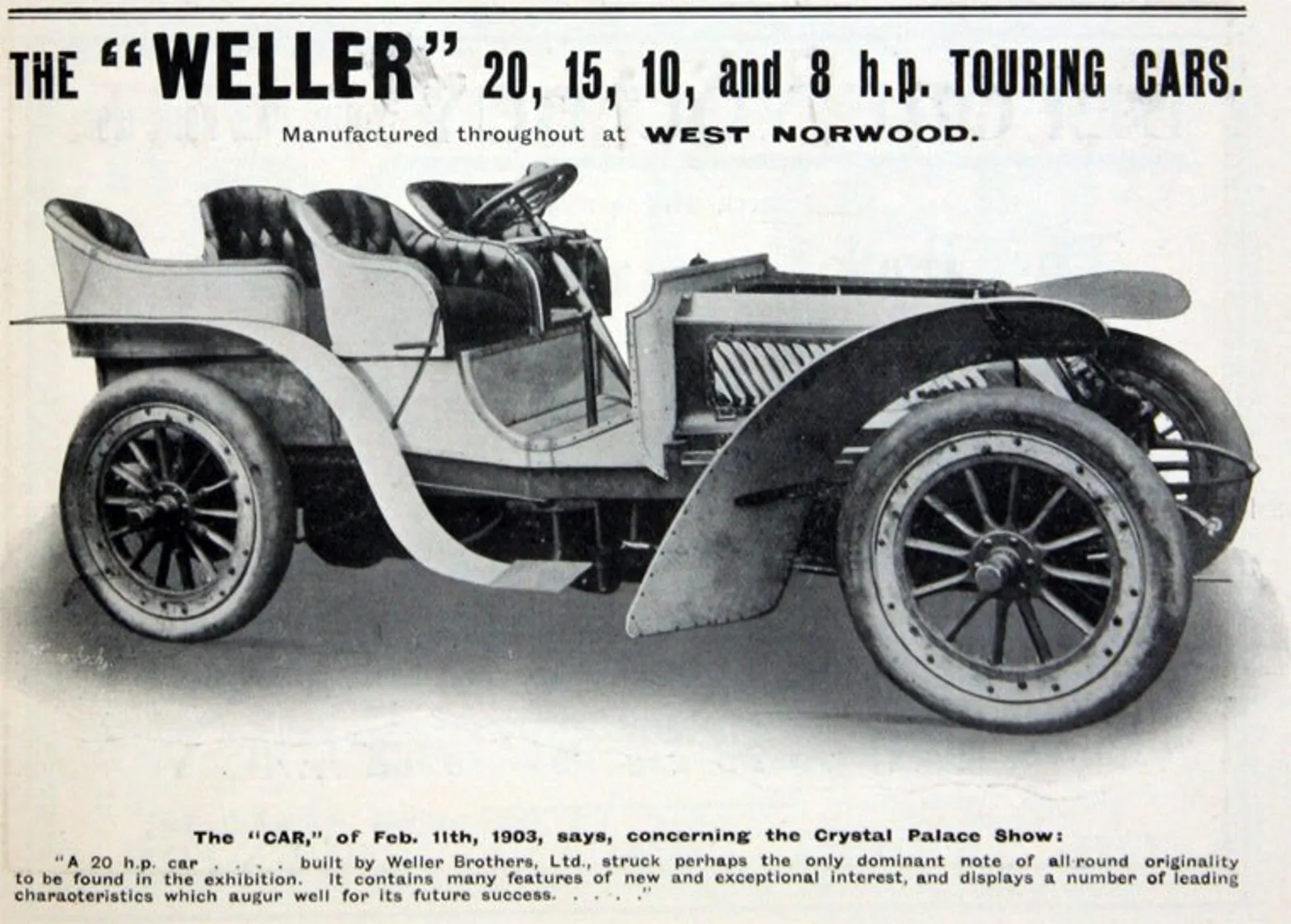
In outline the body was a conventional four-seat tourer, though it sat unusually low and long for its era. It had no side doors, windscreen or hood, because special weather protection was judged unnecessary, as with motorcycles. Broad front guards and long rear ones, plus running boards for easier entry, shielded the car on roads that were frequently still unsurfaced.
The front had no radiator grille. Set low ahead of the front axle, the radiator tucked in among the leaf-spring extensions, while the bonnet was narrow and flat with slanted vents. Brass trim of the period seems to have made the bonnet look flatter still.
The design took its cues from French cars by De Dion-Bouton, Peugeot and Renault rather than from English models. Its nose looked much like De Dion-Bouton and Peugeot designs of the time, perhaps copied, given that Weller's business was mostly servicing such machines.
Four padded bucket seats sat inside. Rear passengers entered through a slim opening at the tail, a layout De Dion-Bouton had used on certain Phaeton cars since 1902. Two carbide lamps with brass housings sat on the splashboard, and a large signal horn was mounted beside the steering wheel.
What happened to the one-off?
Weller and Portwine gave up the idea of a luxury car after no financiers came forward, especially as Rolls-Royce soon served that limited market with its own models. The car's whereabouts after 1904 are unclear, and it was probably later dismantled or scrapped.
A reader's letter to The Autocar in 1952 offers a possible trace. The writer had been in contact with Felix W. Hudlass, once a Weller employee, who had given him a fuller description of the car. The writer recalled seeing a Weller car on a scrapyard at Whetstone in 1919, although he may have seen one of the Hitchon-Weller cars that were built from 1904 to 1907 with John Weller's involvement and sold under the Globe name.
A single black-and-white photo is all that remains, kept in AC's works archive. It shows the car from the side while standing still, and it appears in some specialist books and on several websites.
How did the Weller business end?
Portwine voluntarily liquidated Weller Brothers Ltd. in 1904, because the car had put heavy financial and time pressure on the firm. The workshop business, and possibly the Weller tourer as well, was taken over by Douglas S. Cox and Co., which had briefly built its own Emerald cars from 1903 to 1904.
Portwine and Weller redirected their other firm, Autocars and Accessories Ltd., toward smaller, simpler commercial vehicles. They shared that business until 1922. In 1907 the firm became Autocarriers Ltd., and in 1911 it relocated to Thames Ditton in Surrey. Eventually it became AC Cars, a sports car maker.
The AC 10 hp, which used a Fivet four, arrived in 1913; the AC 12 hp followed in 1920 with a four from British Anzani. During the First World War Weller also developed a 2.0-litre in-line six with a light alloy block and overhead camshaft, which helped lift AC towards exclusive sporting cars. It was built, with constant development, until 1963.
How did the four-seat tourer return at AC?
The open four-seater came back in the early 1920s on the AC 12 hp, yet the added weight kept buyers away from the 1.5-litre car. From 1922 to 1939 the AC Six range carried the four-seat idea on larger bodies and with much more power.
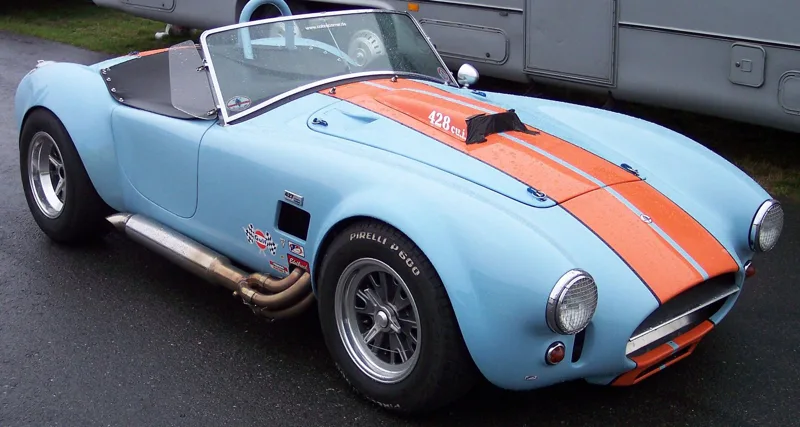
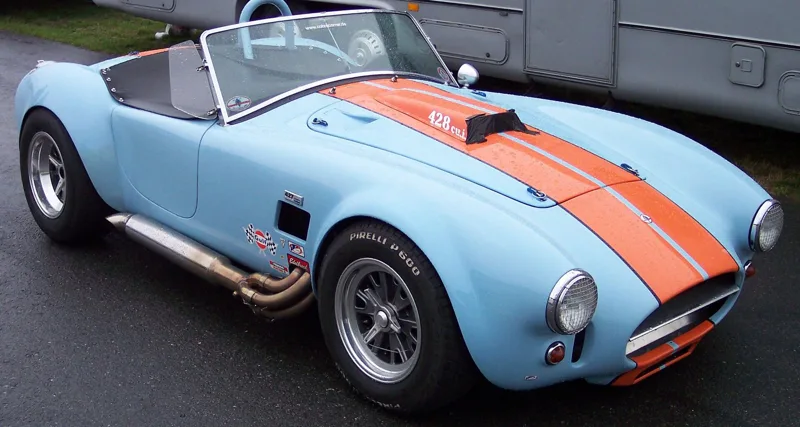
Postwar, AC brought back the four-seat tourer between 1949 and 1953 in the Buckland Tourer, an AC 2-Litre derivative; roughly 75 were made. AC later had its greatest successes with the AC Cobra of the 1960s, built with Carroll Shelby and Ford.
It was only in the mid-1960s that AC re-entered the top of the market, through the AC 428. Shown first as a convertible in 1965 and later as a fastback coupe in 1967, the car went up against Aston Martin, Bentley, Bristol and Jensen.