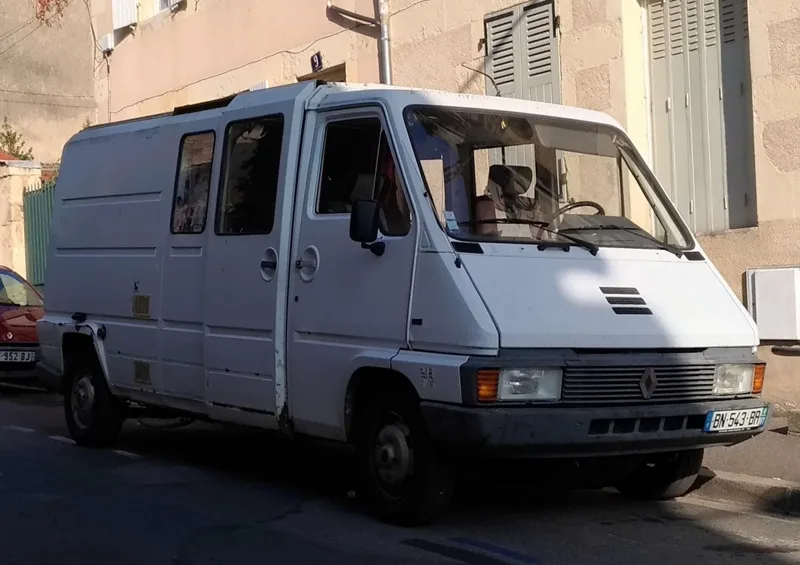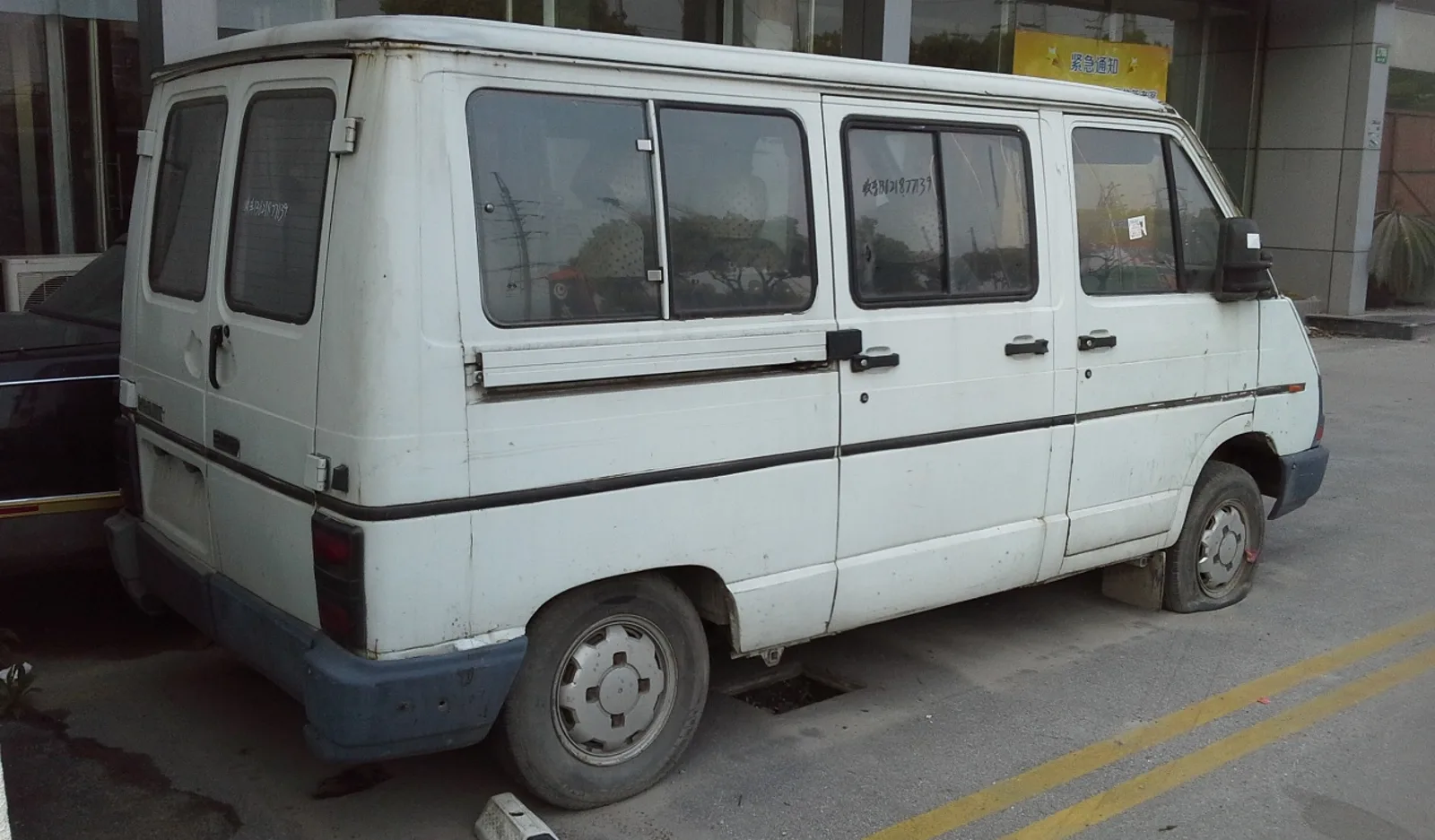
A van built to replace the Estafette with front-wheel drive, a low flat floor and up to 1,400 kg of payload, sold from 1980 to 2004.
The Renault Trafic I was a light commercial van that Renault built from 1980 to 2004. It replaced the Estafette with a front-wheel-drive design and carried payloads up to 1,400 kg. It was also sold as the Opel Arena and the Chevrolet Trafic, and it was built under licence by several brands around the world.
Renault's Trafic began life as a replacement for two tired vans, and it stayed on sale until 2004, although European production ended in 2001. Later it wore the badges of Opel, Vauxhall and Chevrolet in other markets.
Why did Renault replace the Estafette?
The Estafette had been in service since 1959 and was starting to look old by the early 1970s. Peugeot's J7 offered a more modern alternative, and a 1973 market study showed buyers wanted payloads above 1,000 kg, beyond what the Estafette could carry.
Both the Renault 4 Fourgonnette and the Estafette were outdated by the competition, so the new van had to replace both. Renault decided in 1973 to renew the Estafette, and the market study became the basis of its specification.
The brief was clear: a more modern van able to carry 1,000 kg (2,205 lb). Renault chose front-wheel drive because it allowed a low, flat floor, which gave a usable load volume and easier loading.
Front-wheel drive, a flat floor and a badge for every market: the Trafic I went out as a multi-brand van.
How was the Trafic planned, and who shared the cost?
Renault planned a van with front-wheel drive and a 1,000 kg payload, and it also wanted a rear-drive version for African and American markets. A North American venture with American Motors Corporation, which had sold the Renault 5 since 1976, needed heavy investment, so Renault turned to Peugeot to share the costs.
The two French carmakers had worked together before, on joint projects such as the Francaise de Mecanique engine company and the PRV V6. Peugeot, however, was then engaged in taking over Citroen, and it already had the C35, a model that could duplicate the new van. It declined the offer, and Renault carried on alone.
In 1973 Renault officially started development of two new light vans: the Trafic and the Master, to replace the Estafette and the Super Goelette. The Master came from the Renault Industrial Vehicles division, built on the former Saviem teams, while the Trafic was drawn up in Renault's own design offices. Together the pair would cover payloads from 800 to 1,800 kg (1,764 to 3,968 lb).
Who styled the Trafic I?
Renault gave the styling job to Jacques Nocher in 1975. He had been the right-hand man of Robert Opron and had worked on the Citroen C35, and he aligned the bonnet and windscreen to give the van a distinctive look. The final mock-up was submitted to management for approval in 1976.
The Trafic I was the first Renault van to take in elements from the large-scale car production. It shared certain mechanical parts with the Renault 18 and Renault 20, a link that gave a commercial vehicle the components of a mainstream car.
What engines did the Trafic I use?
At launch Renault offered a petrol and a diesel engine. The petrol was the Cleon-Fonte unit of 1,397 cc (85.3 cu in), producing 46 PS (34 kW; 45 hp), and the diesel was the Douvrin of 2,068 cc (126.2 cu in), producing 58 PS (43 kW; 57 hp).
| Engine | Displacement | Power | Torque | Notes |
|---|---|---|---|---|
| Cleon-Fonte C1J petrol | 1,397 cc (85.3 cu in) | 46 PS (34 kW; 45 hp) at 4,750 rpm | 98 Nm (72 lb ft) at 2,500 rpm | Bore and stroke 76 x 77 mm; top speed 109 km/h (68 mph) |
| Douvrin J8S diesel | 2,068 cc (126.2 cu in) | 58 PS (43 kW; 57 hp) at 4,000 rpm | 118 Nm (87 lb ft) at 2,000 rpm | Diesel version of the first range |
The petrol engine had a bore and stroke of 76 x 77 mm and was rated at a top speed of 109 km/h (68 mph). Payloads ran from 800 to 1,400 kg (1,764 to 3,086 lb), with gross vehicle weights from 2.1 to 3 tonnes depending on the version.
The transmission choice was deliberate. Front-wheel drive lowered the loading floor, while rear-wheel drive gave better traction when the van was loaded. A four-wheel-drive version with engageable transmission arrived in 1985.
What wheels and tyres did the Trafic I use?
Every Trafic I rolled on 14-inch steel rims finished in silver. Tyre width rose with the payload, from 165 mm on the T900 and minibus to 205 mm on the rear-drive versions, all sized 14 inches in diameter, which kept the wheel size the same across the range.
On the T1100 the tyres were 175 mm wide, and on the T1400 they were 185 mm wide, both 14 inches in diameter (175 R14 and 185 R14). The four-wheel-drive versions used 195 R14 tyres, which were 195 mm wide, so the 4 x 4 sat between the T1400 and the rear-drive vans.
How did the Trafic I handle and stop?
The Trafic I used a MacPherson-type front suspension with triangular lower arms, coil springs and telescopic dampers, plus an anti-roll bar. Braking combined ventilated front discs with rear drums and a load-sensitive proportioning valve to stop the rear wheels locking in an emergency.
Rear suspension depended on the drive layout. Front-drive models had a tubular rigid axle, while rear-drive and four-wheel-drive models used a rigid axle guided by leaf springs. Leaf springs came as single-leaf, two-leaf for front-drive passenger transport, or multi-leaf for rear-drive and four-wheel-drive models, according to the payload.
The braking system used a dual circuit with a brake servo. In goods versions the first circuit served the front wheels and the second the rear. Passenger versions routed the first circuit to all four wheels, leaving the second to the rear pair alone.
How was the body protected against rust?
Renault applied a zinc coating by electrophoresis to the metal before folding and assembling sensitive parts such as corners and pillars, then carried out phosphating and passivation to harden the panels chemically. Cataphoresis then put a base layer over every surface, which was baked at 200 deg C for extra resistance.
An anti-corrosion sealant went around the doors and bonnet, and a stone-chip coating protected the areas struck by spray from the wheels. A thick bitumen layer strengthened the underbody insulation.
Paint went on after a sealer primer, in two coats, each baked at 150 deg C for 25 minutes to give an even finish. Over its life the van was offered in 34 colours. Blanc (O355) replaced Blanc (O319) in 1983, and the only colour offered throughout production was Rouge (O705).
Colour codes followed Renault's own scheme. A short letter prefix described the paint finish, covering opaque, pearl, metallic and effect shades, both varnished and unvarnished. The character that followed usually named the colour family, and the scheme applied to new shades until 1998.
What changed in the 1989 and 1994 restylings?
The Trafic was restyled in April 1989 with a completely new front end that sloped in line with the bonnet and integrated the headlights and indicators. A lighter update in September 1994 brought a new grille and two-tone red and black rear lights.
The earlier changes were smaller. Chrome handles gave way to grey plastic handles in June 1981 because they were cheaper and more durable, and a rectangular Renault monogram appeared on the bonnet in January 1982. A plastic strip framing the headlights and grille arrived in July 1986.
In 1992 Renault changed its logo, dropping the Vasarely emblem, and the Trafic received the new badge on its grille from September 1992. The monograms at the rear became chrome on the same occasion.
Across its life the Trafic I went through two restylings, of the front end and the dashboard, and many technical changes to its engines, mechanical parts and comfort and safety equipment.
The 1994 update came in a crowded market. Early that year Fiat, Peugeot and Citroen had launched their second shared generation of commercial vehicles, the Ducato II, Boxer I and Jumper I.
Why did General Motors sell the Trafic as the Opel Arena?
In 1997 General Motors bought part of the Trafic's production, which allowed the American firm to offer the model under its own brands. From 1997 to 2000 it was sold as the Opel Arena across most European countries and as the Vauxhall Arena in the United Kingdom, where Opel was not present.
The Arena was mechanically identical, sharing the engines and the general design. Badges and a few finishing details were the only differences from the Renault-badged van. Opel offered it as a van or a nine-seat minibus, each with an optional raised roof, and the engines were the 1.9 D and the 2.5 D 75.
Brazil received a similar treatment. The Trafic was sold there as the Chevrolet Trafic or Chevrolet Space Van. Unlike Opel, Chevrolet added no model-specific grille, and its logo was simply placed over the Renault diamond.
Renault's own Pro+ operation handled the conversions in France. Stickers, body cut-outs, van fittings and adaptations for carrying people with reduced mobility were added to both the Trafic and its Opel twin. Vans built at Batilly were converted on site there, while those made at Luton were converted at Verneuil-sur-Avre.
How did the Trafic reach China and South America?
A Sanjiang-Renault joint venture was agreed in 1994 to assemble the Trafic in China, first from CKD kits imported from France in 1995 and then locally from 1998. The plan targeted 15,000 units a year, but only 4,112 were assembled or made between 1995 and 2004.
Production for South America had begun at the Renault plant in Cordoba, Argentina, in 1986 to supply that market. Production for Europe ended in 2001, and production for South America in 2002, while kits were assembled in China until 2004.
Renault also tried to introduce the Espace in China, to be assembled in CKD form, but fewer than 2,000 were assembled. Renault withdrew from China in 2004 after that bitter setback.
How many Trafic I vans were made?
Renault's production figures are known only for the last seven years of the model's sales. Output in 1996 was 43,998 units, which fell to 12,655 in 2000 as the Trafic II arrived, and then to 928 in 2002 before production ended.
Volumes fell steadily through the late 1990s, and the successor was presented in September 2000. In 1997 output was 39,333 units, in 1998 it was 30,421, and in 1999 it was 17,316. The final two years saw residual volumes of 2,467 units in 2001 and 928 in 2002.
What body versions did the Trafic I come in?
The van came in three forms: the sheet-metal van, the glazed van and the mixed van. They shared one base but differed in the glazing of the load compartment. Wheelbases were short (L1) or long (L2), roof heights normal (H1) or raised (H2), and each model code used a letter and three figures.
The sheet-metal version had no side glazing at all, with only the rear doors glazed, which was designed above all for carrying goods. The glazed version had four side windows in the cell as well as the rear doors, making it brighter and better for small loads. In the long version the rear window was wider.
The mixed version had two side windows at the front of the cell, in addition to the rear doors. Minibuses and chassis-cabs were also offered, and at launch the stylist Marc Held presented a Trafic van called La Meridienne, designed with Chausson.