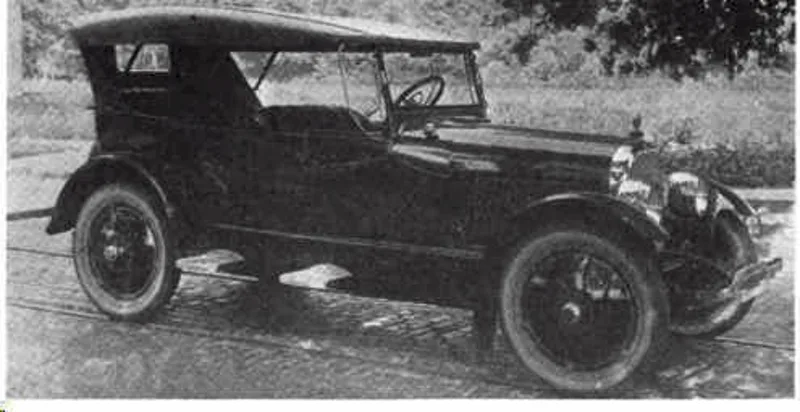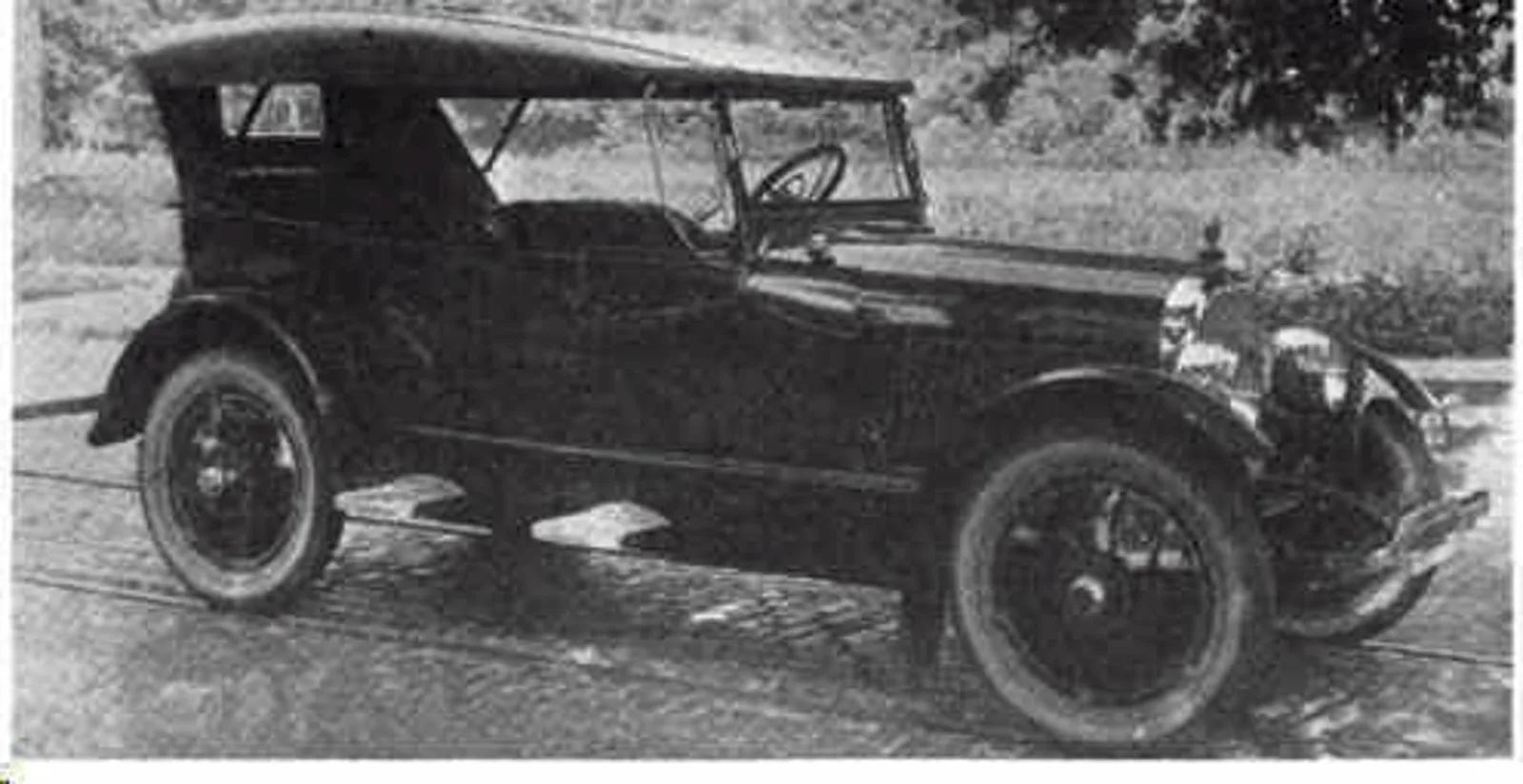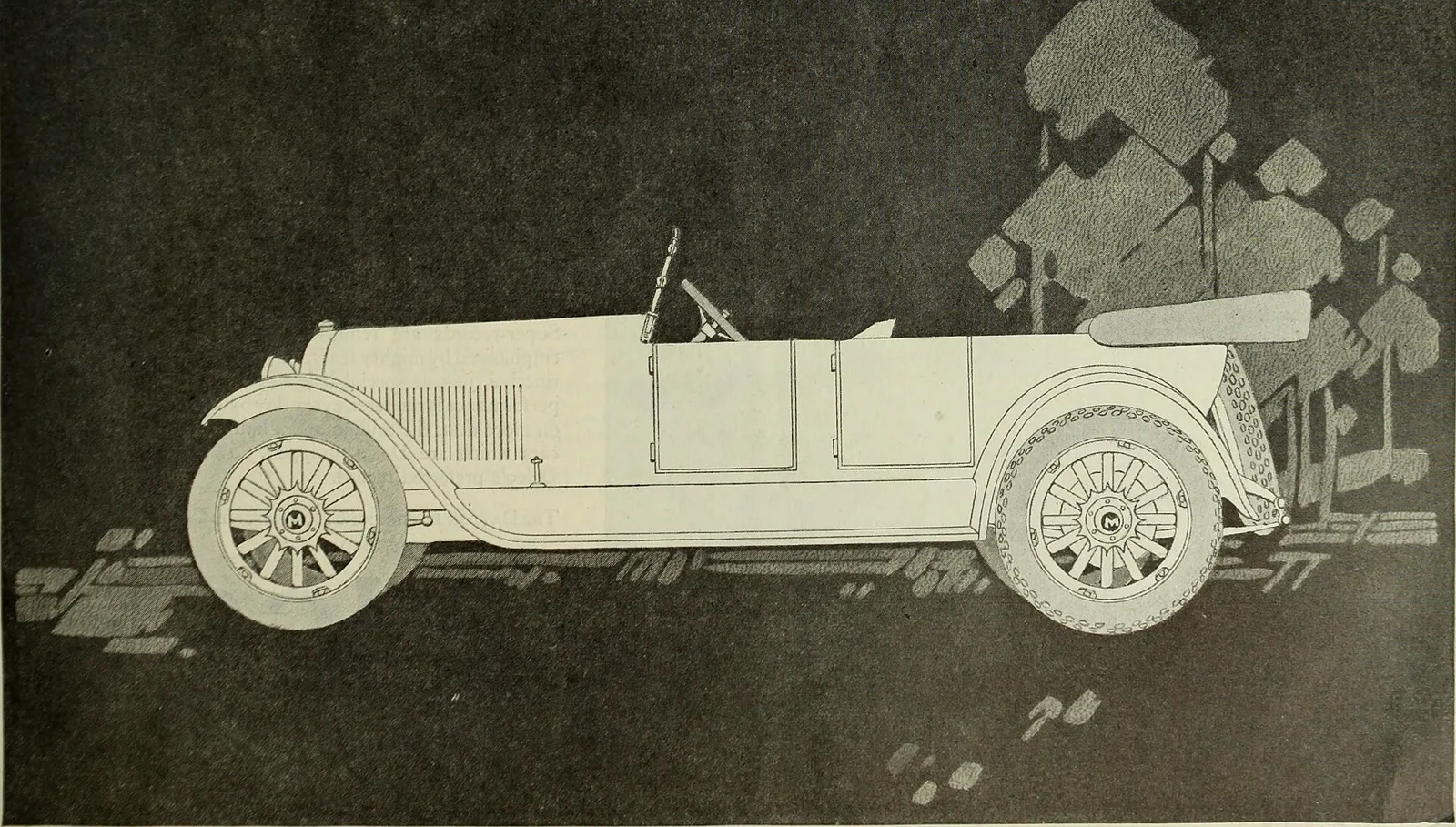
A six-cylinder American car from 1918 to 1922, built by a carriage maker that suffered a fire, a change of owner and a rescue company.
Introduced in 1918, the six-cylinder model from Maibohm became the B-6 in 1919, with a longer wheelbase and a six-cylinder engine of probably 3,205 cc. The company's cars totalled 2,994 across 1918 to 1922, and after creditors took over in May 1922, a rescue company offered the Courier Model D.
The Maibohm Model B, built by the Maibohm Motors Company, was a six-cylinder car in the American mid-size segment. From 1919 it was sold as the Model B-6, and in Britain it was offered as the Maibohm 20 h.p. The maker began as a carriage builder, suffered a fire at the turn of 1918 and 1919, and in 1922 creditors took it over.
How did Maibohm Motors come to build cars?
Maibohm Motors grew out of the Maibohm Wagon Works, a carriage builder in Racine, Wisconsin. The company was formed in 1916, and its first car, the Model A, was a two-seat open or closed car with an in-house two-litre engine. It went on sale in late 1916 as the 1917 model.
The larger Model B arrived in 1918 with a six-cylinder engine, and the Model A ended without a successor at the end of that year. A fire on New Year's Eve 1918 was followed by a move, and from 1919 the reworked six-cylinder was built in new facilities in Sandusky, Ohio, as the Model B-6.
From a carriage builder to a rescue company: a six-cylinder car shaped by a fire, a new owner and a successor.
What happened to the company in 1922?
In May 1922 creditors took control of Maibohm Motors. The creditors then backed a rescue company set up alongside Courier Motors Company, and its single product was the Courier Model D. Courier Motors fell into insolvency in 1923 and closed.
The Courier Model D was built in the same facilities in 1922 and 1923, and it was offered only in 1923 as a successor to the B-6. The Model D was listed as a four-door sedan with a body virtually identical to the B-6's.
Why did sales fall after 1920?
Sales peaked in 1920, when Maibohm sold 1,212 cars, but they fell sharply in the next two years to 623 in 1921 and 217 in 1922. Prices rose every year, in some cases considerably, and the cuts for 1922 were probably more a result of the market and the collapsed sales of the previous business year.
The price rises were more likely a way of passing on rising cost pressure than of paying for better equipment, at least for the open versions. The Model B-6 sat in a crowded market. Auburn, Buick, Chalmers, Chandler, Hudson, Hupmobile, Nash, Jordan, Oldsmobile, Reo and Studebaker were among the better-known rivals in its class.
Similarly small suppliers included Ace, Fremont, Handley-Knight, Inter-State and Stephens, along with Bush, which sold only by mail order. The Grant Motor Car Company had introduced a small sports car in 1913, dropped that concept after 1916 and remained a rival of the B-6 until its own production ended in 1923.
Was the Model B sold in Europe?
Some Maibohms were exported, although American cars with large engines faced tax disadvantages in Europe. Southgate, Ltd. held the sole concession for Great Britain and Ireland, with premises in Heddon Street, London, and in France the B-6 was probably rated at 16 CV. That placed it in the same French tax band as luxury makes such as Lorraine-Dietrich and Panhard & Levassor.
In Britain the car was also offered by a regional agency in Manchester, which sold a tourer as the Sporting model. The body maker for that model is not known.
What was under the bonnet?
The Model B-6 had a water-cooled six-cylinder engine that was bought in from an outside engine supplier. It was probably an inline overhead-camshaft unit, likely the supplier's X-9000, which has a displacement of 3,205 cc (195.581 cu in), a bore of 3.13 in and a stroke of 4.24 in (79.38 x 107.95 mm). That engine ran its crankshaft on three main bearings.
Quoted power varies, with 46 bhp (34.3 kW) and 45 bhp (33.6 kW) both cited at 2600 rpm. A British agency quoted 46 bhp at 2,290 rpm and a top engine speed of 3,510 rpm. The N.A.C.C. rating, derived from the bore, comes to 23.44 PS, and that figure was the tax horsepower in Britain, although the importer quoted 20 h.p. The rating says nothing about the real output.
Splash lubrication was used, and the Courier Model D replaced it with dry-sump lubrication. Cooling was by thermosiphon, typical of the period. A Stromberg carburettor formed the mixture, and a Tillotson is mentioned only for 1922. The engine design also appeared in the Fremont R-6 and the Handley Six-40.
How did the drive and chassis work?
Drive came through a single-plate clutch and a three-speed box. A conventional, unsynchronised drive to the rear axle is recorded from 1921, though it was probably the same earlier. The final drive used a spiral-bevel crown wheel and pinion, with ratios of 4.25:1 for 1918, 4.5:1 for the years 1919 to 1921, and 5.0:1 for 1922.
Little is documented about the chassis. The typical frame of the period was a pressed-steel ladder with two cranked side members and four or five cross members, and rigid front and rear axles were also typical. Leaf springs were used at the rear throughout, and front leaf springs, documented for 1922 and the Courier, were probably used earlier as well. Steering was by worm gear on the later cars.
The B and B-6 had a free-floating rear axle up to the 1921 model year, and a three-quarter floating one in 1922.
The brakes were drum units on the rear axle, documented from 1921. Front-wheel brakes only spread widely after 1925. In 1918 the wheels were offered in a 32 x 3 1/2 in tyre size, probably with wooden-spoke artillery wheels, and from 1920 those wooden-spoke wheels were the standard fitment.
How were the bodies built and what models were offered?
The usual method of the time was mixed construction, a seasoned hardwood frame clad in sheet steel. Early models came as a five-seat tourer, a two-seat roadster, a coupe and an unspecified roadster-coupe, probably with a fixed or detachable winter top. Its origin as a carriage builder makes it plausible that Maibohm built its own bodies, although the bodies' origin is not documented.
Apparently from 1919 the B-6 was marketed more on comfort and everyday use than on sportiness. A phaeton replaced the tourer, and two-seaters gave way to a brougham and a sedan. In 1921 a roadster and a coupe returned with three and four seats, and a fashionable sport body appeared, which Britain would have called a sports tourer and the rest of Europe a torpedo. The 1922 sport roadster was added later and is absent from the earlier type sheet.
The 1922 B-6 came in Baltic green or Burgundy, with a black chassis and matching wheels. The standard equipment included a speedometer, a battery charge indicator and an electric horn. A Courier Motors sales brochure carried the note 'custom built in the Courier shops'. The 1922 cars are also documented with cord tyres, which had only just come onto the market, and the cord fabric worked into the tyre gave the carcass a textile reinforcement.
How many cars were built?
The Standard Catalogue of American Cars records 2,994 vehicles from 1918 to 1922. That total includes both the four-cylinder Model A and the six-cylinder Model B of 1918. Output was 615 in 1918, 327 in 1919, 1,212 in 1920, 623 in 1921 and 217 in 1922.
Of those, 2,379 were the B-6 with the longer wheelbase, built from 1919 to 1922. Some accounts add 373 Courier Model D cars as a further development of the B-6.
The engine number doubled as the chassis number. On the Model A the number plate was fixed to the left side of the engine block, but the position is not documented for the B and B-6. The engine supplier almost certainly applied numbers of its own, so the cars must have carried two sets of numbers.
Key specifications
| Specification | Detail |
|---|---|
| Maker | Maibohm Motors Company, Racine, Wisconsin, from 1916 |
| Model B | Six-cylinder, introduced 1918 |
| Model B-6 | Reworked six-cylinder from 1919, built in Sandusky, Ohio |
| Engine | Water-cooled six-cylinder, probably 3,205 cc (195.581 cu in) |
| Bore and stroke | Probably 3.13 in x 4.24 in (79.38 x 107.95 mm) |
| Power | 46 bhp (34.3 kW) or 45 bhp (33.6 kW) at 2600 rpm |
| Wheelbase | 2,921 mm (115 in) in 1918; 2,946 mm (116 in) afterwards |
| Final drive | 4.25:1 (1918), 4.5:1 (1919 to 1921), 5.0:1 (1922) |
| Output | 2,994 vehicles in total, 1918 to 1922, Model A included |