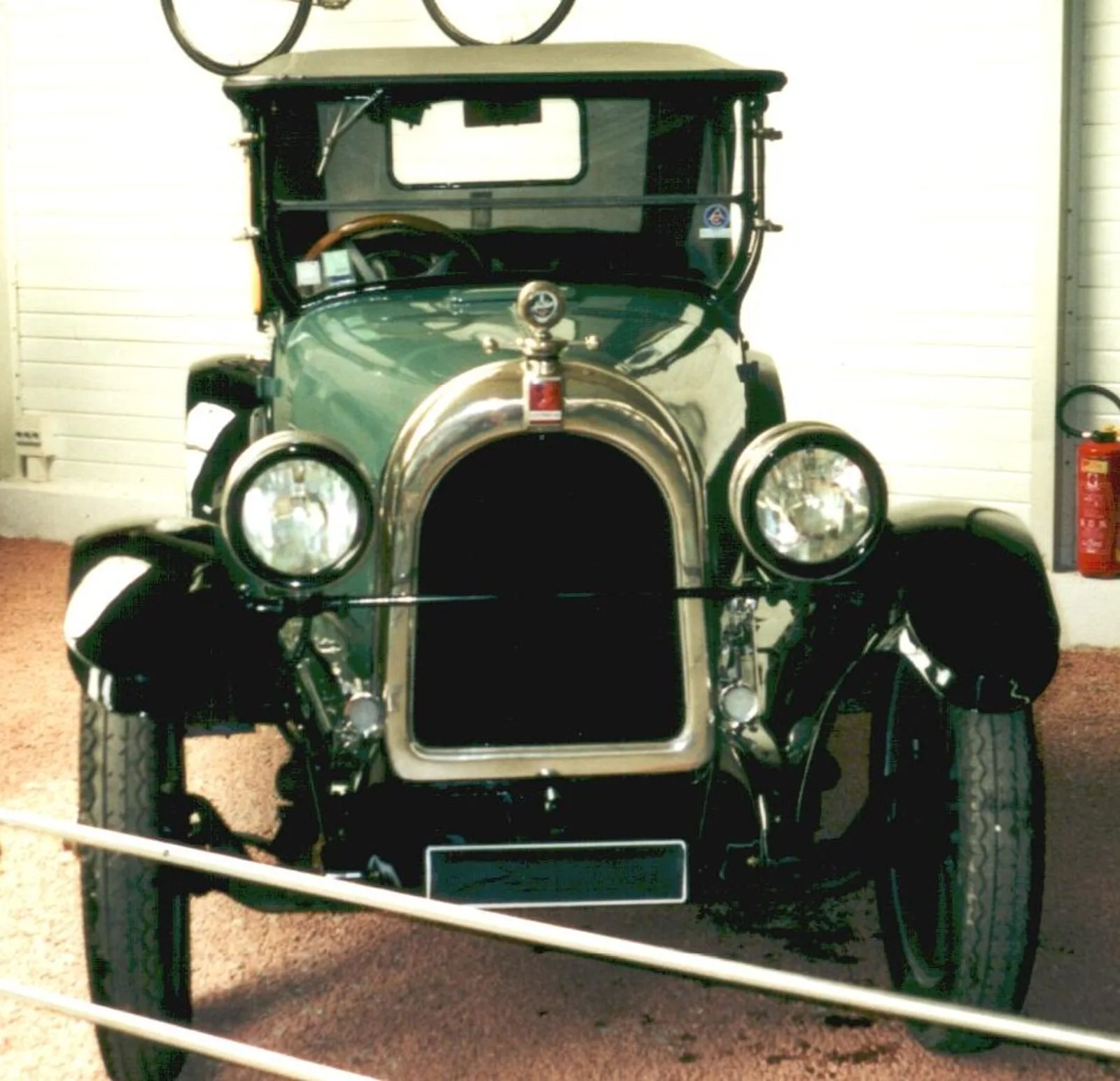
From a Detroit dealership and a cyclecar to the Grant Six and a truck line, the American maker that ran from 1913 to 1922.
Grant was an American car maker from 1913 to 1922, founded in Detroit and later based in Findlay, Ohio, and Cleveland. It built the Model M cyclecar and the Grant Six, sold trucks from 1917, and ended up in receivership in October 1922.
Grant was an American automobile maker that operated from 1913 to 1922. It began in Detroit, moved to Findlay, Ohio, and later set up in Cleveland, producing several thousand four- and six-cylinder cars. Some were sold in England under the Whiting-Grant name, but a receivership ended car production in October 1922.
Where did the Grant name come from?
The Grant name first appears in Detroit through the Grant Bros. Auto Company, a dealership run by George D. Grant and Charles A. Grant. Its showrooms at 1000 and 742 Woodward Avenue sold Thomas Flyers, Thomas Detroit and Buick cars, and the business dates from 1907 at the latest.
In May 1908 one of the brothers entered a three-day, 400-mile reliability run around Detroit, driving a 40 horsepower Thomas Detroit. The roads were rough and largely unpaved, and many cars broke down, but both cars run by the firm earned perfect scores.
By 1910 the dealership sold Chalmers cars exclusively, a line that later changed to Everitt and then to Lozier. The building was shared with the Winton Motor Carriage Company, with each firm occupying one half of the structure.
The trade journals stopped mentioning Grant Bros. in 1914. By then the dealership's job was to distribute Grant-built cars in Michigan, and its future after 1914 is unclear.
A Detroit dealership's cyclecar grew into a six-cylinder maker that also sold trucks, then ended in receivership in 1922.
Why did Grant move from Detroit to Findlay?
The Grant Motor Company was incorporated in Detroit in May 1913, with capital of $100,000 to build cyclecars. George Grant was president, Charles Grant vice president and sales manager, and David Shaw became secretary and treasurer. G. F. Salzman and J. M. Howe served as manager and engineer.
Demand was strong, and the company raised its capital first to $165,000 and then to $200,000. Late in 1913 production moved to Findlay, Ohio, where a vacant factory had once belonged to the Findlay Motor Company. That firm had been placed in the hands of a receiver two years earlier.
Grant publicly apologised for leaving Detroit, but a larger factory was necessary for success. The company already had enough supplies to make more than 5000 cars, and its Detroit premises were too small to build them quickly. The supplies were shipped to Findlay soon after the purchase.
By 1914 the company was turning away from cyclecars and towards a larger six-cylinder car. Demand pushed it to lease a 40,000 square foot factory once used by the Finding Table Co, and it planned to build 50 cars a day. Output for 1914 reached about 2,174 cars.
What was the Model M cyclecar like?
The Model M was a small cyclecar with seating for two. It went on sale in early 1913 in a single body style, with left-hand drive and centre controls. Its 16 horsepower four-cylinder L-head engine was built in-house, with a Mayer carburettor and a Bosch magneto as standard.
The engine was cooled by thermo-syphon action and had no water pump, and the gearbox offered two forward gears and a reverse. Advertising claimed 30 to 35 miles per gallon. The first price was $495, reduced to $425 by mid 1914. Gas lighting was standard, and for $80 more a buyer could have electric lights and an electric starter. The car weighed 1,075 pounds.
Why was the Grant Six a bargain?
In late 1914 Grant announced a six-cylinder model, publicly known as the Grant Popular-Priced Six or simply the Grant Six. It had an overhead valve engine producing 33 to 36 horsepower, and it was built on a 106 inch wheelbase. Two bodies were offered at first, with a cabriolet added in 1915.
The Six sold mainly on price. Most six-cylinder cars then cost more than $1000, while the touring car and roadster were listed at $795, or $750 with the Prest-O-Lite gas lighting system. Economy was rated at 25 miles per gallon with five people aboard, and the cyclecar soon disappeared from the advertising.
How did the Grant Six change from model to model?
The Six passed through several model letters, each with small but noticeable changes. The table sets out the main steps, from the original Model T six to the Model H, with the wheelbase, the headline change and the prices given in the record.
| Model | Year | Wheelbase | Main change | Price |
|---|---|---|---|---|
| Model T (Grant Six) | 1914-1915 | 106 inches | Original six; cabriolet added in 1915 | $795 touring car |
| Model V | 1916 | 112 inches | Longer wheelbase; sloping side louvers | Not given |
| Model K | 1917 | 112 inches | More side louvers; Wagner starting and lighting | $825; cabriolet $1050 |
| Model G | 1918 | 114 inches | New nickel radiator and fenders; five body styles | $1055 to $1595 |
| Model H | Two years after Model G | 116 inches | Angular grille; 44 horsepower; Durston three-speed | $1495 to $2450 |
The Model K kept the Six's layout but took its starting and lighting from Wagner and its ignition from Remy. The Model G was recognisable by its closed bodies or by the sloping windshield on open cars. The Model H was a clean break, with an angular grille and a modern look, and the cars began to be advertised as luxury products rather than cheap transport.
How did Grant enter the truck business?
In mid-1917 Grant bought the Deneen Motor Company of Cleveland, which had built trucks under the Denmo brand. Denmo offered six models, from a three-quarter ton to a 2 1/2 ton truck, and the purchase gave Grant a network of over 1200 truck dealers. By late 1917 the Denmo name had been dropped and the trucks were sold as Grants.
The 1917 range included the Models 10, 11, 12, 15 and 16. The Model 12 had an 1800 pound payload and sold for between $1,020 and $1,065, depending on body style. The other models were sold as chassis only, with prices from $1,490 for the Model 10 up to $1,885 for the largest.
Truck output was estimated at 10,000 a year. Wartime work included assembling standardised 1 1/2 ton four-wheeled trailers for the military. In 1920 the range was trimmed to one model, the Model 17, a 1 1/2 ton truck on a 140 inch wheelbase weighing 3,550 pounds. It was priced at $2,675 in August 1920, and in early 1921 the company stopped truck production to concentrate on cars.
Why did Grant fail after 1919?
Grant cut its car prices by $130 in 1919 and estimated output at 12,000 for the year. Late in 1920 it bought the H. J. Walker Company, an engine builder, and expected to produce 20,000 cars in 1920, almost double its previous output.
The forecasts were badly wrong, and a post-war depression had hit the firm hard, so in December it took out a note for an unspecified sum. Grant had built large numbers of parts for cars that buyers did not want, and its inventory topped $500,000. At one point the firm was said to hold more crankcases than cash. Grant sold the Walker company to raise cash, but this was not enough.
In October 1922 Grant was placed in receivership, and car production stopped, although truck work carried on under the receiver. In June 1923 the plant was sold to the Lincoln Electric Corporation for $425,000, and the company's car era was over.