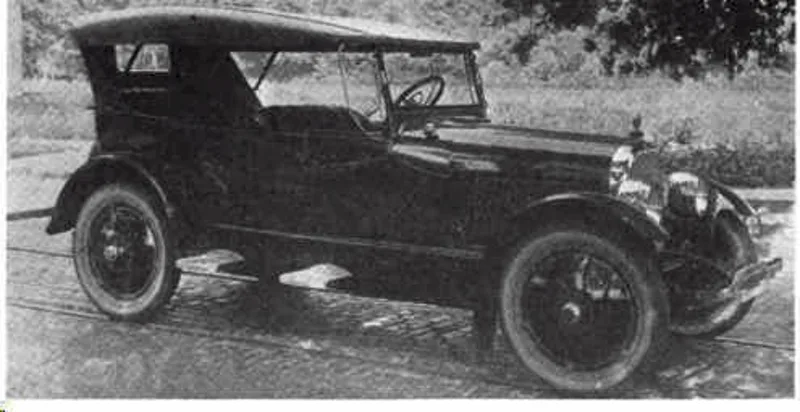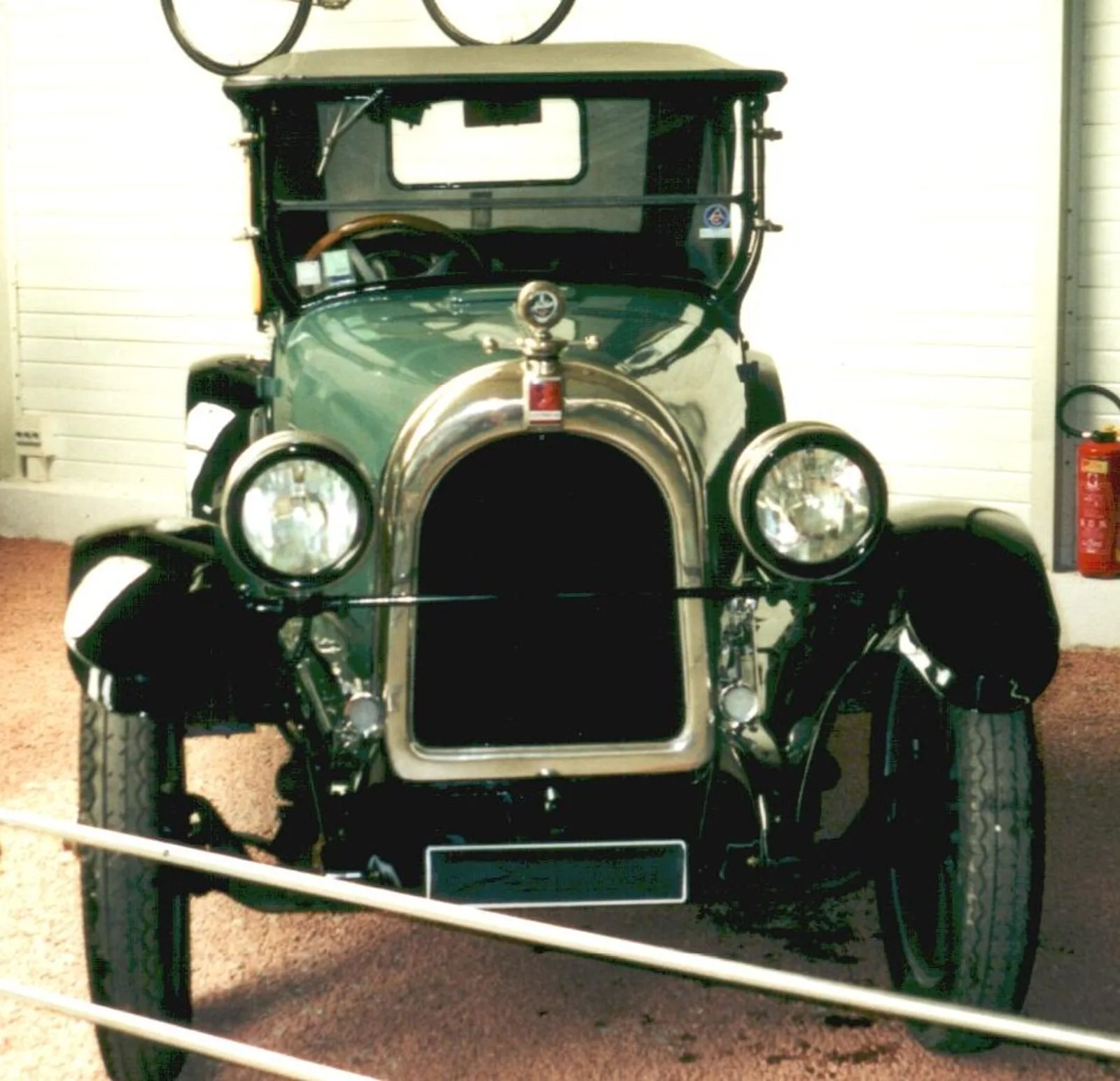
A carefully engineered six from an Illinois farm machinery firm, sold as the Salient Six from 1917 and kept in the range as the 6-20 until 1924.
Stephens sold the Salient Six from 1917 to 1922, and it was built by an Illinois farm machinery firm's car division. Its overhead-valve six made 57 bhp at first and was kept in the range as the Six and 6-20 until 1924.
The Stephens Salient Six was a middle and upper class car that Stephens sold under that name from 1917 to 1922. Technically almost identical versions carried on as the Six and the 6-20 until production ended in the summer of 1924.
Where did the Stephens Salient Six come from?
The car came from the Stephens Automobile Branch of the Moline Plow Company, an agricultural machinery and tractor maker in Moline, Illinois. Moline Plow began preparing automobile production in 1915 to offset a slump in its core farm equipment business.
Production was prepared in Detroit but was set up in Freeport, Illinois, where it stayed for the whole production period of the Stephens automobiles. The design came from the engineer Edward T. Birdsall, and Matthew A. Steele headed the subsidiary that built the car.
The chief engineer was John T. Trumble, who had held similar posts at the Monroe Motor Company and at Chevrolet, which did not yet belong to General Motors. The Moline parent was at times owned by businesses controlled by John North Willys.
Moline Plow then announced that it wanted to concentrate on agricultural machinery. The automobile division became independent when the Stephens Motor Car Company was formed in 1922.
Stephens engineers built a carefully designed six, but the public still saw an assembled car.
Why were Stephens cars called assembled cars?
Stephens cars were perceived as Assembled Cars, meaning automobiles put together from bought-in components. That was a common route at the time, but it was often seen as lower quality, and it was a market disadvantage for the Salient Six even though its design was careful.
The Stephens was soundly designed and solidly built, but the public still saw it as an assembled vehicle. Many brands of that kind existed by the dozen, and their products, trucks and tractors included, were often regarded as inferior, often unjustly.
The Salient Six's body was built by hand according to the principles of individual coachbuilding, which were also used on cars in the highest price segment. The structure was made of seasoned hardwood covered with sheet steel.
What engine did the Salient Six use?
The Salient Six used an overhead-valve six-cylinder engine from Root & Vandervoort Engineering of East Moline, which Moline Plow took over in 1920. It produced 57 bhp at 2,600 rpm in the early versions, and 59 bhp from 1923.
The predecessor was a side-valve Continental six of 224.0 cubic inches (3,670 cc) and 55 bhp (41 kW). The R & V unit had the same bore and stroke, three and a quarter inches (82.55 mm) and four and a half inches (114.3 mm), so the gain in output was small.
Air was led through channels in the cylinder head and preheated by the exhaust gases, which was meant to improve combustion. Cooling channels connected to the water circuit were there to keep the temperature down. The valves had double springs and could be adjusted with a screw while the engine was running.
Stephens used Tillotson and Stromberg downdraught carburettors, fed by a Stewart vacuum fuel system. The electrical system was 6-volt, with a U.S.L. battery rated at 113 amp, and ignition came from AutoLite, Connecticut or Delco depending on the year.
Under the N.A.C.C. rating the power was 35.25 PS, and the 25.3 tax horsepower used in Britain derives from the same rating. Stephens later quoted the more realistic bhp figures, so the rise from 25.3 to 57 bhp reflected the change of rating rather than any engine change.
How did the Salient Six transmit power and ride?
The Salient Six had shaft drive and a three-speed gearbox with reverse, made to Stephens' own plans. It rode on a pressed-steel ladder frame with five cross members, with rigid axles at the front and rear.
The clutch was a dry-disc unit of 10 inches from Borg & Beck, and the handbrake acted on a drum at the gearbox output. Steering came from Gemmer, and the brakes were drums on the rear axle.
The wheels were wooden-spoke artillery wheels with detachable rims. Leaf springs for the later models came from Mather, and the Series 90 springs were 95.3 cm (front) and 133.4 cm (rear) long.
How long was the wheelbase in each series?
The wheelbase changed several times, growing from 118 inches (2,997 mm) in the Series 70 to 122 inches (3,099 mm) in the Series 80 and 90. It shrank to 117 inches (2,972 mm) for the 1923 Series 10, and the Series 20 measured 124 inches (3,150 mm).
Salient Six series at a glance
| Series | Years | Wheelbase | Engine output |
|---|---|---|---|
| Series 70 | 1918-1919 | 118 in (2,997 mm) | 57 bhp (42.5 kW) at 2,600 rpm |
| Series 80 | 1920-1921 | 122 in (3,099 mm) | Little changed from Series 70 |
| Series 90 | 1922 | 122 in (3,099 mm) | Little changed |
| Series 10 | 1923 | 117 in (2,972 mm) | 59 bhp (44.0 kW) at 2,750 rpm |
| Series 20 | 1923-1924 | 124 in (3,150 mm) | 59 bhp (44.0 kW) at 2,750 rpm |
| 6-20 Series 20 | 1924 | 124 in (3,150 mm) | No changes known |
What did the first Salient Six models cost?
The Six went on sale in May 1916 as a five-seat touring car, and a three-seat roadster followed at the turn of 1916/1917. At market launch both cost US$ 1,150. In 1918 the roadster, model 72 at US$ 1,485, was the only model, and in 1919 touring cars were priced from US$ 1,675 to US$ 1,850.
The first closed Stephens was a five-seat sedan in 1919 at US$ 1,985. Closed bodies of this kind were costly to make before mass production arrived, and such bodies could cost up to double the price of a touring car.
Its nose echoed contemporary Dodge and Citroen designs, yet the car was bigger than either. Standard equipment included central chassis lubrication, a theft-proof transmission lock, a Stewart speedometer, an electric horn and a Kellogg tyre pump.
How did the Series 80 and 90 change the range?
The Series 80 of 1920 and 1921 changed little technically. Its wheelbase grew to 122 inches (3,099 mm), and the ignition moved from AutoLite to Connecticut. Roadsters returned in two forms at US$ 1,975 each, while the 1920 sedan rose to US$ 3,050, the same price as a coupe offered only that year.
The 1922 Series 90 was again little changed. It had a new rectangular logo with an S stylised as a lightning bolt, and its wheelbase stayed at 122 inches (3,099 mm). Roadsters came as model 92 at US$ 1,800 and model 92-B at US$ 1,900, the latter with helmet wings, running boards and wire-spoke or disc wheels.
In its last production year the car came with eleven body variants according to the sales brochure, more than ever before, although one brochure shows only eight and the Standard Catalogue lists seven. Prices were drastically cut, and the six-seat sedan stayed the only closed model.
What changed with the 1923 Series 10 and 20?
In 1923 two series were offered at once for the first time, and they differed little technically. The Series 10 used a 117 inch wheelbase, while the Series 20 used 124 inches, and both produced 59 bhp.
The new radiator shell recalled the successful Reo passenger car. The Stromberg downdraught carburettor was replaced by a Tillotson, and some body variants were available in only one of the two series.
The Series 10 came as a three-seat roadster (model 12) at US$ 1,345, a five-seat touring car (model 15) at US$ 1,295, a five-seat coach called the Touring Sedan (model 16), and a four-door, six-seat sedan (model 18) at US$ 1,950.
The Series 20 offered a seven-seat touring car (model 24) at US$ 1,685, a seven-seat four-door sedan (model 27) at US$ 2,385, and the four-seat 26 Sport at US$ 1,985, a model that also carried the name Foursome. The Series 10 was discontinued after one year.
When did Stephens end production?
Production ended in the summer of 1924, after a single range had been sold under the 6-20 name. The 1924 touring car was US$ 1,585, the sedan became model 25 at US$ 2,250, and the Foursome was offered at US$ 1,750 as model 24-B.
The 6-20 was effectively the Series 20 of the previous year. No technical changes are known for it, and the lower prices may point to a simplified production programme, although no evidence for this could be found.
A Stephens Salient Six Victoria touring car also appears in the 1995 television film Truman.
How many Stephens cars were built?
The Standard Catalogue of American Cars 1805-1942 gives the most exact production figures: 1,337 Six cars and 17,809 Salient Sixes, including the Series 10, 20 and 6-20 models. Estimates of total Stephens output range from under 20,000 to 35,000 cars.