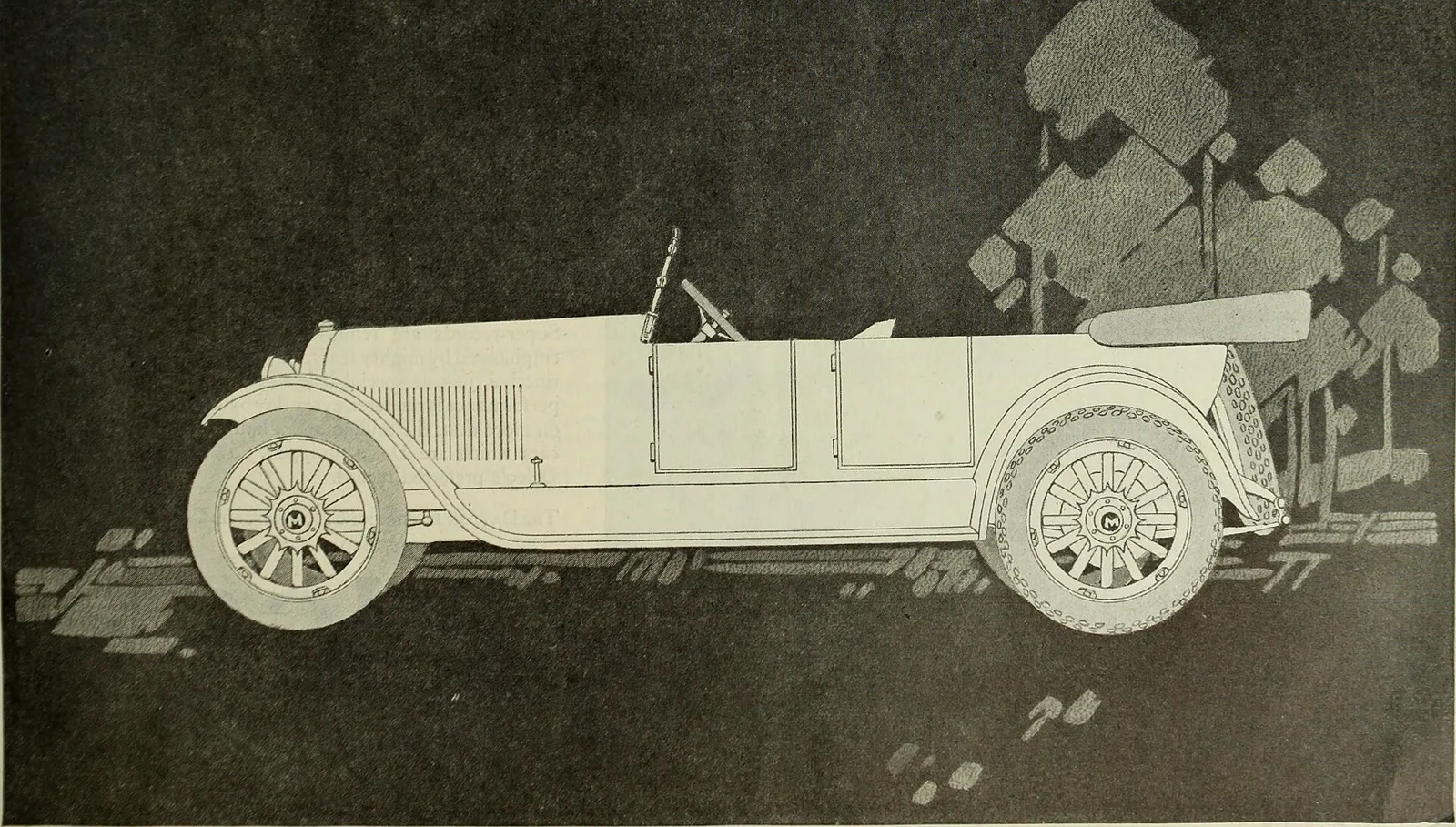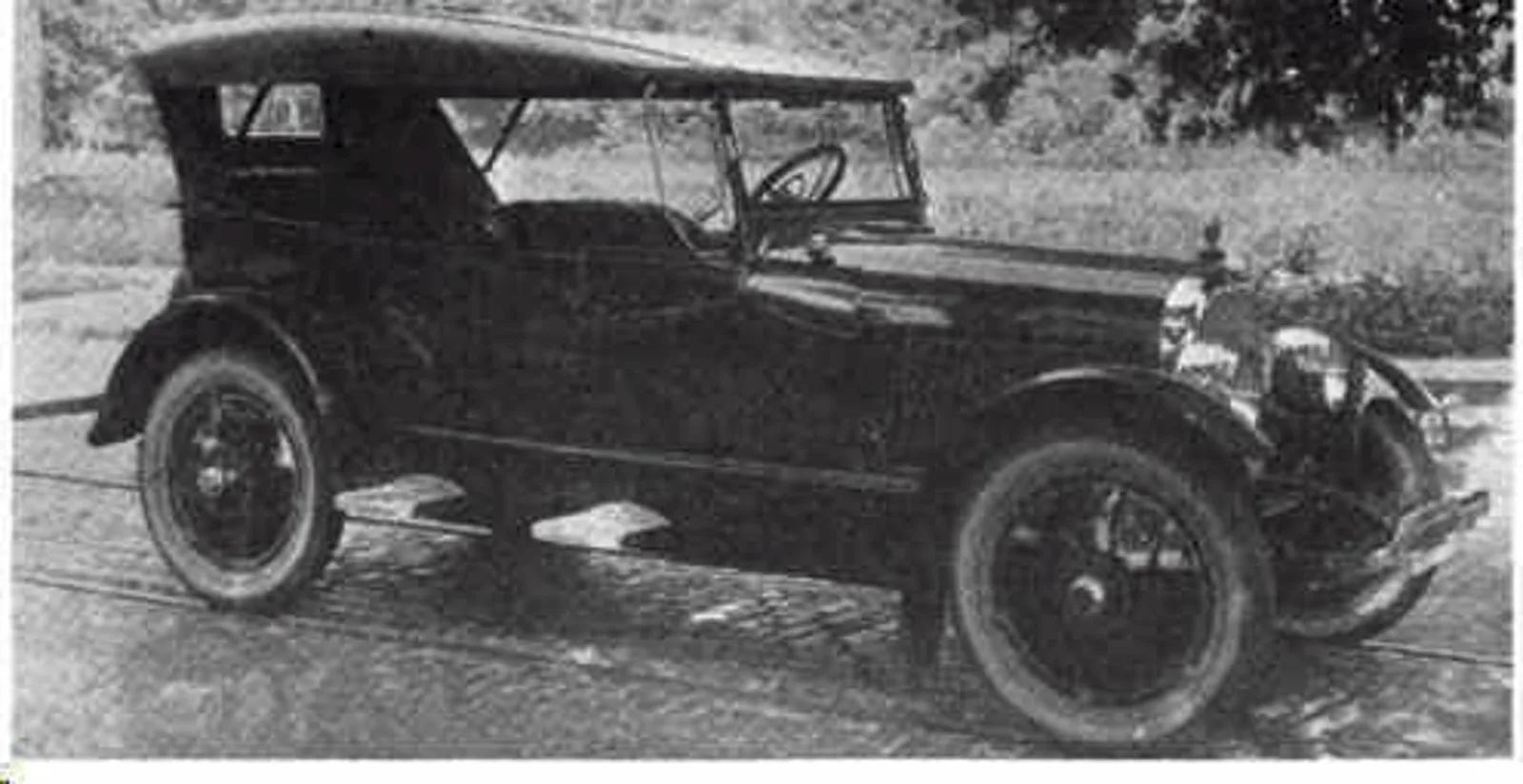
A short-lived mid-size American car from Sandusky, Ohio, with a bought-in Falls six, dry-sump lubrication and a chassis that was greased from the dashboard.
Courier Motors of Sandusky, Ohio, offered this six-cylinder mid-size car for model year 1923 only. It used a Falls engine carried over from the Maibohm Model B-6, added central chassis lubrication, and 373 were built.
Built for one model year only, the 1923 Courier was a mid-size car from the Courier Motors Company of Sandusky, Ohio. The firm had been set up by creditors of Maibohm Motors, and the car borrowed heavily from the Maibohm Model B-6 while adding its own lubrication and chassis features. Only 373 were built before the company gave up.
Where did the Courier Motors Company come from?
The business was founded in 1922 as the Arrows Corporation, set up by creditors of Maibohm Motors who wanted to prop up the firm and protect their earlier investments. Soon after that the business was restructured as Courier Motors. The plan did not succeed, and the company had to stop after 373 cars. Bankruptcy does not appear to have happened.
Its ambitions were large: the firm advertised nationwide in the USA and planned to grow quickly. A right-hand-drive car known in Australia points to export efforts too.
A mid-size American six with a bought-in engine, dry-sump lubrication and a chassis lubricated by a system triggered from the dashboard.
What did the Courier inherit from Maibohm?
The Courier's design came from the Maibohm Model B, a six introduced in 1918 that used the same Falls engine with a different lubrication system. Courier built its cars in Maibohm's former premises and fitted in-house bodies. Aside from small details, the Courier matched the final form of the Maibohm Model B-6 technically.
Differences that have been identified include the engine lubrication, the central chassis lubrication, the carburettor, the steering and, in some cases, the body variants. Output is also given slightly differently by different records.
How did the Courier Model D engine work?
The six, water-cooled, came from Falls as a bought-in unit. It was a monobloc casting with a removable head, and it was taken over almost unchanged from the Maibohm Model B-6, differing mainly in its lubrication. Other makers, Fremont and Handley, also fitted this unit.
It was an overhead-valve inline engine, identified as either the T-8000 or the X-9000, with a crankshaft supported three times. Its displacement was 195.581 cubic inches (3,205 cc), from a 3.13 in bore and a 4.24 in stroke (79.38 x 107.95 mm). Here it produced 45 bhp (34 kW) at 2,600 rpm, while another set of figures lists 46 bhp (34 kW). The N.A.C.C. formula, which uses the bore, yields 23.4 PS, which in Britain also set the tax horsepower. That number says little about real output.
The maker quoted a fuel figure of 20 mpg (about 11.7 L/100 km), and the car used one quart (0.95 litre) of oil per 500 miles (about 800 km).
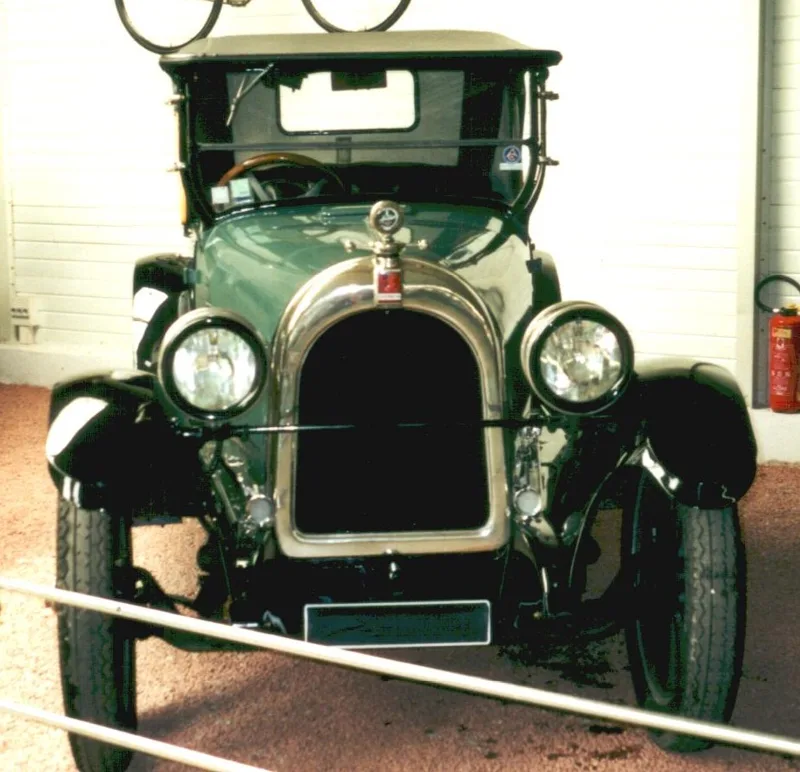
The car most probably kept the predecessor's layout: honeycomb radiator, battery ignition, 6-volt wiring and vacuum-fed fuel.
Cooling came from a thermosiphon, as was typical for the period. Last year's Tillotson carburettor was dropped, and the Stromberg carburettors used earlier were brought back.
How did power reach the rear wheels?
The drive ran from a plate-type dry clutch into a three-speed box with reverse that lacked synchromesh. That box was bolted to the engine, and a propeller shaft linked it to the rear-axle differential. The rear ratio was 4.66:1 by one reckoning, or 5.0:1, the figure used on the 1922 Maibohm.
What were the key specifications?
| Specification | Courier Model D |
|---|---|
| Engine | Water-cooled six-cylinder, overhead valves |
| Displacement | 195.581 cubic inches (3,205 cc) |
| Power | 45 bhp (34 kW) at 2,600 rpm |
| Wheelbase | 116 inches (2921 mm) |
| Phaeton weight | 1,275 kg (2,811 lb) |
| Fuel use | 20 mpg (about 11.7 L/100 km) |
| Final drive | 4.66:1 or 5.0:1 |
| Tyres | No Skid cord, 32 x 4 inches |
How did the lubrication system work?
Splash lubrication with an oil pump, usual at the time and still used in the Maibohm, gave way to dry-sump lubrication, which delivered oil under pressure to every bearing apart from the gudgeon pin.
The Courier also used central chassis lubrication. This feature is rarely found outside much more expensive cars of the period, such as the Packard or the Pierce-Arrow. A tank bolted inside the left main member carried oil for roughly 3,000 miles (about 4,800 km).
Most central systems rely on one pump feeding its own pipework. The Courier's version spread several small pumps through the system instead. The maker called it Automatic Chassis Lubrication. It worked only after being triggered from the dash, which made it semi-automatic. It reached the customary chassis and suspension points, including bearings, springs, steering linkage and axles.
The system saved owners the chore of lubricating every point by hand, a job that stayed common for years afterwards. For 1923 it was undoubtedly advanced.
How was the chassis built and suspended?
The chassis was a conventional ladder frame, built from two cranked side members joined by five cross members. The second cross member from the front carried the engine and gearbox, and the rearmost carried the petrol tank. Both axles were solid, as was typical for the period.
The rear axle was three-quarter floating. The Maibohm Model B and B-6 had a full-floating rear axle up to model year 1921, and the 1922 Maibohm changed to three-quarter floating, as the Courier did. Semi-elliptic leaf springs were used at the front and rear, and the wheelbase stayed at 116 inches (2946 mm) on the chassis description, unchanged from the earlier model.
The Courier Model D had spindle steering. Later Maibohms are said to have used worm-and-sector steering, so the Courier was different in that respect.
What wheels, tyres and brakes did the Courier use?
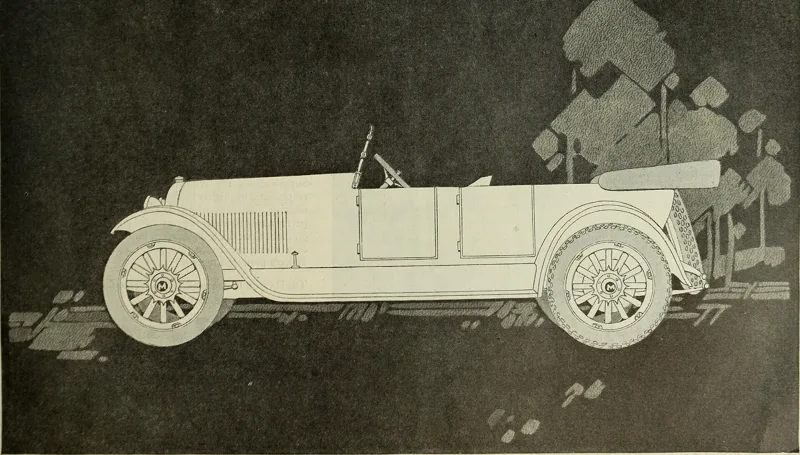
Wooden-spoke artillery wheels came from the factory. The illustrations show solid disc covers, which were fashionable at the time, and these are removable and fastened to the wheel by the existing wheel nuts. The detachable rim introduced with Maibohm was standard, and it had been fitted to every Maibohm since 1920.
The Courier ran on No Skid cord tyres in the 32 x 4 inch size. The cord fabric in the tyre aimed to reinforce the casing with textile. Each set lasted 12-15,000 miles (19-24,000 km).
The service and auxiliary brakes both worked on drums at the rear. Front brakes only became widespread after 1925.
What bodies and equipment did the Courier offer?
Bodies were made in-house, and a sales brochure advertised them as custom built in the Courier shops. Maibohm Motors had begun making cars from a carriage-building base, and Courier used those premises. The brochure lists nine body variants. A standard catalogue of American cars lists only five, and that gap could mean that some models were announced but never built, or, more likely, that some of the entries were simply variants of one body.
The Sport Roadster may have been a modified roadster, with shortened helmet-style wings and steps in place of full-length side boards. Similar logic could explain the Sport Phaeton and the Sport, though the latter seated four rather than five. The Brougham name was occasionally used for club coupes, so it may have been an upgraded coupe with five seats. No special bodies are known.
The standard kit ran to a radiator shell in nickel plating and headlights with dimmers. Open cars had upholstery in Spanish leather, and closed cars could be had in a choice of imported fabrics. The customer could choose from five colours.
How many Couriers were built, and how were they numbered?
The standard catalogue records 373 vehicles in model year 1923, and production probably began during calendar year 1922. Like Ford and earlier Maibohm, Courier did without chassis numbers, and the engine number served in their place. Maibohm had used four-digit numbers on the Model B, while the Courier used five digits, starting at 10150. Production figures are taken from a standard reference covering American makes from 1805 to 1942, published in 1996.
The number plate was fixed to the front spring perch of the left-hand side member. Because Falls almost certainly fitted engine numbers of its own, two sets of numbers must have existed.
Why does the Courier Model D still stand out?
Its dry-sump engine and central chassis lubrication made it unusual for a car in its class, even though its power figures are uncertain. Its right-hand-drive example in Australia hints at exports, and the company advertised across the USA.