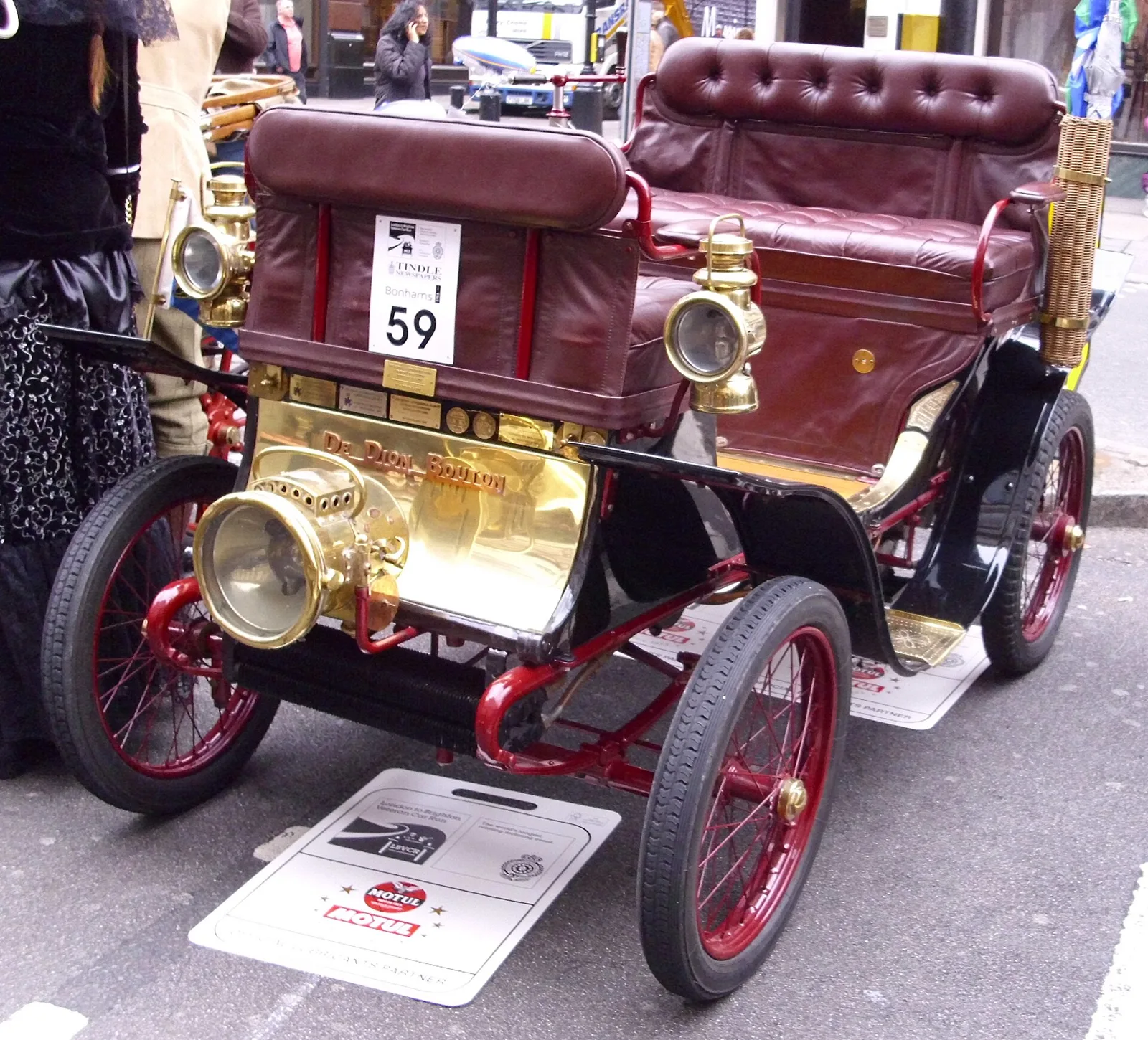
A light French car built from 1898 to 1902, with a steel-tube frame, a De Dion rear axle and a single-cylinder engine regarded as fast-running.
The De Dion-Bouton Vis-a-vis was a light French car built from 1898 to 1902 in several types, D, E, G and L. It used a tubular steel frame, a De Dion rear axle and a single-cylinder engine largely developed by Georges Bouton.
The Vis-a-vis is described as the first car produced in large numbers. Its steel-tube frame, its shaft drive to a De Dion axle and its easy handling made it a pioneer of the light car. The name was never official, yet it stuck, and the survivors are still driven at veteran events.
Where did the Vis-a-vis come from?
The car came out of a firm that had built steam engines, tricycles and quadricycles before it built a car. De Dion-Bouton's own engine, a single-cylinder design largely developed by Georges Bouton, powered the firm's first petrol-driven vehicle, a tricycle shown in 1895.
The company was founded in 1893, but its roots go back to 1882. That year Count Albert de Dion set up a design office with the railway engineer Charles-Armand Trepardoux and the mechanic Georges Bouton. Trepardoux & Cie. worked in Paris and Puteaux from 1882 to 1886, and it did well building steam engines and steam cars.
The firm traded as De Dion, Bouton & Trepardoux until 1893. Its move to internal combustion engines led to a dispute and a parting with Trepardoux. He had developed the De Dion axle around 1885, and it was used on some steam cars. The Vis-a-vis was the first combustion-engined passenger car to use that axle.
Car making came late. Engine production was fully occupied, and the tricycles and quadricycles sold well despite their comparatively high price. The commercial vehicle side, with steam lorries, buses and special vehicles for refuse collection and street cleaning, also made a profit. A small number of very expensive steam cars was more of a blemish than a serious drawback. The company's real aim, an affordable car for wider circles, could not be reached with steam, however.
The first car produced in large numbers, built light and driven through universal-joint shafts.
What did the Voiturette name mean?
Voiturette was the term that Leon Bollee coined around 1895 for his successful 3 PS Tricar, and he had it protected as a model name. It became common language for particularly light automobiles, and from 1902 the Automobile Club de France ran it as an official category at its sporting events.
De Dion-Bouton respected Bollee's naming rights and steered clear of the word for its own cars. Instead its brochures and documents labelled the Vis-a-vis and the Populaire petite voiture, though both count among the best-known members of the class.
The name Vis-a-vis comes from the seating arrangement. Most cars were built that way, but not all of them. The name was not official, but it became established anyway.
In 1895 Bollee's 3.5 PS Voiturette had already shown what a pioneering light car could be. Other makes followed, mostly with engines from Benz, such as the Roger-Benz, or from Daimler. The Daimler-engined cars were especially successful from Panhard & Levassor, which held the French production licence, and from Peugeot.
What engine powered the Vis-a-vis?
The Vis-a-vis used a single-cylinder four-stroke engine that had been patented in 1893. It began at 137 cc (8.4 cu in) and half a PS, grew to 189 cc (11.5 cu in) soon after, and by the Type D reached 402 cc (24.5 cu in) and 3.5 PS (2.6 kW).
The valve layout was a variant of inlet-over-exhaust developed by Bouton. The inlet valve worked on atmospheric pressure, while the exhaust valve was operated mechanically by a gear-driven camshaft. Some parts were made of aluminium to save weight.
Early engines had a small water circuit to cool the removable cylinder head. Series models had a somewhat stronger engine with water cooling, and the first production Voiturette had a coiled-tube radiator and a centrifugal pump.
Speed was what set the engine apart. Its revolutions started at 1,200 to 1,500 per minute, and with a maximum of 1,500 rpm it ran at three times the speed of the Carl Benz engine, which is why it was regarded as fast-running. By the turn of the century it was, by a wide margin, the most successful engine anywhere.
How were the chassis and transmission built?
The Vis-a-vis used a simple, sturdy chassis of welded round steel tubes and a two-speed sliding-key gearbox, with the engine mounted transversely above the rear axle. The drive ran through universal-joint shafts to a De Dion axle.
The gearbox was shifted at first by a handwheel on the steering column. All gear pairs of a gear stayed in mesh, but only the pair of the engaged gear was connected to the shaft. When changing gear, a sliding key released the active wheel and connected another.
At the front, three semi-elliptic leaf springs formed a kind of platform. Two ran lengthwise, with their ends hanging from the downward-bent end of the chassis side member, and the third ran crosswise on a cross member. At the rear, lengthwise quarter-elliptic leaf springs were used.
Wire-spoke wheels measuring 700 x 80 mm were fitted as standard, although other wheels seem to have been available too. The very first models of 1898 and 1899 still lacked the De Dion rear axle. Later improvements brought it in, together with rear suspension.
Which body styles were built?
The Vis-a-vis body, with its removable front bench and wooden structure, was by far the most built. Other versions included the Coupe Docteur or Cab, which was heavier and seated two on the same layout, and the Double Phaeton, which had two rows of seats facing forward.
De Dion-Bouton set up its own body department early on, so that it could control the quality of the cars. The company had a British presence from 1898, and there it usually offered its own bodies. Those suited British tastes and also brought a lower import duty with them.
The front bench could be removed on request and often fitted facing forward or backward. The space under it served as a compartment for tools. The engine bay formed the platform for the driver's seat, which folded forward to give access to the engine. A foot-operated bell served as the warning device.
Very few cars received a closed Coupe Opera body, and a taxi version was derived from it. Tonneau and box-body commercial versions are also mentioned. For the commercial version, the record does not show whether the load bed sat ahead of or behind the driver, or whether it had a roof.
What were the Vis-a-vis model series?
The Vis-a-vis went through a pre-production run, then Types D, E, G and L between 1898 and 1902. Most steps brought a stronger engine, and by the Type L the output was given as 6 PS (4.4 kW).
Pre-production (2 3/4 CV)
Before the market launch, prototypes and a kind of pre-production run were built. They were made over only a few months, from late 1898 into early 1899, and were not freely sold. Outwardly they resembled the later model, but the engine was the current 327 cc (20.0 cu in) unit with a removable water-cooled head and an air-cooled block, producing 2 3/4 PS (2 kW). The rear axle was unsprung, and the carburettor was the surface type developed by Georges Bouton.
Type D (3 1/2 CV)
The Type D was the first model made in proper series production, arriving in the last weeks of 1899. Its new rear axle, with suspension and rear wheel springing, was the main change beside the stronger engine. The first cars carried a pair of brake pedals: one worked the gearbox, the other a metal strap around the differential. The model ended in 1900.
Type E (3 1/2 CV)
Type E followed in 1900 as an improved successor. This was a transitional car: the Type D engine went into the upgraded frame that the Type G would use, which brought a steering wheel, a gear lever and drums on the rear wheels. A few cars wore bodywork by H. J. Mulliner & Co. of England, and the 1900 car carrying the British plate Y 65 is still around.
Type G, G1 and G2 (4 1/2 CV)
The main change in the Type G was a stronger engine. A bore of 84 mm and a stroke of 90 mm gave 499 cc (30.5 cu in), and at 1,800 revolutions it delivered 4.5 PS, enough for 35 km/h (22 mph). Mid-run changes earned the car the informal label G2, and the earlier cars became G1 in the same unofficial way.
Type L (6 CV)
The Type L pushed the engine further, with a 90 mm bore, a 110 mm stroke and 700 cc (42.7 cu in). Its output was given as 6 PS (4.4 kW).
De Dion-Bouton Vis-a-vis specifications
| Specification | Detail |
|---|---|
| Built | 1898 to 1902 |
| Types | D, E, G and L |
| Engine, Type D | Single-cylinder, 3.5 PS (2.6 kW), 402 cc (24.5 cu in) |
| Engine, Type G | 4.5 PS, 499 cc (30.5 cu in), bore 84 mm, stroke 90 mm |
| Engine, Type L | 6 PS (4.4 kW), 700 cc (42.7 cu in), bore 90 mm, stroke 110 mm |
| Top speed, Type G | 35 km/h (22 mph) |
| Gearbox | Two-speed sliding-key |
| Wheels | Wire-spoke, 700 x 80 mm as standard |
| Coupe Docteur weight | 500 kg (1,102 lb), against 300 kg (661 lb) |
| Estimated output | 2,970 examples, according to two further counts |
How many Vis-a-vis cars were built?
No precise figure is available. One count puts the total at more than 1,500 vehicles by April 1901 and says the maker later quoted a rate of 200 units a month. Another puts output at about 100 vehicles a month until April 1901, which extrapolates to roughly 1,500 over 15 to 16 production months.
Two further sources arrive at 2,970 examples. The second count also mentions a forecast by the owner of 200 vehicles a month for the following year.
How was the Vis-a-vis judged at the time?
Automotive historian Eric Favre judged the Vis-a-vis the first modern automobile, citing its light construction, innovative engineering and shaft drive. The British expert Anthony Bird praised its sturdy yet light build and its handling, drawing on his own experience.
Bird also praised the well-thought-out construction, the simple operation and the pleasant driving characteristics and performance, which he was able to judge from personal experience.
What survives of the Vis-a-vis today?
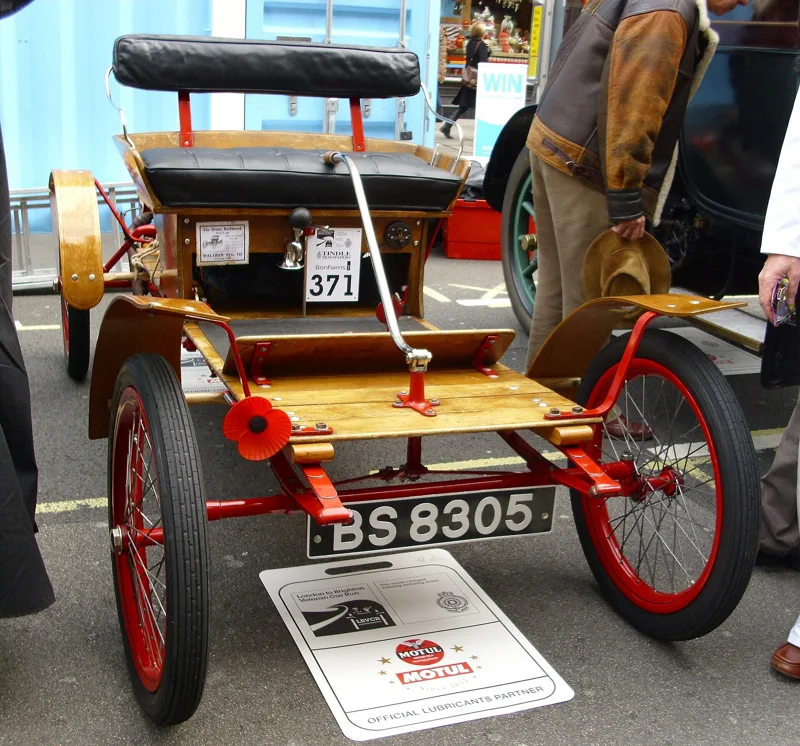
A surprisingly large number of Vis-a-vis cars have survived, most of them with the Vis-a-vis body. Many still run, and a good number join the London to Brighton event that is held each year over the first November weekend.
The marque turns up strongly there, and after the Populaire the Vis-a-vis is its biggest group.
Bonhams took 66,278 euros for a 1901 Type G in 2008, buyer's premium included. On 26 October 2011 RM Auctions sold a Type E for 100,800 pounds.
Collections also hold examples, among them the Musee National de l'Automobile in Mulhouse, where the Schlumpf collection is housed, the Musee de la Vendee and the National Motor Museum at Beaulieu. The Musee Henri Malartre in Rochetaillee-sur-Saone owns one of the rare coupes.