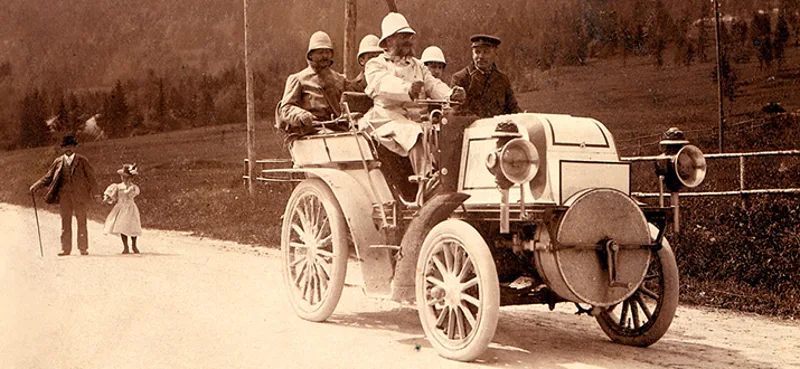
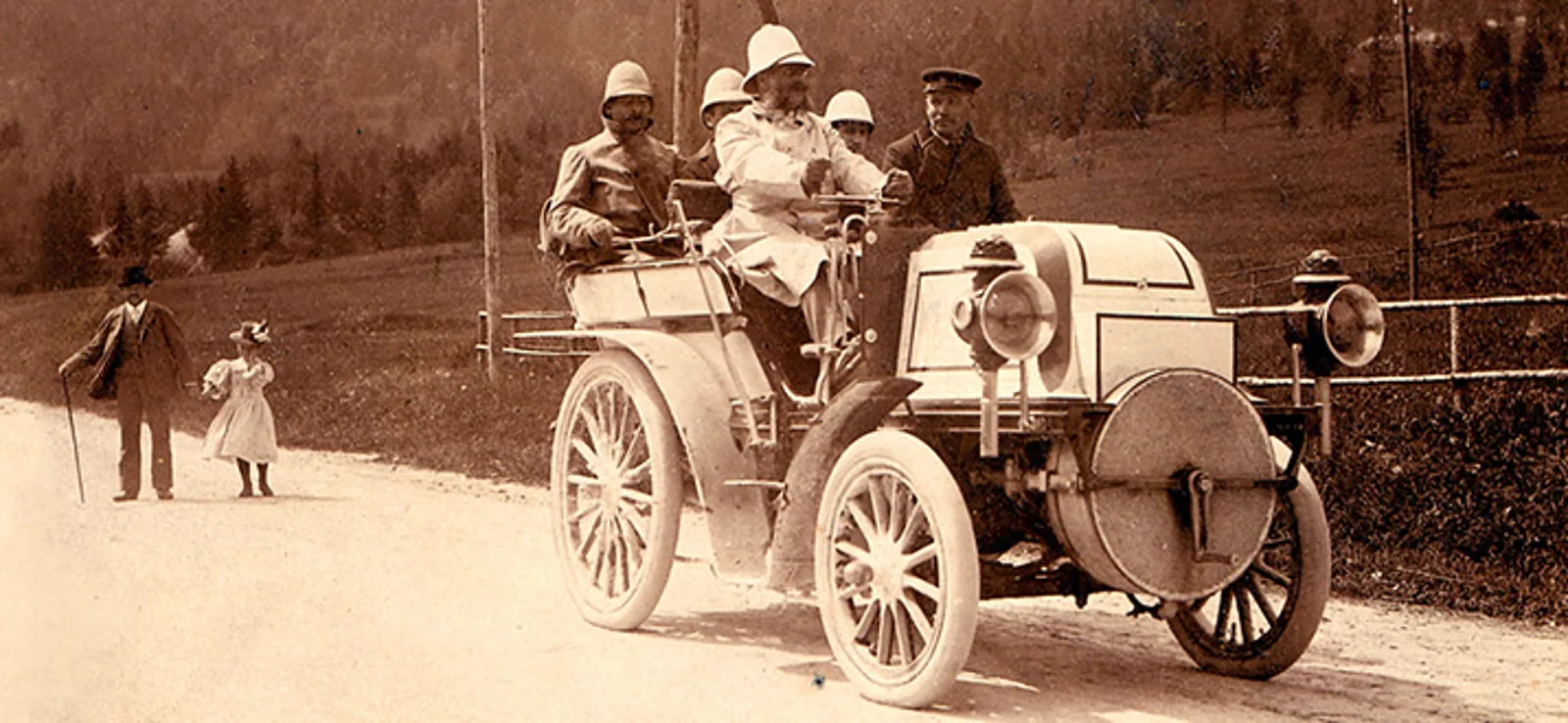
A one-off Daimler of 1907 with four-wheel drive and steering, built for the Colonial Office and driven on long journeys by state secretary Bernhard Dernburg.
Built in 1907 as a single example for the Reich Colonial Office, this Daimler combined four-wheel drive with four-wheel steering. A four-cylinder engine of about 6.8 litres powered it, and it took its name from state secretary Bernhard Dernburg, who used it in German South West Africa in 1908.
The Dernburg-Wagen was a one-off four-wheel-drive Daimler that the Daimler-Motoren-Gesellschaft built in 1907 for the Reich Colonial Office. It had four-wheel steering, sand-proof drive parts and a four-cylinder engine of about 6.8 litres. In 1908 state secretary Bernhard Dernburg covered many kilometres in it, and the car took his name.
Where did the Dernburg-Wagen come from?
The Reich Colonial Office knew what it wanted from Daimler: a dependable vehicle that could cope with bad roads and long distances without complaint. Paul Daimler, son of the company founder, led the design, and the car was finished as a single example at the Berlin-Marienfelde works in 1907.
Four-wheel drive was not new in principle. The Dutch firm Spyker had shown its two-seat racing car, the Spyker 60 HP, in 1903 as the first combustion-engined automobile with four-wheel drive. The Daimler design used a DMG truck chassis, with a wheelbase of four metres and a track of 1.42 metres.
Paul Daimler had already gained experience on the Austro-Daimler armoured car. A ground clearance of 32 centimetres was not unusually large for the time, since most automobiles often had to run on deeply rutted roads.
Four-wheel drive and steering in 1907, tested through sand, hills and colonial service, then lost from the record.
How was the body arranged?
The body was a touring car layout with two places on the driver's bench and four passenger seats behind them. Only the rear passengers had doors. A sunshade on eight posts reached almost to the front, so that the driver would not be dazzled by a low sun.
Steps let passengers climb in from a height of about one metre. A luggage bridge at the rear carried suitcases or spare wheels, and a large roof rack under a cover held more baggage. Canvas blinds below the roof could be lowered to close the sides against wind, weather and sand.
What made the drive system special?
Power went to all four wheels through a permanent four-wheel-drive system. The engine drove a gearbox mounted exactly in the middle of the car, which had four forward gears and a reverse, and propeller shafts carried the drive to bevel-gear differentials at the front and rear axles. The engine itself gave 35 PS at 800 rpm, which gave a top speed of about 40 km/h on level asphalt.
Climbing was where the car stood out. Four-wheel drive gave it a climbing ability of 25 per cent, which mattered far more than top speed on the routes it was built for.
What were the key specifications?
| Item | Specification |
|---|---|
| Length | About 4.90 metres (16.1 ft) |
| Height | A little over 2.70 metres (8.9 ft) including roof |
| Wheelbase | Four metres |
| Track | 1.42 metres |
| Ground clearance | 32 centimetres |
| Weight | About 3.6 tonnes (7.9 thousand lb), with special features |
| Engine | Four-cylinder, about 6.8 litres (415 cu in) |
| Power | 35 PS (26 kW; 34 hp) at 800 rpm |
| Top speed | About 40 km/h (25 mph) on level asphalt |
| Climbing ability | 25 per cent |
| Gearbox | Four forward gears and one reverse, centre-mounted |
| Tyres | Pneumatic, 930 x 125 |
| Coolant | 140 litres |
| Price | 34,750 marks |
How did the drive parts resist sand?
Paul Daimler enclosed the front-axle drive parts in a sturdy cylindrical shell, because the usual telescoping bevel-gear covers in the wheels could not survive the expected jolts and fine blown sand. Grease pressed from inside the joints also pushed sand back out and slowed wear.
The shell restricted steering lock to 23 degrees, so the car received steered rear wheels to achieve an adequate turning circle. The rear axle got the same sand protection, and the two axles shared nearly every component, including differentials, wheels and brakes, which eased the stocking of spare parts.
The wheels were closed sheet-steel discs rather than the spoked wheels common at the time, since spokes would have let sand reach the drive components. A spoked wheel buried in sand was also almost impossible to free without help. Paul Daimler probably chose the 930 x 125 pneumatic tyres to help the robust leaf springs carry the heavy vehicle.
How was the cooling built for the tropics?
The cooling system was designed for a tropical climate, with a larger radiator surface, an enlarged water jacket around the cylinders and about 140 litres of coolant in circulation. A second radiator wrapped around the bulkhead in a horseshoe shape, and the two radiators were linked by side tanks.
Hot water had to pass through every pipe and tank before it flowed back around the cylinders.
How was the car tested in Germany in 1908?
An extensive 1,677-kilometre test took place in Germany at the end of March and start of April 1908, from Berlin-Marienfelde to Stuttgart-Untertuerkheim and back. Part of the route left paved roads to test the four-wheel drive, and an internal Colonial Office report said a turn in deep ploughed land on a gradient of five to ten per cent was carried out flawlessly. The acceptance report was positive.
Near Wittenberg the car sank up to its axles in a sand pit, yet it drove out again on gradients of 20 and 21 per cent. In the Thuringian Forest it climbed a hill about 150 metres high on stony, winding roads with gradients of up to 20 per cent. The steering was sluggish because of the four-wheel drive, but it proved itself.
The car was shipped to Swakopmund in May 1908 on the steamer Kedive and made available to Dernburg in German South West Africa in June. The tours also tested the automobile as a means of transport in the colony. Rear-drive Benz and Daimler vehicles, including a seven-seat, largely armoured Benz and three Daimler trucks, sometimes travelled alongside it.
What did the Dernburg journey cover?
A contemporary travel report describes one stage: 600 kilometres from Keetmanshoop through Berseba and Gibeon, then on through Maltahoehe and Rehoboth to Windhoek, covered in four travelling days without an accident. The same report says an experienced rider on horseback would have needed twelve days for that route.
The state official could also keep in touch. The car carried a field telephone that could be connected to the telegraph line anywhere along the way.
How did the colonial police use it?
After the journey the car served the colonial police in German South West Africa as a permanent vehicle, and a careful logbook was kept. By early 1910 it had covered about 10,000 kilometres, and its tyres suffered badly, with 36 tyres and 27 inner tubes used up over that distance.
Daimler had sent a driver who was also its mechanic, which was normal practice then. Because the car belonged to the police, the driver Paul Ritter was made a policeman. He stayed on after Dernburg left, looked after the vehicle and returned to Marienfelde for spare parts and skills.
Solid rubber tyres were tried and failed, because the force on the rims destroyed them. Four-wheel drive, however, outperformed the rear-drive trucks in deep sand. A lieutenant colonel of the colonial police nonetheless recommended conversion to pure rear-wheel drive, because the four-wheel system was costly to service and repair. The conversion appears to have been carried out, but no exact details survive.
What happened to the car?
No records are known of the Dernburg-Wagen's use during the First World War in South West Africa, and its whereabouts after the end of the German colonial period are unknown. The driver, Paul Ritter, returned to Marienfelde in 1919 and found work again there with the Daimler-Motoren-Gesellschaft.
How was the 2006 model made?
DaimlerChrysler rebuilt the Dernburg-Wagen as a detailed model in 2006 to mark 100 years of four-wheel-drive passenger cars. There were no technical drawings, only six contemporary photographs and five known dimensions: the wheelbase, the track, the lowest ground clearance and the tyre diameter and width.
The model makers worked at a scale of 1:4, producing a result about 1.25 metres long. One puzzle took a while to solve. The wheel centres seemed to sit at a different height from the drive shafts, until they realised that four-wheel drive with four-wheel steering needed a bevel-gear combination on each wheel, which accounted for exactly that difference.
Parts were made anew in small scale, from the chassis and leaf springs to the body, the starting crank and the hood. Maple wood served for most of the work, while the chassis side members are plastic reinforced with aluminium. The specialists even worked out the sun's position from shadows in the old photographs and copied it with a torch.
The paint is medium grey, as for a police vehicle, and the seats are covered in leather shaved to three tenths of a millimetre. The model has no engine. It first appeared at the North American International Auto Show (NAIAS) in Detroit in January 2007.