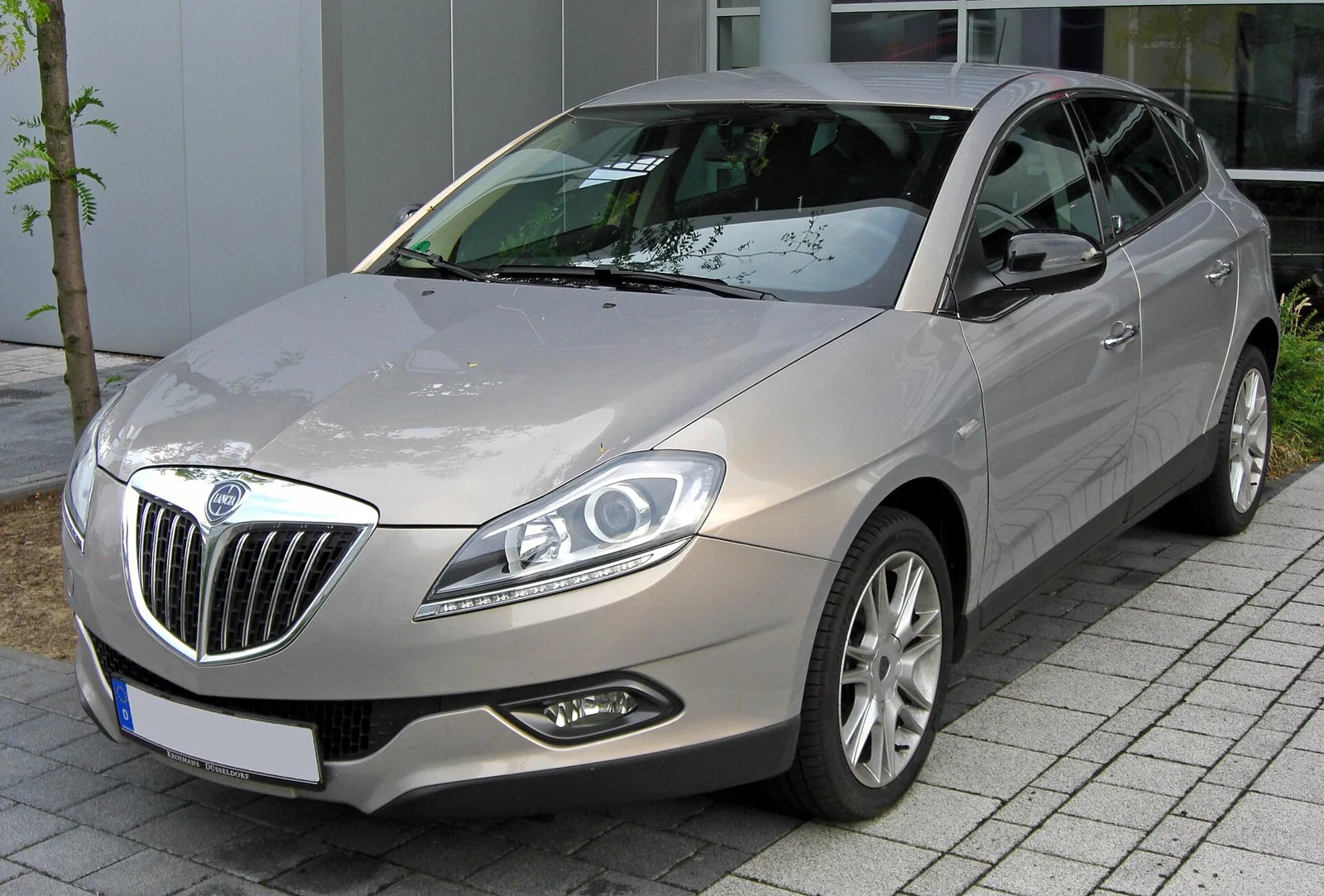
A Bravo-based C-segment saloon that took nine years to arrive, sold an LPG-ready EcoChic and served with the Italian police.
This Lancia, built on a lengthened Bravo platform from 2008 to 2015, came with turbo petrol engines, Multijet diesels and an LPG-capable EcoChic. Its size leaned towards comfort, and some fans of the original car did not accept it as its heir.
The third-generation Lancia Delta was a C-segment saloon built at Cassino from June 2008 to summer 2015 on a lengthened Fiat Bravo platform. It replaced the second-generation Delta, which had left production in 2000, and from September 2011 it was also sold with a Chrysler badge in Ireland and the United Kingdom.
Why did the new Delta take so long to arrive?
Enthusiasts wanted a new Delta before the second series ended in 2000, and the wait stretched for nine years. Even after the project was confirmed, the route to production was long and demoralising for supporters, some of whom were unconvinced by the result.
The project, known as Project 844, was built on a stretched space-frame platform from the Fiat Bravo, which had launched in 2007. The car is a two-volume design, like the first series of the Delta, and it covers the same medium-sized saloon segment.
Assembly happened at Piedimonte San Germano, close to Cassino.
A medium-sized Delta built for comfort, which some fans of the original did not accept as its heir.
Was the new Delta a true heir to the first car?
Some enthusiasts did not accept it as the heir to the first Delta. Its rally pedigree belonged to the first car, and the second series had never been loved as much as the original, partly because of the withdrawal from rally racing.
The new car's size was a central reason. At more than 4.5 metres (14.8 ft) long, with a 2.7 metre (8.9 ft) wheelbase, it leaned towards comfort rather than sportiness. The market had moved towards combining comfort with sporty lines, but buyers still did not link the car to the rally-winning first Delta, although the Delta of '79 was itself a five-door family saloon rather than a rally car.
The name added to the problem. The name Delta seemed too closely tied to a rally champion rather than to a medium-sized family car, and the name was still undecided until the official photos were released in February 2008.
What did the 2003 Stilnovo concept set out?
The Stilnovo concept, shown at the 2003 Barcelona motor show, set the guidelines for the production car. It was designed by the Lancia style centre under Flavio Manzoni, and it had an all-glass roof, a rear window running into the side glass and a rear pillar separated from the roof, as the production car would have.
Its stylistic philosophy was the High Performance Estate (HPE), a famous acronym of the seventies, and the concept recalled the brand's past in many features of the body. An earlier three-volume Granturismo had been shown at Geneva earlier that year, and the Stilnovo was built with an outside design studio and coachbuilder.
A structural arch made the glasshouse look suspended, like a suspension bridge, paying tribute to Pier Luigi Nervi and Santiago Calatrava. Its length was 4,236 mm (166.8 in), its width 1,828 mm (72.0 in) and its height 1,465 mm (57.7 in), so it was far more compact than the production model.
Unlike the production car, the Stilnovo was a hybrid between a saloon and a sporty coupe. It had three doors and a very compact profile, and its taut, flowing lines were carried into the production car.
Delta HPE prototype (2006)
On 5 September 2006 Lancia officially announced the Delta HPE prototype in a press release. It was first shown at the 63rd Venice International Film Festival and then presented to the public at the Paris motor show that same year.
The prototype was an almost finished model of the new Delta and a direct evolution of the Stilnovo. It took its HPE idea from the Lancia Beta HPE, though that car had three doors, and it aimed for dynamism combined with great habitability in a slender, elegant line. It was meant to sit between the compact two-volume Delta of the first series and the three-volume Lancia Beta, and it would later replace the Lancia Lybra.
Lancia Delta key specifications
| Item | Detail |
|---|---|
| Engine (1.6 Multijet Platino) | 1,598 cc (97.5 cu in), 120 PS (88 kW; 118 hp) at 4,000 rpm |
| Compression ratio | 16.5:1, bore and stroke 79.5 x 80.5 mm |
| Front brake discs | Ventilated, 284 mm |
| Rear brake discs | 251 mm |
| Standard wheels | 7x17 alloys with 225/45 R17 tyres |
| EcoChic economy | 8.3 l/100 km (34.0 mpg-imp; 28.3 mpg-US) average |
| EcoChic range | 1,413 km declared |
| EcoChic performance | 0 to 100 km/h in 9.8 seconds, 195 km/h (121 mph) top speed |
| Transmission | Six-speed manual, front-wheel drive |
What did the styling bring?
The Delta was meant to set the stylistic direction for the whole Lancia range, so styling was given great weight. The front has a large curved chrome shield and a prominent air intake that wraps the fog lights, while taut lines reduce the car's visual bulk.
The window line runs along the flanks and joins the rear window directly, so the trapezoidal rear pillar does not touch the roof's load-bearing line. Much of the roof is glazed.
The interior was not shown in the prototype, and in the production car it largely recalled the related Bravo, though the materials and finish were revised. Benova and Alcantara materials, or leather, were used. The dashboard, steering wheel and light area were redrawn by the Lancia style centre.
What safety and handling technology came with it?
Torque Transfer Control unloaded torque from the front axle, while ESP with Drive Steering Torque actively controlled oversteer. Above 0.6 g (5.88 m/s2) of lateral acceleration, the steering stiffened automatically, and six airbags were standard across the range.
An optional Reactive Suspension System, a commercial name for Synaptic Damping Control, varied damping through fast proportional valves inside the shock absorber. It acted in cornering, braking, acceleration, understeer and oversteer, and in vertical accelerations, to improve comfort and dynamics together.
The front axle used MacPherson struts with coil springs and an anti-roll bar, while the rear was a torsion-beam axle with interconnected wheels. The steering was rack-and-pinion with dual-drive electric power assistance, and the braking was a dual-circuit hydraulic system with ABS and EBV.
Which engines were offered?
The petrol engines were all turbocharged. The 1.4 T-Jet met Euro 4 rules. The 1.8 T-Jet, introduced from March 2009 with high-precision direct injection, met Euro 5 and was paired with the six-speed sequential Sportronic automatic.
The diesel engines were homologated to Euro 5 from March 2009. The 1.6 came with a six-speed manual or an automated-manual gearbox, the Dualogic renamed Selectronic, while the 1.9 biturbo and 2.0 Multijet were offered only with a six-speed manual. A particulate filter was standard on all engines.
How did the EcoChic version work?
The EcoChic ran on petrol and LPG, and its 1.4 turbo engine was reworked in the head and valves for gas use. It had a declared range of 1,413 km, and it managed 8.3 l/100 km (34.0 mpg-imp; 28.3 mpg-US) on average. Its 0 to 100 km/h time was 9.8 seconds, and its top speed was 195 km/h (121 mph).
The LPG system was designed by an outside supplier and installed by Lancia, which allowed the factory to homologate it. Emissions were 134 grams of CO2 per kilometre on LPG and 149 grams on petrol.
Which trim levels were sold in Italy?
Italy's Delta came in four versions: the Argento as entry level, the Oro as the intermediate version, the Platino as the slightly sportier choice with alloy wheels as standard, and the Executive, introduced in 2009 as the most luxurious. LPG-powered EcoChic versions were available alongside them.
In 2010 Lancia began building the HardBlack, which used the 1.8 Di Turbo petrol and the 1.9 twinturbo diesel, the two most powerful engines in the range. It had a dedicated bodywork finish and 18-inch alloy wheels, and its black Pelle and Alcantara Starlite seats were standard, although beige seats were also offered, without the special Alcantara covering.
Why was there a Chrysler-badged Delta?
After the partial takeover of Chrysler by the Fiat Group, the Delta was shown at the 2010 Detroit motor show with the Chrysler badge. It was really a pilot project to test the American market, which was by then looking to European trends, and the company issued no press release, so the car was never formally presented.
The Chrysler Delta stayed Italian-built and was sold from 2011 to 2014 in England and Ireland, with minimal styling changes. The Lancia shield was replaced by the new Chrysler badge, presented by Sergio Marchionne, on the grille, rear window, wheels and steering wheel. The grille took horizontal slats, the style of Chrysler cars, while keeping the original Lancia shape.
What changed in the 2012 and 2014 model years?
The 2012 model year brought a small restyling shown at the 2011 Geneva show, with a new entry 1.6 M-Jet 105 PS engine, a new grille with horizontal slats and a protruding descending logo. The trim packs were reorganised, and an S by MOMOdesign trim followed from early 2013.
The 2014 model year was shown at the 2013 Frankfurt motor show with a second, smaller restyling. The bumpers and side skirts were now painted in body colour, and chrome double exhaust tailpipes and chrome details made their debut.
Why did production end in 2015?
Production ended in summer 2015, a year after the Fiat Bravo, mainly because of its low sales volume, seven years after the car's debut. It also fitted a strategy to revive the Cassino plant by dismantling lines for older, less profitable models ahead of the new Alfa Romeo Giulia.
Some foreign markets kept Delta models on Lancia price lists until 2015, in order to clear unsold stock.
Where did the Delta serve the Italian police?
The Delta was used by Italian police from its debut, by the State Police and the Penitentiary Police, for patrols, rapid response, escort duties and plain-clothes work. In 2014 the State Police received 198 new cars with the 1.6 MultiJet turbodiesel of 105 PS (77 kW; 104 hp).
The latest police livery had a white band with a small tricolour along the whole side of the car, and the Lancia shield on the front. At the rear, the side pillar carried a new logo of the number 113 alongside the word Polizia, set in a new typeface.
How was the Delta sold in advertising and film?
Richard Gere is the star of the launch advert, which follows him from Hollywood to Tibet, where he leaves handprints in the snow beside young monks. It was filmed partly on Hollywood Boulevard in Los Angeles and partly in the Rocky Mountains, where a small Tibetan village was rebuilt.
Ennio Morricone was among the masters who provided music for the spot, and the company said its message was one of peace, stressing human values rather than the car's technical ones. The Chinese state protested, and the Fiat Group apologised.
Lancia also supplied the Delta driven by the characters in the film Angels and Demons, directed by Ron Howard. Howard made a promotional spot from the film's Delta sequences, which also launched the 1.8 Turbo engine of 200 PS (147 kW; 197 hp) and promoted the film, then being released in cinemas around the world.