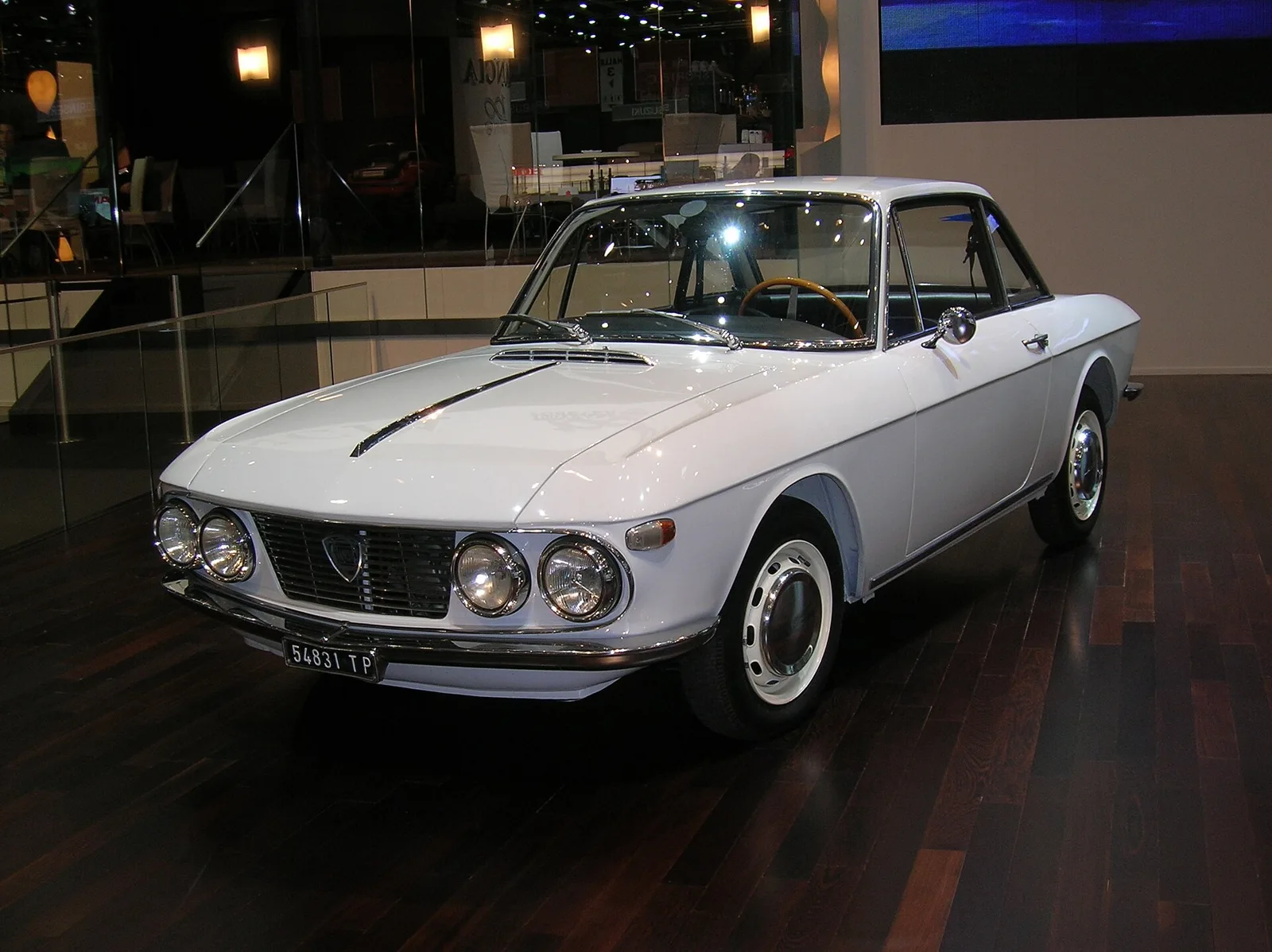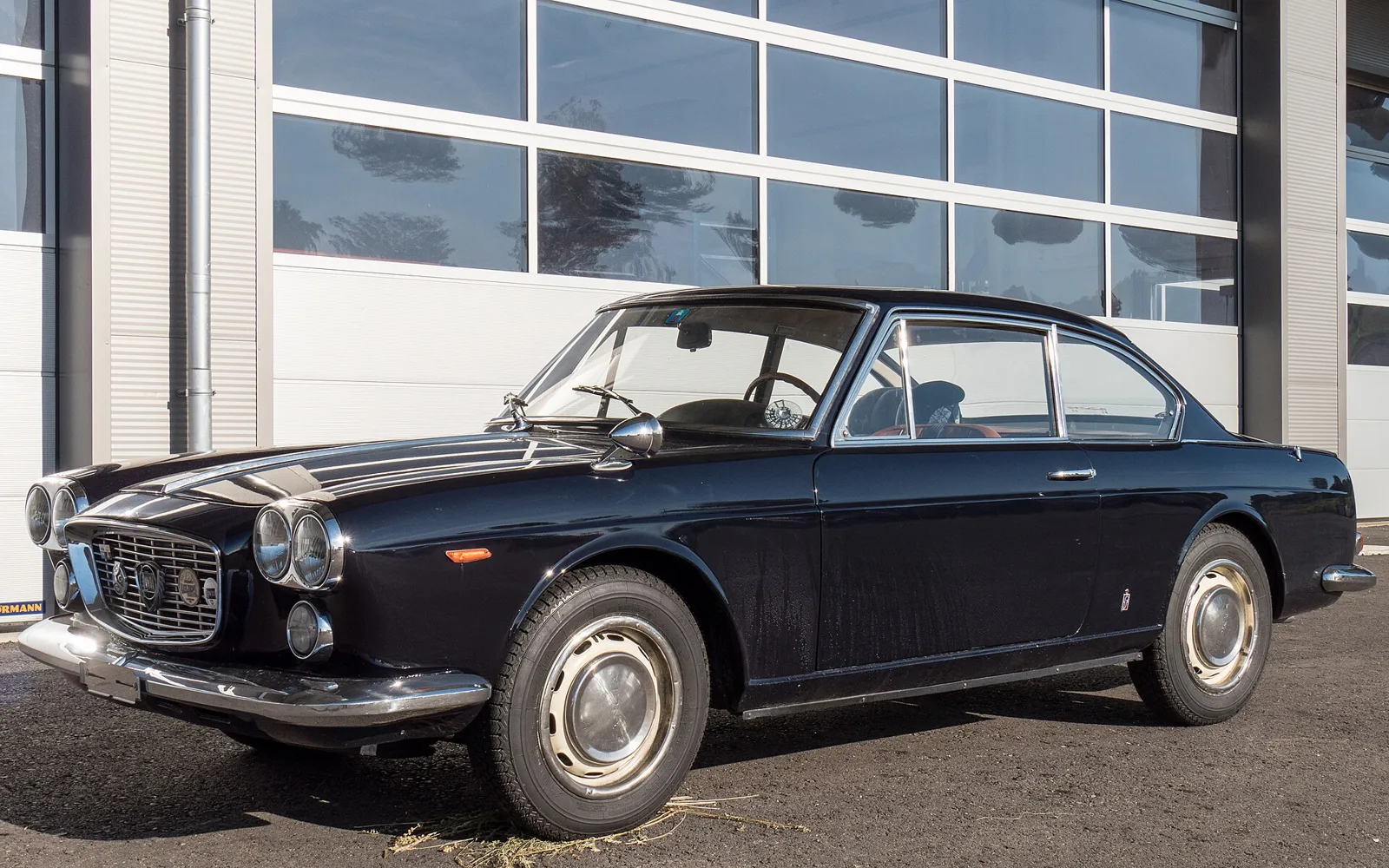
A 1960 front-wheel-drive saloon with disc brakes all round, a Giugiaro-styled Delta saloon with a three-differential four-wheel-drive system and a compact executive car that sold best at home.
The Lancia Flavia was a front-wheel-drive executive car with a boxer engine, built from 1961 to 1971. The Prisma was the saloon version of the first Delta, sold from 1983 to 1989. The Dedra, from 1989 to 1999, was a compact executive car that replaced the Prisma and was built on a Fiat platform.
Lancia's Flavia of 1960 was the first Italian production car with a boxer engine and the first with disc brakes on all four wheels, and it drove its front wheels. Less than thirty years later, the Dedra sat on a Fiat floorpan shared with a Fiat and an Alfa Romeo. The Flavia, Prisma and Dedra mark the stretch of Lancia history between those two points.
What was the Lancia Flavia?
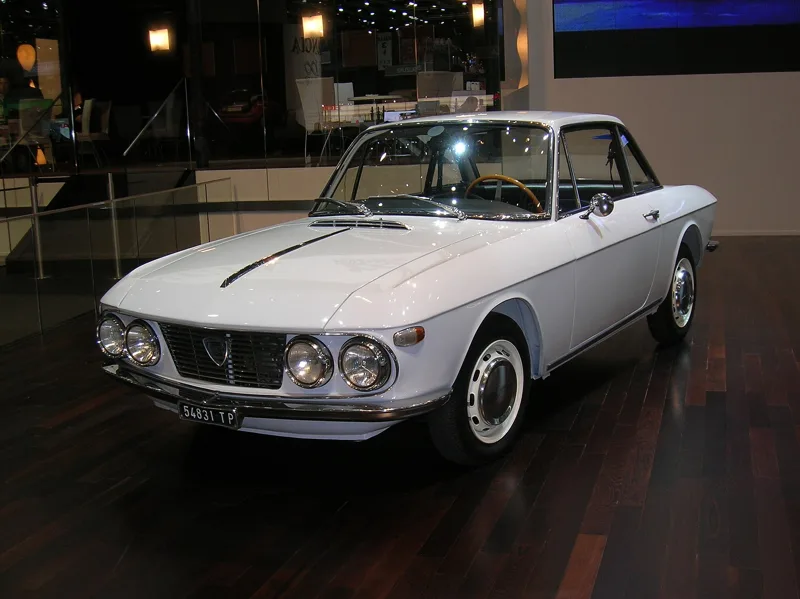
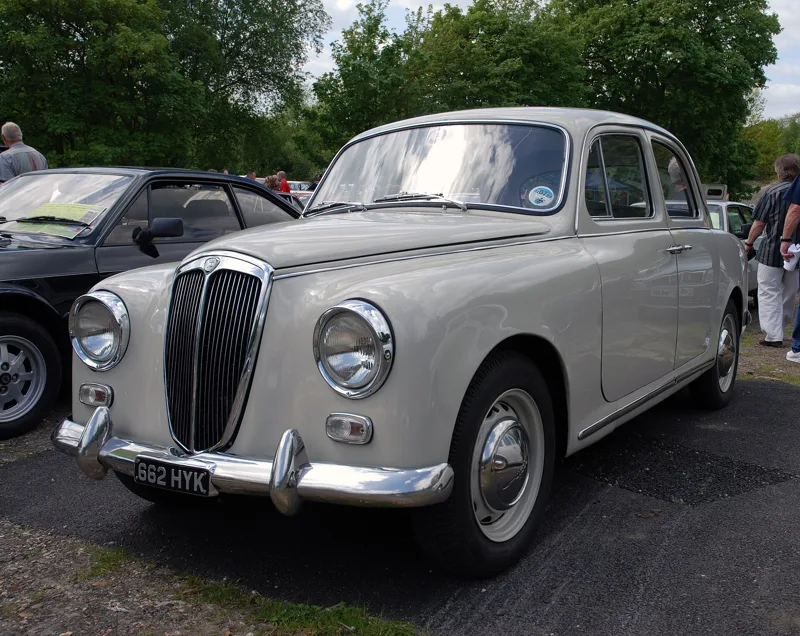
The Flavia (Tipo 815, 819 and 820) was an executive car built by Lancia from 1961 to 1971. It debuted at the 1960 Turin Motor Show with a 1,500 cc engine and reached the major European markets over the following twelve months. Coupe and convertible bodies soon followed.
The name refers to the Via Flavia, a Roman road that ran from Trieste, then Tergeste, to Dalmatia. Antonio Fessia developed the car in the late 1950s on the orders of Carlo Pesenti, who owned Lancia at the time. Its job was to fill the gap between the Appia and the Flaminia.
At first only a four-door saloon was offered. Its 1.5-litre engine was an aluminium boxer, the first in an Italian production car, and Dunlop discs stopped all four wheels. Front suspension used unequal-length wishbones. Fessia chose front-wheel drive so that 62 per cent of the weight sat over the front axle, which improved traction.
The Dedra shared one Fiat floorpan with the Tempra and the Alfa Romeo 155.
How did the Lancia Flavia coupe, convertible and Zagato versions differ?
Pininfarina designed a two-door coupe on a shortened platform, Vignale turned out 1,601 two-door convertibles and Zagato produced a lightweight sport model. Only 626 Zagato cars were built, along with three prototypes. Ninety-eight carried the 1500 engine, while 512 got the larger 1800.
The sport engine used twin carburettors for just over 100 CV (99 hp; 74 kW), but it had a reputation for being very hard to keep in tune. Zagato's lightweight body looked outlandish.
Two further variations never reached series production. The Flavia Super Sport of 1967 started from a shortened Sport Zagato chassis, with a body by Ercole Spada designed for efficiency and speed and the 1,800 flat-four. A second, bright yellow prototype with the 1,991 cc engine appeared at the 1968 Turin Motor Show, but Lancia's worsening finances ended the project.
The Sinthesis 2000 Berlinetta of 1970 was a one-off coupe. Peter Giacobbi did the engineering and Tom Tjaarda the styling, and they saw it as a more refined grand tourer. It used Flavia running gear and a Nardi-modified engine giving 130 PS (128 hp; 96 kW) at 5,000 rpm. Road tests suggested a top speed above 200 km/h (124 mph).
What went wrong with the Flavia engine?
The aluminium boxer had weak points. Even the single-carburettor engine suffered from timing chain stretch, so the sprockets carried adjusters to take up chain wear, and owners were supposed to have the cam timing checked every 9,700 km (6,000 miles). Early cars also suffered corrosion in the cylinder heads, caused by copper gaskets on aluminium heads.
Despite that, the car had good performance for its size. Lancia went on to enlarge the engine to 1.8 litres, offer mechanical injection from Kugelfischer and add a five-speed manual gearbox.
What changed with the Flavia Series II and the Lancia 2000?
In May 1967 a rebodied Berlina with a new interior, model 819 and usually called the Series II, went on sale. The Vignale and Zagato cars were dropped and the coupe took a break, returning at the Geneva Motor Show in March 1969 with new bodywork. Engines in 1969 changed from a 74 mm stroke to 80 mm, becoming narrow-bore relatives of the new 2-litre 820 unit.
The 2.0-litre engine could be had with carburettors or injection, and with four or five speeds, but only in the revised bodies. When Fiat took over Lancia in 1971, the Flavia badge was retired along with the smaller engines, which left just the 2000 Berlina and coupe.
The revised car became the Lancia 2000 in 1971. It had Girling disc brakes instead of the Dunlops on the Flavia 2000, bumpers in stainless steel and, on injected cars, Bosch D-Jetronic fuel injection. It was built until 1973 or 1974, although new cars stayed in stock until 1975, and came only as a Pininfarina coupe or a Lancia sedan.
The Flavia name did not die. Lancia revived it when Fiat said in 2011 that, from early 2012, the Chrysler 200 convertible would reach left-hand-drive European markets wearing Lancia badges and the Flavia name.
How fast was the Lancia Flavia, and what did testers think?
Road testers rated it smooth and rather quicker than it felt. Autocar called its performance pleasingly deceptive. The three published tests below show how the car developed from the 1500 to the 1800.
| Test | Model | Top speed | 0-97 km/h (60 mph) |
|---|---|---|---|
| Motor, 1961 | 1500 | 149.0 km/h (92.6 mph) | 18.6 seconds |
| Car and Driver, 1964 | 1800 Coupe, four-speed | 169 km/h (105 mph) | 14.2 seconds |
| Autocar, 1967 | 1800 four-door | 166 km/h (103 mph) | 15.0 seconds |
Motor recorded 9.4 L/100 km (30.0 mpg imperial) on a touring run in the 1500, and the car cost GBP 1,499 including taxes of GBP 688. Autocar measured the same consumption in 1967, and placed the Flavia behind the BMW 1800 TI for performance but slightly ahead on economy. The testers praised the engine's smoothness but found it short of low-speed punch.
The price gap told its own story. The Flavia's recommended retail price had risen to GBP 1,909, against GBP 1,498 for the BMW and just GBP 1,008 for the mechanically simpler Ford Corsair 2000E, and in a Britain protected by tariffs those figures suggest sales volume was not a Lancia priority.
Car and Driver compared the 1800 Coupe with the Flaminia 3C GT in April 1964. It found the engine a little fussy above 5,000 rpm, so that a driver kept trying to shift into a fifth gear that was not there. Reviewers liked the comfortable cruising, the handling and the polish of the front-drive system, and said plenty of drivers could cover long distances without suspecting that the front wheels did the pulling.
What was the Lancia Prisma?
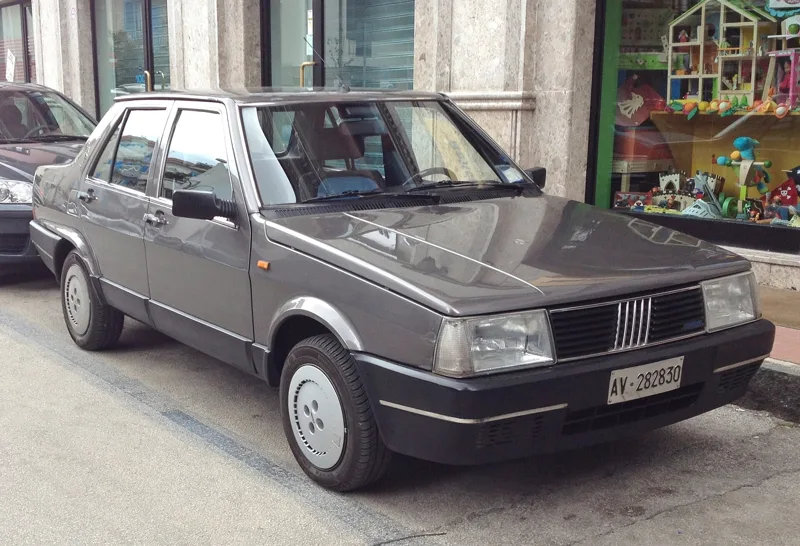
The Prisma (Tipo 831) was a small family car that Lancia built from 1983 to 1989. It was the saloon version of the first-generation Delta hatchback, and like the Delta it came from Giorgetto Giugiaro. A 4x4 integrale version also existed, though its engine had no turbocharger and its open rear differential had a driver-operated lock.
Giugiaro turned the Delta into a saloon between 1979 and 1980. The two cars share a platform with a 2475 mm wheelbase, plus drivetrains, doors and windscreen. The Prisma proved popular almost at once: at 250 a day, cumulative production reached 100,000 in 1984.
Underneath, the Prisma has a steel unibody, seats five and has four doors. The engine sits across the car, joined to the transaxle, and the suspension is independent at all four corners: MacPherson struts, offset telescopic dampers, coil springs and anti-roll bars at both ends.
How did the first Lancia Prisma range work?
The Prisma launched in late December 1982, reached Italian showrooms in early January 1983 and made its European debut at that year's Geneva Motor Show. The first range had five models, mirroring the freshly revised 1982 Delta.
The Prisma 1300 had a 1301 cc engine with 78 PS and a five-speed gearbox. The 1500 used a 1498 cc engine with 85 PS and the same gearbox, or Lancia's own three-speed automatic built at Verrone. At the top, the 1600 borrowed the Delta 1600 GT's twin-cam engine of 1585 cc and 105 PS, which had Marelli Digiplex ignition. It also had four disc brakes, a five-speed gearbox with its own ratios, and wider wheels with lower-profile tyres. It also had the richest equipment, including chequerboard wool upholstery designed by Zegna.
June 1984 brought Lancia's first modern diesel passenger car, a step Lancia had to take, since diesels accounted for over a third of Italian sales in the class. The 1929 cc four-cylinder had an iron block, an aluminium head and indirect injection, and it produced 65 PS. Fiat had developed the engine, which also went into the Fiat Regata DS, but Lancia added measures to reduce noise and vibration. It weighed only 11 kg (24 lb) more than the 1.6-litre petrol engine, and all diesel Prismas had a slightly domed bonnet to clear the taller engine.
A turbo diesel followed in May 1985. The 1.9-litre engine gained a KKK turbocharger with a wastegate, an intercooler and an oil cooler, and it was paired with the ZF five-speed gearbox from the Delta HF turbo. Output was 80 PS, with 172 N.m (17.5 kg.m) of torque. The car took the 1600's discs, wheels and tyres, and standard power steering.
What changed in the second-series Prisma?
A major refresh arrived at the Turin Motor Show in April 1986. Outside there were more modern, wrap-around bumpers, with the front one ready for fog lights, and a redesigned grille and bonnet that looked like those of the flagship Thema. Inside came new seats, new instruments and a new air conditioning system.
The new Prisma 1.6 i.e. used the 1585 cc twin-cam engine with Weber-Marelli IAW electronic ignition and fuel injection, giving 108 PS. Compared with the carburetted 1600, which stayed on as the 1.6, the cylinder head had been turned through 180 degrees to put the exhaust at the front for better cooling, and the engine leaned forward 18 degrees to lower the centre of gravity. The 1.6 i.e. could easily reach more than 200 km/h. A 90 PS 1.6 i.e. with SPI intake and a catalytic converter sat alongside it.
The other arrival was the Prisma 4WD, with a two-litre fuel-injected engine taken from the Thema: 1995 cc, twin-cam, eight-valve, with two counter-rotating balance shafts and IAW injection. It made 115 PS (85 kW) and 163 N.m (120 lbf ft). The 1.6's four disc brakes, power steering and 185/60 low-profile tyres on 14-inch eight-spoke alloys finished the package. A 4WD script on the grille and skirts set it apart outside, and inside it had the Delta HF 4WD's panel, with six round gauges and yellow scales.
In June 1987 the 4WD became the Prisma integrale. It gained optional two-tone paint, a matching Alcantara interior and a price cut of 10 percent in the home market. The last addition was the eighth model, the upmarket Prisma 1.5 LX, in March 1988, with metallic paint and a checked cloth interior. In all, 386,697 Prismas were built. The Dedra was unveiled in early 1989 with sales starting in May, and Prisma production ended that year.
How does the Prisma four-wheel-drive system work?
Lancia's permanent four-wheel drive used three differentials. Think of the centre one as a fixed see-saw that hands out engine torque in the same proportion every time: 56 per cent to the front axle and 44 per cent to the rear on the Prisma 4WD.
That centre unit was an epicyclic gear train. The gearbox output shaft turned the ring gear. Torque left by two routes: the sun gear passed it to the open front differential, and the planet carrier passed it on through bevel gears and a drive shaft in three pieces to the rear differential. To keep the axles from slipping too far against each other, a Ferguson coupling governed the centre unit. The epicyclic gears, the coupling and the front differential sat together in one transverse unit just behind the engine.
Where the Delta HF 4WD had a complex Torsen rear differential, the Prisma had a plain open one with a differential lock, useful at low speeds on slippery surfaces and switched on by the driver from the dashboard. The difference reflected the goals of the two cars: the Delta HF was made for sport driving, the Prisma for safe driving in all conditions.
The single-overhead-cam engines were Fiat Ritmo units that Lancia reworked, adding a Weber twin-choke carburettor, a different inlet manifold, exhaust and ignition. Lancia cast its own aluminium heads and built its own injection systems for them.
What was the Lancia Dedra?
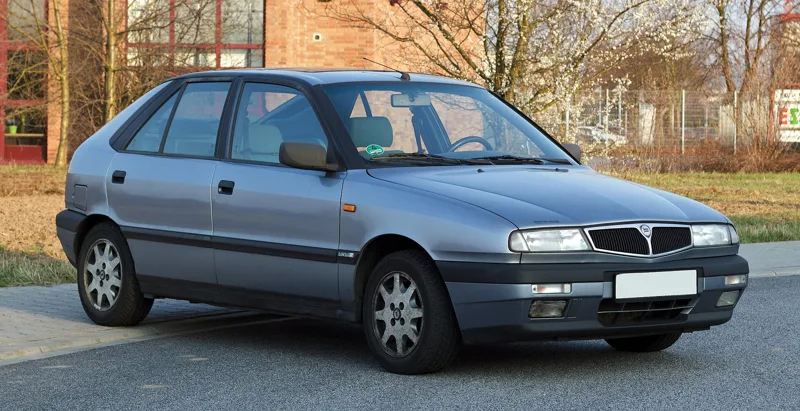
The Dedra (Type 835) was a compact executive car built from 1989 to 1999. Lancia designed it to support the Prisma, which was struggling to stay competitive six years after its launch, and it went on to replace it. It is often considered a saloon version of the Delta.
The Dedra was larger than the Prisma and ranked as Lancia's second flagship, for buyers wanting an elegant medium-sized saloon who did not want an executive car such as the Thema. It was built on the Fiat Tipo Tre platform.
The styling came from Ercole Spada at the I.DE.A Institute, and it delivered an excellent drag coefficient of only 0.29. The idea was prestige, exclusivity, personality and comfort, delivered through lavish equipment and materials such as Alcantara, plus configurable colours, alloy wheels and careful soundproofing and ventilation. Adjustable seats, steering wheel and electric mirrors helped drivers find the right position, and ABS and an airbag were part of the safety plan.
To give the Fiat Group economies of scale, one floorpan served three cars with different themes: elegance in the Dedra of 1989, practicality at a competitive price in the large-boot Fiat Tempra of 1990, and sportiness in the Alfa Romeo 155 of 1992.
What is the Lancia Dedra Integrale?
The Dedra Integrale arrived in 1991 as the performance model. It used an engine and transmission similar to the Delta Integrale 8v: a fuel-injected 2-litre twin-cam four. Balancing shafts spun in opposite directions, and a Garrett T3 turbocharger fed through an intercooler. In catalysed form it made 169 PS (167 hp; 124 kW).
The Integrale also had the new Visco Drive 2000 traction control, and electronically controlled suspension was an option across the 2.0 and upper models. Equipment was close to that of the Dedra LX, but the seats gave more support and the steering wheel was sportier. The car stayed biased to the front, which took 56 percent of the power, and a rear spoiler was standard.
A front-wheel-drive Dedra 2000 turbo arrived at the same time, with a little less power so as not to overwhelm the chassis. It needed Visco Drive 2000 to avoid wheelspin, was lighter and sat somewhat lower, and the Integrale's spoiler was an option on it.
The front-drive 2.0 Turbo made 165 PS (163 hp; 121 kW) in the 1992 range. After the 1994 facelift the 2.0 16V and 2.0 16V Integrale both made 139 PS (137 hp; 102 kW), and the turbocharged HF versions gave way to atmospheric 16-valve engines, with the facelifted Integrale on the 2.0 16V engine arriving in January 1997.
How did the Lancia Dedra sell?
The timing looked good for Lancia. A year before, the Thema had been facelifted and was still selling well, the Delta was enjoying a second youth because of rally success, and the Y10 had been lightly restyled and sold well. Even so, the Dedra never became a big seller beyond Italy.
A big facelift in 1993 brought little improvement, and the following year Lancia pulled its entire range, the Dedra included, out of right-hand-drive markets. From 1994 a station wagon built by the French coachbuilder Heuliez joined the range. The Dedra stayed reasonably popular in Italy until the all-new Lybra replaced it in 1999. In total, 418,150 saloons and 44,488 station wagons were built.
Judgement of the Dedra has been harsh in some quarters. Top Gear put it on its October 2013 list of the 13 worst cars of the previous 20 years, chiefly as an illustration of how Lancia's spirit faded once Fiat took over. One more footnote: in 1992 IAD Studio showed the Magia, a four-seat, wedge-shaped orange coupe on a Dedra Integrale rolling chassis, designed by Michael Ani and Chris Garfield.