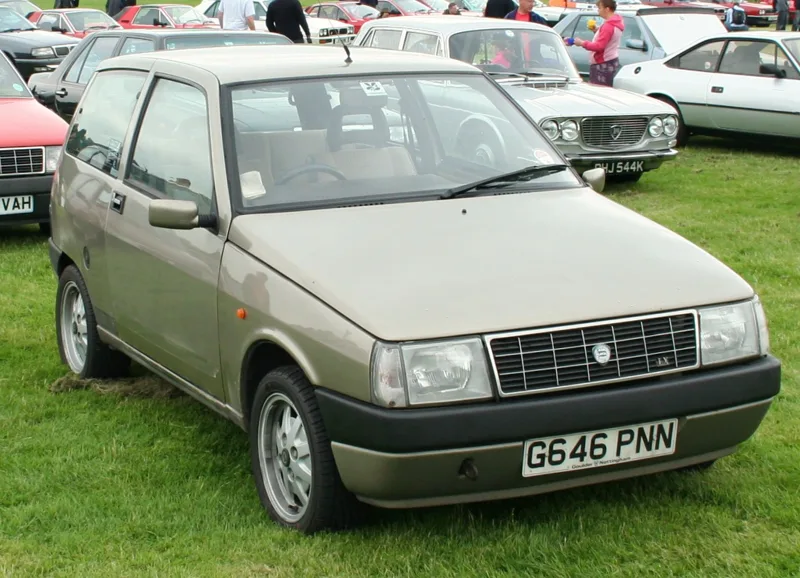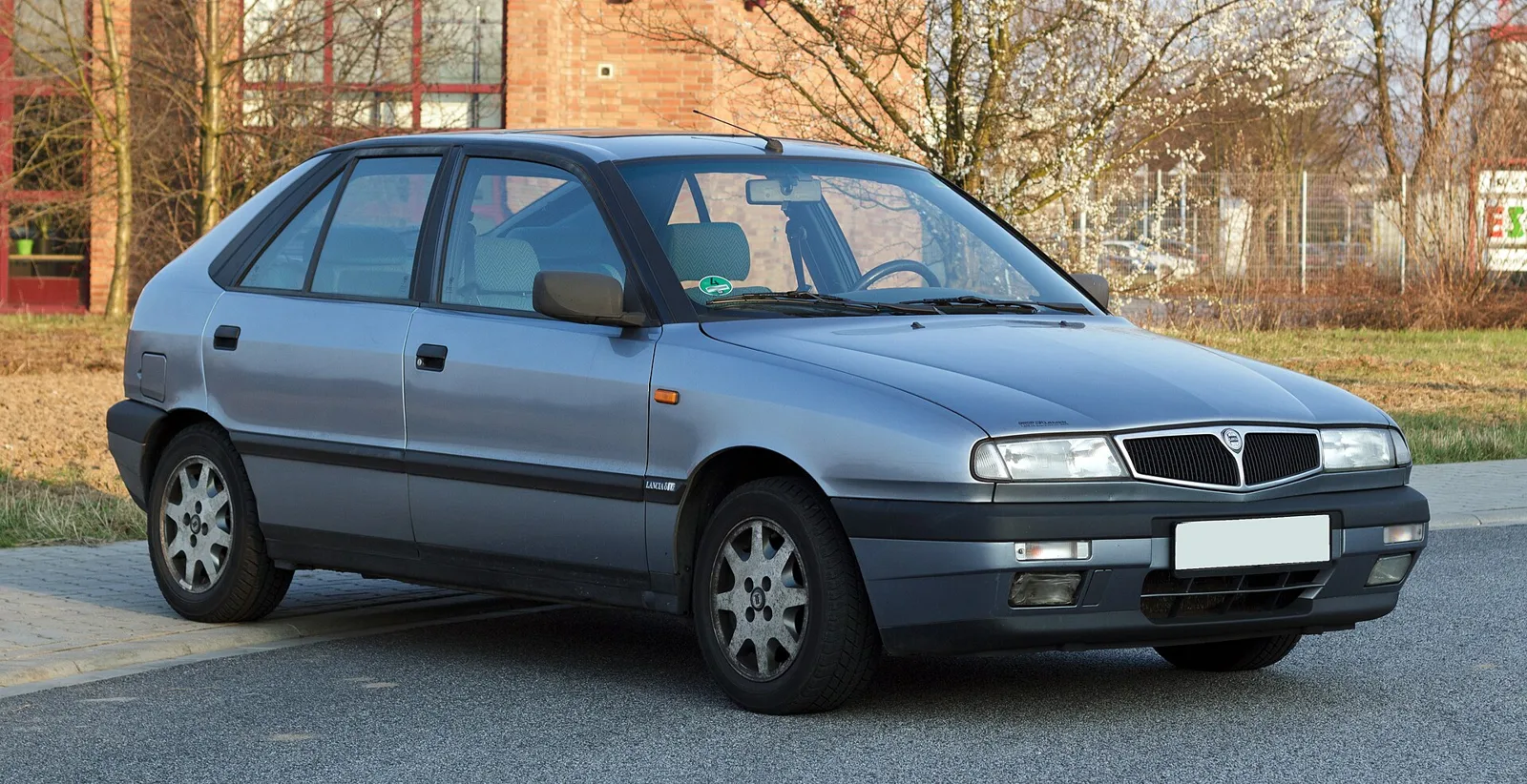
Lancia's second Delta, a Fiat Tipo Due hatchback built from 1993 to 1999 with a turbo HF range and a three-door HPE.
The Lancia Delta 836, also called the Nuova Delta, was a three- and five-door compact produced from 1993 to 1999. Built on Fiat's Tipo Due platform, it replaced the first Delta and offered petrol engines up to 142 kW (193 PS; 190 hp).
Lancia's second Delta, the 836, was a three- and five-door hatchback built from 1993 to 1999. It rode on Fiat's Tipo Due platform, and its petrol engines ran from 1.4 litres up to 142 kW (193 PS; 190 hp) in the HF, the model that gave the range its performance credentials.
Where did the Delta 836 come from?
The Delta 836 replaced the first Delta, introduced in 1979 and very successful in motorsport. It was a Fiat Tipo Due car, its development took four and a half years, and it debuted in spring 1993 as a hatchback for the Lancia range.
Lancia had belonged to Fiat since 1969. The first Delta, the Tipo 831, arrived in 1979 with Fiat Ritmo technology and an angular body by Giorgio Giugiaro. A notchback Prisma followed three years later, using comparable technology.
Fiat introduced the Tipo Due platform in 1988, under the decisive responsibility of the manager Vittorio Ghidella. Over the following decade it became the basis of almost every compact model in the group. The first derivative was the five-door Fiat Tipo, and the second was the Lancia Dedra notchback, presented in 1989 to replace the Prisma.
Lancia did not add a hatchback on the same platform straight away. The original Delta stayed on sale until 1993, and in a few special versions until 1994, and it kept selling well thanks to the publicity from the rally wins of the Integrale and its variants.
Work on the second Delta began in 1988, by which time the four-door Dedra was already ready for production. The longer development period meant the new car arrived with safety equipment that the older Fiat Tipo had gained only later.
A Fiat Tipo Due hatchback whose turbocharged HF gave the Delta range its performance credentials.
What did the Delta's engines deliver?
The Delta used four-cylinder engines from the Fiat range, mostly petrol units with electronic fuel injection. Outputs ran from 55 kW (75 PS; 74 hp) on the small engines to 142 kW (193 PS; 190 hp) on the 2.0-litre HF, with a 1.9-litre turbodiesel added in the second year.
The base engines were two derivatives of the Fiat 128 SOHC unit, in 1.4 and 1.6 litres (85.4 and 97.6 cu in). The 1.4 was offered briefly in selected markets because of local tax rules, and it was never sold in Germany. Elsewhere the 1.6 was the entry engine, available with eight or 16 valves and rated between 55 kW (75 PS; 74 hp) and 76 kW (103 PS; 102 hp).
The middle engine was a 1.8-litre (109.8 cu in) unit from Fiat's Pratola Serra design. It produced 66 kW (90 PS; 89 hp) to 96 kW (131 PS; 129 hp), and at least at first it came with either eight or 16 valves.
The top models used 2.0-litre (122.0 cu in) versions of the Fiat Twin-Cam, designed by Aurelio Lampredi, with two overhead camshafts. They were offered with and without turbocharging, and the most powerful versions carried the HF designation. Every car had a five-speed manual gearbox, because an automatic was never offered, unlike on the Dedra.
How was the Delta 836 styled?
The Turin studio I.DE.A Institute, led by Ercole Spada and working with the Centro Stile Lancia, shaped the body. The result is read as a throwback to the Alfa Romeo Alfasud, a car Italians still prized a decade after it left production.
The high tail with its short overhang, the roofline that runs out at a low slope and the plastic C-pillar trim are the clearest quotations. The trim stylises the door profile of the Alfasud, and the tail bead echoes the Alfasud's second series of 1980 to 1983.
The Delta also shares a good deal with contemporary Lancias. The five-door doors, the windscreen and the side windows are common with the Dedra, which the same studio drew. Its front end is raked more steeply than the Dedra's, and it has its own wide-beam headlamps set either side of a radiator opening framed by a stylised Lancia emblem.
Base versions have a plain tail, while the stronger models leave the factory with a spoiler in body colour below the rear window. Widened front wings mark the HF and every diesel, and from 1996 the five-door 2.0 16V wore them too.
Inside, the dashboard sweeps across the full width of the car, with the instruments set side by side. The same dashboard appeared in the Dedra from late 1997. Simpler models had cloth seats, a suede-style fabric was available at extra cost, and every variant had a split-folding rear seat back.
What were the Delta's suspension and brakes like?
Every Delta 836 had independent suspension at all four wheels. The front used wishbones, MacPherson struts and an anti-roll bar, while the rear used trailing arms, coil springs and an anti-roll bar. Only on the HF with the most powerful engine were some parts, such as the front wishbones, reinforced.
Nearly every version had disc brakes at the front and rear. The exceptions were the 1.4 and the eight-valve 1.6 without ABS, which had drum brakes at the rear.
What made the HF special?
The HF was the Delta's performance model in the range, with a 2.0-litre 16-valve turbo engine. Its overboost briefly raised boost pressure under full load, lifting torque by about 10 per cent, and it added a limited-slip differential and electronically adjustable dampers.
Unlike the HF of the older Delta 831, the new HF Turbo was front-wheel drive only. Four-wheel drive, the Integrale system, was not offered on it, although it could be specified on the top Dedra notchback and on the Dedra estate.
How did the first and second HF series differ?
The first HF series ran from 1993 to February 1996 on the five-door body, with 137 kW (186 PS; 183 hp) and a top speed of 225 km/h (140 mph). The second series, from 1996 to 1999, was three-door only, with its output raised to 142 kW (193 PS; 190 hp).
The first HF was the only Delta with air inlets under the headlamps and a deeper-drawn front apron, and it came with a body-colour rear spoiler as standard. Over two and a half years, 3,155 of these first-series cars were built.
The second series stayed in the range until production ended in 1999, and otherwise its technology remained unchanged. Lancia also offered special models from time to time.
In 1996 the Delta HPE EVO 500 arrived with a sports package that cost an extra 4,500 DM. It was lowered, had front and rear aprons, light-alloy wheels and carbon-look trim inside, and in total Lancia built 2,445 units of the HPE version of the HF.
What was the Delta HPE?
The HPE was the three-door Delta, presented at the Geneva Motor Show in 1995. Its name, High Performance Executive, followed the Beta HPE combi-coupe built from 1975 to 1984. It could be had with every engine except the 1.4, the only one left out.
The rear matched the five-door car, while the front had a body-colour surround to a more sharply contoured radiator grille. The doors were wider than the front doors of the five-door, and all HPEs had rear wheel-arch extensions.
Flared front wings were fitted only to the 16V, the HF and the diesel HPE until 1998. In the final facelift that year every HPE received them, whatever its engine.
How did the Delta change in 1996 and 1998?
For model year 1996, Lancia made a first revision with body-colour mirrors and A-pillars, and a chrome bar grille on the simpler versions. A second update in 1998 painted the bumper tops and side strips in body colour and gave the rear lamps a red base tone.
The 1998 update also cut back the seat trim choices on the five-door. Six full suede-style equipments were dropped in favour of one standard cloth and suede combination.
Where was the Delta built?
The Nuova Delta was not built in Lancia's own plants, unlike its predecessor. Its first production year took place at the Alfa Romeo plant in Pomigliano d'Arco in southern Italy, and in 1994 production moved to Fiat's Rivalta works in Turin.
The first Delta and the early Dedras had come from Lancia's Chivasso works near Turin, so the move marked a clear change of plant for the second Delta.
How many Delta 836s were built?
Lancia built 137,743 Delta 836 cars from 1993 to 1999, counting all versions together. Nearly half of them were 1.6-litre cars, and by 1999 Lancia had built more than three times as many Dedra notchbacks as Deltas. That gap says a good deal about how the two cars fared in the market.
Production ended in late summer 1999, and the sell-off of the last cars ran until 2000. By the late 1990s the Delta had come to look dated, and its sales fell sharply in the final years.
Lancia's plan had the notchback Lybra take the Delta's place in the range for some years. The third Delta generation, the hatchback known internally as Tipo 844, did not arrive until 2008.
What did the Delta cost in Germany?
At its spring 1993 launch in Germany, the 1.6 ie cost 25,700 Deutsche Mark (DM) and the 1.8-litre cost 30,800 DM. The top HF 2.0 Turbo LS was listed at 43,500 DM, and the entry Delta was about 3,000 DM dearer than a comparable VW Golf.
Against the Fiat Tipo, the Delta was about 4,000 DM more expensive. The HF sat about 1,000 DM above the VW Golf VR6, which was slightly less powerful.
The four-door Dedra with four-wheel drive was 1,000 euros cheaper than the Delta HF. Three-door HPEs, which arrived in 1995, each sat roughly 1,000 DM below the five-door models.
How powerful was the Holzer tuned Delta?
In 1994 the Augsburg tuner Holzer offered a five-door Delta HF 2.0 Turbo LS with output raised from 186 PS to 236 PS (183 hp to 233 hp). The conversion cost 4,370 DM, almost a tenth of the list price of the standard car.
Extra boost pressure, plus a new fan-shaped manifold linking the head to the turbo, delivered the gain. The car also received a sports chassis built from third-party components.
A German test report criticised the uneven power delivery, describing power that starts in the middle of the rev range. The tester called the Holzer Delta 'unplaned', playing on the tuner's name.