A three-door hatchback from 1985 to 1996 with a 0.31 drag coefficient, an Omega rear axle, turbo and four-wheel-drive versions and a run of fashion editions.
The Autobianchi Y10 was a three-door supermini built from 1985 to 1996 and sold as the Lancia Y10 in most export markets. It had a 0.31 drag coefficient, an Omega rear axle and Fire, Touring, Turbo and four-wheel-drive versions.
The Autobianchi Y10 was a supermini economy car built from 1985 to 1996. It had a wedge-shaped body and a three-door hatchback form, with a rigid rear axle called the Omega axle.
Where did the Y10 come from?
The Y10 made its official debut at the Geneva Motor Show in March 1985. It was a runner-up for the 1986 European Car of the Year, behind the Ford Scorpio, and it took over from a fifteen-year-old model.
The car was built at Fiat's Autobianchi plant in Desio, Milan, until 1992. After that it was built at Arese and at Pomigliano d'Arco, which is near Alfa Romeo's facilities.
Italy, France, Portugal and Japan sold the Y10 with Autobianchi badges, while most other markets saw it as a Lancia.
After discussions with Lancia headquarters, the car was marketed as the Lancia Y10 in the United Kingdom. In Portugal and France it kept its Autobianchi badging until 1989, when it was rebadged as a Lancia.
A wedge-shaped supermini that Lancia sold as a premium small car, built to 942,000 units.
How was the Y10 styled?
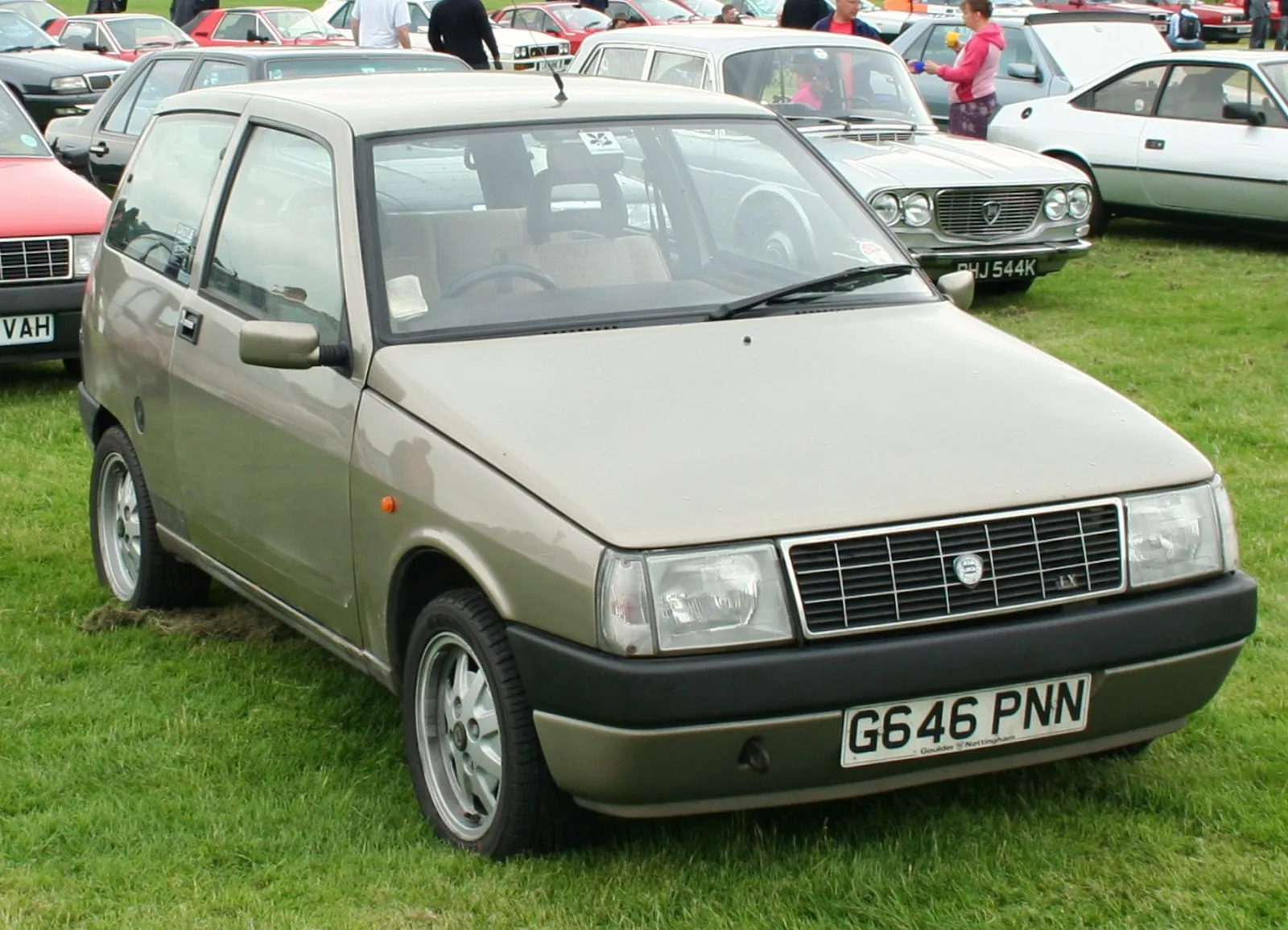
Its wedge-shaped profile gave the Y10 a drag coefficient of 0.31.
The side glass was flush-mounted, the door handles were recessed, and the car had no roof gutters.
The design was developed by Fiat Centro Stile, which was then under the direction of Vittorio Ghidella. The Y10 project took over three years to complete, and its goal was a model that clearly matched Lancia's premium image.
Design proposals came from Pininfarina, Giorgetto Giugiaro and the in-house Fiat Centro Stile. Work on sketches and scale models began in 1980, and the in-house design was chosen for its fit with a select and elite clientele.
Rectangular headlights sat above a simple grille. Silicone resin, rather than rubber, held the steeply raked windscreen in place, and a single wiper cleaned it.
The Y10 was available only as a three-door hatchback, and the near-vertical tailgate had its hinge pivot moved 11 cm (4.3 in) inward, which improved access to the luggage compartment.
What was the Y10 built on?
Mechanically the car shared its underpinnings with the Fiat Panda, with front-wheel drive and four-wheel drive optional on selected models. The fuel tank held 47 L (10.3 imp gal; 12.4 US gal).
That axle was later adopted by the facelifted Fiat Panda.
The interior had cloth-upholstered seats. Higher trim levels offered optional Alcantara on the dashboard, seats and door panels.
An advanced climate control system with electronic controls and an LED display was an option, similar to the unit introduced on the Fiat Regata.
How did the first Y10 sell?
Despite strong interest from the press and the public at Geneva, the car did not sell well at first. Buyers balked at its premium price, and in 1985 Autobianchi-Lancia produced 63,495 examples.
Sales were lower than the A112 managed, which had sold 88,292 units the year before. The range was therefore restructured, with a more affordable entry-level Y10 Fire introduced.
The model improved in 1986. Total production across all models reached 80,403 units that year, and the range now consisted of the Fire, Fire LX, Touring and Turbo.
Production that year was well above the 1985 figure of 63,495 examples.
In 1987 production rose to 109,708 examples, bringing the cumulative total since launch to approximately 254,000 units.
Which engines did the first-series Y10 use?
The Y10 Fire used a 999 cc FIRE four-cylinder. Output was 45 hp (33 kW) at 5,000 rpm, and torque reached 80 N-m (59 lb-ft) at 2,750 rpm, enough for 0 to 100 km/h in 16 seconds.
The engine's name stands for Fully Integrated Robotised Engine, and its low fuel consumption and reduced noise were part of its appeal.
The Y10 Touring's 1,049 cc unit was built in Brazil to the FIASA design and gave 56 hp (41 kW). Top speed reached 155 km/h (96 mph), with 0 to 100 km/h taking 14.5 seconds.
Its Alcantara upholstery on the seats and door panels set it apart from the cloth-trimmed Fire.
The Y10 Turbo used the same 1,049 cc engine with an IHI turbocharger, producing 84 hp (62 kW) at 5,750 rpm. It reached 180 km/h (112 mph), with a 9.5-second run to 100 km/h.
The Turbo also had sodium-filled exhaust valves, an electric fuel pump and Magneti Marelli Digiplex electronic ignition. Its interior had sportier seats and a boost pressure gauge.
What did the four-wheel-drive Y10 offer?
In late 1986 a four-wheel-drive variant was introduced. A tuned 999 cc FIRE engine, rated at 50 hp (37 kW) at 5,500 rpm, powered it, and its top speed was 145 km/h (90 mph).
The 4WD model accelerated from 0 to 100 km/h in 17.4 seconds and had a smaller fuel tank of 35 L (7.7 imp gal; 9.2 US gal) than the front-drive cars.
The four-wheel-drive system was derived from the Fiat Panda 4x4 and developed with Steyr. The rear axle engaged below 55 km/h (34 mph) with the engine running.
The 4WD system engaged automatically whenever the engine was switched off, which kept ice and snow from blocking its actuators. The car was identified by wide side mouldings, unique wheels without hubcaps and 4WD badging.
What were the Fila, Martini and Missoni editions?
The Y10 Fila was the first special edition, launched in February 1987 in collaboration with the sportswear brand Fila.
The Fila 2 followed, reversing the colour scheme so that the body was painted black.
The Y10 Martini was launched in June 1987, a few months after the Fila edition. It was based on the Y10 Turbo and offered exclusively in white.
The Y10 Missoni was launched in October 1987 in collaboration with the Italian fashion designer Ottavio Missoni. It was based on the Fire LX and had a Memphis Blue body colour, with seat velvet in Missoni's Missonato pattern.
What changed in the second series?
In February 1989 the facelifted second-series Y10 was unveiled.
The 999 cc engine was discontinued and replaced across the range by a 1,108 cc FIRE unit with single-point electronic fuel injection. Its output was 56 hp (41 kW) at 5,500 rpm, while torque peaked at 88 N-m (65 lb-ft) at 3,000 rpm.
The Fire LX i.e. managed 156 km/h (97 mph) and 0 to 100 km/h in 13.9 seconds.
UK sales were consistently weak before the Y10 was withdrawn from the British market at the end of 1991.
What was the Selectronic CVT?
In December 1989 the Fire LX i.e. gained a continuously variable option, badged as Selectronic. Its electronically controlled CVT came from Fuji Heavy Industries and was the same unit fitted to the Subaru Justy.
The Selectronic was paired with the 1,108 cc FIRE engine and its single-point injection. Top speed was 150 km/h (93 mph), with the sprint to 100 km/h taking 15.0 seconds.
Which performance versions followed the Turbo?
The Y10 GT i.e. superseded the Turbo, because stricter emissions rules in Switzerland, Austria and Germany forced the discontinuation of the 1,049 cc engine. The GT i.e. used a Brazilian-built 1,301 cc engine that developed 78 hp DIN (57 kW).
The GT i.e. was rated at 178 km/h (111 mph), and 0 to 100 km/h took 11.5 seconds.
The Y10 4WD i.e. was updated with the 1,108 cc engine, and its top speed rose to 151 km/h (94 mph) with a 0 to 100 km/h time of 15 seconds.
What catalysed and later editions followed?
In March 1990 Lancia introduced catalysed versions of the Y10 range, which were badged with the i.e. cat. suffix, or simply i.e. in some markets.
The Y10 Mia arrived in 1991 with four Alcantara colour schemes for the dashboard, door panels and upholstery: ice, camel beige, turquoise or carmine red. The Mia accounted for nearly 40% of total Y10 production in 1991 and 1992.
The Y10 Ego was launched in September 1991. It was available only in Black Mica paint, with a Bulgarian Red leather interior supplied by Poltrona Frau.
The Y10 Avenue was released in early 1992 with a body-coloured tailgate in place of the matte black finish. It was offered with the standard manual or the optional Selectronic CVT.
The Y10 Marazzi Certa was presented at the 1992 Turin Motor Show. It was a security-focused variant developed by Carrozzeria Marazzi, aimed at female buyers concerned about personal safety.
The Certa was built in runs of 300 a year, at a launch price of 24 million lire.
What changed in the third series?
In mid-1992 the Y10 received its final facelift, which marked the third series. The styling moved closer to the Lancia Dedra, and the dashboard was redesigned with softer lines.
From 1993 the range was supplemented by special editions including the Mia, Igloo, Junior and the Selectronic-equipped Ville.
In 1995 the output of the 1,108 cc engine was raised to 54 hp (40 kW) at 5,500 rpm. Between 1992 and 1994 the Elite was optionally available with the 1,301 cc FIASA engine, which produced 72 hp (53 kW).
What were the Autobianchi Y10 specifications?
| Specification | Detail |
|---|---|
| Years built | 1985 to 1996 |
| Body | Three-door hatchback |
| Drag coefficient | 0.31 |
| Rear suspension | Rigid Omega axle |
| Fire engine | 999 cc, 45 hp (33 kW) at 5,000 rpm |
| Touring engine | 1,049 cc FIASA, 56 hp (41 kW) |
| Turbo output | 84 hp (62 kW) at 5,750 rpm; top speed 180 km/h (112 mph) |
| 4WD top speed | 145 km/h (90 mph); 0-100 km/h in 17.4 seconds |
| Fire LX i.e. top speed | 156 km/h (97 mph); 0-100 km/h in 13.9 seconds |
| GT i.e. output | 78 hp DIN (57 kW) from 1,301 cc |
| GT i.e. top speed | 178 km/h (111 mph); 0-100 km/h in 11.5 seconds |
| Fuel tank | 47 L (10.3 imp gal; 12.4 US gal); 4WD 35 L (7.7 imp gal; 9.2 US gal) |
| Production | Over 942,000 units |
How many Y10s were built?
Production totalled approximately 667,000 units in the first seven years of the model. Across all series, total output went beyond 942,000 units before production ended in late 1995.
Production by year rose from 63,495 units in 1985 to 80,403 in 1986 and 109,708 in 1987. The Mia accounted for nearly 40% of total production in 1991 and 1992.