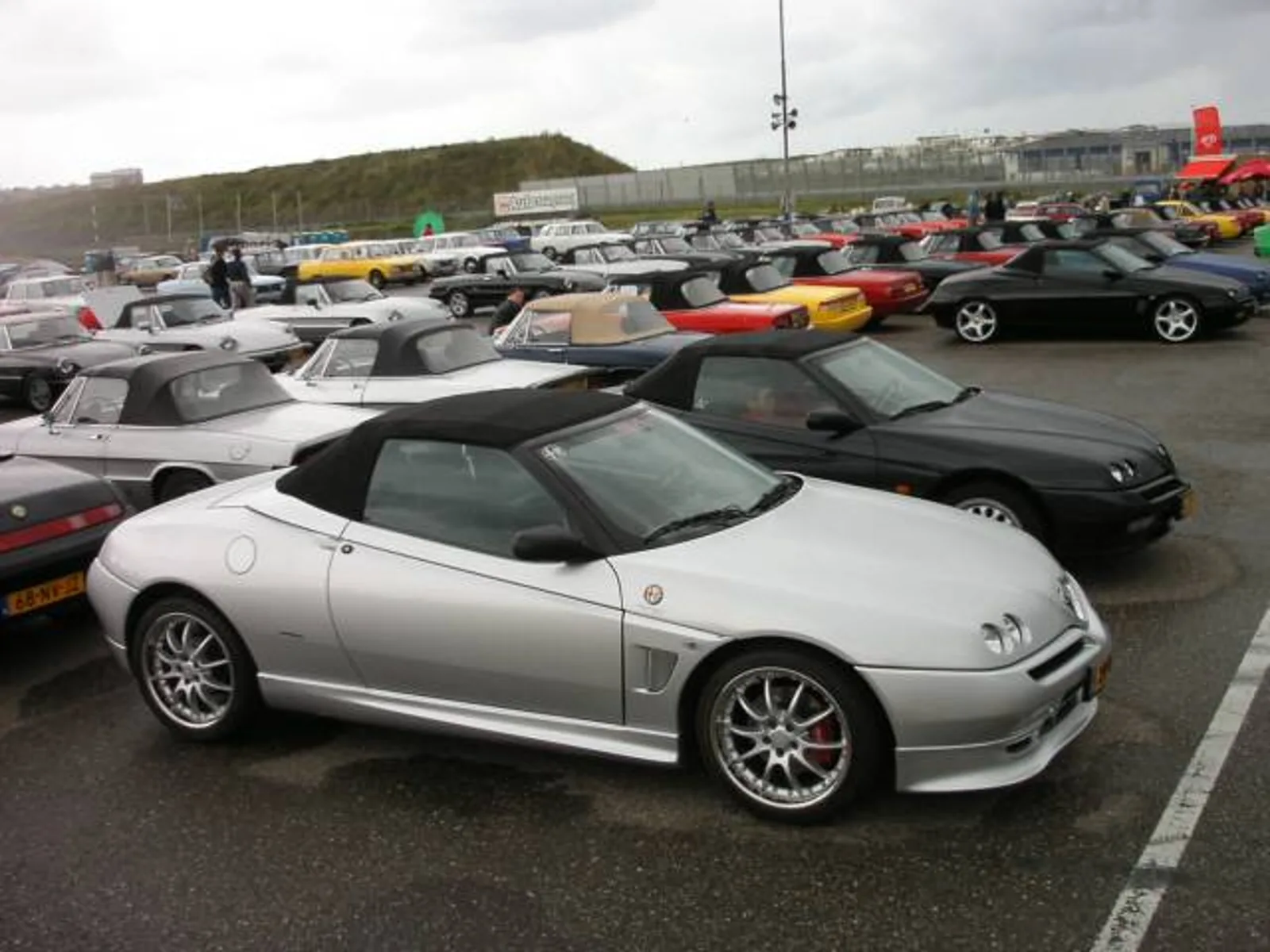
A 1993 to 2004 pair built on one platform, with Pininfarina styling, a four-cylinder and V6 engine range and a string of limited editions.
The Alfa Romeo GTV and Spider were sports cars built from 1993 to 2004 on the Type 916 design. The GTV was a 2+2 coupe, the Spider a two-seater roadster, and engines ranged from a 1.8-litre four to a 3.2-litre V6 producing 240 PS.
Alfa Romeo's GTV and Spider arrived in 1993 as a 2+2 coupe and a two-seater roadster. Both used the Type 916 design, were styled at Pininfarina, and stayed in production until 2004. Between them the pair covered the whole of the 1990s and the early 2000s.
Where did the GTV and Spider come from?
The GTV took its name from Gran Turismo Veloce, meaning fast grand touring, and it succeeded the long-discontinued Alfetta GTV coupe. The Spider replaced the 105-series Giulia Spider, which was then 30 years old. The GTV stayed on sale until the Brera arrived in 2005, and the Spider lasted until its Brera-based successor in 2006.
Production began in late 1993 with four 3.0 V6 Spiders assembled at the Arese plant in Milan. The first GTV, fitted with the 2.0-litre Twin Spark engine, followed in early 1994. Production models debuted at the 1994 Paris Motor Show, and the range was officially launched at the Geneva Motor Show in March 1995.
Both cars were built on the Tipo Due compact platform of the Fiat Group, heavily modified for Alfa's purposes. The GTV and Spider also shared their front suspension and drivetrain with the 1992 Alfa 155 saloon.
A Pininfarina-styled pair that carried Alfa's sporting coupe heritage through the 1990s.
Who styled the GTV and Spider?
Enrico Fumia designed the GTV and Spider at Pininfarina, with renderings dating from September 1987. Fiat chief executive Vittorio Ghidella rejected the Pininfarina interior proposal, so Centro Stile Alfa Romeo under Walter de Silva finished the exterior and a new interior. The GTV's drag coefficient came out at 0.33, and the Spider's at 0.38. Design work therefore ran from renderings in September 1987 to the first cars leaving the line in late 1993.
Full-size 1:1 clay models were completed in July 1988, and Bruno Carela served as chief engineer. The body had a wedge shape with a low nose and a Kamm tail. The Spider's rear was rounded so that its folding soft-top could fit, and the five-hoop frame folded under a flush cover behind the seats. An electric folding mechanism was available as an option.
Journalists at the launch said build quality had improved considerably and came close to German rivals. The Proteo concept of 1991 had styling cues that matched the GTV and Spider design of the time.
What engines did the GTV and Spider use?
At launch the GTV offered a 2.0-litre Twin Spark four or a 2.0-litre turbocharged V6, while the Spider could be ordered with the Twin Spark or a naturally aspirated 3.0-litre 12-valve V6. The range later included a 1.8-litre four and a 3.2-litre V6 making 240 PS (177 kW; 237 hp).
Across the range, output therefore ran from 144 PS on the smallest four to 240 PS on the largest V6. The 1.8-litre 16-valve four produced 144 PS (106 kW; 142 hp). The 2.0 Twin Spark 16-valve was rated at 150 PS (110 kW; 148 hp) and later at 155 PS (114 kW; 153 hp).
The turbocharged 2.0-litre V6, known as the V6 TB, was a sleeved-down version of the 3.0-litre engine. It was built to avoid a higher Italian sales tax on engines above 2.0 litres, and its turbo produced 200 PS (147 kW; 197 hp). The turbo kept power up at the smaller size.
The 2.0 Twin Spark sat on a block from the Fiat SuperFIRE family, with an Alfa-developed head that carried two spark plugs per cylinder. Its variable inlet cam timing offered 25 degrees of variation, and two balance shafts turned at twice engine speed to cut vibration. The 12-valve V6 units redlined at about 6,500 rpm, while the 16 and 24-valve engines ran to 7,000 rpm.
The 3.0 12-valve V6 produced 192 PS (141 kW; 189 hp), and the 3.0 24-valve V6 produced 220 PS (162 kW; 217 hp). The 3.2 24-valve V6 was the fastest road-going Alfa Romeo at the time. It reached 100 km/h in just over six seconds, and its top speed was 255 km/h (158 mph).
The 2003 facelift brought the 2.0 JTS, a direct-injection engine producing 165 PS (121 kW; 163 hp). It used one spark plug per cylinder rather than two.
How did the chassis, suspension and brakes work?
The front suspension used MacPherson struts with lower wishbones and an anti-roll bar, while the rear was an independent multilink layout designed by Gianclaudio Travaglio. Brakes were ventilated discs at the front and solid 240 mm discs at the rear. The GTV's chassis was 64% stiffer than the Spider's.
The 3.0 V6 24V fitted 305 mm Brembo discs at the front, while most cars used 284 mm ventilated discs. Weight distribution was 61% front and 39% rear on the four-cylinder cars, and 63% front and 37% rear on the V6 models. Power steering ran 2.2 turns lock-to-lock.
The rear multilink uses quadrilateral geometry, with an upper triangle, double lower arms and coil springs. It is mounted on a light alloy subframe, which keeps the unsprung mass low at the back of the car.
What were the Alfa Romeo GTV and Spider specifications?
The GTV and Spider shared a platform and most running gear, with a fuel tank of 70 litres (18 US gal; 15 imp gal) and a boot that grew to 155 litres (5.5 cu ft) from 1998. The top figures belong to the 3.2 V6, which reached 255 km/h (158 mph). The table gathers the main figures for both body styles and the engine range.
| Specification | Detail |
|---|---|
| Production years | 1993 to 2004 |
| Body styles | GTV 2+2 coupe; Spider two-seater roadster |
| Engines | 1.8-litre 16-valve four to 3.2-litre 24-valve V6 |
| Top output | 240 PS (177 kW; 237 hp), 3.2 24-valve V6 |
| Top speed | 255 km/h (158 mph), 3.2 V6 24V |
| 0-100 km/h | Just over six seconds, 3.2 V6 24V |
| Fuel tank | 70 litres (18 US gal; 15 imp gal) |
| Boot | 155 litres (5.5 cu ft), from 1998 |
| Drag coefficient | 0.33 GTV; 0.38 Spider |
| Turning circle | 11.2 m on most cars |
| Weight split | 61% front, 39% rear (four-cylinder); 63% and 37% (V6) |
| Production | 38,891 Spiders; 42,937 GTVs |
The 155-litre boot figure applies from 1998, because the boot grew at that point and earlier cars had less room. Standard equipment included power steering, driver and passenger airbags, automatic air conditioning and Bosch ABS. The Alfa-CODE immobiliser and central locking also came as standard.
Which limited editions were built?
Alfa produced a long run of limited editions, from the Edizione Sportiva of 2001 to the Spider Edizione of 2004. The rarest was the GTV Cup of 2001, of which only 419 cars were built.
Lusso was a trim level of its own, not an option pack, and in the UK the standard car was called Turismo instead of Medio. Pleated leather MOMO seats were offered from 1997 in white, red or tan, and the seats were paired with matching carpets in those colours.
The GTV Cup took its styling from the mono-make Alfa GTV Cup race series in Italy. Of its 419 cars, 264 were left-hand drive and 155 right-hand drive. The 3.0 V6 24V accounted for 180 cars, while 239 used the 2.0 TS, so the special edition was offered with both engine families.
The Edizione Sportiva GTV was limited to 500 cars, though around 200 were made. The Spider Serie Speciale Elegant of 2001 was offered in 600 examples, with around 300 built. The Spider Edizione of 2004 was limited to 350 cars, and the Edizione Nero Spider had 150 cars in total, 30 of them for Austria.
Three phases and the end of production
The GTV and Spider were updated in phases. Phase 2 and Phase 3 were the two main updates after launch. A 24-valve 3.0-litre V6 arrived on the GTV in 1997, and the May 1998 facelift, called Phase 2, brought a new centre console.
In August 2000 the engines were revised for Euro3 emissions and given the CF3 code. The CF3 engines carry three catalytic converters, against one on the earlier CF1 and CF2 units. Production was moved from the Arese plant to Pininfarina's Giorgio Canavese plant in Turin in October 2000.
The 2003 Phase 3 facelift was styled by Pininfarina without Enrico Fumia, and it brought the 2.0 JTS direct-injection engine. Production ended by late 2004, though some cars remained available until 2006. The 2.0 TS was the best-selling model in the range.
What concepts came before the production car?
Alfa showed several concepts on the way to the production cars. The Vivace of 1986 comprised twin coupe and spider concepts that previewed the 916 series, and it was styled by Diego Ottina at Pininfarina. The Proteo of 1991, designed by Walter de Silva and based on the 164, carried cues from the GTV and Spider design that was then ready.
The Vola, a 2000 concept styled by Leonardo Fioravanti, was built on a Spider chassis. It was a concept rather than a production model, and it showed the Spider platform in a different form from the cars that had reached showrooms.
How were the GTV and Spider received?
The cars were received well at launch. Autocar named the GTV and Spider its 1995 Car of the Year, Car Magazine gave them the Best Designed Car award, and Jeremy Clarkson called the GTV one of the best sports cars of its time in 1998.
Not every point was praised. The turning circle of 11.2 m on most cars drew criticism for parking, and the low seating position hid the end of the bonnet from the driver's line of sight. Even so, the GTV placed 29th in the Top 100 Cars list published in 2001.
The 1995 awards also included Bild's Goldenes Lenkrad and the Auto Zeitung Best Car to Drive. Taken together, the launch-year honours covered the overall car, its design and its driving.
Three concepts, dated 1986, 1991 and 2000, show the platform being explored across more than a decade.
Read across the table, the GTV offered the lower drag and the stiffer structure, while the Spider offered the open-top body.
.jpg)