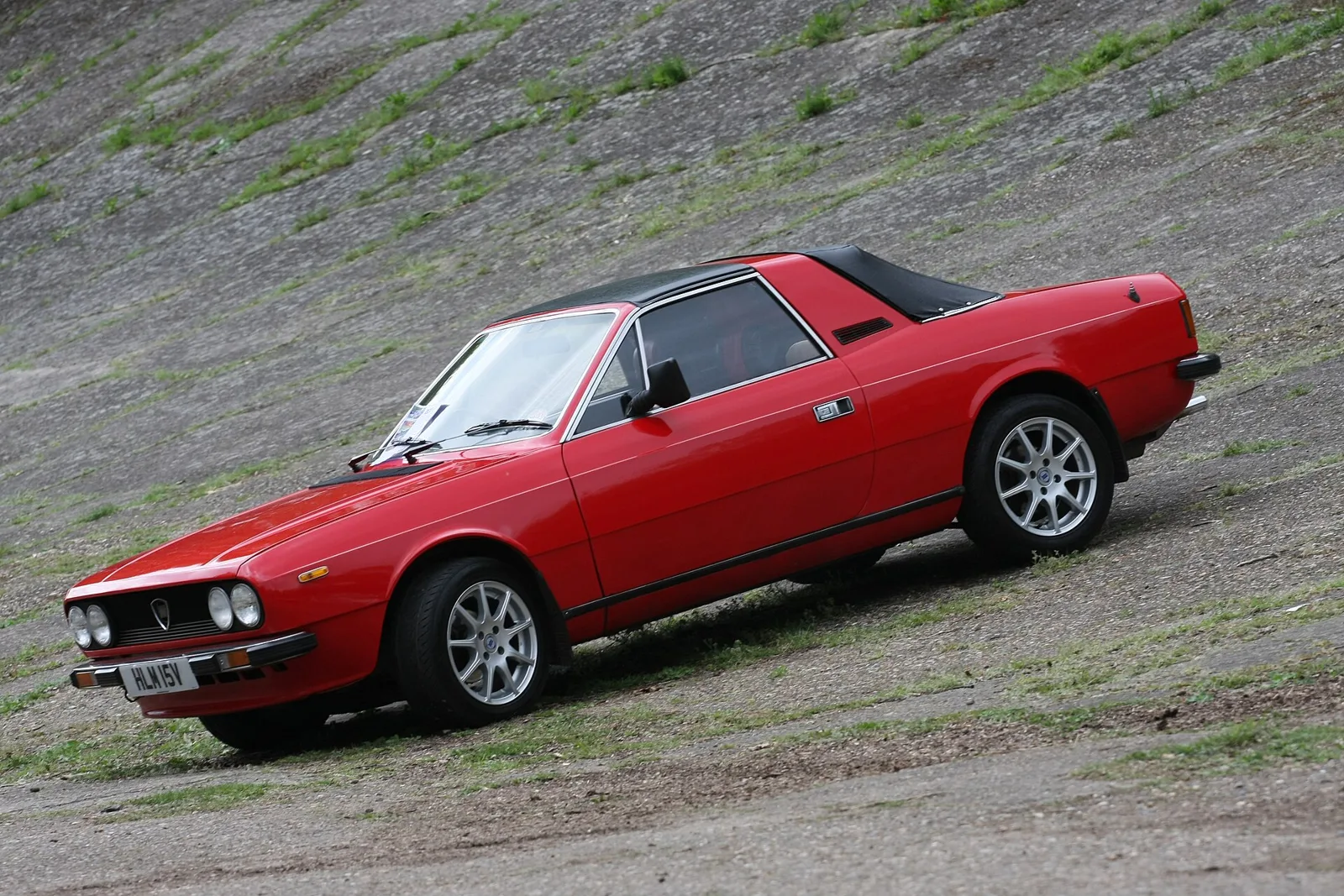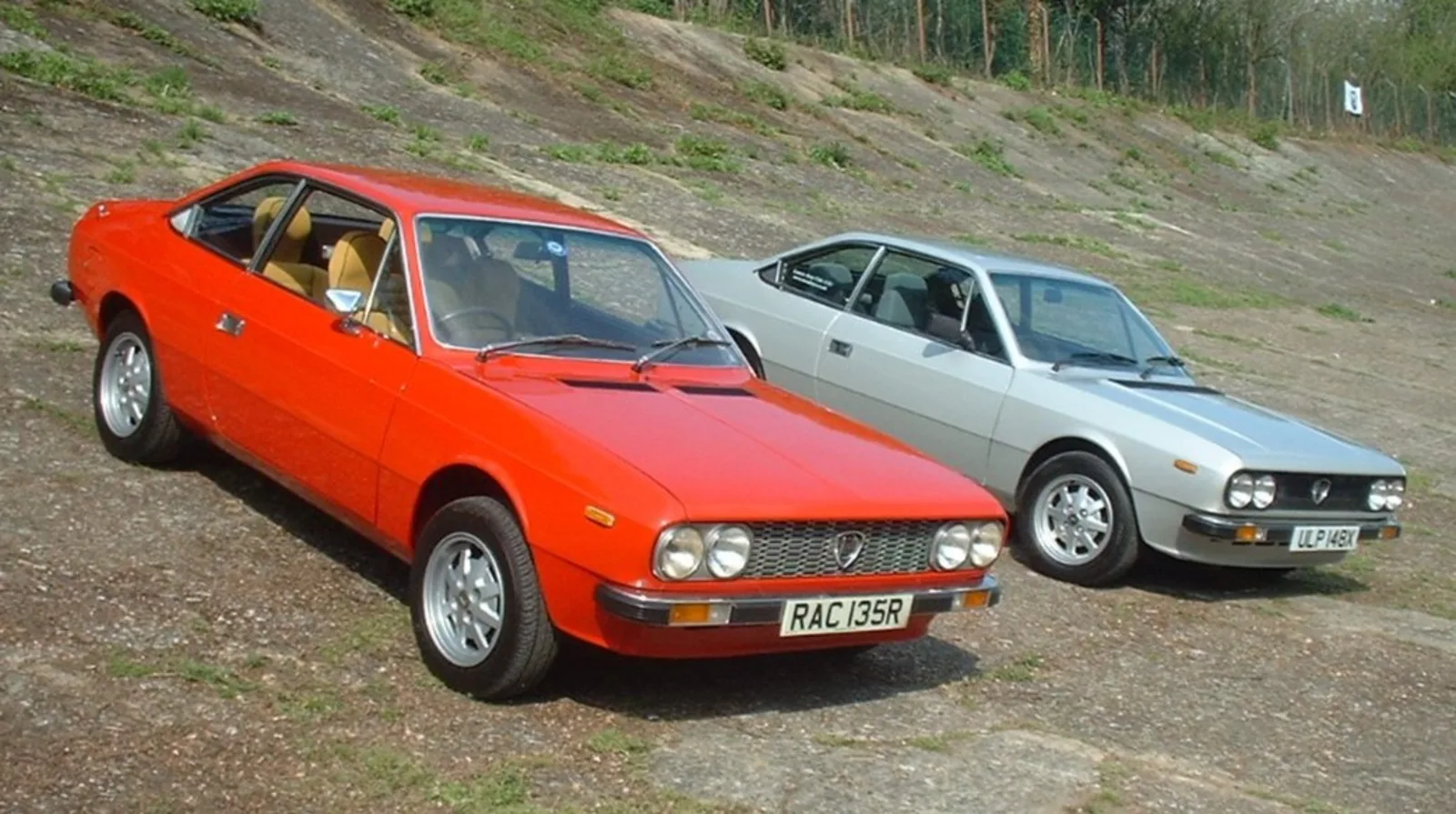
A two-door notchback built on a shortened Beta Berlina floor pan, with Fiat-derived engines from 1.3 to 2.0 litres and a Volumex supercharger.
The Lancia Beta Coupe was a two-door notchback built by Lancia from 1974 to 1984. It shared its basic mechanics with the Beta Berlina saloon, used Fiat-derived twin-cam engines from 1.3 to 2.0 litres, and from 1982 offered a supercharged Volumex version.
Lancia sold this two-door notchback for a decade, from 1974 to 1984. Under the skin it was a shortened version of the Beta Berlina, but its body and its cabin were its own. Its story runs from the 1.6-litre and 1.8-litre first-series cars to a supercharged 2.0-litre, across two series, and it carries a rust problem that became part of its reputation.
Where did the Beta Coupe come from?
The Beta Coupe was built inside the Fiat group. Lancia's first all-new range after the takeover was the Beta Berlina saloon, which appeared in autumn 1972, and the coupe followed in 1974 to replace the Fulvia Coupe in the medium term.
Development of the Beta Berlina took only a little more than two years. Lancia borrowed heavily from Fiat, including the basic engine design, and took its gearbox from the cooperation partner Citroen.
The Fulvia Coupe was cut back to a basic 1.3-litre version when the Beta Coupe arrived, but the two-door Beta did not offer that engine size. The Beta's basic engine was at first a 1.6-litre four-cylinder. Only when the last Fulvia version was dropped did the Beta Coupe take the 1.3-litre as its new basic engine.
The coupe was first shown at the Frankfurt International Motor Show in 1973, and sales started half a year later. Lancia gave it a shorter wheelbase than the saloon. In the Fiat group's range it took the place of two models: the two-door Lancia Fulvia and the Fiat 124 Coupe.
Lancia extended the Beta line in the usual way, one step at a time. The Milan coachbuilder Zagato built the Beta Spider on the coupe's basis, while the estate-style Beta HPE used the saloon's longer wheelbase with body parts from the coupe.
A coupe on a shortened saloon floor pan, with its own body and a Fiat-derived engine family.
How was the Beta Coupe styled?
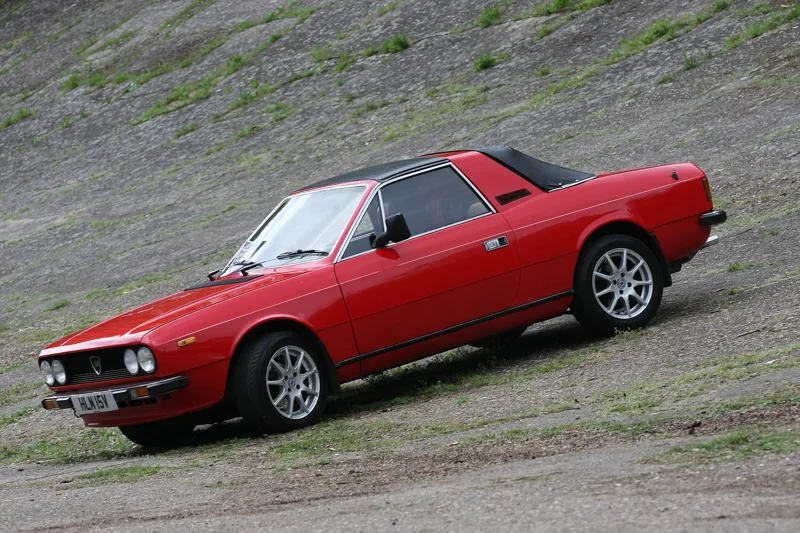
Pietro Castagnero styled the coupe as a freelance consultant after leaving Lancia during the Fiat takeover. Its upright nose, paired round headlights and horizontal octagon tail lights set it apart from the raked-nose saloon, and the tail lights never changed during production.
Castagnero had earlier worked on the Flavia, including its coupe version. The Beta Coupe body had no link with the saloon, and its trapezoidal roof and steeply raked C-pillar gave the car a profile of its own.
The cabin shared no parts with the saloon either. The Spider and the HPE later took over the coupe's interior design, so two of its relatives shared the coupe's cabin.
Between series, the changes at the front included the radiator grille and the headlight surrounds.
What engines did the Beta Coupe use?
Like the rest of the Beta family, the coupe ran revised Fiat twin-cam engines with two overhead camshafts rather than engines of Lancia's own design. Displacements ranged from 1.3 to 2.0 litres. Most used carburettors, while the largest engine was also offered with fuel injection from 1980 and an optional supercharger from 1982.
The manual gearbox was a five-speed unit as standard. Buyers who wanted an automatic could order a three-speed unit from the British supplier AP, except on the Coupe 1300, which was excluded.
The first series, built from spring 1974, used the first generation of Lampredi four-cylinder engines. From autumn 1975 the second series switched to the B generation of the same family, which stayed in the coupes until production ended in 1984.
First series cars can be recognised by their flat bonnet, a radiator grille with offset openings of different sizes that some publications call honeycomb-shaped, and an aluminium surround for the double round headlights. Production of this series ended in the second half of 1975. Across all engines, 27,571 cars were built in that time, and 3,722 of them went to North America.
How did the second series change over its life?
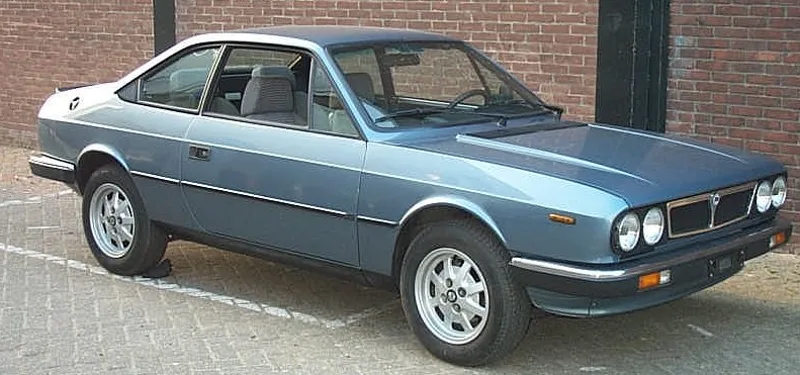
The second series arrived in autumn 1975 and is usually split into three generations. The original car ran to 1978, the first facelift to 1981 with a higher roof and free-standing headlights, and the second facelift to 1984 with a new split grille and matt-black trim.
Original second series (1975 to 1978)
The original car dropped the honeycomb-style trim from its radiator opening. The grille was painted black with stacked chrome bars, and a shared octagonal lens covered the double headlights. The basic 1.6-litre became a new version with a changed bore-to-stroke ratio, 1,585 cc (96.7 cu in) and 100 PS (74 kW; 99 hp), while in European markets the 1.8 was dropped and a 2.0-litre became the top model with 119 PS (88 kW; 117 hp).
Lancia built 30,000 Beta Coupes of this generation, not counting the Lancia 1300. That total included 4,300 cars for North America and 264 kits completed in South Africa.
First facelift (1978 to 1981)
The first facelift brought a higher roof, a larger windscreen and round headlights that stood free in black surrounds. The 1.6-litre and 2.0-litre engines carried on unchanged. Lancia also folded the separate 1300 Coupe into the range as the Beta Coupe 1300.
Lancia produced 32,700 cars from autumn 1978 to autumn 1981. About 2,500 of them went to North America, and 1,520 kits were sent abroad for assembly, 1,400 in Spain and 120 in Thailand.
Second facelift (1981 to 1984)
The second facelift in autumn 1981 gave the coupe a full-width radiator grille, divided vertically in the middle and modelled on the contemporary Delta. Window surrounds and door handles went from chrome to matt black, and the black plastic bumpers ran round to the wheel arches at both ends.
The entry engine grew to 1,367 cc (83.4 cu in) and 84 PS (62 kW; 83 hp), a near-twin of the unit in the Fiat 131 Supermirafiori. The 2.0-litre gained Bosch L-Jetronic injection, which lifted it to 122 PS (90 kW; 120 hp). This generation totalled 10,061 cars, 1,272 of them Volumex. The Spider did not get the facelift for Europe, but about 800 Spiders with this front end were sold in the USA in 1982.
What was the Volumex supercharger?
The Volumex was the supercharged top version of the Beta Coupe's 2.0-litre, fitted with a Roots-type compressor and launched for model year 1982. Lancia pitched it as an alternative to turbocharging that avoided turbo lag, and it was rated at 99 kW (135 PS; 133 hp).
Lancia promised more power without the usual turbo drawbacks, chiefly the lag. The supercharged engine also went into the Beta HPE and the Trevi, and for a time into the Fiat Argenta and the Pininfarina Spidereuropa.
Some accounts argue the real trigger was motorsport. While searching for a powerful engine for the Lancia 037 rally car, Aurelio Lampredi arrived at supercharging in 1981. A road version selling in larger numbers was then needed to justify the development costs.
Fitting the compressor meant a lower compression ratio, newly designed pistons, revised camshafts and valves, a changed intake and exhaust, and a new cooling system. Critics attacked the decision to pair it with Weber carburettors rather than the fuel injection that was already available.
Why was the Beta Coupe so prone to rust?
The Beta Coupe is cited as an outstanding example of a very rust-prone car, and corrosion reached load-bearing parts of the body. Looking back, the causes are put down to poor steel quality, inadequate corrosion protection and an outdated painting process.
The weakness was not limited to cosmetic panels, because the corrosion also reached structural parts of the shell. Hindsight puts it down to several causes arriving together, not to one fault.
What was the 1300 Coupe and how did it fit in?
The 1.3-litre coupe was sold as the Lancia 1300 Coupe in 1976 and 1977, standing as a separate model beside the second series Beta Coupes. At the end of 1978 it became the Beta Coupe 1300. It had a fully black radiator trim and plain round headlights with no glass covers, and its standard equipment was reduced.
The 1300 Coupe was Lancia's new entry-level two-door, taking over the market position of the Fulvia 1300 Coupe, whose production Lancia had stopped. Its rear bench had no head restraint, no rear reading lamp and no clock in the instrument carrier.
From 1976 the 1.3-litre four, series 828 B3.000, was fitted to the coupe. Until 1979 its engine matched the former 1300 Coupe at 1,297 cc (79.1 cu in). After that the displacement rose slightly to 1,301 cc (79.4 cu in), and the car was otherwise matched to the better-engined coupes.
What was the Hi Fi special?
The Beta Coupe Hi Fi was a 1981 special series for the British market. Lancia's importer had 300 coupes upgraded with add-on trim and an elaborate sound system, and some of them had sat unsold on British lots for more than two years.
Aston Martin Tickford developed the details. The package brought special aluminium wheels, a broad black spoiler on the boot lid, flank stripes and an Italian Hi Fi system with a graphic equaliser and four loudspeakers.
Selling the stock took a long time. Lancia tried to hide how old the cars really were, and it was the press that revealed they were lot stock. The affair damaged Lancia's position in Britain for years and was one of the reasons the brand later pulled out of the country completely.
The Laser had come earlier, in 1980, as a special series on the facelifted second-series coupe. It was offered with the standard 1.3- or 1.6-litre engine, in red, dark grey metallic or light blue metallic, and Lancia sold 2,000 of them.
Lancia Beta Coupe specifications
| Specification | Detail |
|---|---|
| Body | Two-door notchback coupe |
| Built | 1974 to 1984 |
| First series, basic engine | 1,592 cc (97.2 cu in), 108 PS (79 kW; 107 hp) |
| First series, larger engine | 1,756 cc (107.2 cu in), 120 PS (88 kW; 118 hp) |
| Second series 1.6-litre | 1,585 cc (96.7 cu in), 100 PS (74 kW; 99 hp) |
| Second series 2.0-litre | 119 PS (88 kW; 117 hp) |
| FL2 entry engine | 1,367 cc (83.4 cu in), 84 PS (62 kW; 83 hp) |
| FL2 2.0-litre with injection | 122 PS (90 kW; 120 hp) |
| Volumex | 99 kW (135 PS; 133 hp) |
| Gearbox | Five-speed manual; three-speed automatic optional |
| Output, first series | 27,571 cars |
| Output, original second series | 30,000 cars |
| Output, first facelift | 32,700 cars |
| Output, second facelift | 10,061 cars, 1,272 Volumex |