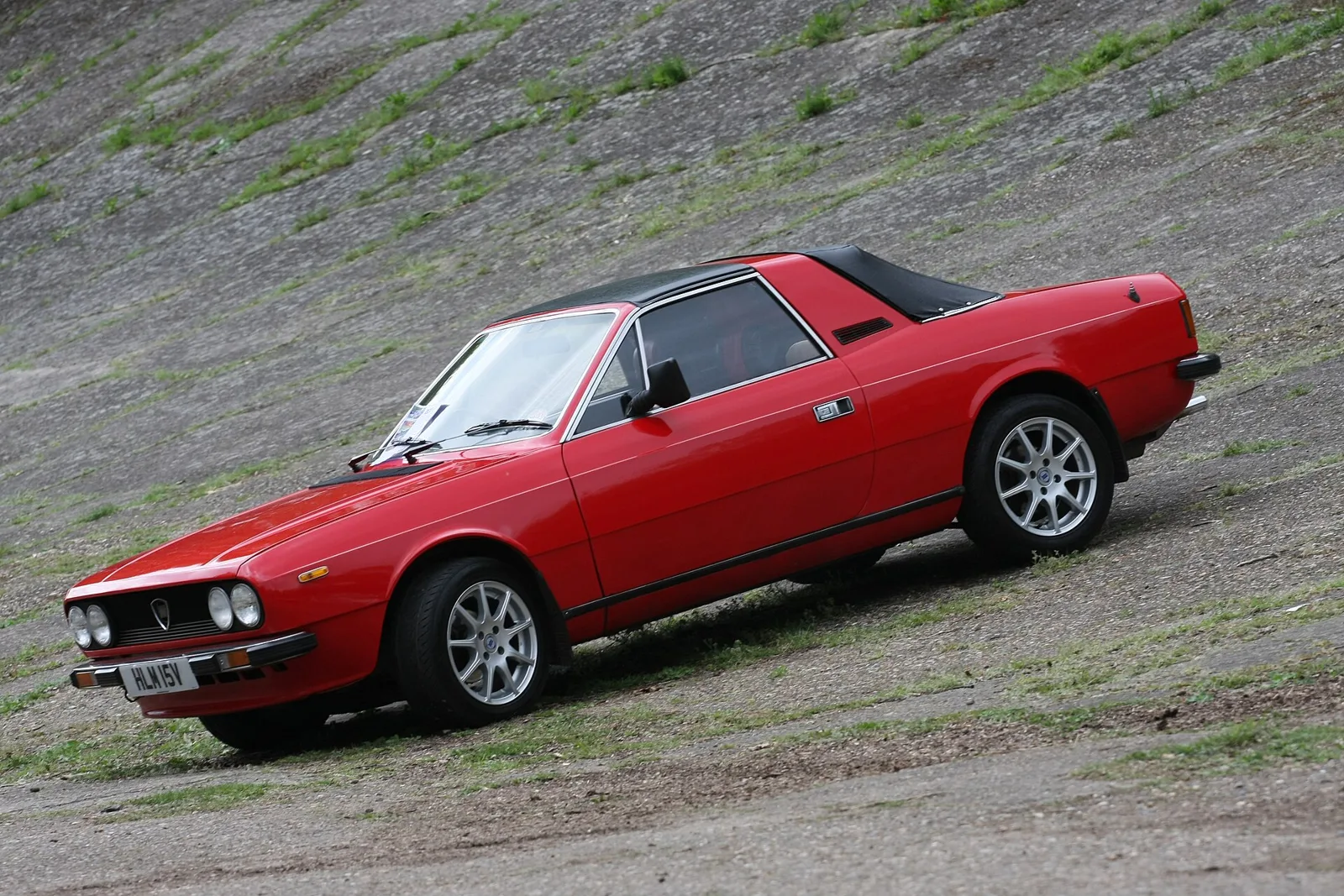
Three European series, a North American Zagato version and 9,390 cars built between 1975 and 1982 from a coupe body that Pininfarina opened up.
Built between 1974 and 1982 on the Beta Coupe's body, this open Lancia was converted by Pininfarina and reworked at the rear by Zagato. About 9,390 were made, and North American buyers received a Zagato-badged variant with different engines and bumpers.
The Lancia Beta Spider was a two-door open sports car built on the body of the Beta Coupe. Pininfarina carried out the open conversion, and Zagato reworked the roof and rear end. Series production ran from 1974 to 1982, and the car is the least common member of the Beta family apart from the mid-engined Beta Montecarlo.
Where did the Beta Spider come from?
The Beta was Lancia's first new range after the Fiat group took over the company, and it replaced the Fulvia. It appeared in autumn 1972 as a four-door hatchback saloon, the Beta Berlina, and had been developed in just over two years. Much of its mechanical hardware came from Fiat, while the gearbox was sourced through the cooperation partner Citroen.
Lancia extended the range as earlier model families had been extended. In 1974 a two-door coupe with a shorter wheelbase joined the saloon, gradually replacing the compact Fulvia coupe. That same year the Turin design studio Pininfarina developed an open version of that coupe, sold as the Spider, which blended targa-coupe and landaulet features.
An open Beta built from a coupe body, with three European series and a Zagato-badged North American twin.
How did the Spider's body differ from the coupe?
Pininfarina reworked the roofline, the door glass and the tail. The nose, bonnet, front wings, windscreen and door skins were carried over from the coupe, whose shape came from Piero Castagnero, a designer with a long career at Lancia.
The Spider was built as what was then called a safety convertible. Its roof owed much to a targa coupe that Baur, a German coachbuilder, had turned out in small batches from 1971, using the BMW 02 as its base. A fixed roll bar linked the B-pillars, and a removable plastic targa panel sat between the roll bar and the windscreen. Cars of the first two model years had no fixed link between windscreen and roll bar. From 1977 onward, fixed connecting pieces above the doors stiffened the structure and kept out damp.
Behind the cabin, above the rear seats, sat a folding fabric top with a landaulet look. The rear end was unique to the Spider, with plain, vertically divided lamps in place of the coupe's octagonal units. The instrument carrier matched the coupe, though the seats were different.
What engines did the Beta Spider use?
Like the rest of the Beta family, the Spider ran on reworked Fiat Twin Cam four-cylinder units, a design by Aurelio Lampredi. Lancia offered 1.6, 1.8 and 2.0-litre sizes; the 1.8 lasted just one model year.
The first-series 1.6 stuck with the original Lampredi block, its cylinder spacings measuring 87, 90 and 87 mm. Spacing on the 1974 and 1975 1.8 was uniform at 91 mm, a second-generation Lampredi that ran longer than the first-series unit.
Beta Spider engines at a glance
| Engine | Type | Geometry | Output |
|---|---|---|---|
| 1.6, first series | 828.AC.000 | Spacings 87, 90 and 87 mm | 109 PS |
| 1.8, 1974 to 1975 | 828.AC1.000 | Uniform spacing 91 mm | 120 PS |
| 1.6, second generation | 828.B.000 | 84 mm bore, 71.5 mm stroke | 100 PS |
| 2.0, from 1975 | 828.B.100 | Stroke 90 mm, bore unchanged | 119 PS |
The second Beta generation brought the end of the older 1.6 and 1.8. Its replacement 1.6 kept the bore of the former 1.8 but shortened the stroke, and the 2.0 from 1975 lengthened the stroke to 90 mm while keeping the bore.
Every European Spider carried carburettors. The petrol-injected 2.0 that other Beta models offered from 1980 was not offered on European Spiders, and neither was the supercharged Volumex 2.0 or the 1.3-litre base engine of the coupe. Power went through a manual five-speed gearbox alone, because the three-speed automatic that most other Betas could have was not offered on the European Spider.
How many Beta Spiders were built in Europe?
Lancia made the Spider in three European series that developed alongside the coupe. The first ran in 1974 and 1975 and totalled 743 cars. The second debuted in autumn 1975 and reached 3,219 cars, four of them for North America. The Series 2 FL facelift came in autumn 1978, and 2,561 were built in the European configuration up to 1981.
What set the first series apart?
The first series had no side links between windscreen frame and roll bar, a flat bonnet and a radiator grille whose staggered openings vary in size, a feature some writers liken to a honeycomb. Twin round headlamps sat in an aluminium surround, and the rear bumper had a dip in the middle to take the rectangular number plates then still used in Italy.
Engines on offer were the 109 PS 1.6 from the first Lampredi generation and the 120 PS 1.8 from the second.
What changed with the second series?
The second series, which appeared in autumn 1975, dropped the honeycomb grille. Its black-painted grille carried several chrome bars at the bottom and kept the large Lancia badge. The twin round headlamps now shared an octagonal lens that echoed the rear lamps, the bonnet had a slight central bulge, and the rear bumper ran straight.
Engine-wise, the new 1.6 with 100 PS made its debut, and a 2.0 with 119 PS took the place of the 1.8 as the top version.
What was the Series 2 FL?
The facelift of autumn 1978 separated the twin headlamps, which now stood freely in a black-painted surround. The smaller 1.6 stayed unchanged, while the 2.0 was reworked in details. Slightly lower compression cut output by 4 PS, leaving 115 PS, while torque rose by 2 to 176 Nm.
How did the North American Zagato differ?
From 1976 to 1982 Lancia exported the Spider to North America, and from 1978 the car was sold in the USA and Canada as the Lancia Zagato. Wide safety bumpers at both ends lengthened it to 4,181 mm, and the engines were adapted to North American emissions rules. Over six years there were three distinct versions.
In 1976 Lancia sold four Spiders with a 1.8-litre inline four rated at 87 SAE PS. From 1978 to 1981 a 2.0-litre carburettor engine was offered, with 84 SAE PS for cars bound for California and 88 SAE PS elsewhere, roughly 30 percent below the European cars.
Once European sales had finished, close to 800 Zagatos reached the USA in 1981 and 1982, most in the latter year. They wore the front end of the Series 2 FL2 coupe, with a full-width radiator grille split vertically in the middle, and their 2.0 had petrol injection that produced 109 SAE PS. In the USA the car was seen as attractive and pleasant to drive, but was said to have been very poorly assembled and poorly marketed.
How were the Spiders built?
Three factories shared the work. The unpainted bodyshells of the coupe went from Pininfarina to Zagato at Rho, where the roof was removed, a new roof structure fitted and the new rear end installed. The car then went to Lancia's works at Chivasso for anti-corrosion treatment.
Zagato returned the car for painting and interior fitting, after which Lancia installed the engine and gearbox. The process was complicated and expensive, and the car passed between the three firms several times.
Did the Spider influence other cars?
Its roof concept appeared on several other contemporary models. Baur's Kadett Aero, built on the Opel Kadett C from 1976, used the same roof concept, as did Reliant's open Scimitar GTC, derived from the GTE estate coupe.
The Beta Spider also has a particular link with the Bristol 412, the luxury model from the British upper-class maker Bristol Cars. The 412 came onto the market in 1975 and evolved into the Beaufighter from 1982. Its design, traced to Giuseppe Mittino, was drawn up at Zagato in 1974, and it is generally seen as inspired by the body of the Beta Spider. Mittino also worked some Beta Spider add-on parts into the design of the Bristol, including its rear lamps. Zagato, which had already reworked the Beta Spider's roof and rear end, also built the first Bristol bodyshells.